Mushroom Cultivation for Maximum Bioactives
+31% beta-glucan from elicitation during late fruiting
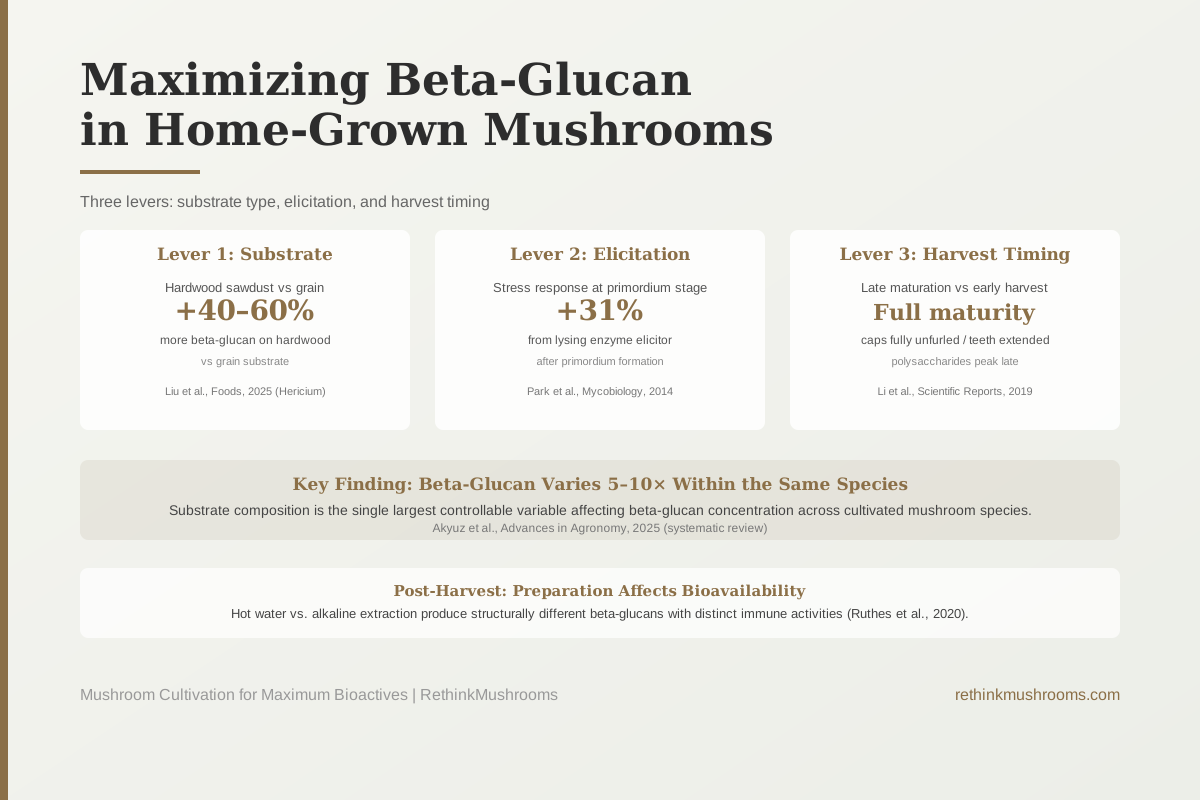
A 2014 cultivation study found that applying a lysing enzyme during late fruiting increased beta-glucan concentration in cauliflower mushroom by up to 31% versus untreated controls — one of several controllable levers that shift how much immune-active polysaccharide a mushroom accumulates.
Park et al., Mycobiology, 2014
wood species
substrate wood type and fungal strain strongly affect beta-glucan content (Cortina-Escribano 2020)
by species
beta-glucan content varies widely across mushroom species (Mirończuk-Chodakowska 2017)
harvest timing
bioactive metabolites keep accumulating into late maturation (Oh 2019)
Park et al., Mycobiology, 2014
 View as image ↗
Most mushroom growing guides treat all mushrooms of a given species as equivalent. Pick your substrate, colonize, fruit, harvest. The approach works for producing food. It is not optimized for producing mushrooms with high concentrations of immune-active compounds.
Beta-glucan content in home-grown mushrooms is not fixed by the species alone. It is shaped by which species you grow, the substrate you grow it on, whether you deliberately stress the fungus, and when you harvest. That means growing decisions made before the first thread of mycelium has spread have already shaped the ceiling on what the finished mushroom can deliver.
This article covers what the research actually shows moves that ceiling, in order of impact.
For broader context on mushroom cultivation, see How to Grow Mushrooms at Home: A Complete Beginner's Guide.
Key Takeaways
- Beta-glucans are long-chain fiber molecules in mushroom cell walls that have been studied for immune effects; quantitative screening shows their concentration varies widely across species (Mirończuk-Chodakowska et al., 2017, Roczniki PZH)
- Substrate matters: a controlled Ganoderma lucidum trial found the wood species and fungal strain together determined beta-glucan content, with an aspen (Populus tremula) wood-based substrate producing the highest beta-glucan (Cortina-Escribano et al., Molecules, 2020)
- In Hericium erinaceus (lion's mane), both the plant-based substrate composition and the extraction method significantly influenced the levels of bioactive compounds accumulated (Kała et al., Molecules, 2025)
- A 2014 elicitation study found that applying a lysing enzyme during late fruiting increased beta-glucan content by up to 31% versus untreated controls, though yield fell (Park et al., Mycobiology, 2014)
- Walnut waste-wood sawdust carried 18 to 89% higher mineral and phenolic content than standard sawdust and altered the nutritional profile of Auricularia auricula, showing that wood species differences matter within the wood-substrate category (Hao et al., Foods, 2022)
- Harvest timing is a lever: in Cordyceps militaris, bioactive metabolites continued accumulating into the late senescence stage, so harvesting at or just past full maturity captures more than early harvesting (Oh et al., Journal of Microbiology, 2019)
- Post-harvest extraction method changes the product: beta-glucan extracts from the same shiitake mushroom differed in physicochemical properties and immune activity depending on how they were prepared (Murphy et al., Science of the Total Environment, 2020)
What Beta-Glucan Is and Why the Concentration Varies
Beta-glucans are a class of long-chain fiber molecules found in the cell walls of mushrooms. They are composed of glucose units linked in a specific three-dimensional pattern that the human digestive system does not break down, allowing them to reach immune cells in the gut wall where they bind to receptors called Dectin-1 and activate immune signaling. This is why beta-glucan from mushrooms has been studied for immune function.
The concentration in a given mushroom is not fixed by the species alone. Quantitative analysis of glucan contents across edible and wild mushroom species has shown that beta-glucan levels differ substantially between species, with several wild and bracket fungi carrying markedly higher contents than common cultivated species such as Agaricus bisporus.[1] Comparative work that isolated glucan-rich polysaccharides from seven different mushroom species confirmed that both glucan content and immune activity differ markedly from species to species.[8]
Within a single species, the substrate and growing conditions then shift the concentration further. A useful mental model is the C:N ratio — how much carbon (from wood cellulose and lignin) versus nitrogen (from bran, grain, or other supplements) is available in the substrate. Substrates heavy in easily digestible nitrogen tend to push the fungus toward protein production and rapid biomass, while wood-rich substrates supply more of the structural carbohydrate that feeds cell-wall polysaccharide synthesis.
The Biggest Lever: Substrate Choice
One of the most actionable levers is the substrate: what the fungus is grown on measurably changes beta-glucan content, not just total yield.
In a controlled cultivation study published in Molecules in 2020, Cortina-Escribano and colleagues grew Ganoderma lucidum (reishi) on sawdust and wood chips from five different tree species — birch (Betula spp.), aspen (Populus tremula), spruce (Picea abies), pine (Pinus sylvestris), and larch (Larix sp.). Both the beta-glucan content and the yield of the fruiting bodies depended on the wood substrate and the fungal strain: beta-glucan content was highest on an aspen wood-based substrate, and aspen and birch substrates also produced the highest yields.[2]
The mechanism is straightforward: wood is composed largely of lignin and cellulose. As the fungus breaks down these compounds for energy, some of the structural carbohydrate is incorporated into the growing mycelium and fruiting-body cell walls as beta-glucans. Different wood species carry different lignin and mineral chemistry, and that chemistry influences what the mushroom produces.
The same principle holds for lion's mane specifically. A 2025 study by Kała and colleagues in Molecules cultivated Hericium erinaceus on different plant-based substrates (including beech sawdust and hemp straw) and found that both the substrate composition and the extraction method significantly influenced the levels of bioactive compounds accumulated in the fruiting bodies.[3]
Hao and colleagues demonstrated the same idea at a finer scale in a 2022 study published in Foods, cultivating Auricularia auricula (wood ear mushroom) on substrates containing walnut waste-wood sawdust. The walnut sawdust carried significantly higher mineral and phenolic content than the standard mixed sawdust — higher by roughly 18 to 89% across the measured compounds — and changed the growth and nutritional profile of the mushroom.[4] Wood species differences matter even within the broad "wood substrate" category.
Practical implications drawn from this evidence:
- For Lion's Mane: hardwood sawdust (oak, beech) supports the compound profile the research links to wood substrates; heavy bran supplementation raises yield but not necessarily beta-glucan density
- For Shiitake: hardwood sawdust (oak) is the species' natural substrate and a better fit for polysaccharide-rich fruiting bodies than straw alone
- For Oyster mushrooms: Pleurotus species tolerate straw well, but growers who want to lean toward beta-glucan can include a hardwood sawdust component
The trade-off is that heavily supplemented, high-nitrogen substrates tend to produce higher weight yields per batch, while wood-rich substrates may produce fewer grams of mushroom but with a compound profile weighted toward structural polysaccharides. Optimizing for medicinal content and optimizing for maximum harvest weight are different goals.
For more on how substrate choice affects compound content across species, see How Substrate Composition Affects Mushroom Health Compounds.
The Advanced Approach: Elicitation
Elicitation is the practice of deliberately triggering a stress response in a growing fungus to cause it to produce higher concentrations of secondary metabolites, including immune-active polysaccharides.
The most direct evidence for this approach in the context of beta-glucans comes from a 2014 study by Park and colleagues, published in Mycobiology, using cauliflower mushroom (Sparassis latifolia). They applied enzyme elicitors — including a lysing enzyme complex that partially breaks down cell walls and triggers a cellular stress response — after primordium formation (just after the first tiny fruiting structures appeared). Compared to untreated controls grown under identical conditions, the lysing-enzyme treatment increased beta-glucan concentration by up to 31%. The same treatment reduced mushroom yield, so its economic efficiency has to be weighed against the gain in concentration.[5]
The biological mechanism is analogous to plants producing more defensive compounds when attacked. When a mushroom's cell walls are partially damaged by an enzyme, the fungus responds by upregulating cell-wall synthesis, including the production of more beta-glucan.
This approach has not been widely replicated across species in peer-reviewed research, and the specific enzyme concentrations required are not standardized for home use. The finding is significant mainly as proof of concept that beta-glucan production is an active, responsive process that can be deliberately influenced, not a fixed property of the species.
A milder version of the same principle applies to natural environmental stress: mushrooms grown in slightly more challenging conditions (lower nitrogen, cooler temperatures during late fruiting) are generally understood to shift toward secondary-metabolite production. Treat this as a reasonable extension of the elicitor biology rather than a separately proven beta-glucan result.
For more on how environmental stress conditions affect bioactive production, see Stress and Bioactive Production: How Challenging Conditions Make Stronger Mushrooms.
Harvest Timing: When Bioactives Peak
Beta-glucans accumulate as fruiting bodies mature and the cell walls thicken and differentiate. Direct evidence that bioactive accumulation continues late into the growth cycle comes from research on Cordyceps militaris, published in the Journal of Microbiology in 2019 by Oh and colleagues. Using metabolomic profiling across developmental stages, they found that cordycepin — a signature bioactive compound — and associated metabolites became significantly enriched during the late aging (senescence) stage of the fruiting body, alongside glucose accumulation.[6]
This research tracked cordycepin and related metabolites in Cordyceps rather than beta-glucan directly, so treat it as an illustration of a general pattern rather than a beta-glucan measurement: bioactive compounds continue to accumulate through late maturation, and mushrooms harvested well before full maturity have less developed cell-wall structures.
The practical implication for home growers targeting bioactive content rather than visual appeal: waiting until caps on oyster mushrooms have fully unfurled and are just beginning to curl upward, or until Lion's Mane teeth are fully extended and starting to show slight yellowing, generally captures more accumulated compound than harvesting earlier, when mushrooms are visually perfect but not yet fully mature.
The trade-off is that post-peak mushrooms have shorter storage lives and more variable texture for culinary use. Growers with a specific medicinal goal may accept this trade-off.
Post-Harvest: How Preparation Affects What You Get
Growing conditions set the beta-glucan content of the raw mushroom. How you prepare it afterward determines how much of that content becomes bioavailable — and in what form.
Research by Murphy and colleagues, published in Science of the Total Environment in 2020, found that beta-glucan extracts prepared from the same shiitake mushroom (Lentinus edodes) using different extraction approaches varied in their physicochemical properties and produced different in-vitro immunomodulatory and cytoprotective effects.[7] In other words, how the beta-glucan is extracted — not only how much is present in the mushroom — shapes its biological activity.
For growers consuming their mushrooms as food rather than making extracts, cooking method matters for a simpler reason. Beta-glucans are water-soluble to varying degrees, so prolonged boiling leaches some content into the cooking liquid. Consuming mushrooms in soups or broths recaptures this; sautéing or stir-frying at high heat for short periods keeps more of the structure within the mushroom tissue itself.
For dried mushroom storage, drying at lower temperatures (below roughly 60°C) is generally preferred over high-temperature oven drying for preserving polysaccharide structure.
For more on how extraction method affects beta-glucan delivery, see Hot Water Extract vs. Dual Extract vs. Raw Powder: Which Delivers More Beta-Glucans?.
How to Know If Your Beta-Glucan Content Is High
There is no practical home test for beta-glucan concentration in fresh mushrooms. Third-party lab testing (typically $50 to $150 per sample) can provide a percentage by dry weight, which is the same metric used by commercial supplement companies.
The stronger guide is indirect: if the substrate, species selection, and harvest-timing decisions are aligned with the research above, the resulting mushroom is operating near its practical ceiling for polysaccharide production. The evidence points to species selection and substrate — especially the wood species — as the main controllable levers, followed by harvest timing and deliberate elicitation.
Comparing home-grown fruiting bodies to grain-based mycelium supplements is useful context. Research has consistently found that fruiting bodies contain higher beta-glucan concentrations than mycelium grown on grain substrate, where residual starch from the grain is often incorporated into the final dried product and dilutes the measured polysaccharide content. For more on this distinction, see Fruiting Body vs. Mycelium on Grain: The Consumer Guide.
The Bottom Line
Beta-glucan content in home-grown mushrooms is shaped by species, substrate, elicitation, and harvest timing rather than fixed by the species alone. Beta-glucan levels vary widely between mushroom species, and controlled cultivation trials show the wood substrate and fungal strain measurably change how much beta-glucan a fruiting body accumulates. A 2014 elicitation study demonstrated a 31% beta-glucan increase from enzyme application during late fruiting, at the cost of yield. Bioactive metabolites keep accumulating into late maturation, so harvest timing matters, and the post-harvest extraction method further changes how much active beta-glucan you ultimately get.
Frequently Asked Questions
Sources & References
- 1RTHM-00484·Mirończuk-Chodakowska, Iwona et al. (2017). “Quantitative evaluation of 1,3,1,6 β-D-glucan contents in wild-growing species of edible Polish mushrooms..” Roczniki Panstwowego Zakladu Higieny.Study breakdown →PubMed →↩
- 2RTHM-01183·Cortina-Escribano, Marta et al. (2020). “Effect of Strain, Wood Substrate and Cold Treatment on the Yield and β-Glucan Content of Ganoderma lucidum Fruiting Bodies..” Molecules (Basel.Study breakdown →PubMed →↩
- 3RTHM-02103·Kała, Katarzyna et al. (2025). “Influence of Plant-Based Substrate Composition and Extraction Method on Accumulation of Bioactive Compounds in Hericium erinaceus (Bull.) Pers. Fruiting Bodies..” Molecules (Basel.Study breakdown →PubMed →↩
- 4RTHM-00763·Hao, Zhenkun et al. (2022). “Enhancing the Nutritional and Functional Properties of Auricularia auricula through the Exploitation of Walnut Branch Waste..” Foods (Basel.Study breakdown →PubMed →↩
- 5RTHM-00632·Park, Hyun et al. (2014). “Enhancement of β-Glucan Content in the Cultivation of Cauliflower Mushroom (Sparassis latifolia) by Elicitation..” Mycobiology.Study breakdown →PubMed →↩
- 6RTHM-00582·Oh, Junsang et al. (2019). “Metabolomic profiling reveals enrichment of cordycepin in senescence process of Cordyceps militaris fruit bodies..” Journal of microbiology (Seoul.Study breakdown →PubMed →↩
- 7RTHM-00638·Murphy, Emma J et al. (2020). “β-Glucan extracts from the same edible shiitake mushroom Lentinus edodes produce differential in-vitro immunomodulatory and pulmonary cytoprotective effects - Implications for coronavirus disease (COVID-19) immunotherapies..” The Science of the total environment.Study breakdown →PubMed →↩
- 8RTHM-01588·Murphy, Emma J et al. (2022). “Immunomodulatory activity of β-glucan polysaccharides isolated from different species of mushroom - A potential treatment for inflammatory lung conditions..” The Science of the total environment.Study breakdown →PubMed →↩