Growing Lion's Mane at Home
42.6% biological efficiency
A 2023 peer-reviewed study achieved 113g of fresh Lion's Mane per bag using optimized hardwood substrate, establishing a yield benchmark for home growers.
Chutimanukul et al., Scientific Reports, 2023
13–18°C
optimal fruiting temperature
85–95%
relative humidity during fruiting
beech sawdust
highest bioactive accumulation (Kala 2025)
Chutimanukul et al., Scientific Reports, 2023
 View as image ↗
Lion's Mane is one of the more beginner-accessible mushrooms to grow at home. It does not require the complex fruiting triggers of Cordyceps or the precise contamination management of highly supplemented substrates. Most first-time growers who follow reasonable protocols get mushrooms.
What most growing guides miss is that the substrate you choose affects more than how many grams you harvest. A 2025 study published in Molecules found that fruiting bodies grown on beech sawdust accumulated greater amounts of most measured bioactive compounds compared to those grown on hemp straw.[5] Substrate is not just a growing medium. It is a variable that affects the medicinal potency of what you produce.
This guide covers the full process in four stages, with the research that explains why each step works.
For context on mushroom cultivation generally, see How to Grow Mushrooms at Home: A Complete Beginner's Guide.
Key Takeaways
- Lion's Mane (Hericium erinaceus) is one of the easier mushrooms to cultivate at home; it grows on sterilized hardwood substrate and fruits at cool temperatures with high humidity and fresh air exchange
- A 2025 study (Kała et al., Molecules) found beech sawdust produced greater accumulation of most measured bioactive compounds in fruiting bodies than hemp straw, indicating that substrate choice affects medicinal potency, not just yield
- Mycelial growth is optimal near 25°C (Diskit et al., 2024), while fruiting is best initiated at the cooler 15 to 18°C range; this temperature drop between colonization and fruiting mirrors the autumn cooling that triggers reproduction in the wild
- A peer-reviewed substrate study (Chutimanukul 2023, Scientific Reports) achieved 113g fresh weight per bag with a biological efficiency of 42.6% on rubber sawdust, establishing a research-backed yield benchmark
- Nutrient composition — including the nitrogen source and the carbon-to-nitrogen ratio — simultaneously affects both biomass and bioactive compound production in H. erinaceus (Ofosu 2016), the principle behind supplementing substrate with a nitrogen source such as wheat bran
- Fruiting bodies contain hericenones, the fat-soluble brain-active compounds; erinacines (the compounds that cross the blood-brain barrier) come from mycelium, not from home-grown fruiting bodies
How to Grow Lion's Mane at Home: Five Steps
Growing Lion's Mane from inoculation to harvest follows a reliable sequence:
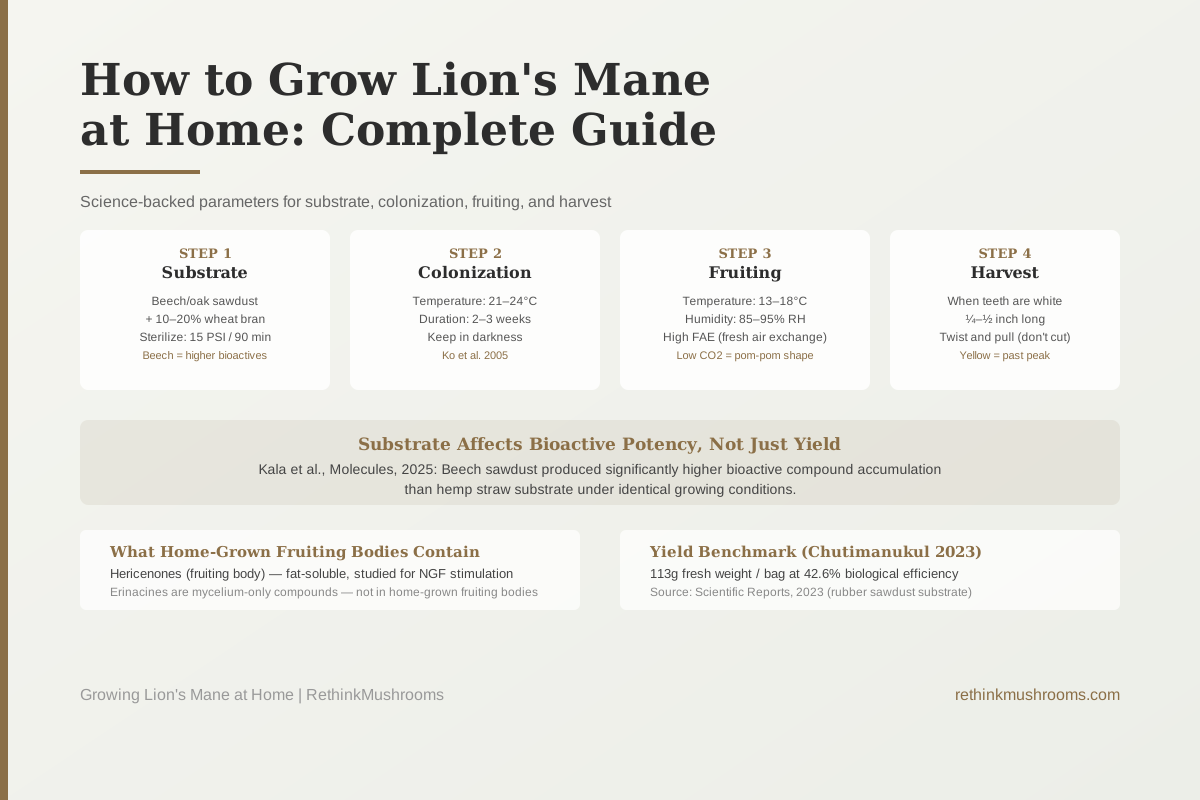
- Prepare sterilized hardwood sawdust substrate with 10 to 20% wheat bran supplementation
- Inoculate cooled substrate with grain spawn and seal containers
- Colonize at 21 to 24°C for 2 to 3 weeks in darkness
- Initiate fruiting at 13 to 18°C with 85 to 95% relative humidity and fresh air exchange
- Harvest when teeth are white and approximately one quarter to one half inch long (typically 5 to 14 days after pin formation)
The sections below cover each stage with the biological reasoning behind the parameters.
Step 1: Substrate Preparation (The Choice That Affects More Than Yield)
Lion's Mane is a wood-decomposing fungus. In nature, it grows on hardwood trees, particularly oak and beech. This determines what it can digest efficiently: hardwood sawdust or chips provide the cellulose and lignin the fungus is adapted to break down.
The two common substrate formats for home growing are sawdust in bags or jars, and fruiting blocks (larger blocks of inoculated substrate typically in polypropylene bags). Most home growers start with bags.
Wood species matters. Kała and colleagues, publishing in Molecules in 2025, compared fruiting bodies grown on beech sawdust and hemp straw and measured their bioactive compound content.[5] Fruiting bodies from beech sawdust accumulated greater amounts of most of the measured bioactive compounds, including ergothioneine, lovastatin, and ergosterol. The difference the study documented was in the concentration of bioactive compounds per fruiting body rather than in total grams harvested, meaning substrate choice can shape medicinal potency independent of raw yield.
Hardwood sawdust, particularly from oak or beech, is the most research-supported base substrate for Lion's Mane.
Supplementation increases yield but requires sterilization. Adding a nitrogen source such as wheat bran to the base substrate increases the amount of nutrients available to the fungus. Ko and colleagues, testing agricultural by-products as sawdust supplements across seven Hericium species, found that bran supplements (wheat, rice, and barley bran among them) were all suitable for Hericium growth, and that oak sawdust supplemented with 20% bran produced biological efficiencies ranging from 26 to 70% depending on species and strain.[1] Separately, work by Ofosu and colleagues in 2016 optimizing the growth medium for H. erinaceus found that nutrient composition — including the carbon-to-nitrogen ratio and the nitrogen source used — simultaneously affected both biomass and bioactive compound production.[3] A substrate with 80% hardwood sawdust and 20% wheat bran is a common practical formulation, often producing substantially higher yields than unsupplemented sawdust alone.
The trade-off: supplemented substrates must be fully sterilized, not just pasteurized. The additional nitrogen is also food for bacteria and mold. A pressure cooker running at 15 PSI for 90 minutes is standard. Plain hardwood sawdust without supplementation can be pasteurized at lower temperatures, which is simpler but produces lower yields.
Chutimanukul and colleagues achieved 113 grams of fresh Lion's Mane per bag with a biological efficiency of 42.6% using rubber tree sawdust substrate in a 2023 study.[4] "Biological efficiency" is the standard metric for comparing substrate formulas: it is calculated as the weight of mushrooms produced divided by the dry weight of substrate used. A biological efficiency above 30 to 40% is considered good for Lion's Mane. This benchmark is useful for home growers to assess whether their setup is performing as expected.
For more on substrate science across mushroom species, see Mushroom Substrate Guide: Hardwood, Straw, Sawdust, and Supplemented Formulas.
Step 2: Colonization: Temperature, Time, and What to Watch For
After inoculating sterilized and cooled substrate with grain spawn, the fungus begins growing its network of thread-like cells (the mycelium) through the substrate. This is the colonization phase.
Research optimizing mycelial growth parameters for H. erinaceus found that 25°C was the best temperature for mycelial growth on standard medium.[6] For home growing on sawdust, the practical colonization temperature range is 21 to 24°C. Temperatures below 18°C significantly slow colonization; temperatures above 26°C increase contamination risk and can stress the mycelium.
Colonization typically takes 2 to 4 weeks depending on inoculation rate, temperature, and substrate density. During this phase, keep containers in darkness. Light is not needed and does not accelerate colonization.
What normal colonization looks like: A white or cream-colored network of threads spreading through the substrate from each inoculation point. As growth progresses, the substrate firms up and becomes a solid block of interwoven mycelium.
What problems look like: Green or black patches indicate mold contamination. A single contaminated bag should be removed immediately and sealed before disposal. Yellow patches at the inoculation point can indicate metabolite secretion from the mycelium, which is usually normal but can indicate stress. Wet patches or sour smell indicate bacterial contamination from inadequate sterilization.
Step 3: Initiating Fruiting: The Temperature Drop That Triggers Pinning
Once the substrate is fully colonized, a transition in conditions triggers the fungus to shift from vegetative growth into reproductive mode, producing the visible mushroom structures.
Fruiting body formation in Hericium erinaceus is best initiated at temperatures of 15 to 18°C, substantially cooler than the optimal colonization temperature. This temperature differential is not arbitrary. Lion's Mane evolved as a tree fungus that would encounter cooler, more humid autumn conditions as the year progressed, which signals the appropriate time to reproduce. Replicating that temperature drop at home initiates the same developmental transition.
The key fruiting conditions:
- Temperature: 13 to 18°C (critical; sustained warmth above 20°C during fruiting aborts or distorts pin development)
- Relative humidity: 85 to 95% (mist the walls of the growing space several times daily; the mushroom itself does not need to be misted)
- Fresh air exchange: Lion's Mane is unusually sensitive to elevated CO2. The mushroom evolved growing on exposed trees with constant airflow. In a closed growing environment, CO2 accumulates and triggers a stress response in which the fruiting bodies grow as elongated, branching coral-like structures rather than compact pom-pom shapes. Several air exchanges per day or a low-speed fan are standard practice.
- Light: Indirect natural light or a few hours of LED light per day is sufficient; no intense lighting required
If pins form but grow as elongated coral structures rather than dense clusters, the cause is almost always insufficient fresh air exchange. For a detailed breakdown of the biology behind CO2 sensitivity and the full environmental parameter research, see Lion's Mane Growing Conditions: Temperature, Humidity, and FAE.
Step 4: Harvest: White Teeth Mean Peak Quality
The mushroom is ready to harvest when the teeth (the characteristic downward-pointing projections that give Lion's Mane its distinctive appearance) are fully formed, white or cream-colored, and approximately one quarter to one half inch long. This point typically arrives 5 to 14 days after pins first appear.
The timing matters for quality. Friedman's comprehensive 2015 review of Lion's Mane chemistry documents hericenones as the primary brain-active compounds found in the fruiting body.[2] Harvesting while the teeth are still white and the tissue is at peak condition is standard practice for preserving quality; as fruiting bodies age past peak and begin to yellow, tissue condition and bioactive content decline.
Harvesting technique: Grip the base of the fruiting body and twist gently while pulling away from the substrate. Do not cut with a knife if avoidable; cutting leaves substrate material that can become a contamination point. Remove any remaining stem material from the substrate surface after harvest.
After the first harvest, Lion's Mane typically produces a second flush. Allow the substrate block to rest in slightly lower humidity for 3 to 5 days, then re-establish fruiting conditions. Second and third flushes tend to be smaller than the first but still meaningful.
For harvest timing specifics and the bioactive content connection, see Harvesting Lion's Mane: When and How to Pick.
Kit vs. DIY: What the Trade-offs Look Like
Grow kits, pre-colonized blocks that only require fruiting conditions, are the fastest entry point. They remove substrate preparation and colonization from the process entirely. The trade-offs are higher cost per harvest, no control over substrate type (and therefore no ability to optimize for bioactive content per Kała 2025), and dependence on kit quality.
Making your own substrate allows substrate selection and supplementation to be dialed in. The upfront investment is a pressure cooker, bags, and a grain spawn source. After the first successful harvest, subsequent batches cost significantly less per gram of mushroom produced. For growers who care about bioactive content specifically, DIY on beech or oak sawdust is the higher-potency path.
A timeline comparison:
- Kit: Ready-to-fruit block arrives, fruits in 1 to 2 weeks. Total time 1 to 2 weeks.
- DIY from grain spawn: Prepare substrate, sterilize, inoculate, colonize 2 to 3 weeks, fruit 1 to 2 weeks. Total time 5 to 6 weeks.
For the timeline from spawn to harvest in full detail, see Growing Lion's Mane at Home: From Spawn to Harvest in 3 Weeks.
What You're Actually Growing: Hericenones, Not Erinacines
Home growers producing fruiting bodies will harvest material that contains hericenones: a class of aromatic compounds found in the visible mushroom that have been linked to nerve growth factor stimulation and studied for cognitive health effects.
Erinacines, a different class of compounds that can cross the blood-brain barrier, are produced in the mycelium, not the fruiting body. Mycelium is grown as a separate process in submerged liquid culture or on grain, not as the visible white pom-pom structures that home growers harvest.
This is a meaningful distinction when evaluating what home-grown Lion's Mane is delivering versus mycelium-based supplement products. The Friedman 2015 review documents both compound classes and their distribution across tissue types.[2]
For a full breakdown of each compound class and the research behind them, see Hericenones and NGF Synthesis: How Lion's Mane Stimulates Nerve Growth and Erinacines: The Compounds That Cross the Blood-Brain Barrier.
The Bottom Line
Lion's Mane can be grown at home on sterilized hardwood substrate at 21 to 24°C during colonization, then transferred to 13 to 18°C with high humidity and fresh air exchange to initiate fruiting. Harvest when teeth are white and fully extended. The substrate choice affects both yield and bioactive compound accumulation: a 2025 Molecules study found beech sawdust outperforms hemp straw for the accumulation of most measured bioactive compounds. Home-grown fruiting bodies contain hericenones but not erinacines, which are a mycelium-specific compound class.
Frequently Asked Questions
Sources & References
- 1RTHM-00160·Ko, Han Gyu et al. (2005). “Comparative study of mycelial growth and basidiomata formation in seven different species of the edible mushroom genus Hericium..” Bioresource technology.Study breakdown →PubMed →↩
- 2RTHM-00371·Friedman, Mendel (2015). “Chemistry, Nutrition, and Health-Promoting Properties of Hericium erinaceus (Lion's Mane) Mushroom Fruiting Bodies and Mycelia and Their Bioactive Compounds..” Journal of agricultural and food chemistry.Study breakdown →PubMed →↩
- 3RTHM-00813·Ofosu, Fred K et al. (2016). “Nutrient Optimization Using Response Surface Methodology for Simultaneous Biomass and Bioactive Compound Production by Lion's Mane Medicinal Mushroom, Hericium erinaceus (Agaricomycetes)..” International journal of medicinal mushrooms.Study breakdown →PubMed →↩
- 4RTHM-01680·Chutimanukul, Preuk et al. (2023). “Commercial scale production of Yamabushitake mushroom (Hericium erinaceus (Bull.) Pers. 1797) using rubber and bamboo sawdust substrates in tropical regions..” Scientific reports.Study breakdown →PubMed →↩
- 5RTHM-02103·Kała, Katarzyna et al. (2025). “Influence of Plant-Based Substrate Composition and Extraction Method on Accumulation of Bioactive Compounds in Hericium erinaceus (Bull.) Pers. Fruiting Bodies..” Molecules (Basel.Study breakdown →PubMed →↩
- 6RTHM-01882·Diskit, Stanzin et al. (2024). “Optimization of Mycelial Growth Parameters in Lion's Mane Edible Medicinal Mushroom Hericium erinaceus (Agaricomycetes) by Supplementation of Growth Hormones..” International journal of medicinal mushrooms.Study breakdown →PubMed →↩