Growing Lion's Mane
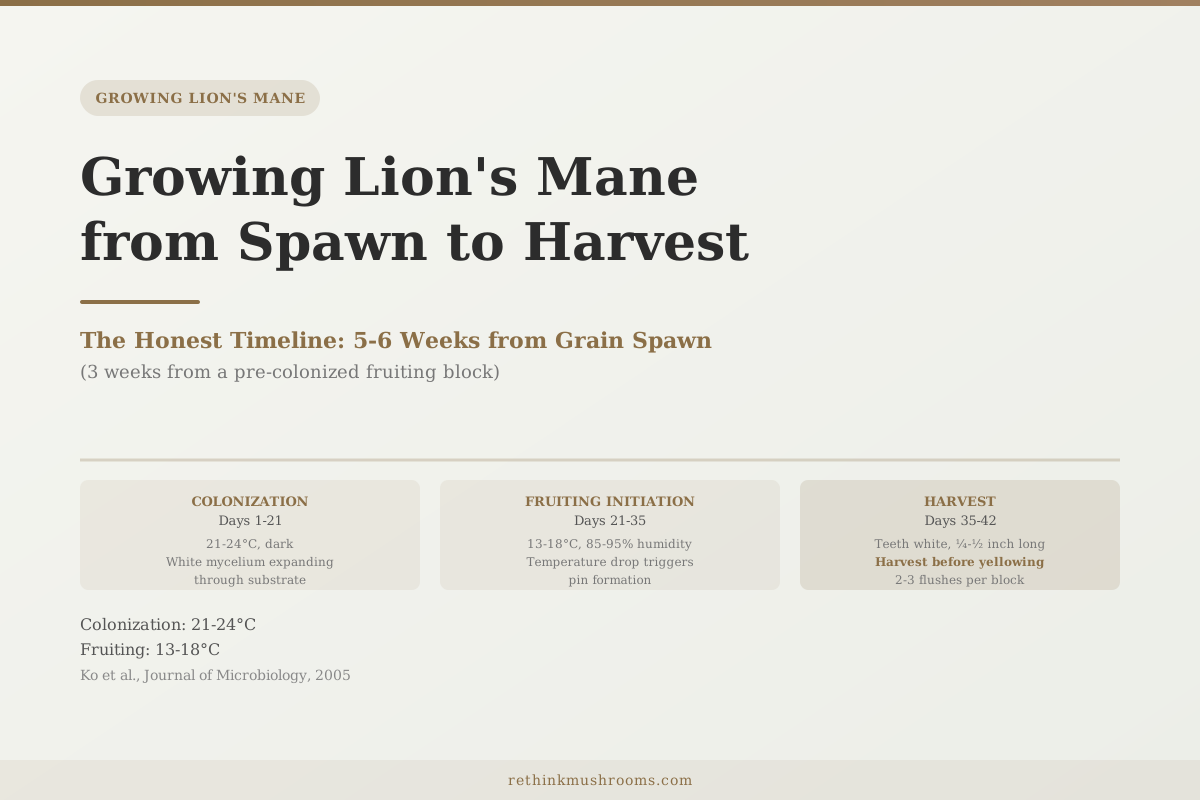
5 to 6 weeks
The full timeline from grain spawn inoculation to first harvest under optimal conditions. The '3-week' claim you see in most guides refers to ready-to-fruit blocks, not grain spawn starts.
Ko et al. Bioresource Technology. 2005
21-24°C
optimal colonization temperature for H. erinaceus mycelium
13-18°C
optimal fruiting temperature (temperature drop triggers pins)
2 to 3
flushes expected from a single well-managed substrate block
Ko et al. Bioresource Technology. 2005
 View as image ↗
Search for "how long does lion's mane take to grow" and you'll find articles claiming three weeks. That number is real, but it describes a specific starting point: a pre-colonized, ready-to-fruit block. If you're starting from grain spawn and preparing your own substrate, which is what most home growers do, the timeline is closer to five to six weeks under good conditions.
This article covers the full journey from grain spawn to harvest, stage by stage, with what to look for at each step and what to do when things go wrong. It also covers the scientific basis for why each stage's conditions matter, not just the numbers to aim for.
For the complete setup guide including substrate preparation and kit options, see How to Grow Lion's Mane at Home: Complete Guide. For the detailed biology of temperature, humidity, and fresh air exchange requirements, see Lion's Mane Growing Conditions: Temperature, Humidity, and FAE. For the pillar overview of home mushroom cultivation, see How to Grow Mushrooms at Home: A Complete Beginner's Guide.
Key Takeaways
- "3 weeks from spawn to harvest" describes a pre-colonized fruiting block, not a grain spawn start. Grain spawn inoculation to harvest is 5-6 weeks
- Colonization temperature: 21-24°C, keep dark, expect full colonization in 14-21 days from inoculation
- Substrate composition drives both colonization speed and yield: Ofosu et al. (2016) optimized medium composition for mycelial biomass and bioactive output, and Chutimanukul et al. (2023) found that substrate carbon-to-nitrogen ratio strongly influences H. erinaceus productivity
- Diskit et al. (2024) showed that media composition and growth conditions significantly affect mycelial growth rate, so substrate choice affects colonization speed, not just final yield
- The transition from colonization to fruiting requires a temperature drop: move to 13-18°C and increase fresh air exchange
- Contamination is the primary failure mode: green mold (abort immediately), yellow patches (acceptable, slow colonization), brown patches (normal substrate aging)
The 3-Week Claim: What It Actually Means
The "three weeks" figure that appears in most lion's mane growing guides is accurate, but it describes a specific scenario. Pre-colonized fruiting blocks are substrate blocks that have already been inoculated and incubated by a supplier until the mycelium has fully colonized the material. When you buy one and bring it home, you're skipping the longest part of the process.
From that point, a ready-to-fruit block can produce pins within 7-14 days and be ready for harvest 1-3 weeks after pinning. Add those up and you're in the "three weeks" range from the moment you receive the block to the moment you harvest.
If you're inoculating your own substrate with grain spawn, the timeline looks different:
- Days 1-21: Colonization incubation (grain spawn into sterilized hardwood substrate)
- Days 21-35: Fruiting initiation and pin formation
- Days 35-42: Growth to harvest-ready size
Total: five to six weeks from inoculation to first harvest. This is not slower than it should be. It is the biology.
Understanding this prevents one of the most common beginner mistakes: exposing a block to fruiting conditions before it is fully colonized. Partially colonized blocks under fruiting conditions are at significantly higher risk of contamination, because the uncolonized substrate has no mycelial protection.
What You Need Before Day One
Lion's mane requires more precise conditions than oyster mushrooms, the other common beginner choice. The specific requirements for fresh air exchange matter more for lion's mane than for most other species. Set these up before you inoculate.
Substrate: Sterilized hardwood sawdust, supplemented or unsupplemented. Supplemented substrate (adding wheat bran or soy hulls to the hardwood) increases colonization speed and yield but requires full sterilization at 121°C and 15 psi. Pure hardwood blocks can be sterilized more conservatively. If you are using a kit, this step is done for you.
Spawn: Grain spawn (rye grain colonized with H. erinaceus mycelium) is the standard inoculation method. Pre-made bags or jars of grain spawn are available from cultivation suppliers.
Incubation space: A space that maintains 21-24°C consistently. A room in the low-to-mid 70s Fahrenheit works. Stable temperature is more important than hitting an exact target.
Fruiting space: A separate area (or the same space after resetting conditions) that can be maintained at 13-18°C with high humidity (85-95% relative humidity) and regular fresh air exchange. A small tent, a monotub with modified FAE, or even a dedicated bathroom works for small-scale grows.
Humidity source: A cool-mist ultrasonic humidifier with a hygrometer. Lion's mane is more sensitive to low humidity than most species. If humidity drops below 80%, tips dry out and turn yellow.
Days 1-21: The Colonization Phase
Inoculation means introducing grain spawn to your sterilized substrate. The typical spawn rate is 10-20% of the dry substrate weight. Higher spawn rates accelerate colonization but cost more in spawn material.
After mixing grain spawn into the substrate block and sealing it (leaving a small amount of gas exchange through a filtered patch or injection port), move the block to your incubation space.
What to look for:
- Days 1-5: White mycelial growth visible beginning around the spawn grains. Looks like white fuzz or "hair" spreading from points of inoculation.
- Days 5-14: White growth expands. The substrate should show an advancing white front moving through the brown sawdust.
- Days 14-21: Full colonization. The entire block surface is white. Interior may still have brown patches, which is normal.
Home cultivation targets 21-24°C during colonization: warm enough for fast mycelial growth, but below the point where competing molds gain the upper hand. Higher temperatures speed up the mycelium, but they speed up contaminants more, which is why the incubation range sits a few degrees below the mycelium's raw thermal optimum.
Diskit and colleagues showed in 2024 that media composition and growth conditions significantly affect mycelial growth velocity in H. erinaceus, with average growth rates ranging from roughly 4.8 to 8.5 mm per day depending on the medium.[3] Both temperature and substrate composition therefore determine how quickly the colonization phase completes. Supplemented substrates (higher nitrogen content from wheat bran or soy hulls) tend to colonize faster because the mycelium has more available nutrition.
Colonization troubleshooting:
No visible growth after 7 days: Check temperature. Below 18°C colonization slows dramatically. Above 28°C, risks increase.
Green or black patches: Abort the block. Green mold (Trichoderma) and black mold are aggressive competitors that will overrun the substrate. There is no recovery from established green contamination.
Yellow or orange patches: Often mycelial metabolites, not contamination. Smell the block: contaminated substrate often smells sour, rotten, or fermented. If it smells like mushrooms, the yellow is metabolic and the block is usually fine.
Brown patches on the outside: Normal substrate aging. Inner brown areas surrounded by white mycelium are simply spots the colonization hasn't reached yet.
What Fully Colonized Looks Like
A fully colonized block looks uniformly white on the exterior. The grain spawn has been completely consumed and replaced by mycelium. Some blocks will show small areas of surface browning. That is normal as long as white mycelium covers the majority of the surface.
Press gently on the block. A fully colonized block feels firm and solid, with the substrate bound together by mycelium rather than loose and granular. The substrate smells like fresh mushrooms, not like sawdust or grain.
If you cut into a block that is fully colonized, the interior is white throughout. This is not typically needed and risks contamination from the cut, but it is the definitive test of colonization status.
Do not expose a block to fruiting conditions until you are confident it is fully colonized. A common mistake is moving blocks to fruiting conditions at day 14 because they look mostly white. Patience here prevents most contamination failures in the fruiting stage.
The Temperature Shift That Triggers Pins
Lion's mane fruiting is triggered by a specific set of environmental changes, all of which signal to the fungus that conditions are suitable for reproduction.
Fruiting bodies form best under cooler conditions than the mycelium prefers, roughly 15-18°C with lower CO2, a well-established departure from the warmer colonization phase. This reflects the species' natural biology: lion's mane grows on dead or dying hardwood trees in temperate forests, and commercial cultivation has historically been confined to temperate regions for this reason.[4] In the wild, late summer and autumn bring the cooler temperatures, higher humidity, and increased air movement that cue reproduction.
The cues to initiate fruiting are:
- Temperature drop to 13-18°C (55-64°F). This is the strongest fruiting trigger.
- High humidity at 85-95% relative humidity.
- Increased fresh air exchange. More air movement reduces CO2 accumulation around the developing fruiting body.
- Light exposure. Indirect light for 12 hours per day helps orient fruiting body development.
The fresh air requirement is particularly important for lion's mane compared to other species. Elevated CO2 suppresses the pom-pom formation that characterizes the species and causes the fruiting body to elongate into coral-like branches instead. This is not a disease. It is a stress response that can be reversed by improving air circulation. For the full explanation of why this happens biologically and how to prevent it, see Lion's Mane Growing Conditions: Temperature, Humidity, and FAE.
To expose the substrate surface where fruiting bodies will form, cut an X or circular opening in the bag covering the block. Place the block opening-side up or at an angle. Pins form preferentially at the cut surface.
Days 21-35: What Happens in the Fruiting Chamber
Once exposed to fruiting conditions, a fully colonized lion's mane block should begin showing pins within 7-14 days. Pinning is visible as small white bumps emerging from the substrate surface at the cut opening.
What the timeline looks like:
| Days After Fruiting Initiation | What You See | What to Do |
|---|---|---|
| Days 1-7 | No visible change | Maintain conditions, be patient |
| Days 7-14 | Small white bumps (pins) | Maintain high humidity, good FAE |
| Days 14-21 | Pins elongate; teeth developing | Do not disturb; avoid direct misting on fruiting body |
| Days 21-28 | Teeth ¼-½ inch, all white | Harvest now |
The harvesting window matters more for lion's mane than for most species. Once the teeth tips begin turning yellow, the mushroom is past peak. It is still edible and safe to eat at that stage, but quality degrades and bioactive compound concentrations in the fruiting body decline as enzymatic breakdown begins. For the detailed harvest guide including technique and storage, see Harvesting Lion's Mane: When and How to Pick.
Fruiting troubleshooting:
No pins after 14 days at fruiting conditions: Verify the temperature has actually dropped to the target range. The most common cause of delayed pinning is insufficient temperature reduction. Also check humidity (should be 85%+) and increase fresh air exchange.
Coral/elongated shape instead of pom-pom: Too much CO2 accumulation. Increase air exchange immediately. The block is not damaged. With better FAE, subsequent pins will form correctly.
Yellow tips on the fruiting body: Too dry at the tips, or harvest is overdue. Increase local humidity. If the whole body is yellowing, harvest immediately.
How Substrate Composition Affects Colonization Speed
Not all substrates colonize at the same rate. The nutritional composition of the substrate directly affects how quickly the mycelium can grow through it.
Comparing seven Hericium species, Ko and colleagues found that agricultural by-product supplements (rice bran, wheat bran, barley bran, and others) all support vigorous mycelial growth, and that supplement and strain selection drive biological efficiency: a 20% rice bran supplement yielded 26-70% biological efficiency across species.[1] Ofosu and colleagues then used response surface methodology to optimize medium composition for simultaneously maximizing both mycelial biomass and bioactive compound output in H. erinaceus.[2]
Substrate carbon-to-nitrogen ratio is a decisive variable. In a commercial-scale cultivation study, Chutimanukul and colleagues found that a high-C:N rubber sawdust substrate (C:N around 65) produced the greatest biological efficiency, and principal component analysis identified pre-spawning substrate C:N ratio as a dominant driver of productivity.[4] Notably, higher nitrogen content was associated with more individual fruiting bodies but lower overall yield, so the relationship between nitrogen and productivity is not simply "more is better."
This helps explain why supplemented substrates (adding wheat bran at 10-20% by weight, or soy hulls at higher supplementation rates) colonize noticeably faster than pure hardwood sawdust: the wheat bran provides accessible nitrogen that the mycelium can metabolize quickly. The tradeoff is that the additional nutrition also supports competing organisms, which is why supplemented substrates require sterilization rather than pasteurization.
For the science behind substrate selection, including the 2025 research showing that substrate type affects bioactive compound content in the harvested mushroom (not just yield), see Lion's Mane on Supplemented Hardwood: Optimizing Yields. For substrate preparation techniques including sterilization, see How to Prepare Mushroom Substrate: Sterilization and Pasteurization.
After First Harvest: Multiple Flushes from One Block
A well-managed lion's mane block can produce two to three harvests before the substrate is exhausted. The process after first harvest:
- Remove all mushroom material from the cut surface, including the base stub. Any remaining tissue will rot and become a contamination source.
- Rest period: Move the block back to colonization conditions (21-24°C) for 5-7 days. Do not spray the surface during this period.
- Re-initiate fruiting: Return the block to fruiting conditions (13-18°C, high humidity, FAE). New pins should form within 7-14 days.
Second and third flushes typically produce slightly smaller fruiting bodies than the first flush. By the third flush, blocks often show significant surface browning and reduced pinning vigor. When a block fails to produce new pins within 14 days of re-initiation, the substrate is largely exhausted.
Spent substrate from lion's mane grows can be added to a compost pile or used as mulch. The substrate is not harmful and retains some residual mycelium that can benefit soil microbial communities.
Why Home-Grown Lion's Mane Is Worth the 5 Weeks
The cultivation timeline is longer than oyster mushrooms and more condition-sensitive than shiitake. What justifies the additional effort is what you get at harvest.
Fresh lion's mane from home cultivation is difficult to find commercially. It is fragile, perishable, and expensive when available. More importantly, substrate selection affects not just yield but the bioactive compound profile of the mushroom you grow. Research has begun to document how cultivation decisions translate into the chemistry of the final product.
For the full context of what lion's mane contains and why people grow it for health purposes, see Lion's Mane and Nerve Growth Factor: The Complete Research Guide. For new growers still deciding where to start, see Your First Mushroom Grow: Step-by-Step for Beginners.
The Bottom Line
Growing lion's mane from grain spawn to first harvest takes 5-6 weeks under optimal conditions: 14-21 days of colonization at 21-24°C, followed by 2-3 weeks in fruiting conditions at 13-18°C with high humidity and good fresh air exchange. The "3-week" claim is accurate for pre-colonized fruiting blocks, not grain spawn starts. Ko et al. (2005) documented mycelial growth and biological efficiency across seven Hericium species; Diskit et al. (2024) showed that media composition and growth conditions affect mycelial growth rate; and Chutimanukul et al. (2023) found substrate carbon-to-nitrogen ratio strongly influences yield. The colonization and fruiting temperatures above are established cultivation parameters that reflect the species' temperate-forest biology. Contamination prevention and the transition to fruiting conditions are the two most critical skill points for beginners. Well-managed blocks produce 2-3 flushes before the substrate is exhausted.
Frequently Asked Questions
Sources & References
- 1RTHM-00160·Ko, Han Gyu et al. (2005). “Comparative study of mycelial growth and basidiomata formation in seven different species of the edible mushroom genus Hericium..” Bioresource technology.Study breakdown →PubMed →↩
- 2RTHM-00813·Ofosu, Fred K et al. (2016). “Nutrient Optimization Using Response Surface Methodology for Simultaneous Biomass and Bioactive Compound Production by Lion's Mane Medicinal Mushroom, Hericium erinaceus (Agaricomycetes)..” International journal of medicinal mushrooms.Study breakdown →PubMed →↩
- 3RTHM-01882·Diskit, Stanzin et al. (2024). “Optimization of Mycelial Growth Parameters in Lion's Mane Edible Medicinal Mushroom Hericium erinaceus (Agaricomycetes) by Supplementation of Growth Hormones..” International journal of medicinal mushrooms.Study breakdown →PubMed →↩
- 4RTHM-01680·Chutimanukul, Preuk et al. (2023). “Commercial scale production of Yamabushitake mushroom (Hericium erinaceus (Bull.) Pers. 1797) using rubber and bamboo sawdust substrates in tropical regions..” Scientific reports.Study breakdown →PubMed →↩