Growing Lion's Mane Mushrooms at Home
5-14 days after pinning
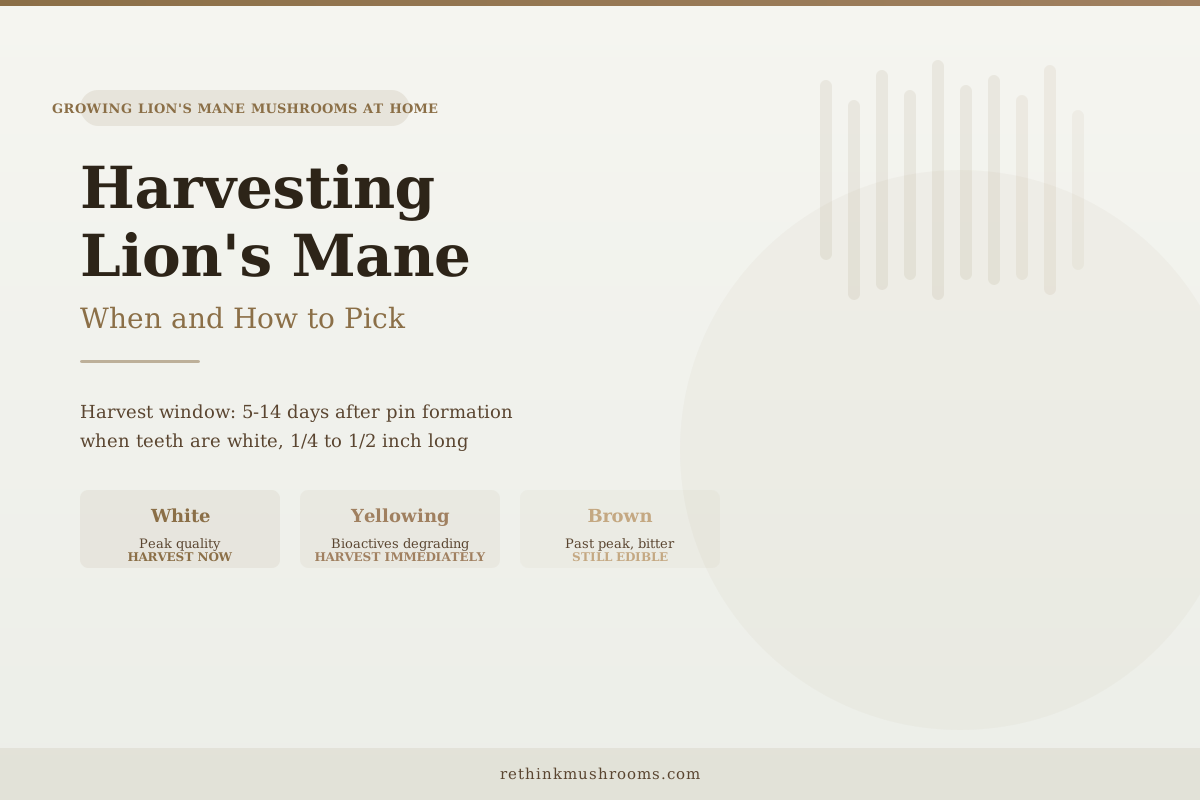
Lion's mane reaches peak harvest when teeth are white and 1/4 to 1/2 inch long, typically 5-14 days after pin formation. Harvesting at this stage preserves hericenones, the fruiting body compounds linked to nerve health.
Friedman, Journal of Agricultural and Food Chemistry, 2015
White teeth
only harvest when fully white, not yellowing at the tips
Twist & pull
preferred harvest method to prevent substrate debris and promote second flush
Beech sawdust
produces highest bioactive compound accumulation per Kala et al., Molecules, 2025
Friedman, Journal of Agricultural and Food Chemistry, 2015
 View as image ↗
The most common mistake new growers make with lion's mane is waiting too long. Unlike oyster mushrooms, which can tolerate a few extra days on the block with minimal quality loss, lion's mane begins degrading from the outside in, and by the time you see obvious yellowing at the tips, the mushroom has already started breaking down.
This article is about growing lion's mane mushrooms for maximum quality at harvest, why timing matters for more than just taste, and how to take the mushroom without damaging the block for subsequent flushes.
Key Takeaways
- Harvest lion's mane when the teeth (spines) are fully white and approximately 1/4 to 1/2 inch long; this occurs roughly 5-14 days after visible pin formation depending on temperature and humidity conditions
- Yellowing at the tooth tips signals the start of enzymatic breakdown; hericenones, the fruiting body compounds linked to nerve health, degrade as the mushroom matures past peak (Friedman, 2015)
- The twist-and-pull harvest method is preferred over cutting; it removes the entire mushroom base cleanly and reduces the chance of leaving substrate debris that promotes contamination
- After the first flush, clean the exposed substrate surface, allow a 3-7 day rest period with slightly reduced humidity, then re-initiate fruiting conditions for a second flush
- A 2025 study found that beech sawdust substrate accumulates significantly higher bioactive compound levels than hemp straw; the substrate you chose at setup affects what you harvest regardless of harvest timing (Kala et al., Molecules, 2025)
- Store fresh lion's mane in the refrigerator for up to 5-7 days or dehydrate at 40-50°C for long-term storage
The One Rule That Matters: Harvest White, Not Yellow
Every experienced lion's mane grower gives the same advice: harvest early.
Lion's mane does not follow the same quality arc as most cultivated mushrooms. It develops rapidly once pins form, and the window between "not quite ready" and "past peak" can be 24-48 hours at room temperature. The visual cue that tells you you're in the harvest window is straightforward: all teeth are white. The cue that tells you you've started to miss it is also straightforward: any tooth tip turns yellow.
The ideal harvest moment is when:
- The teeth (spines) are between 1/4 and 1/2 inch long
- The entire surface is uniformly white with no discoloration
- The mushroom body is firm and compact, not yet becoming fluffy or airy at the edges
- There is no visible moisture beading on the surface that indicates breakdown beginning
This stage typically occurs 5-14 days after visible pin formation. The wide range reflects temperature and humidity variation: cooler conditions slow development and can push the harvest window to the later end; warmer fruiting temperatures accelerate growth and compress the window.
If you are unsure, harvest sooner rather than later. A slightly early harvest loses a small amount of size. A late harvest loses quality, flavor, and bioactive potency in a way that cannot be recovered.
What the Four Stages of Development Look Like
Knowing what to look for at each stage prevents the "I thought it needed more time" mistake.
Stage 1: Pin formation (days 0-5)
Small white bumps appear on the surface of the block. They are rarely visible before day 3 and often take until day 5 before they are clearly identifiable as developing fruiting bodies rather than just surface texture. During this stage, maintain fruiting conditions (13-18°C, 85-95% relative humidity, fresh air exchange). Do not harvest.
Stage 2: Active tooth development (days 5-12)
The central mass expands and tooth-like spines begin elongating. This is the fastest-growing phase. Teeth are fully white. The mushroom is still building size and compound content. This is when harvest interest begins, but the mushroom often benefits from another 2-5 days. Continue maintaining fruiting conditions.
Stage 3: Peak harvest window (days 8-14)
Teeth are white and 1/4 to 1/2 inch long. The mass is full but not drooping. This is the target stage. Harvest now. The window at this stage typically lasts 1-3 days depending on temperature; in warmer conditions it may be shorter.
Stage 4: Past peak (days 12-16+)
Tooth tips begin yellowing. This starts at the outer edges of the mass first, then progresses inward. The yellowing is caused by enzymatic activity and the beginning of spore formation. The mushroom is still edible but the flavor sharpens to bitter and the bioactive compound content is declining.
Why Harvest Timing Affects More Than Flavor: The Bioactive Angle
Most harvest guides focus on size, appearance, and culinary quality. There is a research dimension that no competitor covers.
Lion's mane fruiting bodies contain hericenones, a group of aromatic compounds that have been linked to nerve growth factor stimulation in laboratory studies.[1] Friedman's 2015 comprehensive review of Hericium erinaceus chemistry established that hericenones are fat-soluble aromatic compounds unique to the fruiting body; they are not found in the mycelium. The mycelium, by contrast, contains erinacines, a different class of compounds with different properties.
When a lion's mane fruiting body undergoes the enzymatic breakdown that produces yellowing, those same enzymes act on the aromatic compound fraction. An overripe mushroom has both degraded cell structure (responsible for the change in texture and flavor) and degraded bioactive content.
This does not mean that a slightly yellowed lion's mane is medically worthless. But it does mean that the advice to "harvest on time" has a more specific basis than aesthetic preference. The peak-white stage represents not just culinary peak but chemical peak.
The substrate you grew the mushroom on also matters at the point of harvest. Research published in 2025 by Kala and colleagues found that lion's mane fruiting bodies grown on beech sawdust accumulated significantly higher levels of most bioactive compounds compared to those grown on hemp straw substrate.[2] Harvest timing cannot overcome a substrate-driven deficit in compound accumulation, which is why substrate selection decisions made at setup feed directly into the quality of what you harvest.
For deeper reading on how substrate selection affects medicinal potency, see Lion's Mane on Supplemented Hardwood: Optimizing Yields. For the science behind hericenones specifically, see Hericenones and NGF Synthesis: How Lion's Mane Stimulates Nerve Growth.
How to Harvest: Technique and Why It Matters
The method used to harvest lion's mane affects both the cleanliness of the block and the likelihood of successful subsequent flushes.
The twist-and-pull method
Grip the mushroom at the base where it meets the substrate. Apply gentle rotational pressure (a quarter turn in either direction) while pulling outward. The goal is to separate the entire mushroom at the substrate surface, including the base tissue, in one clean motion.
Do not cut at the surface with a knife. Cutting leaves embedded mushroom tissue in the substrate. This tissue has no structural connection to the mycelium and cannot continue growing, but it is organic material that will begin decomposing within 48-72 hours, providing a colonization site for bacteria and mold competitors.
Cleaning the harvest site
After removing the mushroom, the exposed substrate surface will typically show a small depression or rough patch where the fruiting body was attached. Use a clean, dry paper towel or a small brush to remove any loose substrate material or residual mushroom tissue from the surface. This is the step most beginners skip, and it explains many of the contamination problems encountered between flushes.
If the surface shows any soft, wet, or discolored spots, remove them. A sharp spoon or clean knife can be used to scrape away compromised areas down to firm, healthy-looking substrate. The white mycelium underneath is what you want to protect.
Timing of harvest relative to the growing cycle
Once you have harvested the first flush, the block needs time to recover before it will produce a second. The mycelium must replenish the substrate it depleted during the first fruiting event. Pushing immediately to another fruiting attempt without a rest period produces smaller second flushes and accelerates the block's overall decline.
Getting a Second Flush: Rest, Recovery, and Re-Initiation
Most lion's mane blocks will produce at least two significant flushes, sometimes three, before the substrate is sufficiently depleted that pin formation becomes sparse or does not occur at all.
The rest period between flushes typically runs 3-7 days. During this period:
Allow the surface to dry slightly. The block has been operating in high-humidity conditions and the exposed harvest site benefits from brief exposure to lower humidity (70-80% rather than 85-95%) to allow surface healing without causing the interior to dry out.
Maintain temperature in the colonization range (21-24°C) rather than the cooler fruiting range. This allows the mycelium to metabolize the remaining substrate nutrients and build reserves for the next flush.
After the rest period, re-initiate fruiting conditions: lower the temperature back to the fruiting range (13-18°C), raise humidity back to 85-95%, and ensure adequate fresh air exchange. The block may take 5-10 days to show new pins, or it may pin within 48 hours. The response time is variable and is not a reliable indicator of block health.
Recognizing when a block is spent
A block has reached end-of-life when it produces very small, sparse pins that do not develop into full fruiting bodies, or when the block becomes visibly soft, discolored, or shows green or black contamination patches. At this stage, the block should be removed from the fruiting environment. It can be buried in a garden or added to a compost pile, where the mycelium will continue colonizing the surrounding soil for a period of weeks.
For the growing conditions and FAE parameters that affect flush development, see Lion's Mane Growing Conditions: Temperature, Humidity, and FAE. For the complete timeline from spawn to harvest, see Growing Lion's Mane at Home: From Spawn to Harvest in 3 Weeks.
Storage After Harvest
Fresh lion's mane does not store as well as oyster mushrooms or shiitake. The high moisture content and dense tissue begin deteriorating within a few days at refrigerator temperature.
Refrigeration
Store fresh lion's mane in a paper bag or loosely wrapped in paper towels inside the refrigerator. Avoid sealed plastic bags, which trap moisture and accelerate breakdown. At 3-4°C, fresh lion's mane keeps for 5-7 days before the outer teeth begin softening and developing off-flavors.
Dehydration
Slicing lion's mane into 1 cm slabs and dehydrating at 40-50°C (using a food dehydrator or low oven setting) is the best method for long-term storage. Dehydration at lower temperatures (under 50°C) preserves heat-sensitive compounds better than higher-temperature drying. Dried lion's mane should be fully crisp with no pliable areas, which indicates residual moisture. Store in an airtight container away from light.
Cooking and bioavailability note
Hericenones are fat-soluble, meaning they dissolve in fat rather than water.[1] Cooking lion's mane in butter or oil may improve the bioavailability of these compounds compared to boiling or steaming. This is consistent with the traditional culinary approach of pan-frying or sautéing the mushroom rather than preparing it in water-based dishes.
For context on what lion's mane's bioactive compounds actually do once consumed, see Lion's Mane and Nerve Growth Factor: The Complete Research Guide. For the erinacine compounds found in the mycelium rather than the fruiting body, see Erinacines: The Compounds That Cross the Blood-Brain Barrier.
The Bottom Line
Harvest lion's mane at the white-tooth stage, 5-14 days after pin formation, before any yellowing appears at the tips. Yellowing signals both enzymatic breakdown of texture and degradation of hericenones, the bioactive compounds in the fruiting body. The twist-and-pull harvest method, followed by surface cleaning, gives the best second-flush outcomes. Substrate selection at setup determines bioactive compound accumulation regardless of harvest timing; beech sawdust produces higher hericenone levels than alternatives like hemp straw.
Frequently Asked Questions
Sources & References
- 1. Source details for this reference are not yet available.
- 2. Source details for this reference are not yet available.