Growing Lion's Mane at Home
15-18°C
Fruiting body formation in Hericium erinaceus requires 15–18°C with lower CO2, established by systematic comparison across seven Hericium species. Above that range, fruiting is suppressed.
Ko et al., Journal of Microbiology, 2005
25°C
Optimal temperature for mycelial colonization (agar studies); substrate grows use 21-24°C
5-8x
Fresh air exchanges per hour needed during fruiting to prevent coral-shaped growth
85-95%
Target relative humidity during active pin and fruiting body development
Ko et al., Journal of Microbiology, 2005
 View as image ↗
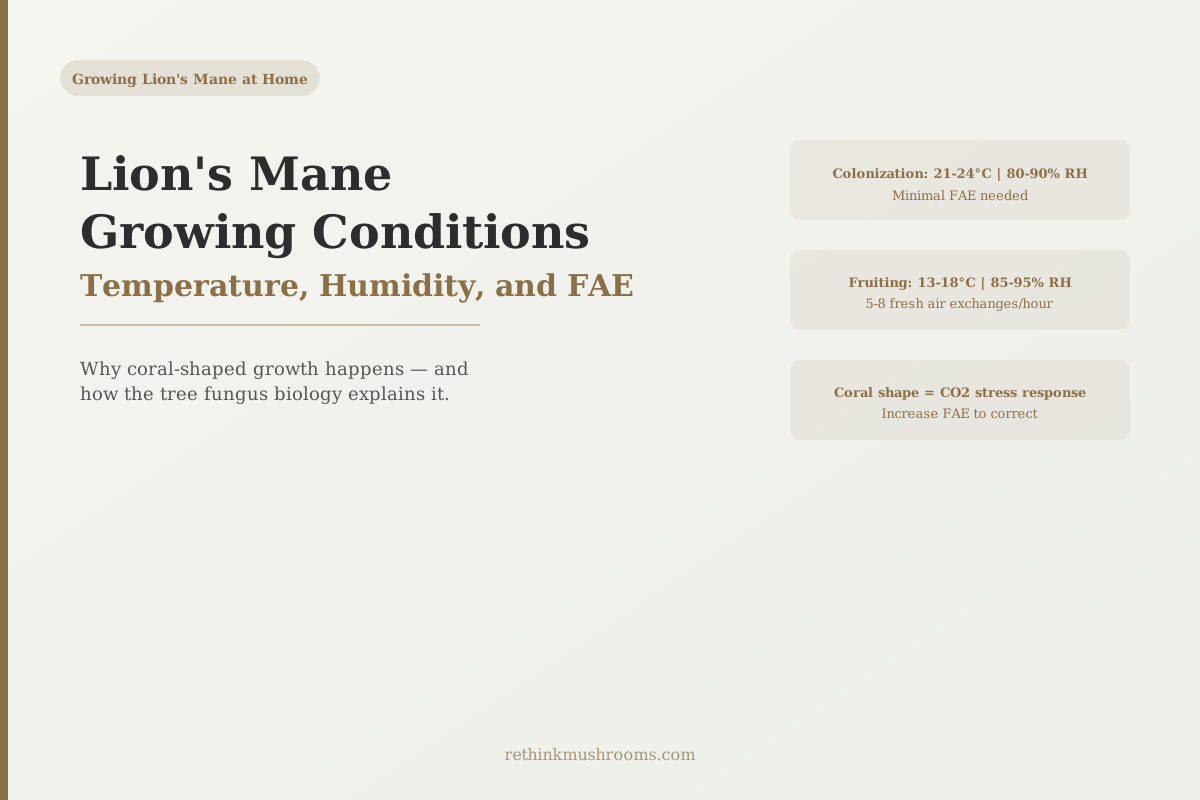
Most lion's mane growing guides give you the numbers: 21-24°C for colonization, 13-18°C for fruiting, 85-95% humidity, 5-8 fresh air exchanges per hour. Very few explain why those numbers matter or what happens biologically when they're wrong.
The most common problem home growers encounter — lion's mane fruiting in an elongated coral or antler shape instead of a round white pom-pom — is a direct consequence of high CO2. Understanding the biology behind it doesn't just help you fix the problem; it helps you understand why the fresh air exchange (FAE) requirement is not optional.
This article covers the three critical growing parameters, the science behind them, and a practical troubleshooting guide for the most common condition-related failures. For a complete guide from spawn to harvest, see how to grow lion's mane at home: complete guide. For the general beginner foundation on mushroom growing, see your first mushroom grow: step-by-step for beginners. And if you want to connect these growing choices to the health compounds you're actually cultivating, hericenones and NGF synthesis: how lion's mane stimulates nerve growth explains what you're optimizing for.
Key Takeaways
- Ko et al. (2005), comparing 7 Hericium species, found fruiting body formation optimal at 15-18°C and strongly suppressed by elevated CO2 — providing scientific basis for the temperature and FAE requirements that growers use
- Mycelial colonization is optimal around 25°C in agar studies (Ko 2005); practical substrate growing typically targets 21-24°C to reduce contamination risk at higher temperatures
- High CO2 during fruiting triggers an elongation stress response — the coral/antler shape — because lion's mane evolved as a tree fungus requiring ambient air circulation
- A temperature drop of 5-10°C from colonization to fruiting conditions is necessary to trigger pinning (the formation of fruiting body initials)
- Humidity during fruiting should be 85-95% RH; during colonization, 80-90% RH with less frequent misting is sufficient
- Diskit et al. (2024) showed mycelial growth rate is a controllable parameter responsive to nutritional inputs — confirming that colonization is not passive waiting but an active phase with optimizable variables
Quick Reference: Lion's Mane Growing Conditions by Stage
| Stage | Temperature | Humidity | Fresh Air Exchange |
|---|---|---|---|
| Colonization | 21-24°C (70-75°F) | 80-90% RH | Minimal — seal bag, check for contamination only |
| Transition to fruiting | Drop to 13-18°C (55-64°F) | Maintain | Begin increasing FAE |
| Fruiting / pinning | 13-18°C (55-64°F) | 85-95% RH | 5-8 exchanges/hour |
| Fruiting body development | 13-18°C (55-64°F) | 85-95% RH | Consistent; increase if coral shape appears |
| Harvest and rest | Room temperature | 70-80% RH | Reduce for 3-5 day rest between flushes |
Ko et al. (2005) confirmed the scientific basis for the temperature differential across a systematic comparison of seven Hericium species: mycelial growth was optimal at warmer temperatures (around 25°C) while basidiomata (fruiting body) formation was optimal at 15-18°C and markedly suppressed at higher temperatures.[1]
Why Lion's Mane Is So Sensitive to CO2: The Tree Fungus Biology
Most of the unusual sensitivity of lion's mane to growing conditions traces back to its ecology in the wild.
Hericium erinaceus grows on dead or dying hardwood trees — typically oak, beech, or walnut — where it produces large, pendulous fruiting bodies exposed to open forest air. Unlike mushrooms that fruit in the soil or inside leaf litter, lion's mane hangs from a tree wound fully exposed to moving air. Ambient CO2 concentrations in outdoor forest air are around 400-450 parts per million (ppm).
Inside a closed growing environment — a bag, a chamber, even a partially ventilated tent — CO2 from the mycelium's own respiration accumulates rapidly. Without intentional fresh air exchange, CO2 levels can reach 2,000-5,000 ppm or higher.
Lion's mane responds to this elevated CO2 as a stress signal. In the wild, high CO2 at any given location means the mushroom is enclosed or buried — not at the surface where spores can disperse. The biological response is to elongate upward and outward, extending growth toward air movement. This elongation produces the coral or antler shape that growers see when FAE is insufficient.
The fruiting body is, in effect, trying to escape the CO2.
Ko et al. (2005) specifically noted that basidiomata formation was suppressed by elevated CO2, aligning the experimental data with what growers observe practically: reduce fresh air exchange, get coral-shaped mushrooms.[1]
The same CO2 sensitivity explains why lion's mane is harder to grow in sealed containers than oyster mushrooms, which are more CO2-tolerant, or shiitake, which can flush inside a log with less active air management.
Colonization Phase: Temperature and the Mycelium's Priorities
During colonization, the mycelium is growing through the substrate — breaking down wood material and establishing the fungal network that will support fruiting. This phase has different requirements from fruiting.
Ko et al. (2005) found mycelial growth of H. erinaceus optimal at around 25°C on potato dextrose agar.[1] Most practical growing guides target 21-24°C for substrate colonization — slightly below the laboratory agar optimum. The reason: at higher temperatures, the risk of contaminating organisms (bacteria and competing molds) also increases, and substrate growing environments are not sterile laboratory conditions. The slightly cooler range balances colonization speed against contamination risk.
Diskit et al. (2024) confirmed that mycelial growth velocity is not fixed — it is a controllable variable responsive to nutritional inputs in the growing medium.[2] The colonization phase is not passive waiting. The substrate's nutritional profile — carbon-to-nitrogen ratio, nitrogen source type — actively shapes how quickly the mycelium colonizes and how robustly it grows.
Practically, this means the "just wait and check" approach to colonization undersells what's happening. A well-formulated substrate colonizes faster, produces denser mycelium, and sets up a more productive fruiting phase. The visual indicator: healthy colonizing lion's mane mycelium appears white to cream-colored and rhizomorphic (rope-like strands), not flat or diffuse. A flat, thin, or patchy mycelial appearance often signals a nutritional deficiency or temperature problem.
During colonization, FAE requirements are minimal. The bag should be mostly sealed to maintain humidity and prevent contamination. The mycelium is producing CO2, but the block isn't trying to fruit — it has no reason yet to respond to CO2 as a stress signal. Check for contamination (green, black, or orange mold; sour or bacterial smell) but don't open the bag for air.
Fruiting Phase: The Temperature Drop That Triggers Pinning
The transition from colonization to fruiting is not just about changing the temperature. It requires a drop in temperature — from the 21-24°C colonization range down to the 13-18°C fruiting range.
This temperature drop is a seasonal signal. In nature, lion's mane fruits in late summer through autumn as temperatures cool from summer peaks. The mycelium registers the temperature change as a cue that conditions have shifted — that it is time to reproduce by producing spores in a fruiting body.
A fully colonized block held at constant 21°C will often sit without pinning even if humidity and FAE are correct. Moving the same block into a cooler environment — a basement, a wine cooler, or even a room that runs cooler in the evening — triggers pinning within 5-14 days in most cases.
Once pins form, the fruiting conditions matter:
Temperature: Keep 13-18°C throughout fruiting body development. Above 20°C, growth continues but can become loose and irregular rather than compact and pom-pom shaped.
Humidity: 85-95% RH. During this phase, the mushroom is mostly water — the fruiting body is typically 90% moisture by weight. Low humidity during this phase causes tips to dry, brown, and die before the mushroom reaches maturity. Mist the chamber walls (not directly on the mushroom) or use a humidifier on a timer.
FAE: This is when FAE becomes critical. The fruiting body is actively respiring and CO2 is accumulating rapidly. Without adequate fresh air exchange, the elongation stress response begins within hours.
Fresh Air Exchange in Practice: How to Get It Right
Fresh air exchange means replacing CO2-saturated air inside the growing space with fresh ambient air. There are two approaches: passive and active.
Passive FAE works for small-scale fruiting chambers (shotgun fruiting chambers, storage totes). Small holes filled with polyfill (polyester fiberfill) allow CO2 to diffuse out and fresh air to diffuse in. The limitation: passive exchange is slow and often insufficient for lion's mane, which is more CO2-sensitive than other common culinary mushrooms.
Active FAE uses a small fan — sometimes on a timer, sometimes running continuously — to move air through or past the growing area. Even a small USB fan running for 30 seconds every 15 minutes can dramatically reduce CO2 accumulation in a grow tent.
How do you know if you're getting enough FAE? Watch the shape. A pom-pom shape — compact, round, white, with short, dense teeth — means adequate FAE. An elongated, coral-like shape with long, branching arms means CO2 is accumulating. If you see the coral shape starting, increase FAE immediately.
The goal is not maximum FAE. Excessive air movement desiccates the fruiting body. The goal is a CO2 concentration low enough that the mushroom receives the "open air" signal rather than the "enclosed" signal — while humidity stays in the 85-95% range.
This is the core tension of lion's mane cultivation: FAE fights humidity. Moving fresh air in dries things out. Most growers resolve this by:
- Misting more frequently when FAE is increased
- Using a humidifier with air movement rather than relying on still, humid air
- Running FAE in short bursts rather than continuously (allows humidity to recover)
The Humidity-FAE Balancing Act
Of the three conditions, humidity and FAE are the ones that trade off directly against each other. Temperature is set-and-forget (relatively). Humidity and FAE need to be actively managed together.
Too much humidity without FAE = high CO2, elongated growth, potential bacterial contamination from standing moisture on surfaces.
Too much FAE without humidity = desiccation of developing teeth, yellowing tips, stunted growth.
The signs tell you which direction you're off:
- White, pom-pom shaped, with teeth ¼-½ inch long: conditions are correct
- Round shape but tips turning yellow: harvest immediately — overripe, or humidity too low for the final growth phase
- Coral/antler shape, all white: increase FAE, reduce humidity slightly to reduce bacterial risk while correcting CO2
- Coral/antler shape with yellowing tips: CO2 too high AND too dry — both problems simultaneously
- No pins forming after 2 weeks in fruiting conditions: verify temperature drop occurred, check humidity with a meter, verify CO2 isn't extremely high
For specifics on what each visual stage looks like and when to harvest, see harvesting lion's mane: when and how to pick. For how substrate choices interact with the growing conditions described here, see lion's mane on supplemented hardwood: optimizing yields. For a complete timeline from spawn to harvest, including what to look for at each stage, see growing lion's mane at home: from spawn to harvest in 3 weeks.
One practical note on compounds: home growers who are cultivating lion's mane for its neuroprotective hericenone content (rather than just for food) are producing fruiting body material that contains hericenones but not erinacines — erinacines are found in the mycelium, not the fruiting body, and are primarily available in mycelium extract supplements. This distinction is explained in erinacines: the compounds that cross the blood-brain barrier. For the growing guide context, it simply means that what you harvest from fruiting bodies at home has a different bioactive profile than certain commercial mycelium-based supplements.
The Bottom Line
Lion's mane growing conditions — temperature, humidity, and fresh air exchange — are connected to the mushroom's ecological biology as a tree fungus adapted to ambient outdoor air. The temperature differential between colonization (21-24°C) and fruiting (13-18°C) provides a seasonal pinning signal; Ko et al. (2005) confirmed basidiomata formation optimal at 15-18°C and suppressed by elevated CO2. High CO2 triggers an elongation stress response — the coral/antler shape — that resolves with increased FAE. The central challenge of lion's mane cultivation is maintaining 85-95% humidity while providing the air exchange that prevents CO2 buildup.
Frequently Asked Questions
Sources & References
- 1. Source details for this reference are not yet available.
- 2. Source details for this reference are not yet available.