Growing Lion's Mane at Home
42.6% biological efficiency
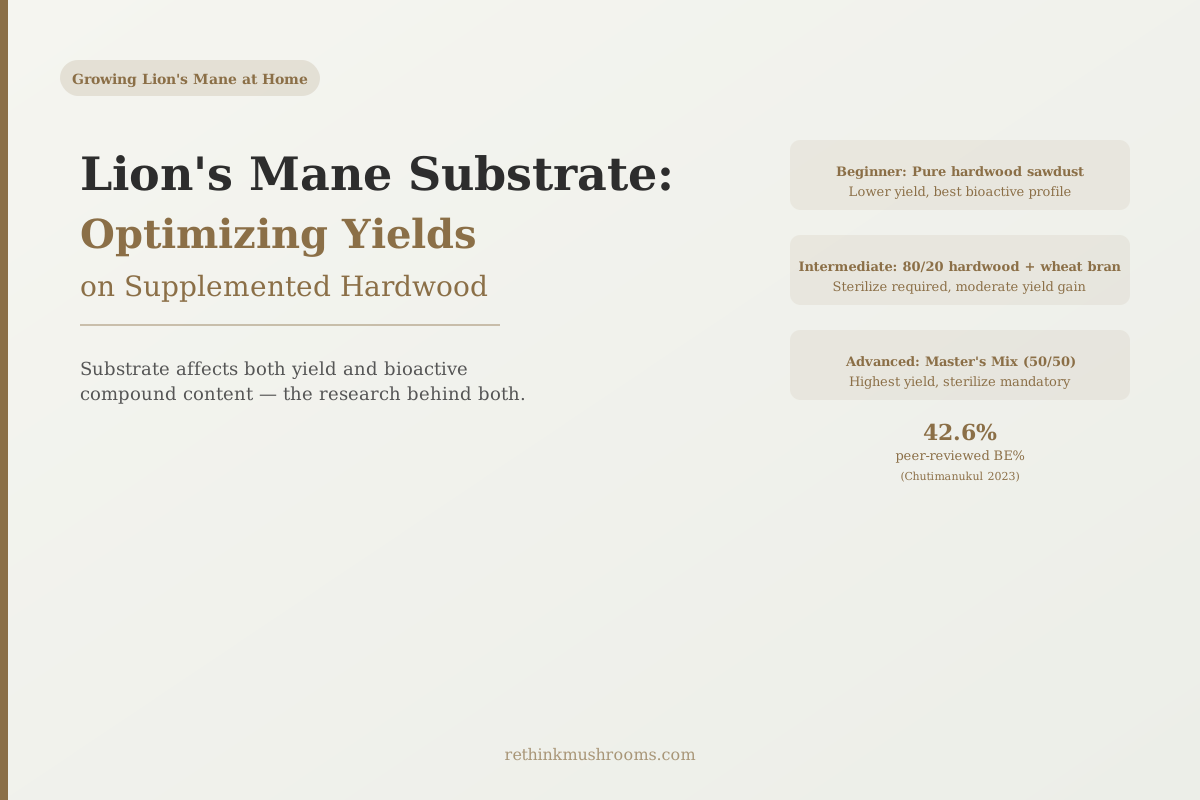
Peer-reviewed substrate trials found 113g per bag with 42.6% biological efficiency using rubber sawdust — establishing the ceiling for what well-chosen hardwood substrates can produce.
Chutimanukul et al., Scientific Reports, 2023
2025
Year beech sawdust was confirmed to produce higher bioactive accumulation than hemp straw (Kala et al., Molecules)
C:N
Carbon-to-nitrogen ratio — the substrate variable that simultaneously affects both yield and bioactive compound content
Sterilize
Not pasteurize — supplemented substrates require full sterilization to prevent contamination
Chutimanukul et al., Scientific Reports, 2023
 View as image ↗
Most lion's mane substrate guides optimize for one thing: yield. More mushrooms per bag. Higher biological efficiency — the weight of mushrooms produced as a percentage of dry substrate weight.
That's useful. But it misses something: substrate selection also affects the bioactive compound profile of what you grow. Kala et al. (2025) found that fruiting bodies grown on beech sawdust accumulated significantly more bioactive compounds than those grown on hemp straw — the same mushroom, the same species, producing different medicinal profiles depending on what it ate.[1]
If you're growing lion's mane primarily for culinary use, optimizing for yield makes sense. If you're growing it for its hericenone content — the fruiting body compounds associated with nerve growth factor stimulation — substrate selection becomes a medicinal potency question, not just a production question.
This article covers both: the research on yield optimization and the newer data on bioactive compound optimization. For the complete growing guide, see how to grow lion's mane at home: complete guide. For the growing conditions that govern when and how those yields appear, see lion's mane growing conditions: temperature, humidity, and FAE.
Key Takeaways
- Kala et al. (2025) found beech sawdust produced significantly higher bioactive compound accumulation than hemp straw in lion's mane fruiting bodies — substrate choice affects medicinal potency, not just yield
- Chutimanukul et al. (2023) documented 113.22g per bag and 42.61% biological efficiency with 100% rubber sawdust — peer-reviewed yield benchmarks no growing guide currently cites
- Ofosu et al. (2016) showed that carbon-to-nitrogen ratio and nitrogen source type simultaneously affect both mycelial biomass yield AND bioactive compound content — not just one or the other
- Friedman (2015) confirmed that the fruiting body's bioactive profile (hericenone content) depends on substrate and growing conditions, not just genetics
- Supplemented substrates (hardwood + wheat bran, Master's Mix) require full sterilization — pasteurization is insufficient because supplemental nitrogen creates a high-contamination-risk environment
- The medicinal optimization angle: beech or oak sawdust may produce better bioactive profiles; Master's Mix may produce higher weight yields; these are not always the same goal
Substrate Formula Quick Reference
| Formula | Hardwood % | Supplement | Sterilize? | Yield Profile | Bioactive Notes |
|---|---|---|---|---|---|
| Pure hardwood sawdust | 100% | None | Recommended | Lower yield, multiple flushes | Baseline; depends on wood species |
| 80/20 hardwood + wheat bran | 80% | 20% wheat bran | Required | Moderate-high yield | Higher nitrogen may reduce hericenones in some studies |
| Master's Mix | 50% | 50% soy hulls | Required | Highest yield, 1-2 flushes | High productivity but wood species still matters |
| Beech/oak sawdust (pure or supplemented) | 100% beech/oak | Variable | Recommended | Moderate | Highest bioactive accumulation per Kala 2025 |
Yields vary significantly based on genetics, conditions, and water content of substrate. Biological efficiency (BE%) = weight of fresh mushrooms ÷ dry weight of substrate × 100.
Two Axes, One Choice
Substrate Trade-off: Yield vs. Bioactive Accumulation
The formula that grows the most mushroom weight is not always the one that grows the most medicinally active mushroom. Positions below are directional, drawn from the cited studies.
Read it as a decision, not a ranking: growing for the plate rewards yield (right); growing for hericenone content rewards substrate choices that favour bioactive accumulation (top). Beech or oak sawdust is the formula the current evidence pushes upward on the bioactive axis.
Sources: Kala et al. (2025), Molecules; Ofosu et al. (2016), Int. J. Medicinal Mushrooms; Chutimanukul et al. (2023), Scientific Reports. Axis positions are directional; only the 42.6% biological-efficiency ceiling is a measured value.
The Bioactive Angle: What Kala 2025 Found That No Growing Guide Mentions
Kala et al. (2025) published a study in Molecules that should change how serious growers think about substrate selection.[1]
Their question: does the plant material a lion's mane mushroom grows on affect the bioactive compounds that accumulate in the fruiting body? They grew H. erinaceus on two substrate types — beech sawdust and hemp straw — and then measured the bioactive compound content in the resulting fruiting bodies using different extraction methods.
The finding: fruiting bodies grown on beech sawdust accumulated significantly higher amounts of most bioactive compounds compared to those grown on hemp straw.
This matters because the bioactive compounds in lion's mane fruiting bodies — primarily hericenones — are the compounds associated with nerve growth factor stimulation and the mushroom's neuroprotective properties. Growing a higher-yield block that produces fewer hericenones is a trade-off that most growing guides don't acknowledge, because they don't cite this research.
Friedman's comprehensive 2015 review of lion's mane chemistry made the same point at a general level: the fruiting body's bioactive profile is not fixed by genetics alone — it depends on substrate and growing conditions.[2] Kala 2025 quantified this with direct comparison data.
The practical implication: if you're growing lion's mane for its hericenone content, beech or oak sawdust as the primary substrate component may produce a more medicinally potent fruiting body than alternative substrate materials — even if a different substrate recipe produces more total mushroom weight.
For context on what hericenones do in the body, see hericenones and NGF synthesis: how lion's mane stimulates nerve growth. For a broader substrate science guide across mushroom species, see mushroom substrate guide: hardwood, straw, sawdust, and supplemented formulas.
The Science Behind Supplementation: C:N Ratio and What Ofosu 2016 Found
Why does adding wheat bran or soy hulls increase yield? And why does it also affect bioactive compound content?
Ofosu et al. (2016) addressed this directly, using response surface methodology to identify optimal nutrient conditions for Hericium erinaceus — specifically trying to maximize both mycelial biomass AND bioactive compound yield simultaneously.[3]
Their finding: the carbon-to-nitrogen ratio (C:N ratio) and the type of nitrogen source significantly affected both outputs — yield and bioactive content — at the same time. They are not independent variables.
What this means practically:
Carbon is what wood provides in abundance — cellulose and lignin. Hardwood sawdust is largely carbon.
Nitrogen is the limiting nutrient. Without adequate nitrogen, mycelial growth slows and fruiting body development is suboptimal. Wheat bran, soy hulls, rice bran, and similar additives increase the substrate's nitrogen content.
Adding too little nitrogen leaves yield on the table. Adding too much shifts the C:N ratio in ways that can favor rapid contaminating bacteria and molds (which thrive in high-nitrogen environments) over the slower-growing Hericium mycelium.
The practical conclusion from Ofosu 2016: supplement rate matters quantitatively, not just qualitatively. "Add wheat bran" is not as complete as "add 15-20% wheat bran by dry weight" — and the source of nitrogen matters too, not just the amount.
Peer-Reviewed Yield Benchmarks: The Chutimanukul 2023 Data
Most yield comparisons in growing guides come from anecdotal reports or commercial claims without peer review. Chutimanukul et al. (2023) provides a rare exception: a controlled scientific study measuring H. erinaceus yields across different substrate formulations in commercial-scale production conditions.[4]
Their results with rubber sawdust as the primary substrate:
- Fresh weight yield: 113.22 g per bag
- Biological efficiency: 42.61%
Biological efficiency (BE%) is the standard way to compare substrate performance: it expresses how much of the dry substrate weight was converted into fresh mushroom weight. A BE% of 42.61% means roughly 43g of fresh mushrooms per 100g of dry substrate — a figure that provides a research-grounded reference point for evaluating other substrate formulas.
The study also tested bamboo sawdust, which produced proportionally lower yields. The research was conducted in Thailand's tropical climate, where temperature management is more challenging — conditions that make the yield data somewhat conservative for growers in more temperate climates with better temperature control.
What the Chutimanukul 2023 data provides is a scientifically measured baseline: a well-optimized pure sawdust substrate can achieve around 40-45% BE in controlled conditions. Supplemented substrates (adding wheat bran, soy hulls, or other nitrogen sources) typically increase this, but the relationship is nonlinear — there's a diminishing return on supplementation, and a risk of contamination that increases with nitrogen content.
Three Substrate Formulas by Skill Level
Beginner: Pure Hardwood Sawdust
Formula: 100% hardwood sawdust (oak, beech, or alder), field capacity moisture (squeeze test: a few drops, not a stream)
Why: No supplementation means low contamination risk. Pasteurization is technically sufficient, though sterilization is still recommended for cleaner results. Multiple flushes are possible. Yield is lower than supplemented formulas.
Best for: First-time growers, open bucket tek, outdoor log-style growing.
Wood species note: Kala 2025 suggests beech or oak as better choices than softer alternative woods for bioactive compound accumulation.[1]
Intermediate: 80% Hardwood + 20% Wheat Bran
Formula: 80% hardwood sawdust, 20% wheat bran by dry weight, field capacity moisture
Sterilization required: The wheat bran raises nitrogen content, creating an environment where bacteria and molds grow much faster. Pasteurization at 70-80°C cannot kill thermophilic bacterial spores. Full sterilization at 121°C (15 PSI) for 2-2.5 hours is necessary.
Why: Wheat bran provides both nitrogen and carbon in a bioavailable form that lion's mane mycelium can use efficiently. Yield is notably higher than pure sawdust. The C:N ratio from Ofosu 2016 research supports approximately this range as effective for balancing both yield and bioactive production.[3]
Watch for: At higher wheat bran rates (25-30%), contamination risk increases substantially without proportional yield gain.
Advanced: Master's Mix (50% Hardwood + 50% Soy Hulls)
Formula: 50% hardwood sawdust, 50% soy hulls by dry weight, field capacity moisture
Sterilization required: Non-negotiable. Soy hulls have very high nitrogen content. Contamination pressure at this supplement rate is extreme; most contaminations in Master's Mix blocks happen in the first 5-7 days if sterilization was insufficient.
Why: Master's Mix is the highest-yield substrate formula commonly used by hobby growers. The combination of woodchip carbon and soy hull nitrogen creates an ideal nutritional environment for rapid colonization and heavy fruiting.
Trade-off: Maximum yield, typically 1-2 productive flushes before the substrate is spent. The bioactive optimization trade-off is unknown — Kala 2025 measured beech vs. hemp straw; no study has directly compared Master's Mix to pure beech sawdust for hericenone content.
Why Supplemented Substrates Require Sterilization
Sterilization (121°C, 15 PSI) kills all biological material including heat-resistant bacterial endospores. Pasteurization (70-80°C, field hot water soak) kills most vegetative bacteria and molds but cannot kill endospores.
Hardwood sawdust is naturally resistant to most competing organisms — the very compounds that make lion's mane thrive are partly antimicrobial. Pure hardwood blocks can sometimes be successfully pasteurized rather than sterilized, though sterilization is still better.
Supplemented substrates change the equation. Wheat bran, soy hulls, and similar additives are rich in nitrogen and simple sugars that bacteria and fast-growing molds can consume much more rapidly than Hericium mycelium. The bacteria present in the substrate — including endospore-forming species like Bacillus — will out-compete the fungus within days if not killed.
The rule: anything above approximately 15% supplementation by dry weight should be considered a sterilization-required substrate. For more detail on the sterilization process and equipment needed, see how to prepare mushroom substrate: sterilization and pasteurization.
Harvesting at the Right Stage to Preserve Bioactive Content
Friedman 2015 established that hericenones — the fruiting body compounds associated with NGF stimulation — are concentrated in the fruiting body tissue.[2] Enzymatic breakdown begins as the mushroom matures past peak — a process that starts when tips begin to yellow.
The substrate optimization that produces higher hericenone content can be partially reversed by harvesting too late. Peak bioactive content is in white, teeth-early fruiting bodies harvested before the tips start to discolor.
The timing and technique for maximizing what you harvest from a well-prepared block is covered in harvesting lion's mane: when and how to pick. The timeline from spawn to your first harvest — including what a successfully colonized block looks like — is in growing lion's mane at home: from spawn to harvest in 3 weeks.
The Bottom Line
Substrate selection for lion's mane affects both yield and bioactive compound content. Kala et al. (2025) found beech sawdust produced significantly higher bioactive accumulation than hemp straw, while Ofosu et al. (2016) established that C:N ratio and nitrogen source type simultaneously affect both biomass yield and bioactive compound production. Chutimanukul et al. (2023) documented 113.22g per bag at 42.61% biological efficiency with rubber sawdust — a peer-reviewed yield benchmark. Supplemented substrates require full sterilization; the formula choice should reflect whether the goal is maximum yield or maximum hericenone content.
Frequently Asked Questions
Sources & References
- 1RTHM-02103·Kała, Katarzyna et al. (2025). “Influence of Plant-Based Substrate Composition and Extraction Method on Accumulation of Bioactive Compounds in Hericium erinaceus (Bull.) Pers. Fruiting Bodies..” Molecules (Basel.Study breakdown →PubMed →↩
- 2RTHM-00371·Friedman, Mendel (2015). “Chemistry, Nutrition, and Health-Promoting Properties of Hericium erinaceus (Lion's Mane) Mushroom Fruiting Bodies and Mycelia and Their Bioactive Compounds..” Journal of agricultural and food chemistry.Study breakdown →PubMed →↩
- 3RTHM-00813·Ofosu, Fred K et al. (2016). “Nutrient Optimization Using Response Surface Methodology for Simultaneous Biomass and Bioactive Compound Production by Lion's Mane Medicinal Mushroom, Hericium erinaceus (Agaricomycetes)..” International journal of medicinal mushrooms.Study breakdown →PubMed →↩
- 4RTHM-01680·Chutimanukul, Preuk et al. (2023). “Commercial scale production of Yamabushitake mushroom (Hericium erinaceus (Bull.) Pers. 1797) using rubber and bamboo sawdust substrates in tropical regions..” Scientific reports.Study breakdown →PubMed →↩