Mushroom Substrate Selection & Preparation
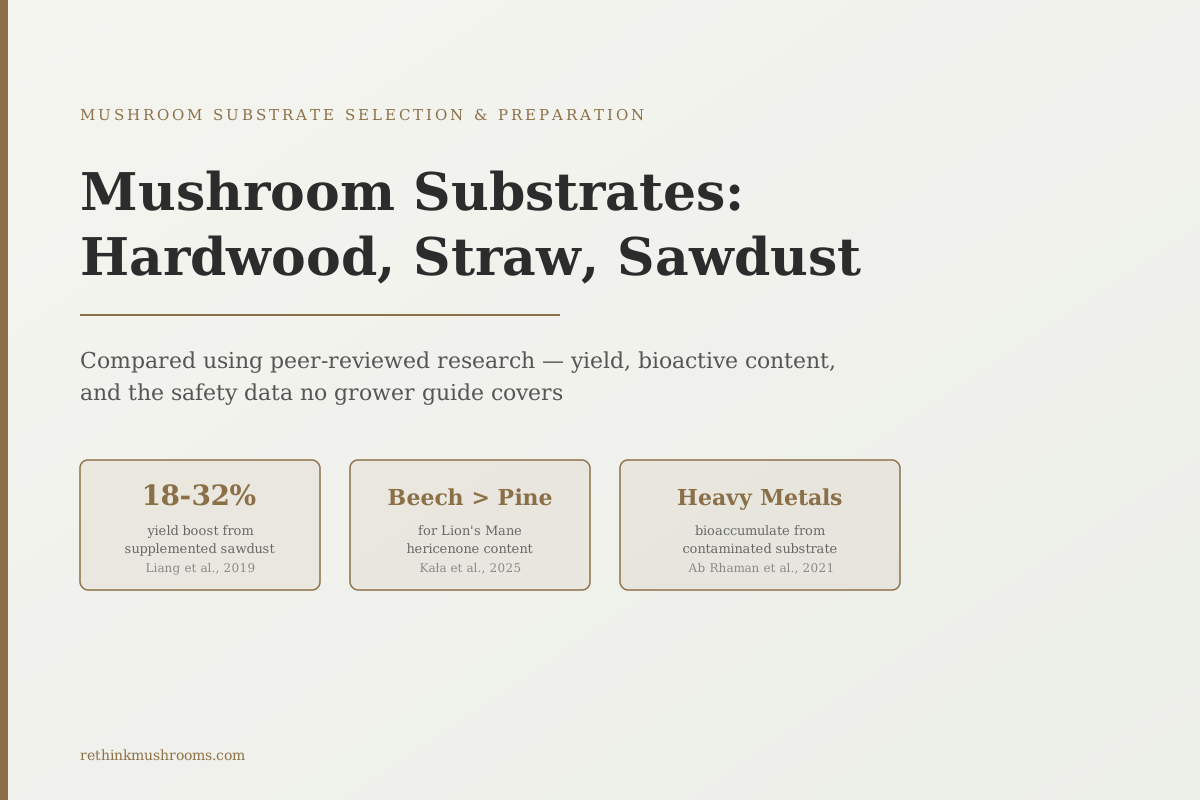
18-32% yield boost
Supplementing sawdust with grass or bran at 15-25% of substrate weight produced 18-32% higher biological efficiency versus plain sawdust in a 2019 controlled study.
Liang et al., Saudi Journal of Biological Sciences, 2019
Beech > Pine
for Lion's Mane brain-health compound concentration; wood species selection changes potency (Kała et al., 2025)
4 substrate types
hardwood, straw, sawdust, and supplemented formulas; each matched to specific species
Cadmium + Lead
heavy metals that bioaccumulate in fruiting bodies when substrate sources are contaminated (Ab Rhaman et al., 2021)
Liang et al., Saudi Journal of Biological Sciences, 2019
 View as image ↗
In 2025, Kała and colleagues published data on a question most growers never think to ask: does it matter which hardwood species the sawdust comes from? For Lion's Mane, the answer is yes. Beech wood-dominant substrates produced higher concentrations of hericenones and erinacines than oak or pine in controlled growing conditions.[1] Hericenones and erinacines are the specific compounds that Lion's Mane research centers on for brain health. The substrate decision, in other words, is not just about how much mushroom you grow. It affects what the mushroom contains. A 2025 comprehensive review by Timm and colleagues confirmed this across multiple species: substrate composition determines yield, nutritional composition, and secondary metabolite content simultaneously.[2] This guide covers the four main substrate types through that lens, as part of the larger skill set covered in the complete beginner's guide to growing mushrooms at home.
Key Takeaways
- Beech wood-dominant substrates produced higher hericenone and erinacine concentrations in Lion's Mane fruiting bodies than oak or pine substrates in a 2025 controlled study (Kała et al., 2025)
- Supplementing sawdust with grass or bran at 15-25% of substrate weight increased biological efficiency 18-32% compared to plain sawdust, with protein and polysaccharide content also increasing (Liang et al., 2019)
- Blended substrates, such as sawdust combined with cotton waste, consistently outperformed single-component substrates in wood ear mushroom yield experiments (Wu et al., 2017)
- Heavy metals including cadmium, lead, and arsenic bioaccumulate in fruiting bodies from contaminated substrate sources at concentrations that can exceed safe limits (Ab Rhaman et al., 2021)
- For grain supplements used within sawdust formulas, rye and wheat consistently outperformed rice and corn for polysaccharide content per gram dry weight (Meng et al., 2014)
- Substrate origin changes the amino acid profile of the fruiting body: Pleurotus species grown on olive mill waste showed different essential amino acid concentrations than those grown on wheat straw (Tagkouli et al., 2020)
Hardwood: Which Wood Species Changes Lion's Mane Potency
Not all hardwood is equivalent. That is the key finding from Kała and colleagues (2025), who grew Lion's Mane on substrates dominated by different wood species and measured the resulting concentration of hericenones and erinacines in the fruiting bodies.[1] Beech wood outperformed both oak and pine. This is not a marginal difference in the bioactive compound content that makes Lion's Mane of interest to researchers.
For growers who are not specifically cultivating Lion's Mane, the practical implication is broader: wood species selection is a meaningful variable, not an interchangeable input. The general rule for wood-loving mushrooms is that hardwood species without terpene-heavy resins work best. Beech, oak, maple, alder, and cottonwood all have established records as viable substrates. Softwoods, including pine, cedar, and fir, contain terpenes and phenolic compounds that inhibit mycelial growth in most species, with a few exceptions in the genus Ganoderma. Black walnut is typically avoided because its juglone content is antifungal.
The 2025 Timm review confirmed species-substrate matching as the single most important cultivation decision across the mushroom species examined.[2] Wood-loving species, including shiitake, Lion's Mane, reishi, and maitake, perform on hardwood because they evolved to break down the lignin and cellulose in hardwood trees. Oyster mushrooms tolerate a broader substrate range but also achieve their peak bioactive yield on wood-based formulas.
For a deeper analysis of why wood substrates produce higher medicinal compound concentrations than grain-based alternatives, see the science behind the fruiting body vs. mycelium argument.
Straw: The Best Substrate for Beginners and Where It Falls Short
Straw is the most forgiving substrate for first-time growers, and the research explains why. Its low nutrient content relative to supplemented sawdust means competing organisms have fewer resources. This reduces contamination risk enough that simple pasteurization, rather than full pressure-cooker sterilization, is sufficient preparation. The time-temperature target for pasteurization is 160-180 degrees Fahrenheit for one to two hours, which kills most competing bacteria and molds without requiring specialized equipment.
Oyster mushrooms, including Pleurotus ostreatus (grey oyster), P. pulmonarius (phoenix oyster), P. erythrpus (pink oyster), and P. citrinopileatus (golden oyster), all fruit readily on straw. Wine caps (Stropharia rugosoannulata) also perform well outdoors on straw-woodchip blends. These species have the enzyme complement needed to break down the straw's lignocellulosic structure efficiently.
The limitation of plain straw is yield. Compared to supplemented formulas, plain straw produces lower biological efficiency because it provides less nitrogen and fewer nutrients to support dense fruiting. Wu and colleagues (2017) demonstrated this directly: blended substrates combining sawdust with cotton waste consistently outperformed single-component substrates in wood ear mushroom yield experiments.[3] Adding a small proportion of sawdust or agricultural supplement to straw can improve output without raising contamination risk dramatically.
The 2025 Timm review confirmed straw as the optimal beginner choice due to pasteurization viability and established species compatibility.[2] The trade-off is lower ceiling yields compared to supplemented formulas and a narrower species range than hardwood sawdust.
Sawdust: How 15-25% Supplementation Boosts Yield 18-32%
Plain hardwood sawdust is the core of most intermediate-to-advanced substrate formulas. It provides the lignin and cellulose structure that wood-loving mushrooms evolved to consume, in a particle size that colonizes faster than wood chips. Finer particles colonize more quickly because they create more surface area for mycelium to contact and penetrate.
The performance gap between plain and supplemented sawdust is quantifiable. Liang and colleagues (2019) tested Auricularia cultivation on sawdust supplemented with grass at varying proportions. At the optimal range of 15-25% grass supplement by weight, biological efficiency increased 18-32% compared to unsupplemented sawdust. Protein and polysaccharide content in the fruiting bodies also increased with supplementation.[4]
The supplement provides nitrogen that hardwood alone lacks. Common supplements include wheat bran, rice bran, oat bran, and soybean hulls. Each adds different nutrient ratios, and those ratios affect the microenvironment inside the substrate bag during colonization. Higher nutrient density increases yield potential and also increases contamination risk, which is why supplemented sawdust typically requires sterilization rather than pasteurization.
Wu and colleagues (2017) found the same pattern in wood ear mushroom trials: blended substrate combinations outperformed single-component approaches in both yield and nutritional outcome.[3] The practical implication is that the starting point for most hardwood sawdust formulas is plain sawdust, with supplementation adjusted by species requirements and sterilization capability.
For the substrate preparation decisions that follow substrate selection, including when pasteurization is sufficient versus when sterilization is required, see how to prepare mushroom substrate: sterilization and pasteurization.
Master's Mix and Supplemented Formulas: Highest Yields, Highest Risk
Master's Mix is a specific substrate formula: 50% hardwood sawdust combined with 50% soybean hulls by weight. It became widely adopted in the cultivar community because of its consistently high yields across multiple species, particularly lion's mane, oyster, and king oyster (Pleurotus eryngii). The soybean hull fraction provides a high-nitrogen supplement that the sawdust fraction provides structure for.
The trade-off is contamination vulnerability. A 50% soybean hull formula is extremely nutrient-dense. Without adequate sterilization, competing organisms colonize it before mushroom mycelium can establish dominance. This formula requires pressure cooker sterilization at 15 PSI (pounds per square inch), typically for two to three hours depending on bag volume. Pasteurization is insufficient.
For grain-based components within supplemented formulas, not all grains are equal. Meng and colleagues (2014) tested multiple grain types as substrate additions for Cordyceps militaris and found that rye and wheat consistently outperformed rice and corn for polysaccharide content per gram dry weight in the resulting fruiting bodies.[5] When grains are used as spawn or as substrate supplements, this species-level variation in grain composition produces measurable downstream differences in the mushroom.
The 2025 Timm review confirmed that supplemented formulas produce the highest yields but require sterilization to manage the elevated contamination risk from high nutrient density.[2] The practical summary: Master's Mix is not a beginner formula. It rewards cultivators who have sterilization equipment and contamination management dialed in.
The Heavy Metal Problem with Industrial Wood Waste
The safety angle on substrate sourcing is almost entirely absent from consumer growing guides. Ab Rhaman and colleagues (2021) documented why it should not be. Heavy metal accumulation in mushroom fruiting bodies is directly substrate-dependent. Mushrooms grown on substrates contaminated with cadmium, lead, and arsenic bioaccumulated those metals into their fruiting bodies at concentrations that exceeded safe food consumption limits in the study samples.[6]
The practical risk comes from industrial wood waste used as growing substrate. Recycled pallets, treated lumber scraps, and construction wood waste are sometimes available cheaply or free. The problem is that industrial wood materials are often treated with preservatives, stains, or fumigants that persist in the wood. Mushrooms bioaccumulate these compounds as they consume the substrate.
Food-grade hardwood sawdust from sawmills processing untreated timber avoids this risk. Sawdust sold specifically for mushroom cultivation is typically sourced and tested with this in mind. Agricultural straw is generally low-risk for heavy metals because it is a field crop grown without preservative treatment, though sourcing from farms that use heavy pesticide applications introduces a separate concern.
The key variable is source documentation. Substrate that comes from a traceable, uncontaminated source avoids the accumulation risk. Substrate from unverified industrial waste streams does not.
How Substrate Choice Changes What You Actually Eat
Beyond yield, substrate composition affects the nutritional and bioactive content of the mushroom at harvest. This is the dimension that consumer growing guides omit entirely, and where the research produces its most practically relevant findings.
Tagkouli and colleagues (2020) measured free amino acid profiles in three Pleurotus species grown on different agricultural by-products, including wheat straw, olive mill waste, and grape marc. The amino acid concentrations differed meaningfully by substrate: mushrooms grown on olive mill waste showed different essential amino acid profiles than those grown on wheat straw.[7] The substrate does not just support growth. It contributes to the building blocks the fungus assembles into its fruiting body.
The Kała 2025 finding for Lion's Mane is the clearest example: beech wood substrates produced higher hericenone and erinacine concentrations than oak or pine, with the same species and growing conditions otherwise held constant.[1] This matters because hericenones and erinacines are the compounds that Lion's Mane research studies specifically measure when assessing whether a Lion's Mane product is therapeutically relevant.
For growers producing mushrooms for personal use, this means substrate selection affects not just how much mushroom grows but the specific compound profile of what they harvest. For growers producing for others, the substrate choice is a quality decision, not just a logistics one.
To understand the relationship between substrate and bioactive compound content more deeply, see growing mushrooms for maximum bioactive content. For a comparison of how the same substrate-quality differences translate into differences between commercial supplement products, see how substrate composition affects mushroom health compounds.
For the complementary decision on which species to pair with which substrate type in a broader growing strategy, see wood-based vs. grain-based substrates for mushroom growing, and for free substrate options that research shows can match commercial performance, see free mushroom substrates: coffee grounds, straw, and cardboard.
For beginner growers starting their first grow, the full setup overview is at your first mushroom grow: step-by-step for beginners.
The Bottom Line
The four main mushroom substrates, hardwood, straw, sawdust, and supplemented formulas, differ not just in yield potential and contamination risk but in the nutritional and bioactive compound profile of the mushrooms they produce. Beech wood produces measurably higher Lion's Mane hericenone concentrations than oak or pine. Sawdust supplemented at 15-25% by weight boosts yield 18-32%. Grain supplement type affects polysaccharide content, with rye and wheat outperforming rice and corn. Heavy metal bioaccumulation from contaminated substrate sources represents a real food safety risk that substrate sourcing must account for.
Frequently Asked Questions
Sources & References
- 1RTHM-02103·Kała, Katarzyna et al. (2025). “Influence of Plant-Based Substrate Composition and Extraction Method on Accumulation of Bioactive Compounds in Hericium erinaceus (Bull.) Pers. Fruiting Bodies..” Molecules (Basel.Study breakdown →PubMed →↩
- 2RTHM-02194·Timm, Thaynã Gonçalves et al. (2025). “Substrate effects on the growth, yield, and nutritional composition of edible mushrooms..” Advances in applied microbiology.Study breakdown →PubMed →↩
- 3RTHM-00928·Wu, Chiu-Yeh et al. (2017). “Effect of Different Proportions of Agrowaste on Cultivation Yield and Nutritional Composition of the Culinary-Medicinal Jelly Mushroom Auricularia polytricha (Higher Basidiomycetes)..” International journal of medicinal mushrooms.Study breakdown →PubMed →↩
- 4RTHM-01093·Liang, Chih-Hung et al. (2019). “Biological efficiency and nutritional value of the culinary-medicinal mushroom Auricularia cultivated on a sawdust basal substrate supplement with different proportions of grass plants..” Saudi journal of biological sciences.Study breakdown →PubMed →↩
- 5. Source details for this reference are not yet available.
- 6RTHM-00669·Ab Rhaman, Siti Maryam Salamah et al. (2021). “Mushroom Quality Related with Various Substrates' Bioaccumulation and Translocation of Heavy Metals..” Journal of fungi (Basel.Study breakdown →PubMed →↩
- 7RTHM-00658·Tagkouli, Dimitra et al. (2020). “Free Amino Acids in Three Pleurotus Species Cultivated on Agricultural and Agro-Industrial By-Products..” Molecules (Basel.Study breakdown →PubMed →↩