Mushroom Substrate Selection & Preparation
40-60% retained
After growing a crop of mushrooms, spent substrate retains 40-60% of its original fiber content, enough for second flushes, composting, or garden use from materials that started as household waste.
Martín et al., Bioengineered, 2023
24 hours
maximum safe window to use coffee grounds after brewing before mold risk increases sharply
160-180°F
pasteurization temperature range for straw substrate (hold 1-2 hours)
parity
agricultural by-products can match commercial casing materials in yield and bioactive content (Mishra 2013)
Martín et al., Bioengineered, 2023
 View as image ↗
Three of the best free mushroom substrates are things most households already discard: coffee grounds, wheat straw, and cardboard. This is not accidental. Mushrooms are specialists in breaking down lignocellulosic plant fiber, the woody structural material that makes up the bulk of these materials. A 2018 review in Applied Microbiology and Biotechnology described mushroom cultivation as the ideal circular economy model precisely because fungi evolved specialized enzymes to digest agricultural by-products that no other organism can process efficiently.[1]
More practically: research confirms that free substrates are not a compromise. Studies on agricultural by-products show they can match or exceed commercial casing materials in both yield and bioactive compound content when used correctly.[2] Each free substrate has specific preparation requirements and species pairings that determine whether you get a productive crop or a contaminated block. This guide covers what the research says about each material and how to use it.
For the broader context of how substrates affect mushroom yield, nutrition, and medicinal quality, see How to Grow Mushrooms at Home: A Complete Beginner's Guide.
Key Takeaways
- Research on agricultural by-products confirms they can match or exceed commercial casing materials in yield and bioactive content for mushroom cultivation (Mishra et al., 2013)
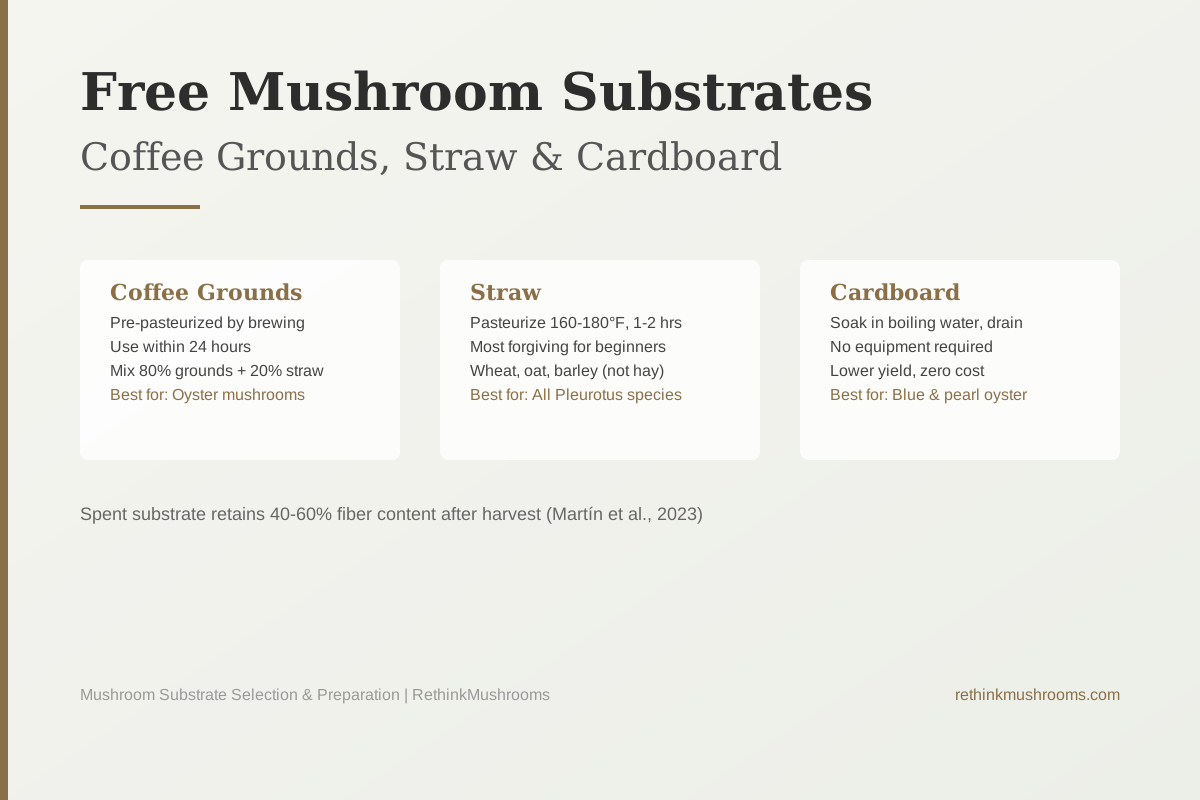
- Coffee grounds are effectively pre-pasteurized by the brewing process but must be used within 24 hours and mixed with straw or another aeration material to prevent compaction and anaerobic pockets
- Straw is the most forgiving free substrate: pasteurize at 160-180°F for 1-2 hours, and it suits the widest range of oyster mushroom varieties; research identifies it as optimal for beginners (Timm 2025)
- Cardboard works for the most aggressive colonizers like blue and pearl oyster; soak in boiling water, drain, and inoculate when cool; no pressurized equipment needed
- Blended free substrates consistently outperform single-material approaches; coffee grounds (nitrogen-rich) plus straw (carbon-rich, structural) produces a better balance than either alone
- Spent substrate retains 40-60% of its original fiber content after harvest (Martín et al., 2023), making it useful for second flushes, composting, or garden mulch
Why Free Substrates Work: The Biology of Lignocellulosic Digestion
Mushrooms are not tolerating straw and coffee grounds as substrate. They evolved to consume exactly these materials.
Plant fiber is made from three interlocked molecules: cellulose (the structural backbone), hemicellulose (a branching support matrix), and lignin (the woody binding compound). Together these form lignocellulose, the most abundant biological material on Earth. Most organisms cannot break it down. Fungi evolved specialized enzymes to do so, dismantling this plant fiber and extracting the carbon and nitrogen locked inside.
Coffee grounds, straw, and cardboard are all primarily lignocellulosic. They differ in their specific molecular composition, moisture content, and available nitrogen, but all three give mushroom mycelium the structural substrate it evolved to consume.[1]
This biological compatibility is why free substrates are not inferior to commercial formulas by default. Mishra and colleagues tested bioconversion efficiency (the weight of mushroom produced per weight of substrate) across multiple locally available agricultural by-products and found they could match or exceed commercial casing materials in both yield and antioxidant content for king oyster mushrooms (Pleurotus eryngii).[2] The difference between success and failure was correct preparation and species matching, not the source or cost of the material.
Coffee Grounds: Pre-Pasteurized, Ready to Use
Coffee grounds are the most accessible free substrate for most urban growers. They have one property that makes them unique among free materials: the brewing process effectively pasteurizes them. Brewing passes near-boiling water (90-95°C) through the grounds, killing most competing organisms in the process. The result is a substrate that is ready to inoculate without additional heat treatment.
The 24-hour window is the most important operational constraint. Within hours of brewing, ambient yeast and mold spores begin colonizing the moist, nutrient-dense surface of used grounds. At room temperature, grounds show visible contamination within 2-3 days. The practical rule: collect grounds, allow to cool, inoculate within 24 hours. Grounds that must be stored should go in a sealed container in the refrigerator and be used within 48 hours.
Coffee grounds are high in nitrogen relative to most other free substrates. Mushroom mycelium needs both carbon (for energy) and nitrogen (for building cell structures). The ideal ratio of carbon to nitrogen for most oyster mushroom cultivation is roughly 30-40 parts carbon to 1 part nitrogen. Coffee grounds alone have a carbon-to-nitrogen ratio closer to 20:1, which is too nitrogen-dense for optimal growth. Mycelium colonizes grounds efficiently, but the fruiting environment lacks the aeration and structural support that keeps it healthy through the fruiting stage.
The solution is mixing coffee grounds with straw at approximately 80% grounds to 20% straw by volume. Wu and colleagues found that blended agricultural waste substrates consistently outperformed single-component substrates in the yield and nutritional composition achieved for wood ear mushrooms (Auricularia polytricha).[4] The straw adds carbon (improving the ratio), loosens the texture (better oxygen exchange), and prevents the compaction that creates oxygen-deprived pockets where bacteria outcompete mycelium.
Best species for coffee grounds: oyster mushrooms of all varieties (Pleurotus ostreatus, Pleurotus eryngii, Pleurotus djamor). These are among the fastest and most aggressive colonizers and tolerate variable nitrogen levels well.
For a deeper look at the specific evidence for oyster mushrooms on coffee grounds, see Growing Oyster Mushrooms on Coffee Grounds: Does It Work?.
Straw: The Best Substrate for First-Time Growers
Straw is the most forgiving free substrate available, and the research confirms it. A comprehensive 2025 review of substrate effects on mushroom yield and nutritional composition identified straw as the optimal starting point for beginning growers: it requires pasteurization rather than full sterilization, tolerates imperfect technique, and produces reliable yields across the widest range of oyster mushroom species.[6]
Straw is the dried stalk of grain crops after harvest, most commonly wheat, oat, or barley. It is not hay, which contains seeds, immature plant material, and a much higher contamination load. The distinction matters: hay fails far more frequently as a mushroom substrate because its higher microbial population competes aggressively with mycelium even after pasteurization.
Pasteurization for straw means heating it to 160-180°F (71-82°C) and holding that temperature for 1-2 hours. Common home methods include hot water submersion (most accessible), lime pasteurization (cold lime-water soak, no heat equipment required), and steam pasteurization in a contained vessel. All three work when executed correctly. The goal is the same in each case: kill competing bacteria and molds without damaging the structural composition that mycelium feeds on.
Chopping or shredding straw before pasteurization increases surface area and speeds colonization after inoculation. Compressing pasteurized straw too tightly in a grow bag restricts airflow; it should be packed firmly but not dense.
Best species for straw: all Pleurotus oyster mushrooms (blue, pearl, golden, pink, king), king stropharia (wine caps), and pioppino. These species colonize straw aggressively and fruit reliably even for growers using basic home pasteurization setups.
For the full comparison of straw against hardwood sawdust and supplemented formulas, see Mushroom Substrate Guide: Hardwood, Straw, Sawdust, and Supplemented Formulas.
Cardboard: No Equipment, Aggressive Colonizers Only
Cardboard is the lowest-barrier entry point for free substrate growing. It requires no pasteurization equipment, and for the fastest-colonizing species, it works reliably with minimal preparation.
Corrugated cardboard is preferred over flat cardboard. The fluted interior layer provides both the carbon substrate and the physical channels that allow mycelium to thread through and colonize efficiently. Remove any tape, labels, or wax coatings before use. Shredding or layering pieces around the inoculation points increases contact surface area.
Preparation: pour boiling water over the cardboard and allow it to soak for 15-30 minutes, then drain until no free water drips, and allow to cool to room temperature before inoculation. This is not a formal pasteurization equivalent. It does not hold temperatures long enough to kill all competing organisms. What it does is create a brief thermal disadvantage for surface contaminants, giving aggressive mycelium time to colonize before competitors establish.
Cardboard's limitation is nutrient density. It contains less available nitrogen and carbon per gram than straw or supplemented sawdust, which translates to lower yields per pound of substrate. It works best when the goal is simplicity rather than maximum harvest weight, or as a component in a blended substrate rather than the primary material.
Best species for cardboard: blue oyster (Pleurotus ostreatus), pearl oyster, and pink oyster (Pleurotus djamor, suited to warm climates). These are the fastest colonizers in the Pleurotus family. King oyster, shiitake, lion's mane, and reishi prefer denser, more nutritious substrates.
What the Research Says About Nutritional Quality on Free Substrates
Most growers treat substrate choice as a yield question. The research shows it is also a nutritional quality question.
Tagkouli and colleagues studied three Pleurotus species grown on different agricultural and agro-industrial by-products and found significant differences in essential amino acid concentrations depending on the substrate origin.[3] Oyster mushrooms grown on one type of agricultural waste had measurably different amino acid profiles than the same species grown on wheat straw, even though both would be sold and labeled as Pleurotus ostreatus.
This connects to the Mishra 2013 finding on bioconversion efficiency: free substrates do not merely replicate commercial substrate performance. They produce mushrooms with distinct compositional profiles depending on what molecular building blocks the substrate provides.[2]
The practical implication is not that one free substrate is nutritionally superior to another in absolute terms. It is that the choice of substrate is meaningful beyond yield alone, and that growing on diverse substrates is more nutritionally varied than growing on a single commercial formula batch after batch.
For the specific research on how substrate composition affects bioactive compound accumulation in medicinal mushrooms, see The Science Behind the Fruiting Body vs. Mycelium Argument.
Blending Free Substrates for Better Performance
Single-material substrates are convenient but rarely optimal. Blended substrates consistently outperform single-component approaches, and the biology explains why: no single agricultural by-product provides the ideal combination of carbon content, nitrogen content, moisture retention, and structural aeration.
Wu and colleagues demonstrated this effect directly for wood ear mushrooms: blended substrates outperformed either material used alone in both yield and nutritional composition.[4] Each material contributed properties the other lacked.
For free substrates available to home growers, the most practical approach:
Coffee grounds plus straw (80:20 by volume): The grounds contribute nitrogen and fine particle texture; the straw adds carbon, structural support, and aeration channels. This is the most consistently recommended blend for urban oyster growers. The straw does not need separate pasteurization when mixed with freshly brewed grounds used within 24 hours, though pasteurizing both together before mixing is safer in warm or humid environments.
Straw plus cardboard (70:30 by volume): Useful when coffee grounds are unavailable. The cardboard adds bulk carbon and slightly increases structural density. Pasteurize the straw, soak the cardboard in boiling water separately, combine both after cooling, then inoculate.
Straw plus hardwood wood chips (60:40 by volume): Transitions toward species that prefer wood-based diets, such as lion's mane and shiitake, without requiring sterilization. Wood chips need the same pasteurization treatment as straw. This blend suits growers expanding beyond oyster mushrooms without investing in pressure-cooker sterilization equipment.
For the complete guide to preparing any of these substrates, see How to Prepare Mushroom Substrate: Sterilization and Pasteurization.
After the Harvest: Spent Substrate Has More Life
One of the most practical findings in recent substrate research concerns what remains after the first harvest. Martín and colleagues reviewed the composition of spent mushroom substrate across multiple species and substrate types and found it retains 40-60% of its original fiber content after one or more fruiting cycles.[5] Enzymes produced during mycelium growth remain active in the substrate material after the mushrooms are harvested.
For home growers, this means the growing cycle does not end with the first harvest.
Second flush: Most substrates produce at least a second crop of mushrooms after the initial harvest, particularly straw blocks and coffee ground bags. Soaking the spent block in cold water for 12-24 hours shocks the mycelium and triggers a new fruiting cycle. Each subsequent flush typically yields somewhat less than the previous.
Composting: Spent substrate is an excellent compost amendment. The mycelium has partially pre-digested the lignocellulosic material, producing a biologically active material that breaks down rapidly in a compost pile. Coffee ground spent substrate is particularly valued for acid-loving plants.
Garden mulch: Straw-based spent substrate spread as garden mulch contributes organic matter and beneficial fungal biology to soil. The mycelial network in spent substrate continues colonizing new organic matter in the garden bed under the right conditions.
Worm feed: Spent substrate works well in vermicomposting (worm bin) systems. Earthworms process the partially broken-down fiber efficiently, producing high-quality vermicompost.
For the beginner's full growing workflow from substrate through harvest, see Your First Mushroom Grow: Step-by-Step for Beginners. For the complete guide to substrate type selection, see Mushroom Substrate Guide: Choosing the Right Growing Medium.
The Bottom Line
Coffee grounds, straw, and cardboard are not budget substitutes for commercial mushroom substrates. Research on agricultural by-products confirms these free materials produce equivalent or superior yields and comparable nutritional profiles when used correctly, because fungi evolved specifically to digest lignocellulosic plant waste. Coffee grounds require use within 24 hours and benefit from straw mixing. Straw is the most forgiving option and the research-confirmed choice for beginners. Cardboard works for aggressive colonizers with minimal preparation. Blended substrates outperform single materials. After harvesting, spent substrate retains enough biological activity for second flushes, composting, or garden use.
Frequently Asked Questions
Sources & References
- 1RTHM-00511·Grimm, Daniel et al. (2018). “Mushroom cultivation in the circular economy..” Applied microbiology and biotechnology.Study breakdown →PubMed →↩
- 2RTHM-00544·Mishra, K K et al. (2013). “Antioxidant properties of different edible mushroom species and increased bioconversion efficiency of Pleurotus eryngii using locally available casing materials..” Food chemistry.Study breakdown →PubMed →↩
- 3RTHM-00658·Tagkouli, Dimitra et al. (2020). “Free Amino Acids in Three Pleurotus Species Cultivated on Agricultural and Agro-Industrial By-Products..” Molecules (Basel.Study breakdown →PubMed →↩
- 4RTHM-00928·Wu, Chiu-Yeh et al. (2017). “Effect of Different Proportions of Agrowaste on Cultivation Yield and Nutritional Composition of the Culinary-Medicinal Jelly Mushroom Auricularia polytricha (Higher Basidiomycetes)..” International journal of medicinal mushrooms.Study breakdown →PubMed →↩
- 5RTHM-00844·Martín, Carlos et al. (2023). “Spent substrate from mushroom cultivation: exploitation potential toward various applications and value-added products..” Bioengineered.Study breakdown →PubMed →↩
- 6RTHM-02194·Timm, Thaynã Gonçalves et al. (2025). “Substrate effects on the growth, yield, and nutritional composition of edible mushrooms..” Advances in applied microbiology.Study breakdown →PubMed →↩