Oyster Mushroom Home Growing
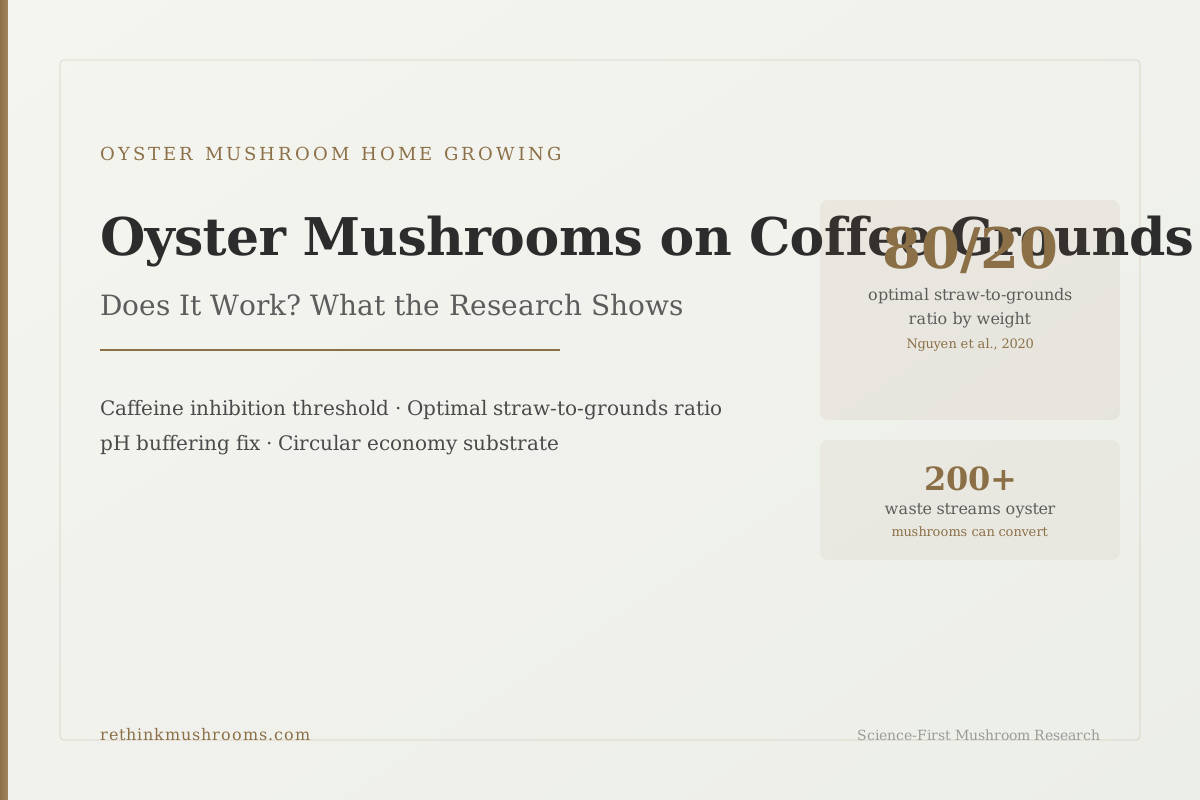
80/20 straw-to-grounds ratio
Research shows 80% straw plus 20% spent coffee grounds improves oyster mushroom mycelial extension beyond straw alone, while pure coffee grounds underperform due to caffeine inhibition.
Nguyen and Ranamukhaarachchi, Pak J Biol Sci, 2020
Pre-pasteurized
brewing temperatures eliminate most competing organisms in fresh coffee grounds
Caffeine threshold
high spent coffee ground concentration inhibits mycelial growth and fruiting
Free substrate
coffee grounds are a validated circular economy substrate from cafes and kitchens
Nguyen and Ranamukhaarachchi, Pak J Biol Sci, 2020
 View as image ↗
Yes, oyster mushrooms grow on coffee grounds. The short answer that every forum, blog, and hobbyist video gives is correct. Brewing pre-pasteurizes the grounds, the substrate is nitrogen-rich, and Pleurotus ostreatus, the most commonly grown oyster species, handles it readily during initial colonization.
The longer answer explains why so many coffee grounds grows fail: caffeine in spent coffee grounds inhibits mycelial growth and delays or prevents fruiting body formation when grounds are used at high concentrations. Peer-reviewed research documents this mechanism. Not one popular growing guide mentions it.
Understanding why the concentration matters, what ratio of grounds to straw produces the best results, and how the acidity of coffee affects colonization gives growers far better odds than the generic "use fresh grounds" advice that fills most of the internet.
For a broader introduction to substrate options and the full mushroom cultivation process, see How to Grow Mushrooms at Home: A Complete Beginner's Guide.
Key Takeaways
- Carrasco-Cabrera et al. (2019) showed that caffeine in spent coffee grounds inhibits P. ostreatus mycelial growth and delays or prevents fruiting at high concentrations. This is the biological reason pure coffee grounds grows stall or fail
- Nguyen and Ranamukhaarachchi (2020) found 80% straw plus 20% spent coffee grounds improved mycelial extension compared to straw alone, while 100% spent coffee grounds underperformed straw as a primary substrate
- Hnydiuk-Stefan et al. (2024) showed that pure coffee grounds can support fruiting body formation when pH is buffered upward. Coffee grounds are mildly acidic at pH 6.0-6.5, below the range P. ostreatus prefers
- Adding 1% calcium-containing compound (agricultural lime is the practical equivalent) to pure coffee grounds improved colonization and yield in Hnydiuk-Stefan's 2024 trial
- Freshly brewed grounds are effectively pre-pasteurized, but this advantage lasts only 12-24 hours at room temperature before competing organisms begin recolonizing the substrate
- Grimm and Wösten (2018) confirmed coffee grounds as a validated circular economy substrate for oyster mushroom production, among 200+ lignocellulosic waste streams P. ostreatus can convert to food
Yes, Oyster Mushrooms Grow on Coffee Grounds, With One Important Catch
Coffee grounds became a popular mushroom substrate for two genuine reasons.
First, brewing at 90-96°C (194-205°F) kills most competing bacteria and mold spores. When you add grain spawn to freshly brewed grounds, the mycelium has a window of several hours to establish before environmental organisms can gain a foothold. You skip the pasteurization step that makes straw grows more labor-intensive.
Second, coffee grounds are nitrogen-rich relative to most agricultural fiber substrates. Rice straw, wheat straw, and wood chips have carbon-to-nitrogen ratios of 50:1 to 100:1 or higher. Coffee grounds typically fall around 20:1, closer to the range where mycelium can grow vigorously without being nitrogen-starved.
Timm et al. (2025), reviewing the evidence across edible mushroom cultivation in a comprehensive substrate effects analysis, confirmed that substrate composition is the primary driver of both productivity and nutritional quality in cultivated oyster mushrooms.[5] Oyster mushrooms are among the most substrate-flexible cultivated species, but flexibility does not mean all substrates are equal. The specific chemistry of what you grow on matters at every stage.
The catch with coffee grounds is that they contain caffeine. Caffeine affects mushroom mycelium.
For more context on how different free substrates compare for home growing, see Free Mushroom Substrates: Coffee Grounds, Straw, and Cardboard. For a broader introduction to growing oyster mushrooms specifically, see How to Grow Oyster Mushrooms at Home: The Easiest Beginner Mushroom.
The Caffeine Problem: Why Pure Coffee Grounds Underperform and Often Fail
Carrasco-Cabrera et al. (2019) published the most important and least-cited study on coffee grounds cultivation.[2] The study examined what happens when P. ostreatus is cultivated on spent coffee grounds at different concentrations, tracking both what the mycelium does to caffeine over the grow cycle and how caffeine affects the mushroom's development.
The findings were specific. At higher concentrations of spent coffee grounds, caffeine inhibited P. ostreatus mycelial growth. Colonization slowed. Fruiting was delayed. In some conditions using pure or near-pure spent coffee grounds, fruiting bodies did not form at the expected time, or did not form at all.
Caffeine belongs to a class of compounds called methylxanthines, which are enzyme inhibitors. At sufficient concentrations, caffeine interferes with cellular respiration and enzymatic activity in sensitive organisms. P. ostreatus is sensitive enough that residual caffeine in a dense spent grounds substrate acts as a brake on development, particularly during the transition from colonization to reproductive mode.
There is a positive side to the Carrasco-Cabrera findings: P. ostreatus does metabolize caffeine over the grow cycle. The mycelium degrades caffeine as it colonizes the substrate, and by the time of harvest, caffeine levels in spent substrate have dropped. But this metabolism requires time and a well-established mycelial network. At high concentrations, the inhibition hits before the mycelium can establish robustly enough to degrade caffeine efficiently.
The conclusion from this research: pure coffee grounds fails not from poor technique but from substrate chemistry. The solution is dilution.
The Ratio That Works: 80% Straw Plus 20% Grounds Outperforms Either Alone
Nguyen and Ranamukhaarachchi (2020) tested multiple substrate combinations for P. ostreatus performance, including blends incorporating spent coffee grounds at different ratios.[3] The results provided specific guidance that has not made it into popular growing advice.
The 80% wheat straw plus 20% spent coffee grounds blend produced better mycelial extension than straw alone. At this concentration, coffee grounds add nitrogen and other nutrients that accelerate colonization without reaching the caffeine threshold that inhibits fruiting. The 100% spent coffee grounds condition underperformed straw alone, matching the Carrasco-Cabrera caffeine inhibition finding.
The same study found that 50% wheat straw plus 50% cardboard produced the most favorable overall outcome for mycelial growth and primordia (the first visible pin formations) development. This supports a broader principle: mixing two or more waste materials often improves results for P. ostreatus compared to using any single ingredient alone.
Grimm and Wösten (2018) established the biological basis for this substrate flexibility in a review of mushroom cultivation and the circular economy.[1] P. ostreatus can convert over 200 distinct lignocellulosic agricultural waste streams into edible protein. The enzymatic toolkit the mycelium uses to break down plant fiber is broad enough to handle diverse combinations of materials, and mixing substrates with different carbon structures often expands the range of nutrients available.
The practical takeaway from this research: keep coffee grounds at 20-30% of total substrate weight when blending with straw or other primary substrates. Below that threshold, caffeine concentration stays within the range the mycelium can handle. Above it, yields decline.
For step-by-step guidance on preparing straw as the base substrate in these blends, see Oyster Mushroom Growing on Straw: A Step-by-Step Guide. For a beginner-friendly overview of the bucket method that uses this exact straw-plus-grounds blend as the recommended substrate, see Growing Oyster Mushrooms in a 5-Gallon Bucket: The Easiest First Grow.
The pH Fix: Why Acidic Coffee Grounds Slow Colonization
Spent coffee grounds are mildly acidic, with a typical pH of 6.0 to 6.5. P. ostreatus prefers a slightly more neutral environment, generally pH 6.5 to 7.5, for optimal colonization and fruiting. This gap between what coffee grounds provide and what oyster mushrooms prefer is the second mechanism explaining why pure grounds performs below potential.
Hnydiuk-Stefan et al. (2024) investigated P. ostreatus cultivation with pure coffee grounds as the primary substrate, specifically testing whether pH adjustment could improve outcomes.[4] Adding 1% calcium-containing bottom ash to the substrate raised the pH and improved both colonization and fruiting body formation compared to unbuffered pure coffee grounds.
The mechanism: calcium compounds neutralize acid, shifting the substrate pH upward toward the range where P. ostreatus enzymatic activity is most efficient. At lower pH, the enzymes the mycelium uses to break down substrate components and transport nutrients are less active. Raising pH closer to neutral removes this brake on development.
The practical equivalent of bottom ash for home growers is agricultural lime (calcium hydroxide or calcium carbonate), available at garden centers. Adding a small amount to acidic coffee grounds before inoculation replicates the pH-buffering effect documented in the 2024 study.
This finding has a significant implication: pure coffee grounds can work as a primary substrate, not just a minority additive, when the pH constraint is addressed. Growers who add lime to their coffee grounds grows are working with a pH fix that the research now supports.
For guidance on substrate preparation and pH adjustment, see How to Prepare Mushroom Substrate: Sterilization and Pasteurization.
Fresh vs. Old Grounds: Why Timing Is Critical
The pre-pasteurized advantage of coffee grounds has a time limit.
Freshly brewed grounds are hot, moist, and largely free of competing organisms immediately after brewing. As the grounds cool and sit at room temperature, airborne bacteria and mold spores begin colonizing within hours. By 24 to 48 hours after brewing, grounds stored uncovered at room temperature are typically contaminated enough that they no longer hold the pasteurization advantage over untreated substrate.
The practical rule: use grounds within 24 hours of brewing. Grounds collected at the end of a cafe's day and used the following morning are marginal. Grounds collected first thing in the morning from the previous evening's service are likely too old.
Grounds from espresso machines, which operate at higher pressure and temperature than drip brewers, may have a marginally more thorough decontamination profile. In practice, both espresso and drip grounds work if used fresh. The freshness variable matters far more than the brewing method.
Dried grounds are less suitable than moist grounds. P. ostreatus mycelium requires moisture content in the 60-70% range for optimal colonization. Grounds that have dried out need rehydration before use, which reintroduces a contamination window.
High-volume cafes produce enough spent grounds daily to run meaningful grows. Most cafes give grounds away free to anyone who asks. Requesting grounds at pickup, rather than taking batches that have been sitting, is the simplest way to manage the freshness requirement.
Step by Step: Setting Up a Coffee Grounds Grow
The following process follows the evidence-based parameters from the research above.
Materials needed:
- Fresh spent coffee grounds (brewed within the past 24 hours)
- Pasteurized wheat straw or rice straw
- Oyster mushroom grain spawn
- A container with drainage or air holes (5-gallon bucket, mesh bag, or plastic bin)
- Optional: agricultural lime at 1% by substrate weight for pH adjustment
Prepare the blend. Combine 80% pasteurized straw with 20% fresh coffee grounds by weight. If using coffee grounds as the primary substrate rather than as a supplement, add agricultural lime at approximately 1% of total substrate weight to buffer pH. Mix thoroughly so grounds are evenly distributed through the straw.
Check moisture. Squeeze a handful of the mixed substrate firmly. It should release a few drops of water. If water streams freely, the substrate is too wet. If nothing is released, it is too dry.
Inoculate. Distribute grain spawn evenly throughout the substrate at 10-20% spawn weight relative to dry substrate weight. Spawn distributed through layers colonizes faster than spawn placed only on top.
Incubate. Keep the inoculated container at 24-28°C during the colonization phase, away from direct light. Mycelium will visibly whiten the substrate surface as colonization progresses.
Initiate fruiting. Once the substrate is substantially covered in white mycelium (typically 10-18 days depending on substrate and temperature), introduce fresh air exchange, indirect light, and humidity around 85-95%. Misting the substrate surface once or twice daily without saturating it maintains the moisture fruiting bodies need.
Harvest. Pick oyster mushrooms as the caps reach full size but before the edges begin curling upward. Subsequent flushes typically follow 7-14 days after the first harvest.
What to Expect: Yield Reality for Coffee Grounds vs. Straw
Coffee grounds grows produce lower yields than straw grows on the same weight of substrate. This follows directly from the Carrasco-Cabrera (2019) caffeine inhibition data and from the general nitrogen-to-carbon dynamics of the two substrates.
At the 80/20 straw-to-grounds ratio documented in Nguyen et al. (2020), yields improve relative to pure grounds and may slightly exceed straw alone in terms of colonization speed. The nitrogen supplementation effect of the grounds benefits the straw base. But the ceiling on productivity is lower than premium straw substrates optimized for maximum biological efficiency.
For home growers using genuinely free coffee grounds collected from a local cafe, this trade-off is entirely acceptable. The input cost is minimal and the substrate requires no preparation beyond ensuring freshness and the optional pH adjustment. Lower yields on free substrate often produce a better return than higher yields on purchased substrate.
The contamination rate is also relevant. Coffee grounds grows, especially with pure or high-percentage grounds, tend to show more green mold contamination (Trichoderma and Penicillium) than straw grows pasteurized with hot water, because the grounds' pasteurization protection degrades faster and the lower pH is more hospitable to competing molds. Careful attention to freshness, moisture levels, and container cleanliness reduces but does not eliminate this risk.
The Circular Economy Case: Why Coffee Grounds Matter Beyond Home Growing
Grimm and Wösten's 2018 review of mushroom cultivation in the circular economy established coffee grounds as one of the most ecologically coherent waste streams for conversion into edible protein.[1] Coffee grounds are generated globally at enormous scale. The organic material in spent grounds (cellulose, hemicellulose, lignin, proteins, lipids, and mineral content) retains substantial nutritional value after brewing.
P. ostreatus, with its ability to degrade over 200 distinct lignocellulosic materials, is well-matched to this substrate. The mycelium that grows on coffee grounds produces enzymes (laccase, manganese peroxidase, lignin peroxidase) that break down the grounds' complex organic polymers into simpler compounds the fungus can assimilate. After fruiting, the spent mushroom substrate still contains degraded organic matter suitable for composting.
The spent mushroom substrate that comes out the other end of a coffee grounds grow contains reduced caffeine, increased fungal biomass, and partially degraded plant fiber, making it a richer compost amendment than the original grounds alone.
Timm et al. (2025) confirmed this broader framing: substrate selection for edible mushroom cultivation is simultaneously a food production decision and a waste reduction decision.[5] Coffee grounds grows are not just a budget growing method. They are participation in a verifiable nutrient cycle that converts one food industry's waste into another food.
The Bottom Line
Coffee grounds work as an oyster mushroom substrate, but results depend on concentration and pH. Research by Carrasco-Cabrera et al. (2019) established that caffeine inhibits P. ostreatus mycelial growth and fruiting at high spent coffee ground concentrations, explaining why pure grounds grows often fail. Nguyen and Ranamukhaarachchi (2020) found that 80% straw plus 20% grounds improves mycelial extension beyond straw alone. Hnydiuk-Stefan et al. (2024) showed that pH buffering with calcium compounds allows even pure grounds to support fruiting. The practical conclusion: use grounds at 20-30% of substrate weight blended with straw, use them fresh within 24 hours of brewing, and add lime if growing on grounds-dominant substrates.
Frequently Asked Questions
Sources & References
- 1. Source details for this reference are not yet available.
- 2. Source details for this reference are not yet available.
- 3. Source details for this reference are not yet available.
- 4. Source details for this reference are not yet available.
- 5. Source details for this reference are not yet available.