Oyster Mushroom Home Growing
166% biological efficiency on rice straw
A 2023 peer-reviewed study recorded 956g of fresh oyster mushrooms per bag of rice straw substrate, the highest biological efficiency of any substrate tested.
Subedi et al., International Journal of Medicinal Mushrooms, 2023
200+
substrates oysters can convert (Grimm 2018)
28°C
optimal colonization temperature (Hoa 2015)
3–6 weeks
typical spawn-to-harvest timeline
Subedi et al., International Journal of Medicinal Mushrooms, 2023
 View as image ↗
Oyster mushrooms (Pleurotus ostreatus) are the easiest mushrooms to grow at home because they convert an unusually wide range of substrates into edible protein. Straw, cardboard, coffee grounds, sawdust, and dozens of other materials all work. The mycelium colonizes quickly at room temperature, fruits with minimal environmental control, and produces multiple harvests from a single batch of substrate. Equipment cost is low: a pressure cooker or a pot of hot water, plastic bags or buckets, and grain spawn from a reputable supplier.
This is not a generic claim. A 2022 review published in Applied Microbiology and Biotechnology found that oyster mushrooms can convert over 200 different lignocellulosic agricultural waste streams into fruiting bodies, more than virtually any other cultivated mushroom species.[2] The substrate flexibility is the primary reason they are accessible to beginners.
For a general introduction to mushroom growing, see How to Grow Mushrooms at Home: A Complete Beginner's Guide.
Key Takeaways
- Oyster mushrooms can grow on over 200 lignocellulosic (plant fiber-based) substrates; this substrate flexibility is the scientific basis for why they are the most beginner-accessible cultivated mushroom species (Grimm & Wösten, 2018)
- Rice straw is the highest-performing substrate in controlled trials: Subedi et al. (2023) recorded 956 grams of fresh mushrooms per bag at 166.29% biological efficiency, meaning the mushrooms weighed 66% more than the dry substrate used
- Optimal colonization temperature is 28°C (82°F); fruiting is triggered at cooler temperatures of 16 to 22°C (Hoa et al., 2015)
- Trichoderma, a competing green mold, is the primary contamination risk; pasteurization of substrate before inoculation is the evidence-based prevention method (Jaramillo 2024)
- Coffee grounds work as a substrate, but caffeine at high concentrations inhibits mycelial growth and can prevent fruiting; blending 20 to 30% coffee grounds with straw produces better results than pure grounds (Carrasco-Cabrera 2019)
- A 2025 systematic review (Timm et al., Advances in Applied Microbiology) confirmed that substrate composition is the primary determinant of both yield and nutritional quality in cultivated oyster mushrooms
Why Oyster Mushrooms Are the Easiest: The Science Behind the Claim
The claim that oyster mushrooms are "the easiest" to grow is not just tradition. It has a biological basis.
Oyster mushrooms are wood-rot fungi that evolved to decompose dead trees. They produce a broad range of enzymes, including laccases and peroxidases, that break down lignin, cellulose, and hemicellulose, the three structural components of plant cell walls. Because almost all plant material contains these compounds, Pleurotus species can digest an enormous variety of agricultural waste materials.
A 2018 review by Grimm and Wösten in Applied Microbiology and Biotechnology documented that oyster mushrooms can be cultivated on over 200 lignocellulosic (plant fiber-based) substrates, covering everything from wheat straw to bagasse to banana leaves to wood chips.[2] A 2025 systematic review by Timm and colleagues in Advances in Applied Microbiology confirmed that oyster mushrooms are among the most substrate-flexible cultivated species, capable of efficient degradation of diverse materials that other mushrooms cannot process.[8]
This wide tolerance extends to environmental conditions. Most cultivated mushrooms require narrow temperature windows and precise humidity. Oyster mushrooms colonize well across a broader temperature range and will fruit with modest environmental management in most homes.
What You Need: Materials List
Starting equipment for oyster mushrooms:
- Substrate: Wheat straw, rice straw, or a straw and cardboard blend. Coffee grounds can be added at 20 to 30% of total substrate weight.
- Containers: 5-gallon buckets with holes drilled for airflow and mushroom emergence, or polypropylene grow bags
- Spawn: Grain spawn from a reputable supplier. Research by Hoa and colleagues found that brown rice is the most favorable grain for Pleurotus ostreatus spawn production.[1] Oat grain is also consistently rated highly in substrate research.
- Pasteurization equipment: A large pot for hot water immersion (160°F for 60 to 90 minutes) or a pressure cooker for supplemented substrates
- Growing space: A clean area at 18 to 28°C with access to indirect light and some airflow
Total startup cost is typically under $50 for the first batch, excluding spawn.
The Growing Timeline: Spawn Run to Harvest
Oyster mushroom cultivation follows three phases:
Phase 1: Colonization (1 to 3 weeks). After inoculating pasteurized substrate with grain spawn, keep the container in a warm location at 24 to 28°C. The mycelium, a white thread-like network, spreads through the substrate from each inoculation point. Keep containers mostly closed during this phase to maintain humidity and reduce contamination exposure.
Phase 2: Fruiting initiation. Once the substrate is fully colonized and shows dense white mycelium throughout, transition to fruiting conditions: cooler temperatures (16 to 22°C), higher humidity, and more airflow. Small pin-like clusters will appear at the holes in the bucket or at the mouth of the bag within days.
Phase 3: Harvest (1 week after pinning). Oyster mushrooms grow rapidly. Clusters develop from pins to harvest-ready mushrooms in 5 to 7 days. Harvest when the caps are fully unfurled but before the edges begin to curl upward. Twist the cluster from the substrate at the base.
After the first flush, rest the substrate for 5 to 7 days, then re-initiate fruiting conditions. Most substrates produce 2 to 4 flushes, with yield tapering after the first.
What Substrate Yields Look Like: Research Data
Biological efficiency is the standard metric for comparing growing setups. It is calculated as the weight of fresh mushrooms produced divided by the dry weight of substrate used, expressed as a percentage. A biological efficiency of 100% means you produced the same weight of mushrooms as the dry substrate weighed. Higher numbers mean more mushrooms per unit of material.
Research data on oyster mushroom substrates:
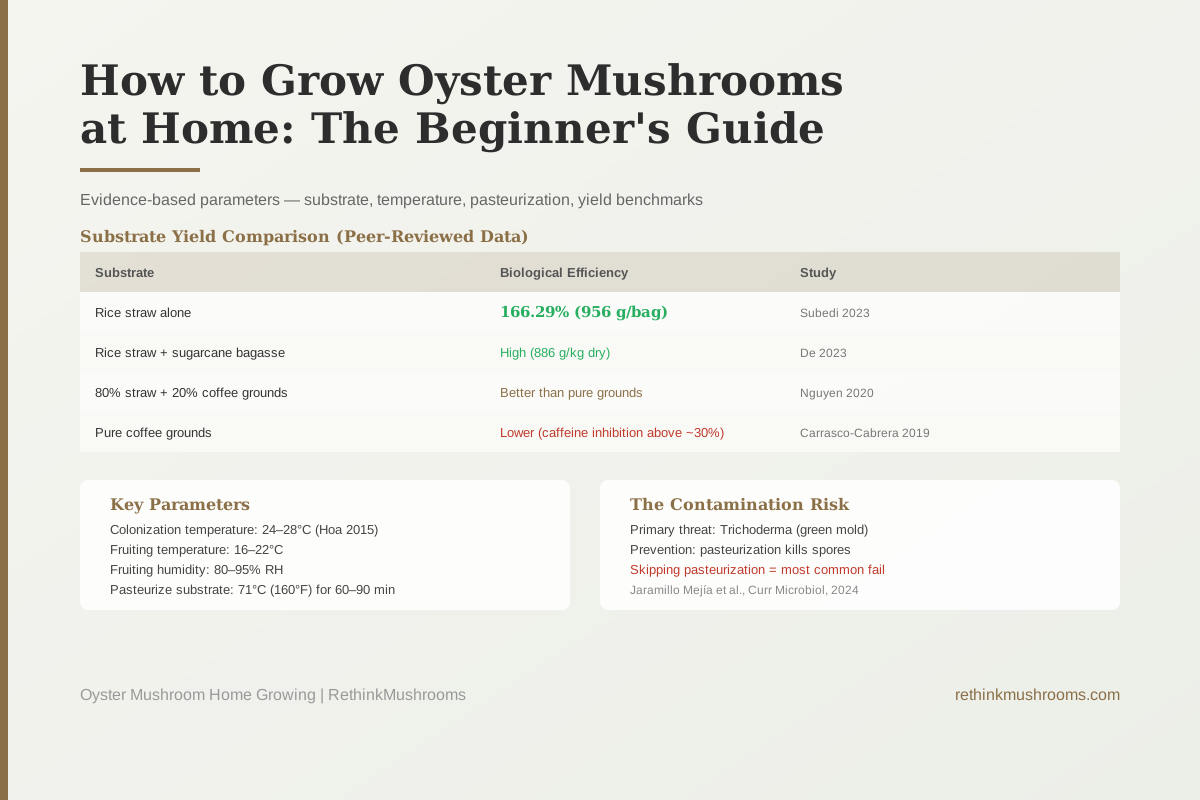
| Substrate | Yield (g/bag) | Biological Efficiency | Source |
|---|---|---|---|
| Rice straw alone | 956 g | 166.29% | Subedi 2023 |
| Rice straw + sugarcane bagasse | 886 g/kg dry | High | De 2023 |
| 50% wheat straw + 50% cardboard | Not reported | High (best for mycelial growth) | Nguyen 2020 |
| 80% straw + 20% coffee grounds | Not reported | Better than pure SCG | Nguyen 2020 |
| Pure coffee grounds | Lower than blends | Lower than blends | Carrasco-Cabrera 2019 |
Rice straw is the strongest single-substrate performer in the peer-reviewed literature. A 2023 study published in the International Journal of Medicinal Mushrooms by Subedi and colleagues compared rice straw against water hyacinth combinations and found that rice straw alone produced 956 grams of fresh mushrooms per bag with a biological efficiency of 166.29%, substantially outperforming every alternative tested.[6]
A 2020 study by Nguyen and Ranamukhaarachchi found that mixing 50% wheat straw with 50% cardboard provided the most favorable conditions for mycelial growth and the formation of the first pin-like structures.[4] This mixed substrate approach is particularly useful for growers who want to use available materials rather than purchasing straw specifically.
The Main Contamination Risk: What Trichoderma Is and Why Pasteurization Stops It
The most common reason beginner grows fail is contamination by a mold called Trichoderma. It appears as green patches on the substrate and spreads rapidly, competing with and eventually overwhelming mushroom mycelium.
Trichoderma spores are present on most raw agricultural substrates, including straw. They are also everywhere in ambient air. The critical point is that Trichoderma spores cannot survive the temperatures used for pasteurization, while mushroom grain spawn can be introduced safely into a substrate that has been properly treated.
A 2024 study published in Current Microbiology by Jaramillo Mejía and colleagues found that pasteurization by steam or hot water immersion is the most effective method for suppressing Trichoderma in oyster mushroom cultivation.[7] For straw, the standard hot water method involves submerging the straw in water at 160°F (71°C) for 60 to 90 minutes. The substrate is then drained and cooled to below 30°C before inoculation. This step eliminates the vast majority of competing organisms before spawn is introduced.
Skipping pasteurization is the most common mistake in beginner grows. A successful colonization period followed by green mold at the fruiting stage is almost always traceable to inadequate substrate treatment.
For step-by-step pasteurization guidance, see How to Prepare Mushroom Substrate: Sterilization and Pasteurization.
Temperature and Humidity: The Environmental Parameters
Hoa and colleagues compared mycelial growth and fruiting across Pleurotus species at different temperatures.[1] For P. ostreatus, they found:
- Optimal mycelium growth temperature: approximately 28°C (82°F)
- Fruiting body formation: triggered at lower temperatures, typically 16 to 22°C depending on the specific strain
This temperature differential is the basis for the two-phase growing approach: keep spawn and colonizing substrate at the warmer end of room temperature, then move to a cooler, more humid location when fruiting is desired.
Oyster mushrooms need humidity of 80 to 95% during fruiting. In practice, most home growers achieve this by misting the walls of a tent or enclosure several times daily, or by covering a simple wire frame with clear plastic sheeting. The mushroom itself should not be misted directly; wet caps increase risk of bacterial rot.
Light: Oyster mushrooms require indirect light to orient fruiting bodies properly. Without any light, clusters may grow in disorganized directions. A few hours of natural indirect light or a standard LED light panel on a timer is sufficient. Intense direct light is not needed.
A Note on Coffee Grounds: What the Research Shows
Coffee grounds have become popular as a home growing substrate because they are free, readily available, and already pasteurized by the brewing process. They do work, with a significant caveat.
Carrasco-Cabrera and colleagues found that caffeine in spent coffee grounds inhibits Pleurotus ostreatus mycelial growth and can delay or prevent fruiting when coffee grounds are used at higher concentrations as the primary substrate.[3] A separate study by Hnydiuk-Stefan and colleagues in 2024 showed that pH buffering, such as adding small amounts of calcium-rich material, can partially compensate for this inhibition in pure grounds.
The practical conclusion from the research: use coffee grounds at 20 to 30% of total substrate weight mixed with straw or cardboard rather than as the sole substrate. The Nguyen 2020 study found that 80% straw mixed with 20% spent coffee grounds actually improved mycelial extension compared to straw alone, while 100% coffee grounds underperformed.[4]
For the full treatment of the coffee grounds topic, see Growing Oyster Mushrooms on Coffee Grounds: Does It Work?.
Methods Overview: Which Format Is Right for You
There are several practical formats for growing oyster mushrooms at home. The substrate science applies to all of them.
5-gallon bucket: Drill holes in the sides and lid, fill with pasteurized straw, inoculate with spawn, and incubate. Mushrooms emerge from the holes. This is the most popular beginner format because buckets are cheap, widely available, and reusable. See The Bucket Method: Growing Oyster Mushrooms in 5-Gallon Buckets for full instructions.
Straw bags: Polypropylene bags of pasteurized straw inoculated with grain spawn are the most common commercial format and scale easily from 1 to 20+ bags. See Oyster Mushroom Growing on Straw: A Step-by-Step Guide.
Simplest beginner version: Pre-pasteurized substrate block inoculated in a single layer of spawn inside a clear plastic tub. No holes needed; just leave a small gap for air. Lower yield but maximum simplicity for a first grow. See Growing Oyster Mushrooms in a 5-Gallon Bucket: The Easiest First Grow.
For a comparison of free substrates across mushroom species, including straw, cardboard, and coffee grounds, see Free Mushroom Substrates: Coffee Grounds, Straw, and Cardboard.
For the nutritional case for growing your own, see Ergothioneine in Oyster Mushrooms: The Longevity Antioxidant You Can Eat.
The Bottom Line
Oyster mushrooms are the most substrate-flexible cultivated mushroom species, capable of growing on over 200 plant-based materials. Rice straw is the highest-performing substrate in peer-reviewed trials, with biological efficiency reaching 166% in a 2023 study. The most important preparation step is pasteurizing substrate to eliminate Trichoderma, the primary competing mold. Colonization happens best at 24 to 28°C; fruiting is triggered at 16 to 22°C. Multiple flushes are typical from a single substrate batch.
Frequently Asked Questions
Sources & References
- 1. Source details for this reference are not yet available.
- 2. Source details for this reference are not yet available.
- 3. Source details for this reference are not yet available.
- 4. Source details for this reference are not yet available.
- 5. Source details for this reference are not yet available.
- 6. Source details for this reference are not yet available.
- 7. Source details for this reference are not yet available.
- 8. Source details for this reference are not yet available.