Growing Mushrooms at Home
Higher bioactive compounds in log-grown vs. sawdust-grown shiitake
Log-cultivated Lentinula edodes showed significantly higher metabolite concentrations and antioxidant capacity than sawdust-cultivated shiitake, matching profiles of wild-harvested mushrooms. The substrate is not just a growing medium; it shapes what you harvest.
Nam et al., Applied Biological Chemistry, 2021
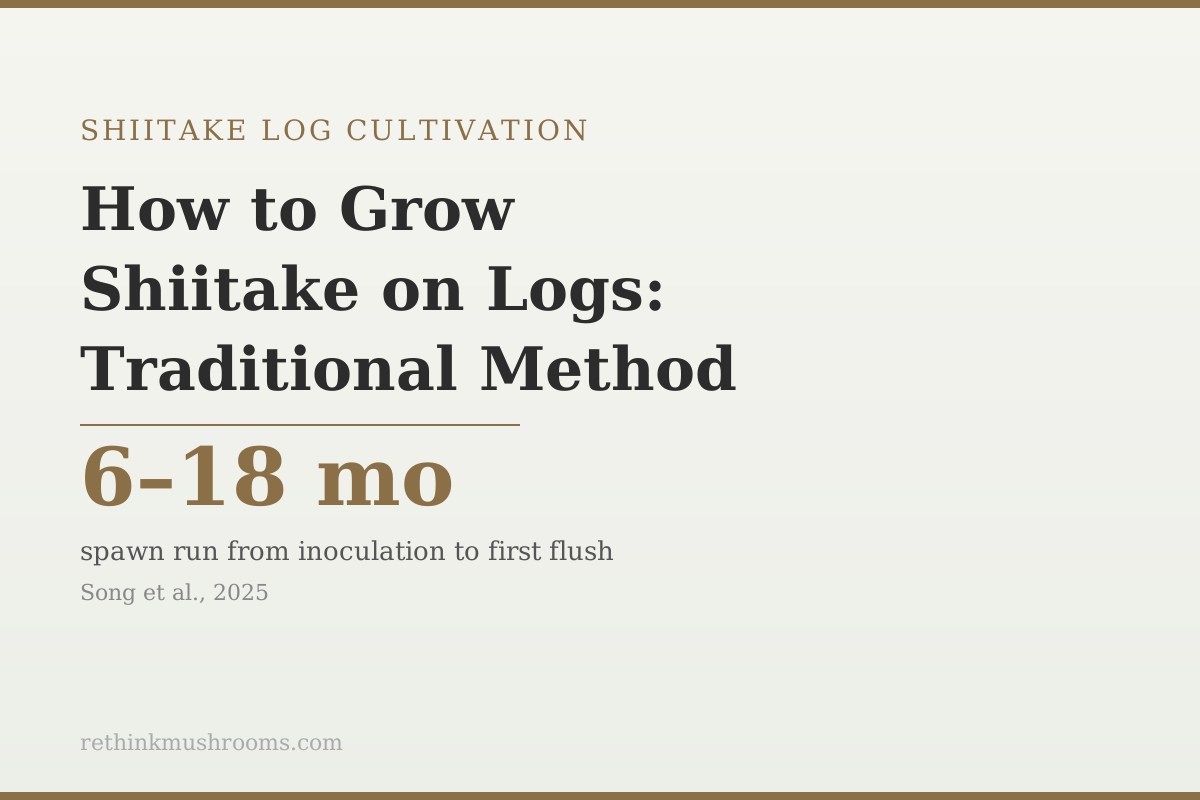
6-18 mo
spawn run duration from inoculation to first fruiting on hardwood logs
3-5 yr
productive fruiting life of a well-managed shiitake log before substrate depletion
Sugar maple
outperforms red and white oak in year-one yield due to higher undiscolored wood volume (Bruhn et al., 2009)
Nam et al., Applied Biological Chemistry, 2021
 View as image ↗
Most guides to growing shiitake on logs focus entirely on technique: how many holes to drill, how far apart, what kind of wax to use. What they miss is the reason the traditional method is still worth doing in an era when sawdust blocks produce faster yields. Nam and colleagues compared the bioactive compound profiles of log-cultivated and sawdust-cultivated Lentinula edodes in a 2021 study and found that the log-grown mushrooms had significantly higher concentrations of metabolites and antioxidant capacity than their sawdust-grown counterparts, with profiles matching those of wild-harvested shiitake.[1] For growers who want to learn how to grow shiitake mushrooms on logs, the substrate is not just a production method. It is part of what makes the mushroom nutritionally distinct.
This article covers the complete log cultivation process with the research behind each decision: which wood species to choose, why spawn run takes months rather than weeks, and what the seal on each plug hole actually prevents. For a broader introduction to home cultivation methods, see your complete beginner's guide to growing mushrooms at home.
Key Takeaways
- Log-cultivated shiitake showed significantly higher bioactive compound concentrations and antioxidant capacity than sawdust-cultivated shiitake, matching wild-harvested mushroom profiles (Nam et al., Applied Biological Chemistry, 2021)
- Sugar maple outperformed red and white oak in year-one yield due to higher volumes of undiscolored wood available for mycelial colonization; after year two, oak yields became more comparable (Bruhn et al., Forest Products Journal, 2009)
- Wide-temperature-range strains outperformed both warm and cold strains across the full growing season in Bruhn's field evaluation, making them the evidence-backed default for most climates
- The spawn run takes 6-18 months because shiitake mycelium must complete two sequential developmental stages: formation of hyphal knots throughout the log, followed by primordium differentiation under trigger conditions (Song et al., 2025)
- Trichoderma species are the primary biological competitor for shiitake logs; they exploit exposed inoculation holes without wax sealing and can displace shiitake mycelium, causing green mold disease (Wang et al., Applied Microbiology and Biotechnology, 2016)
- Substrate type directly affects the nutritional composition of the fruiting bodies produced, meaning the same shiitake strain grown on different substrates yields measurably different mushrooms (Timm et al., 2025)
Why Log-Grown Shiitake Are Nutritionally Different from Sawdust-Grown
The most important finding in shiitake cultivation research for growers who care about what they eat is the substrate comparison in Nam et al. (2021). The study compared the full metabolic profiles of shiitake grown on natural oak logs against shiitake grown on sawdust substrate blocks, using the same strain under otherwise consistent conditions.[1]
Log-cultivated mushrooms showed significantly higher concentrations of bioactive compounds and stronger antioxidant capacity. Their profiles aligned closely with those of wild-harvested Lentinula edodes. Sawdust-cultivated mushrooms, despite being faster to produce and more uniform in appearance, had lower concentrations of the same compounds.
The mechanism behind this difference connects to how shiitake mycelium interacts with substrate over time. A log contains complex lignin-cellulose structures that require extensive enzymatic breakdown across months of colonization. This extended enzymatic process, and the defense responses the mycelium mounts against environmental pressure in the log, appear to drive secondary metabolite biosynthesis in ways that compressed sawdust blocks do not replicate.
Timm and colleagues (2025) studied this substrate-to-fruiting-body nutrient transfer across edible mushroom species more broadly and confirmed that substrate composition produces measurably different nutritional and bioactive profiles in the harvested mushrooms.[4] For growers interested in the broader question of how substrate choices affect supplement quality, see wood-based vs. grain-based substrates for mushroom growing and mushroom substrate guide: hardwood, straw, sawdust, and supplemented formulas.
How to Grow Shiitake Mushrooms on Logs: The Six Steps
Growing shiitake on logs follows a consistent process across wood species and spawn types. Steps 1-4 happen over a single day; steps 5-6 span months.
-
Cut fresh hardwood logs in late winter or early spring, when the wood has its highest sugar content. Logs should be 3-8 inches in diameter and 3-4 feet long. Cut from trees that have been felled within the past two weeks, before the bark begins to dry out and lose contact with the sapwood.
-
Allow logs to rest for 2 weeks after cutting. This lets antimicrobial compounds in freshly cut wood dissipate without allowing the wood to dry out. If logs sit longer than 4-6 weeks before inoculation, the interior sapwood that shiitake mycelium colonizes first may dry out enough to slow establishment.
-
Drill holes in a diamond pattern with a 5/16 inch bit, spacing holes 4-6 inches apart in rows 2 inches apart. A standard 4-foot log receives approximately 50 holes in a staggered pattern. The diamond pattern distributes inoculation points across the log's surface without creating concentrated entry zones that competitors can exploit.
-
Insert spawn plugs and seal each hole with cheese wax or beeswax immediately after inoculation. The seal prevents Trichoderma species and other biological competitors from entering the inoculation points before shiitake mycelium has established. Wang et al. (2016) documented Trichoderma as the dominant cause of green mold disease in shiitake log production and found that exposed entry points are the primary infection route.[5]
-
Stack logs in a shaded location for the spawn run, which takes 6-18 months depending on wood density, log diameter, and temperature. Keep logs off the ground to reduce slug and moisture management problems. Maintain humidity by misting or using shade cloth; the bark should feel slightly moist but the log should not sit in standing water.
-
Force fruit by soaking logs in cold water for 12-18 hours, then stand them upright. Cold water shock disrupts the dormancy state the mycelium enters after spawn run completion. Pin formation typically begins within 5-7 days of forced fruiting. Logs that fruit spontaneously during rain after a dry period are responding to the same temperature and moisture trigger.
Which Wood Species to Choose: Sugar Maple Beats Oak in Year One
The common advice to use oak for shiitake cultivation is not wrong, but it is incomplete. Bruhn and colleagues conducted a long-term field evaluation of shiitake log production across multiple wood species and strain types and found that sugar maple outperformed red oak and white oak in year-one yield.[2]
The mechanism is specific: sugar maple contains a higher proportion of undiscolored wood (sapwood) relative to heartwood than oak. Shiitake mycelium colonizes sapwood preferentially in the early spawn run because sapwood contains more readily available sugars and has less extractive content than heartwood. A log with more sapwood gives the mycelium more colonizable substrate in the first year, producing earlier and heavier flushes.
After year two, oak logs become more comparable to sugar maple as the mycelium progresses deeper into the wood. For growers who want yields in the first year after inoculation, sugar maple is the evidence-backed choice. Red maple, white ash, and ironwood also produced good results in Bruhn's evaluation. Black walnut, cherry, and other species with high extractive content in heartwood performed poorly.
Hardwood is essential. Softwoods contain resin compounds that suppress shiitake mycelial growth and are not viable substrates.
Strain Selection: Wide-Temperature Varieties Outperform Specialists
Shiitake spawn is sold in three general temperature profile categories: warm-weather strains (fruiting best at 60-75°F), cold-weather strains (fruiting best at 45-60°F), and wide-temperature strains (fruiting across 40-80°F).
Bruhn's field evaluation compared all three types across growing seasons and found that wide-temperature strains outperformed both specialists across the full year.[2] Warm-weather strains produced heavier flushes in summer but missed the spring and fall windows when temperatures dropped. Cold-weather strains produced well in spring and fall but stalled in mid-summer. Wide-temperature strains took advantage of all three windows and produced the highest total seasonal yield.
For growers without controlled fruiting environments, wide-temperature strains are the default recommendation with research support. Warm-weather specialists make sense for growers in consistently warm climates who want maximum summer yields; cold-weather strains are used by growers in cooler climates with short warm seasons.
Spawn is sold as plug spawn (wooden dowels colonized by mycelium) and grain or sawdust spawn. Plug spawn is the standard for log inoculation because plugs fit precisely into 5/16 inch drill holes and seal cleanly with wax. Grain spawn requires a different inoculation method and is more commonly used for sawdust blocks.
Why the Spawn Run Takes 6-18 Months
The most common frustration in shiitake log cultivation is the wait. Growers expect to inoculate a log and harvest mushrooms in a few months. What they encounter is 6-18 months of apparently nothing happening inside the bark.
Song and colleagues reviewed the biology of Lentinula edodes cultivation in a 2025 study and documented the two sequential developmental stages that explain the timeline.[3]
The first stage is the spawn run itself: mycelium grows outward from each inoculation point, digesting lignin and cellulose, and the separate hyphal networks from adjacent plugs merge to colonize the log's interior. This enzymatic colonization is why the wood in a fully spawned log develops a lighter, whitened appearance when cut across the grain. The mycelium is not growing in a straight line from plug to plug; it is radiating outward through wood grain paths that can take circuitous routes depending on wood density and extractive content.
The second stage is the formation of hyphal knots: dense aggregates of hyphae that are the precursor structures to mushroom primordia. Hyphal knot formation requires the mycelium to sense specific conditions: a drop in temperature (the cold water soak mimics this), increased humidity, and a shift in CO2 concentration as the log's surface dries. These triggers activate genetic programs that differentiate the hyphal knot from vegetative mycelium into a primordium.
A log inoculated in spring typically completes the spawn run phase over summer and fall, develops hyphal knots over the following winter, and fruits for the first time in the following spring. Logs inoculated in fall with dense wood species may take 18 months to complete colonization before fruiting conditions trigger their first flush.
Trichoderma: The Wax-Preventable Enemy
The seal on each plug hole is not aesthetic and not optional. It is specific protection against a genus of competing fungi that Song's review identifies as the primary biological threat to shiitake log production.
Wang and colleagues (2016) investigated the diversity and effect of Trichoderma species on shiitake cultivation in China and documented that Trichoderma harzianum, T. atroviride, and related species are the dominant cause of green mold disease on Lentinula edodes logs.[5] Green mold disease appears as bright green patches on the log surface, often concentrated around drill holes, and represents Trichoderma colonizing the exposed sapwood before shiitake mycelium has sealed the entry point.
Trichoderma species produce cellulases and chitinases that degrade shiitake mycelial cell walls. Once established at an entry point, Trichoderma competes directly with shiitake for substrate and can displace shiitake mycelium from the colonized zone. Heavy Trichoderma infection of a log can make the log non-viable.
Wax sealing within minutes of plug insertion is the primary preventive measure. Logs that sit for hours with open drill holes in a humid outdoor environment are at measurably higher contamination risk. The wax does not need to be airtight; it needs to physically block fungal spore germination at the hole surface until shiitake mycelium has grown outward from the plug and established its own chemical deterrent through the antibiotic compounds that Lentinula edodes mycelium secretes.
Managing Logs Through Multiple Flushes
A well-managed shiitake log typically fruits 2-3 times per year and continues producing for 3-5 years before substrate depletion. After each flush, the log needs a rest period of 6-8 weeks to allow the mycelium to replenish energy reserves before the next forced fruiting.
Practical management across years:
First year after inoculation: expect zero to one flush, possibly none if the spawn run completes late in the season. This is normal and does not indicate failed inoculation.
Years two and three: peak productivity. Logs are fully colonized and the mycelium has substantial reserve to support heavy flushes. Two or three force-fruitings per year is typical.
Years four and five: declining yields as substrate depletes. The wood becomes lighter, more fragile, and eventually crumbles. Some growers leave spent logs on the ground where they continue to colonize soil and occasionally produce scattered flushes.
Mushroom quality throughout: the research from Nam et al. (2021) is specifically about mushrooms grown on logs through natural colonization.[1] The higher bioactive compound profile associated with log cultivation persists across flushes in the productive years, not only in the first harvest.
For growers interested in how harvested shiitake should be processed to preserve bioactive compounds, see shiitake bioactive compounds: lentinan, eritadenine, and beyond.
The Bottom Line
Log cultivation produces shiitake with significantly higher bioactive compounds than sawdust cultivation, matching wild-harvested profiles according to Nam et al. (2021). The 6-18 month spawn run reflects two distinct biological stages: full hyphal colonization of the log interior followed by hyphal knot formation, with fruiting triggered by temperature drop and humidity shift. Sugar maple outperforms oak in year-one yield due to higher sapwood content (Bruhn 2009), and wide-temperature strain selection delivers the highest total seasonal yields in field conditions. Wax sealing each plug hole immediately after inoculation is the primary defense against Trichoderma green mold, the dominant cause of log cultivation failure.
Frequently Asked Questions
Sources & References
- 1. Source details for this reference are not yet available.
- 2. Source details for this reference are not yet available.
- 3. Source details for this reference are not yet available.
- 4. Source details for this reference are not yet available.
- 5. Source details for this reference are not yet available.