Enoki Safety, Nutrition & Culinary Use
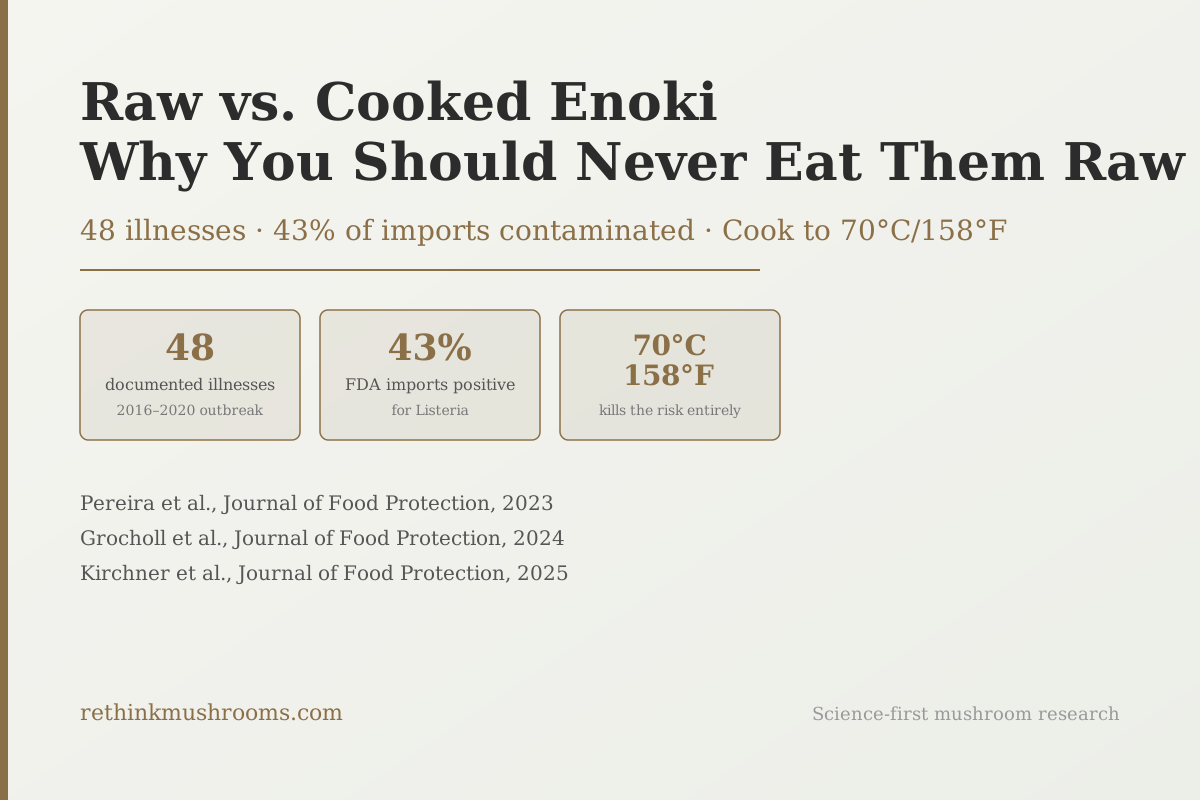
48 people sickened
A single South Korean enoki facility caused 48 Listeria infections across the US and Canada — confirmed by whole genome sequencing. The 2016-2020 outbreak remained undetected for four years.
Pereira et al., Journal of Food Protection, 2023
43%
of FDA-sampled imports Listeria positive
All 6
2022–2023 outbreak patients hospitalized
10³ cfu/g
Listeria count at harvest after cultivation
Pereira et al., Journal of Food Protection, 2023
 View as image ↗
Can you eat enoki mushrooms raw? The answer is no — and the reason is not vague food safety caution. It is specific, peer-reviewed, and mechanistic. Grocholl et al. (2024) found that 43% of FDA-sampled imported enoki tested positive for Listeria monocytogenes, and the contamination is not on the mushroom surface where washing could help.[1] The bacteria grow inside the mushroom tissue during cultivation, reaching roughly 1,000 colony-forming units per gram at harvest. Refrigeration does not stop the growth — it continues during cold storage. Only heat eliminates it.
For an introduction to enoki mushroom research and biology, see what is enoki mushroom — the tiny mushroom with big research. For specific preparation guidance — temperatures, cooking methods, and the rules that follow from this research — see how to safely prepare enoki: cooking requirements.
Key Takeaways
- Raw enoki should not be eaten: 43% of FDA-sampled imported enoki tested positive for Listeria monocytogenes in the Grocholl et al. (2024) study — a rate that makes contamination the rule, not the exception
- The contamination grows inside the mushroom tissue during cultivation, not on the surface — washing cannot remove it regardless of how thoroughly you rinse
- Two documented outbreaks: Pereira et al. (2023) documented 48 illnesses across the US and Canada from a 2016-2020 Korea-linked outbreak; Kirchner et al. (2025) documented 6 illnesses in a 2022-2023 China-linked outbreak, all of whom were hospitalized
- Refrigerated storage makes things worse, not better — Listeria monocytogenes continues to grow at refrigerator temperatures after harvest
- Fay et al. (2023) found that chopping or damaging raw enoki before cooking significantly accelerates Listeria growth — don't pre-cut before cooking
- Cooking to 70°C/158°F for 2+ minutes eliminates the risk entirely — and actually improves enoki's nutritional profile, increasing accessible dietary fiber from 2.7g to roughly 4.1g per 100g
The Mechanism: Why Washing Cannot Make Raw Enoki Safe
Most food safety advice for vegetables focuses on washing. For enoki mushrooms, washing is functionally irrelevant to the Listeria risk — and understanding why requires understanding how the contamination gets there.
Grocholl et al. (2024) grew enoki mushrooms in laboratory conditions, introducing Listeria monocytogenes at four different stages of the cultivation process: inoculation, scraping, pinning, and collaring.[1] At each introduction point, the Listeria survived and grew through the remainder of cultivation, reaching approximately 10³ colony-forming units per gram (cfu/g) at harvest. This is the contamination level at the point of packaging — before the mushrooms have even entered the distribution chain.
The reason washing cannot address this: by the time enoki reaches a consumer, the Listeria is not sitting on the mushroom surface. It is established within the tissue of the mushroom, having grown there during the weeks of cultivation. Rinsing the surface of a contaminated enoki mushroom does not reach the bacteria living inside the tissue.
Grocholl et al. also tested what happens during subsequent refrigerated storage.[1] Listeria counts did not decline. They increased. This reflects a well-documented characteristic of Listeria monocytogenes that distinguishes it from most foodborne pathogens: it is psychrotrophic, meaning it grows at refrigerator temperatures (2-4°C/36-39°F). Most pathogens are inhibited by refrigeration; Listeria is not.
The 43% positive rate from FDA sampling puts this in consumer terms. Roughly one in two packages of imported enoki on retail shelves contains Listeria monocytogenes. This is not a rare contamination event traceable to a single bad actor. It is a systemic contamination rate across the imported enoki supply chain.
Two Outbreaks, Four Years Apart, Same Pattern
The peer-reviewed outbreak literature puts the contamination rate in human terms.
Pereira et al. (2023) documented the 2016-2020 outbreak linked to enoki imported from South Korea.[2] Forty-eight people became ill — 36 in the United States, 12 in Canada. All cases were linked by whole genome sequencing to a single South Korean production facility. The outbreak ran for four years before it was fully characterized, which reflects the challenge of tracing a slowly emerging cluster of listeriosis cases to a specific food source. The paper represents the first peer-reviewed documentation of the enoki-Listeria link at the population level.
Kirchner et al. (2025) documented a more recent outbreak: 2022-2023, linked to enoki imported from China and distributed by Utopia Foods in the United States and Canada.[3] Six people became ill. All six were hospitalized. The methodologically notable aspect of this investigation is that FDA identified the contaminated product through proactive retail sampling before the illness cluster had grown through standard disease surveillance reporting. The contaminated product was pulled from shelves based on a positive environmental or product sample, not based on a wave of reported illnesses.
Together, these two outbreaks span 2016-2023, involve two different source countries (South Korea and China), and account for 54 documented illnesses — with the hospitalization rate in the more recent outbreak at 100%. The pattern is not an isolated event from a single supplier at a single time. It is a recurring supply chain vulnerability.
The Refrigerator Doesn't Help — Listeria Thrives in Cold Storage
The normal food safety reflex — refrigerate immediately to slow pathogen growth — does not apply to Listeria in enoki. Grocholl et al. found that Listeria counts in enoki increased during six weeks of refrigerated storage after harvest.[1] The cold does not halt growth; it just slows it compared to room temperature.
This matters for how people actually buy and store enoki. A consumer who buys enoki, refrigerates it for several days before cooking, and then rinses it before eating raw is not reducing their exposure compared to eating it the day they bought it. The Listeria burden in the mushroom tissue has grown during those days of cold storage.
The flip side: this does not mean refrigeration is wrong. Refrigeration is still the correct storage choice because room temperature storage would be worse. The point is that storage time in the refrigerator does not function as a safety measure. Only the cooking step provides that.
How long should you keep raw enoki refrigerated before cooking? Use it within 7-14 days of purchase, prioritize freshness, and cook before eating. Cooked enoki stored in the refrigerator is safe for 3-5 days because the cooking step has already eliminated the pathogen.
Why Cutting Raw Enoki Before Cooking Makes It Worse
Fay et al. (2023) modeled Listeria monocytogenes and Salmonella growth on whole versus chopped and physically damaged enoki mushrooms under identical storage conditions.[4] Chopped and damaged enoki showed significantly faster Listeria growth than whole mushrooms.
The explanation is straightforward: mushroom cells act as physical barriers that contain the nutrients inside. When a knife cuts through enoki, it ruptures cells along the cut surface, releasing intracellular nutrients to the surface where bacteria can access them more readily. The same damaged tissue has lower structural integrity as a barrier to microbial spread.
The practical implication is specific: do not pre-chop raw enoki. If a recipe calls for chopped enoki, apply the knife after cooking — when the Listeria has been eliminated and the cell rupture is no longer a relevant variable.
This rule applies particularly to meal prep habits. Cutting enoki on Sunday, storing the cut pieces through the week, and adding them to dishes without cooking is a scenario that combines three risk factors: the baseline 43% contamination rate, the accelerated growth from cell damage, and the growth-permissive refrigerator environment.
Dried Enoki Is Not Inherently Safe Either
The second Fay et al. (2023) study examined survival of Listeria and Salmonella on dehydrated enoki and wood ear mushrooms during long-term dry storage.[5] Both pathogens survived on dehydrated enoki over the storage period tested. Dehydration reduces bacterial counts but does not eliminate them.
This closes a logical escape route from the fresh enoki contamination problem. Someone might reason: if fresh enoki is contaminated, buy dried enoki instead, and the drying process will have killed the pathogens. The Fay et al. data shows this is not a reliable assumption. Dried enoki is not inherently safer than fresh. The same cooking requirement applies to dehydrated enoki that has been rehydrated.
The Positive Case: Cooked Enoki Is Better Than Raw in Multiple Ways
The case for always cooking enoki is not only about eliminating risk. Cooking makes enoki nutritionally better in measurable ways.
Raw enoki contains roughly 7.7% chitin by dry weight — the structural polymer that forms mushroom cell walls. Cooked enoki reduces chitin content to about 2.7%. This breakdown of the cell wall releases other fiber fractions that were bound within the chitin matrix and improves the digestibility of the mushroom tissue overall. The measurable result: total dietary fiber increases from 2.7g per 100g raw to approximately 4.1g per 100g cooked — a 52% increase from the cooking process itself. This is covered in detail in enoki nutritional profile: low calorie, high value.
The same chitin breakdown that increases accessible fiber also improves the bioavailability of beta-glucan polysaccharides — the immunologically active compounds in enoki's bioactive profile. Raw enoki's intact cell walls physically contain these compounds. Cooking releases them, making them more available to the digestive tract.
The conclusion: cooked enoki is both safe and nutritionally superior to raw enoki. There is no trade-off to weigh. Cooking eliminates the primary food safety risk and simultaneously improves the nutritional case for eating enoki in the first place.
Raw vs. Cooked Enoki: The Comparison
| Factor | Raw Enoki | Cooked Enoki |
|---|---|---|
| Listeria risk | High — 43% positive rate in FDA sampling | Eliminated at 70°C/158°F for 2+ minutes |
| Surface washing effective? | No — bacteria grow inside tissue | Not applicable post-cooking |
| Refrigeration reduces risk? | No — Listeria grows at cold temperatures | N/A — pathogen eliminated |
| Dietary fiber (per 100g) | 2.7g | ~4.1g |
| Chitin content | ~7.7% dry weight | ~2.7% dry weight |
| Beta-glucan bioavailability | Lower — cell walls intact | Higher — cell walls broken down |
| Who should avoid | Everyone, especially pregnant, 65+, immunocompromised | Safe for all populations when cooked to temperature |
| Culinary texture | Crunchy, neutral | Soft, slightly silky — suited to soup, stir-fry, hot pot |
Source: Grocholl et al. 2024[1] for safety data; USDA FoodData Central for fiber; fiber/chitin change data from published literature.
Who Faces the Highest Risk from Raw Enoki
Listeriosis — the infection caused by Listeria monocytogenes — produces dramatically different outcomes across different populations. In healthy adults, it typically causes fever, muscle aches, and gastrointestinal symptoms that resolve without hospitalization. In vulnerable groups, the same infection can cause septicemia, meningitis, miscarriage, or death.
The three highest-risk groups are pregnant women, adults over 65, and people with weakened immune systems — including those on chemotherapy, immunosuppressant medications for autoimmune conditions or organ transplants, and individuals living with HIV. The 100% hospitalization rate in the Kirchner et al. (2025) 2022-2023 outbreak may reflect the demographics of who consumed the contaminated enoki, though the paper does not specify the immune status of all six patients.[3]
For these high-risk groups, raw enoki at any level is not an acceptable risk. All enoki should be fully cooked before consumption, and the 70°C/158°F for 2 minutes minimum applies without exception.
For healthy adults who are not pregnant, the risk from raw enoki is real but different in severity. The 43% contamination rate means the exposure probability is high; the illness probability given exposure depends on the bacterial load and individual immune response. Cooking removes the question entirely.
For readers who have underlying health conditions — including diabetes, which affects immune function and increases Listeria susceptibility — see enoki for diabetic patients: safety and evidence for a more specific discussion of the risk profile.
The cultivation conditions that create this contamination problem — cold, dark, humid indoor growing environments — are explained further in enoki vs. wild velvet foot: how cultivation changes the mushroom.
The Bottom Line
Raw enoki mushrooms should not be eaten. Grocholl et al. (2024) found Listeria monocytogenes in 43% of FDA-sampled imported enoki, with contamination established within the mushroom tissue during cultivation — washing is ineffective, and refrigerated storage allows further bacterial growth. Two documented outbreaks (2016-2020, 48 cases; 2022-2023, 6 cases all hospitalized) confirm the human health impact. Cooking to 70°C/158°F for at least 2 minutes eliminates the risk completely — and also improves enoki's nutritional profile, increasing accessible dietary fiber by roughly 52% through chitin breakdown.
Frequently Asked Questions
Sources & References
- 1RTHM-01895·Grocholl, John et al. (2024). “Listeria monocytogenes Contamination Leads to Survival and Growth During Enoki Mushroom Cultivation..” Journal of food protection.Study breakdown →PubMed →↩
- 2RTHM-01763·Pereira, Evelyn et al. (2023). “Multinational Outbreak of Listeria monocytogenes Infections Linked to Enoki Mushrooms Imported from the Republic of Korea 2016-2020..” Journal of food protection.Study breakdown →PubMed →↩
- 3RTHM-02108·Kirchner, Margaret et al. (2025). “A Binational Sample-Initiated Retrospective Outbreak Investigation of Listeria monocytogenes Infections in the United States and Canada Linked to Enoki Mushrooms Imported from China 2022-2023..” Journal of food protection.Study breakdown →PubMed →↩
- 4RTHM-01692·Fay, Megan L et al. (2023). “Modeling the Fate of Listeria monocytogenes and Salmonella enterica on Fresh Whole and Chopped Wood Ear and Enoki Mushrooms..” Journal of food protection.Study breakdown →PubMed →↩
- 5RTHM-01691·Fay, Megan L et al. (2023). “Survival kinetics of Listeria monocytogenes and Salmonella enterica on dehydrated enoki and wood ear mushrooms during long-term storage..” Food microbiology.Study breakdown →PubMed →↩