Enoki Mushrooms and Blood Sugar / Glucose Metabolism
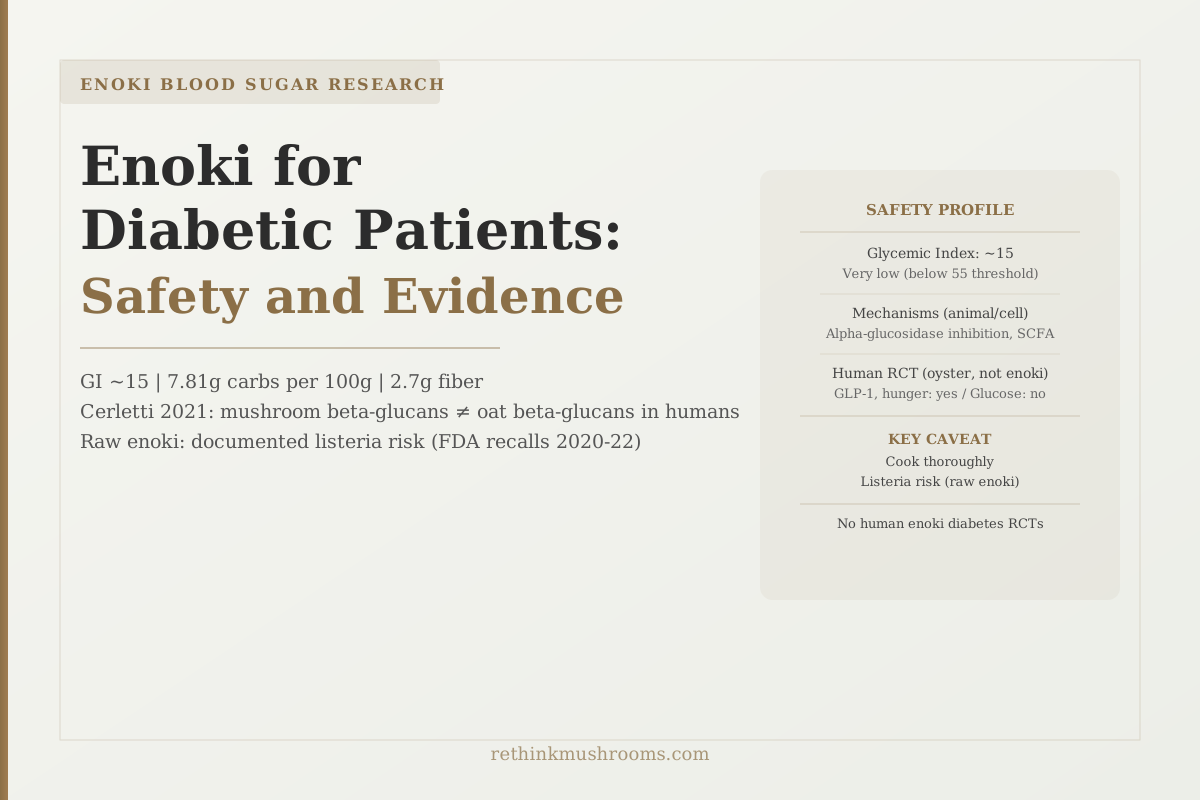
GI ~15, enoki's glycemic index makes it one of the lowest-GI foods available
Das et al. (2022) reviewed 23 edible mushrooms for diabetes management and found enoki's polysaccharides, vitamin D content, and alpha-glucosidase inhibitory activity are its key anti-diabetic mechanisms, while noting that specific clinical dose criteria remain absent due to lack of trials.
Das et al., Pharmaceutics, 2022
7.81g carbs
per 100g raw enoki (2.7g fiber, 0.22g sugar); negligible glycemic load
Cerletti 2021
critical counterpoint: mushroom beta-glucans have NOT shown glycemic benefit in human studies, unlike oat beta-glucans
No RCTs
no randomized controlled trial has tested enoki specifically for diabetes management in people
Das et al., Pharmaceutics, 2022
 View as image ↗
The direct answer to "can diabetics eat enoki mushrooms?" is yes, with an important qualifier about raw enoki safety. Enoki has a glycemic index of approximately 15 and contains only 7.81g of carbohydrates per 100g, with 2.7g of that as dietary fiber and just 0.22g as simple sugar. For people managing blood sugar, those numbers make enoki one of the safer vegetable foods available. The qualifier: raw enoki carries a documented listeria risk that matters especially for people with diabetes, whose immune systems are often compromised. This article covers both the nutritional safety case, the research on enoki's anti-diabetic mechanisms, and the honest counterpoints that most health articles omit. For the broader picture of enoki's biology, see What Is Enoki Mushroom? The Tiny Mushroom with Big Research.
Key Takeaways
- Enoki mushrooms have a glycemic index of approximately 15 and a glycemic load per standard serving that is effectively negligible; they are safe for people managing blood sugar as a food choice
- Das et al. (2022) reviewed 23 edible mushrooms for diabetes and found enoki's mechanisms include polysaccharide-mediated alpha-glucosidase inhibition, vitamin D modulation, and prebiotic effects on gut bacteria; the review explicitly noted the absence of specific clinical dose criteria
- Shamim et al. (2023) confirm that enoki and other edible mushrooms can prevent insulin resistance through polysaccharides, but note the absence of long-term safety and drug interaction data in the literature
- Cerletti et al. (2021) provide the critical counterpoint: unlike oat and barley beta-glucans, mushroom beta-glucans have NOT shown glycemic benefit in human studies; this distinguishes food-form enoki from pharmaceutical-grade polysaccharide interventions
- Dicks et al. (2022) found that adding oyster mushroom powder to meals in a double-blind RCT improved GLP-1 and hunger but did NOT modulate postprandial blood glucose, suggesting the ceiling on mushroom fiber's glycemic effect may be satiety and lipids, not direct glucose numbers
- Raw enoki carries a documented listeria contamination risk based on FDA recalls in 2020-2022; people with diabetes (often immunocompromised) should cook enoki thoroughly before eating
What Makes Enoki Safe for Blood Sugar Management
The nutritional case for enoki in diabetes management starts with the glycemic index. A glycemic index of approximately 15 places enoki well below the threshold of concern for blood sugar response (low-GI foods are generally considered to be under 55). For reference, white bread has a GI of around 70-75; sweet potatoes around 50-60.
The carbohydrate composition matters as much as the GI number. Enoki contains approximately 7.81g of total carbohydrates per 100g raw weight. Of that, approximately 2.7g is dietary fiber (which does not raise blood sugar and actually slows glucose absorption) and only 0.22g is simple sugar. The remaining carbohydrate is primarily complex polysaccharides, which are the enoki-specific compounds that show metabolic effects in research. A typical serving of 50-100g raw enoki delivers a glycemic load well below 5, which is the threshold for "very low" glycemic impact on blood sugar.
The Tang et al. (2016) comprehensive review of Flammulina velutipes confirms that dietary fiber, polysaccharides, and mycosterol (a plant-sterol analog) collectively support reduced blood sugar, blood pressure, and cholesterol in research contexts.[1] This is the authoritative review backing the metabolic-protective framing of enoki, and it makes the safe-for-diabetics nutritional case while also setting up the preclinical research discussion.
For the detailed mechanisms of how enoki polysaccharides interact with glucose metabolism, see Enoki Polysaccharides and Glucose Metabolism.
What the Anti-Diabetic Research Actually Found
Two comprehensive reviews from 2022 and 2023 cover enoki's potential anti-diabetic mechanisms across the published literature.
Das et al. (2022) systematically reviewed 23 edible mushrooms for their mechanisms in diabetes management and explicitly covered enoki.[2] The identified mechanisms for enoki were: polysaccharide-mediated inhibition of alpha-glucosidase and alpha-amylase (the digestive enzymes that break down complex carbohydrates into simple sugars in the small intestine); vitamin D content supporting insulin sensitivity; and prebiotic effects on gut bacteria that produce short-chain fatty acids relevant to insulin signaling. Das 2022 noted directly that "specific dose and efficacy criteria are absent due to lack of clinical trials" for enoki specifically. That qualification from a systematic review author deserves the same prominence as the positive mechanisms.
Shamim et al. (2023) reviewed the evidence for edible mushrooms in diabetes prevention and treatment and concluded that enoki, alongside other edible mushrooms, can prevent insulin resistance through polysaccharides and alpha-glucosidase inhibitory activity.[3] The same review identified the key limitations as absent long-term safety data and absent drug interaction data. Mushrooms and antidiabetic medications (particularly insulin and metformin) could theoretically interact through additive glucose-lowering effects. No study has documented this interaction specifically for enoki, and no human trial has tested it. The absence of evidence is not reassurance; it is a gap.
The mechanism behind alpha-glucosidase inhibition deserves a plain-language explanation. Alpha-glucosidase is an enzyme in the lining of the small intestine that cleaves complex carbohydrates into glucose for absorption. Some diabetes medications (acarbose, miglitol) work by inhibiting this enzyme, slowing the absorption of glucose after meals. Enoki polysaccharides appear to inhibit the same enzyme in laboratory conditions, as documented in the comprehensive mechanistic review by Aramabasic et al. (2021).[4] Whether eating enoki as food delivers polysaccharides to small intestinal brush border cells in quantities sufficient to meaningfully inhibit alpha-glucosidase is a question that has not been tested in humans.
The Critical Counterpoint: Mushroom Beta-Glucans in Human Studies
Every article on mushrooms and diabetes should include this finding from Cerletti et al. (2021), and essentially none do.[5]
Cerletti's team reviewed the evidence on edible mushrooms and beta-glucans for human health and reached a conclusion that runs contrary to the popular narrative: unlike oat and barley beta-glucans, which have strong human clinical evidence for improving lipid levels and glycemic responses, mushroom beta-glucans do NOT appear to beneficially affect lipid levels or glycemic responses in humans. This finding applies to mushrooms generally, not specifically to enoki, but it is directly relevant to any claim that eating enoki will lower blood sugar or improve lipid profiles.
The reason for the discrepancy between oat/barley and mushroom beta-glucans is structural. Oat beta-glucan is predominantly (1,3/1,4)-linked and forms a highly viscous gel in the digestive tract, physically slowing glucose absorption by bulk effect. Mushroom beta-glucans are predominantly (1,3/1,6)-linked and do not form the same viscous gel. Their primary effects appear to run through immune modulation and gut microbiota changes that take weeks or months to produce metabolic outcomes, rather than the acute viscosity mechanism that directly slows postprandial glucose.
This means the Cerletti finding and the positive animal research are not necessarily in contradiction. The polysaccharides in enoki may genuinely improve metabolic markers over time through microbiota and immune mechanisms, but adding enoki to a meal is unlikely to produce a measurable acute reduction in the postprandial glucose spike the way oatmeal does. Both things can be true simultaneously.
The practical implication: someone with type 2 diabetes adding enoki to their diet can reasonably expect a low-GI, fiber-rich food that may provide chronic metabolic benefits through its prebiotic effects. They should not expect the same acute glycemic response blunting they would get from eating oats.
What the Closest Human RCT Shows
Dicks et al. (2022) ran a double-blind randomized controlled trial adding oyster mushroom powder to a mixed meal and measuring postprandial outcomes in adults with impaired glucose tolerance.[6] This is the best available human evidence for what eating mushrooms with a meal does to metabolic markers.
Results: the mushroom-fortified meal significantly improved GLP-1 response (GLP-1 is a gut hormone that signals satiety and amplifies insulin release), reduced non-esterified free fatty acids (a marker of fat mobilization), and improved hunger sensation compared to control. It did NOT produce a significant reduction in postprandial blood glucose.
The Dicks 2022 findings are not from enoki specifically; oyster mushroom is a different species with different polysaccharide profiles. But this study is the best available human analogue for what adding mushroom fiber to a meal does. The pattern is consistent with the Cerletti mechanistic analysis: mushroom fiber helps with satiety and lipid markers more reliably than with direct postprandial glycemia. For people with diabetes, those are meaningful secondary benefits even if the glucose number itself does not change.
Drug Interaction Caution: What No Competitor Mentions
No published study documents specific interactions between enoki and antidiabetic medications. That gap is itself important information.
People with type 2 diabetes managed on insulin, metformin, sulfonylureas (like glipizide or glimepiride), or GLP-1 agonists (like semaglutide or liraglutide) who also eat significant quantities of enoki polysaccharide supplements should be aware that the additive glucose-lowering effect is theoretically possible. The alpha-glucosidase inhibition pathway documented in laboratory studies works through the same mechanism as acarbose, a medication specifically prescribed to blunt postprandial glucose. Eating large amounts of enoki alongside acarbose could potentially produce additive effects.
For food-form enoki in typical culinary quantities (50-200g per meal), the interaction risk from the food alone is very low given the absence of concentrated polysaccharide fractions in whole mushrooms. For people using enoki polysaccharide supplements at concentrated doses, the risk is higher and warrants discussion with a prescribing clinician. This article does not constitute medical advice. The absence of documented interactions is not evidence of safety at any dose.
The Listeria Safety Warning: Critical for Immunocompromised Patients
Diabetes is associated with impaired immune function through multiple mechanisms: elevated blood glucose suppresses white blood cell function, diabetes-related neuropathy reduces inflammatory responses, and diabetes is a recognized risk factor for worse outcomes from bacterial infections including listeriosis.
In 2020, a multistate listeria outbreak linked to enoki mushrooms in the United States resulted in an FDA import alert targeting specific Korean enoki suppliers. Further recalls occurred in 2021 and 2022 involving enoki mushrooms from multiple sources. Listeria monocytogenes can colonize the root ends of enoki bunches and survives refrigeration temperatures. It is killed by thorough cooking (above 74°C / 165°F for at least 15 seconds).
For people with diabetes, the safety implication is specific: raw enoki in salads or cold preparations carries a higher risk of listeria exposure than cooked enoki in hot soups or stir-fries. This is not a reason to avoid enoki, but it is a reason to cook it thoroughly, a preparation step that most Japanese culinary use of enoki already involves. No competitor article on enoki for diabetics mentions this safety history.
Practical Guidance: How Diabetics Can Use Enoki Safely
The evidence supports enoki as a safe food choice for blood sugar management based on its nutritional profile. The mechanisms suggest potential chronic benefits from regular consumption through prebiotic and metabolic pathways. The honest counterpoint is that acute glycemic benefit from food-form enoki is unlikely to be substantial based on human evidence.
Practical points derived from the evidence:
Enoki is safe to include in any diabetes-appropriate diet based on its glycemic profile. A 100g serving delivers negligible glycemic load, meaningful dietary fiber, and the polysaccharides documented in preclinical research.
Cook enoki thoroughly. Raw enoki carries documented listeria risk that is especially relevant for people with diabetes and anyone with compromised immune function. The traditional preparation in hot soups, noodle dishes, and stir-fries satisfies both the culinary use and the food safety requirement.
Enoki polysaccharide supplements at pharmaceutical concentrations are different from food-form enoki. The research on alpha-glucosidase inhibition, AMPKα1/PPARα upregulation, and SCFA production uses concentrated fractions at doses not achievable from eating enoki. If using supplements, flag this with a prescribing clinician if taking insulin or any antidiabetic medication.
No dose of enoki should be considered a replacement for prescribed diabetes management. The preclinical evidence is biologically plausible and the food is safe, but no human trial has tested enoki for diabetes treatment or prevention.
For how enoki compares to the mushroom with the strongest diabetes clinical evidence, see Maitake and Type 2 Diabetes: The SX-Fraction Clinical Trials. For complications-specific research, see Mushrooms and Diabetic Complications: Neuropathy, Retinopathy, and Nephropathy Research.
The Bottom Line
Enoki is safe for diabetics as a food: GI approximately 15, 7.81g carbs per 100g (2.7g fiber, 0.22g sugar), negligible glycemic load. Das et al. (2022) and Shamim et al. (2023) document preclinical anti-diabetic mechanisms but explicitly note absent clinical dose data. The critical honest counterpoint from Cerletti et al. (2021): mushroom beta-glucans do not show glycemic benefit in human studies despite positive animal data. Dicks et al. (2022) RCT found oyster mushroom improved GLP-1 and satiety but not postprandial glucose. Listeria risk from raw enoki is well-documented and requires thorough cooking, especially for immunocompromised patients.
Frequently Asked Questions
Sources & References
- 1RTHM-00831·Tang, Calyn et al. (2016). “Golden Needle Mushroom: A Culinary Medicine with Evidenced-Based Biological Activities and Health Promoting Properties..” Frontiers in pharmacology.Study breakdown →PubMed →↩
- 2RTHM-01500·Das, Arpita et al. (2022). “Medicinal Components in Edible Mushrooms on Diabetes Mellitus Treatment..” Pharmaceutics.Study breakdown →PubMed →↩
- 3RTHM-00850·Shamim, Mohammad Zaki et al. (2023). “Exploring Edible Mushrooms for Diabetes: Unveiling Their Role in Prevention and Treatment..” Molecules (Basel.Study breakdown →PubMed →↩
- 4RTHM-01322·Aramabašić Jovanović, Jelena et al. (2021). “The Effects of Major Mushroom Bioactive Compounds on Mechanisms That Control Blood Glucose Level..” Journal of fungi (Basel.Study breakdown →PubMed →↩
- 5RTHM-00676·Cerletti, Chiara et al. (2021). “Edible Mushrooms and Beta-Glucans: Impact on Human Health..” Nutrients.Study breakdown →PubMed →↩
- 6RTHM-00753·Dicks, Lisa et al. (2022). “Fortifying a meal with oyster mushroom powder beneficially affects postprandial glucagon-like peptide-1, non-esterified free fatty acids and hunger sensation in adults with impaired glucose tolerance: a double-blind randomized controlled crossover trial..” European journal of nutrition.Study breakdown →PubMed →↩