Enoki Mushrooms and Blood Sugar
12 Weeks of FVP
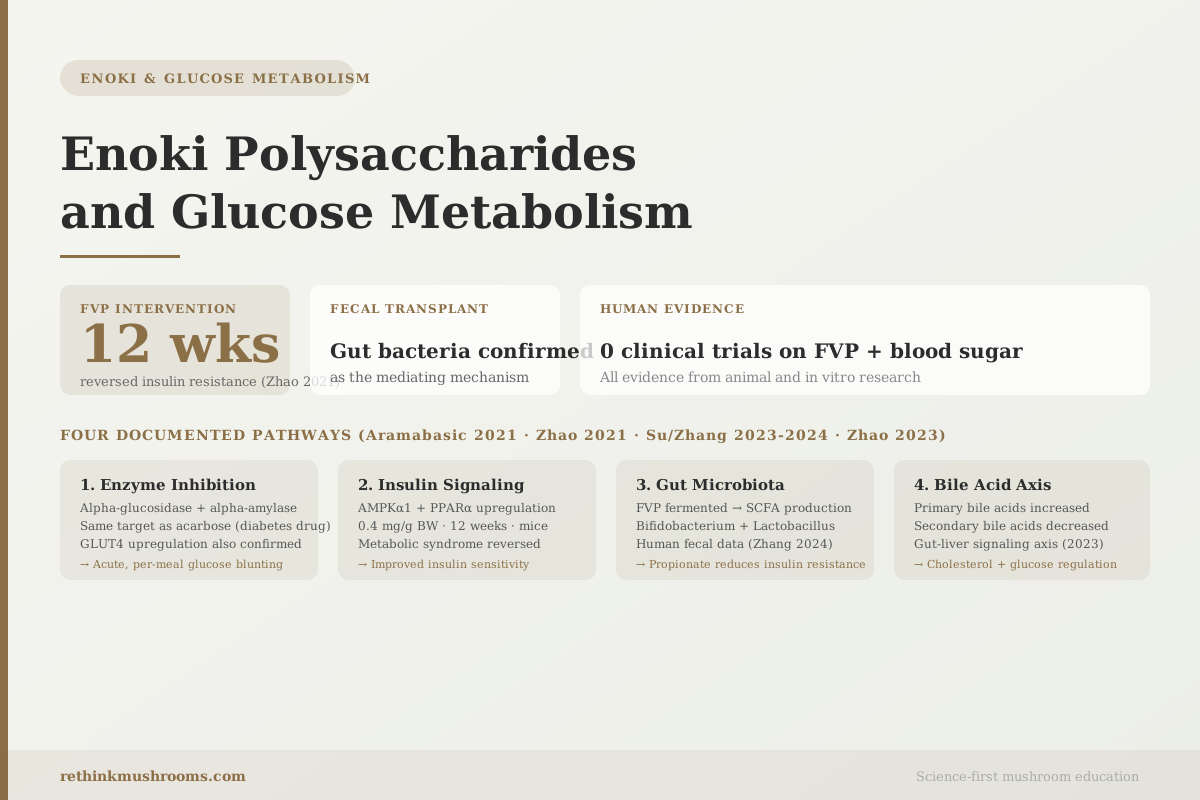
Twelve weeks of Flammulina velutipes polysaccharide supplementation reversed insulin resistance and metabolic syndrome markers in high-fat diet-fed mice — and a fecal transplant confirmed gut bacteria were doing the work.
Zhao et al., Food & Function, 2021
4 Pathways
by which FVP modulates blood glucose
AMPKα1/PPARα
insulin-signaling proteins activated
0 Human RCTs
specifically on FVP and blood sugar
Zhao et al., Food & Function, 2021
 View as image ↗
A decade of research on enoki mushroom polysaccharides has mapped out not one mechanism connecting these compounds to glucose metabolism, but four distinct biological routes. Enzyme inhibition in the small intestine slows carbohydrate digestion after meals. Activation of two key insulin-signaling proteins, AMPKα1 and PPARα, improves how cells respond to insulin. Gut bacteria ferment the polysaccharides into short-chain fatty acids that signal chronic improvements in insulin sensitivity. And a fourth pathway, identified in 2023, involves the bile acid system connecting the gut to the liver.
Enoki mushrooms (Flammulina velutipes) are covered in detail in the enoki mushroom overview. This article focuses entirely on the glucose metabolism side: what enoki polysaccharides are, how each mechanism works, and what the evidence honestly can and can't tell us.
The honest answer upfront: all of this evidence comes from animals and test tubes. No human clinical trial has tested Flammulina velutipes polysaccharides against blood sugar outcomes. That ceiling matters, and we'll return to it at the end.
Key Takeaways
- FVP at 0.4 mg/g body weight per day for 12 weeks reversed insulin resistance and attenuated metabolic syndrome markers in high-fat diet-fed mice, with AMPKα1 and PPARα upregulated (Zhao et al., 2021)
- A fecal microbiota transplant confirmed gut bacteria are the mediating pathway: transplanting gut bacteria from FVP-treated mice into untreated mice produced metabolic improvements even without FVP (Zhao et al., 2021)
- Alpha-glucosidase and alpha-amylase inhibition, the same enzyme targets as the diabetes drug acarbose, are documented for enoki polysaccharides (Aramabasic Jovanović et al., 2021)
- FVP resists upper-GI digestion, reaches the colon intact, and is fermented by human fecal bacteria to produce acetate, propionate, and butyrate while selectively enriching Bifidobacterium (Zhang et al., 2024)
- A 2023 study identified FVP's bile acid remodeling effect: increasing primary bile acids and decreasing secondary ones through the gut-liver axis (Zhao et al., 2023)
- Even waste-stream FV polysaccharides, from mushroom residue after commercial processing, demonstrate hypoglycemic activity and prebiotic fermentation characteristics (Que et al., 2024)
Four Ways Enoki Polysaccharides Affect Glucose Metabolism
Before the mechanisms: what are enoki polysaccharides, exactly?
The shorthand FVP refers to Flammulina velutipes polysaccharides, the complex carbohydrate chains found in enoki mushrooms. These differ from simple dietary fiber in their molecular architecture: long chains of glucose, galactose, mannose, and other sugars arranged in branching structures that human digestive enzymes cannot efficiently break down. That resistance to digestion is central to how FVP works.
Jia and colleagues characterized a specific FVP fraction called FVPT1 in 2024, finding it showed both lipid-lowering and immunomodulatory activity in animal models.[10] Different fractions showed different activity profiles, meaning FVP is not a single compound but a class of related molecules with varying biological effects depending on their structure. Even the waste-stream polysaccharides left over after commercial mushroom processing show hypoglycemic activity: the residue retains its fermentation characteristics and antioxidant properties.[11]
The foundational metabolic data on enoki comes from Yeh and colleagues (2014), who showed that enoki extract reduced total cholesterol, LDL, and triglycerides while raising HDL and antioxidant enzyme activity in rats fed a high-fat diet.[1] That early work established the metabolic-protective effect. The decade of research that followed began explaining the machinery behind it. Here are the four mechanisms researchers have identified.
Mechanism Map
Four Routes From Enoki Polysaccharide to Blood Glucose
Each pathway acts at a different point along the gut-to-liver axis. One is acute and meal-level; the other three are chronic and depend on the gut microbiome. All four are documented in animals and test tubes only — no human trial has tested enoki polysaccharides against blood-sugar outcomes.
Pathway 1: Small intestine
Acute · meal-levelInhibits alpha-glucosidase and alpha-amylase (the same targets as the drug acarbose) and upregulates GLUT4
→ Slows carbohydrate digestion, blunting the post-meal glucose rise
Aramabasic Jovanovic 2021 [2] · Das 2022 [6]
Pathway 2: Host cells
Chronic · weeksUpregulates AMPKalpha1 and PPARalpha — the fuel-sensing and fat-burning switches at the crossroads of glucose and lipid metabolism
→ Reversed insulin resistance in high-fat-diet mice over 12 weeks
Zhao 2021 [5]
Pathway 3: Colon
Chronic · ongoingReaches the colon intact and is fermented by gut bacteria (enriching Bifidobacterium) into short-chain fatty acids — acetate, propionate, butyrate
→ Propionate curbs liver glucose output; butyrate protects the gut barrier
Zhang 2024 [12] · Su 2023 [8] · Hao 2021 [3][4]
Pathway 4: Gut-liver axis
Chronic · ongoingReshapes the gut microbiome so primary bile acids rise and secondary bile acids fall, changing bile-acid signaling to the liver
→ Shifts hepatic lipid and glucose regulation via a route distinct from SCFAs
Zhao 2023 [9]
The causal keystone: a fecal microbiota transplant from FVP-treated mice into untreated mice reproduced the metabolic improvements without any FVP (Zhao 2021 [5]). That experiment tied pathways 2-4 to the gut microbiome itself, not to enoki acting directly on host tissue — the microbiome is doing the work.
Sources: Aramabasic Jovanovic 2021 [2]; Das 2022 [6]; Zhao 2021 [5]; Zhang 2024 [12]; Su 2023 [8]; Hao 2021 [3][4]; Zhao 2023 [9]. All findings are from animal and in-vitro studies; timescale labels reflect the mechanism type, not clinical dosing schedules.
Pathway 1: Blocking the Enzymes That Release Glucose After Every Meal
When you eat carbohydrates, your small intestine digests them using two enzymes. Alpha-amylase breaks starch chains into shorter fragments. Alpha-glucosidase then clips those fragments into individual glucose units, which enter your bloodstream. Block those enzymes and glucose enters the blood more slowly. This is how the type 2 diabetes drug acarbose works.
A comprehensive 2021 systematic review by Aramabasic Jovanović and colleagues covered all major mushroom bioactive compounds and their effects on blood glucose control mechanisms.[2] Their analysis confirmed that mushroom polysaccharides, including those from enoki, inhibit both alpha-glucosidase and alpha-amylase activity. The same review identified a complementary effect: GLUT4, the protein responsible for pulling glucose out of the blood and into muscle and fat cells for storage, was upregulated in response to mushroom polysaccharide exposure. Higher GLUT4 expression means cells take glucose up more efficiently even when insulin signaling is impaired.
A 2022 review by Das and colleagues, covering 23 edible mushrooms for diabetes-relevant activity, specifically named enoki's alpha-glucosidase and alpha-amylase inhibitory activity alongside its vitamin D content as the key anti-diabetic mechanisms for this species.[6] Das's review was direct about the limitation: because no clinical trials exist, no specific effective dose has been established for people.
Enzyme inhibition is a meal-time mechanism. You need FVP present in the small intestine during carbohydrate digestion for this pathway to operate. It doesn't persist or accumulate between meals. The companion article on enoki polysaccharides and postprandial glucose response covers this acute effect in more depth, including how it compares to the slower colonic fermentation pathway.
Pathway 2: How AMPKα1 Activation Reversed Insulin Resistance in 12 Weeks
The most mechanistically specific study in the enoki glucose literature is Zhao et al., Food & Function, 2021.[5]
Zhao et al. (2021) · Food & Function
- Population
- High-fat-diet mice with induced metabolic syndrome (obesity, elevated lipids, insulin resistance)
- Intervention
- Flammulina velutipes polysaccharide (FVP) at 0.4 mg/g body weight per day for 12 weeks
- Comparator
- Untreated high-fat-diet controls; plus a fecal microbiota transplant arm
- Finding
- FVP-treated mice showed lower body weight, improved lipid profiles, and reduced insulin resistance, with AMPKalpha1 and PPARalpha upregulated. Transplanting gut bacteria from FVP-treated mice into untreated mice reproduced the metabolic improvements without any FVP.
preliminary The most causally rigorous study in the enoki-glucose literature — the fecal transplant isolates gut microbiota as the mediating mechanism — but it is an animal study; no human trial has tested FVP on blood sugar.
Zhao et al., Food & Function, 2021 (RTHM-01472)
Zhao's team induced metabolic syndrome in mice by feeding them a high-fat diet, producing obesity, elevated triglycerides and cholesterol, and insulin resistance. One group of those mice then received FVP at 0.4 mg/g body weight per day for 12 weeks. At the end of the experiment, the FVP group had significantly lower body weight, improved lipid profiles, and reduced insulin resistance markers. The untreated control group, still eating the same high-fat diet without FVP, did not improve.
The molecular explanation: two proteins, AMPKα1 and PPARα, were upregulated in the FVP-treated mice. AMPKα1, adenosine monophosphate-activated protein kinase alpha 1, functions as the body's fuel-sensing switch. When cells detect low energy or receive certain dietary signals, AMPKα1 activates, making cells more receptive to insulin, increasing glucose uptake, and slowing fat storage. PPARα, peroxisome proliferator-activated receptor alpha, is a nuclear receptor that regulates how the body burns fat for fuel. Both proteins sit at the intersection of glucose and lipid metabolism, which explains why FVP's effects span multiple metabolic syndrome markers simultaneously rather than just addressing blood sugar alone.
The fecal microbiota transplant experiment is what makes this study stand out. Zhao's team collected gut bacteria from FVP-treated mice and transplanted them into germ-free mice that had also been fed a high-fat diet. The recipients showed improvements in metabolic markers even though they had never received FVP themselves. The transplant isolated the critical variable: gut microbiota, not direct action of FVP on host tissue, was producing the metabolic effect. FVP was changing the gut microbiome, and the changed microbiome was doing the metabolic work. That's pathway 3.
Pathway 3: Gut Bacteria Convert FVP into Short-Chain Fatty Acids
FVP doesn't get fully digested in your stomach or small intestine. Like dietary fiber, it resists breakdown by human digestive enzymes and arrives at your colon intact, where your gut bacteria treat it as a food source.
Zhang and colleagues demonstrated this in 2024 using human fecal fermentation, a method that tests what happens to a compound when exposed to actual human gut bacteria drawn from stool samples.[12] FV residue polysaccharide showed low digestibility in simulated upper-GI conditions, meaning most of it reached the colon essentially unchanged. When exposed to human fecal microbiota, FVP was fermented into short-chain fatty acids, specifically acetate, propionate, and butyrate, while selectively enriching populations of Bifidobacterium. Zhang's study is notable because it uses human-derived microbiota rather than mouse gut bacteria, making it the most translationally relevant piece of evidence available on this question.
Su and colleagues confirmed the fermentation picture in 2023 using a different in vitro fermentation model.[8] Their experiment showed FVP selectively promoting Bifidobacterium and Lactobacillus growth while increasing acetate, propionate, and butyrate. Which bacteria grow in response to a given fiber determines which short-chain fatty acids are produced — a selectivity that matters because propionate and butyrate have different downstream effects.
Propionate travels to the liver, where it suppresses glucose production between meals (a process called hepatic gluconeogenesis) and reduces insulin resistance. Butyrate feeds the cells lining the colon, maintaining gut barrier integrity. A compromised gut barrier allows inflammatory signals to enter circulation, and chronic low-grade inflammation is a known driver of insulin resistance. Acetate circulates systemically and plays roles in appetite regulation.
Two animal studies by Hao and colleagues fill in the in vivo gut picture. Hao's 2021 work showed FVP supplementation in C57BL/6 mice significantly improved gut microbial metabolic activity and increased populations of beneficial bacteria, with improvements in intestinal barrier function.[4] A companion study confirmed FVP modulated gut microbiota composition alongside immune gene expression, evidence that the gut-microbiota pathway has systemic reach beyond just metabolic markers.[3]
The SCFA production pathway is a slower, more systemic mechanism than enzyme inhibition. It requires consistent FVP consumption over time and doesn't produce immediate postprandial effects from a single meal. This distinction between the acute and chronic pathways is one of the core organizing ideas of the article on enoki polysaccharides and postprandial glucose response.
Pathway 4: Bile Acid Remodeling Through the Gut-Liver Axis
In 2023, Zhao and a different team published a study on FVP and bile acid metabolism — a mechanism that doesn't appear in any consumer-facing content on enoki and wasn't documented in earlier FVP research.[9]
The background: the liver produces bile acids to help digest fats in the small intestine. Gut bacteria then convert some of those primary bile acids (made by the liver) into secondary bile acids (produced by bacterial enzymatic action). The ratio of primary to secondary bile acids affects cholesterol metabolism, inflammation, and glucose regulation, because bile acids also function as signaling molecules that activate receptors in the gut and liver. Those receptors influence how the liver manages blood sugar between meals.
Zhao's 2023 experiment in high-fat diet-fed mice showed that FVP altered gut microbiota composition in a way that shifted the bile acid profile: primary bile acids increased, secondary bile acids decreased. This remodeling reduced circulating cholesterol and triglycerides through a route distinct from the SCFA mechanism. It's a gut-liver axis effect: FVP changes which gut bacteria are present, those bacteria change which bile acids circulate, and the changed bile acid profile signals the liver to regulate lipid and glucose metabolism differently.
This fourth mechanistic pathway was identified a full decade after Yeh's foundational metabolic data. The field is still working out how much each pathway contributes to the total metabolic effect.
Structure Determines Activity: Not All FVP Fractions Are Equal
The research described above was conducted on FVP preparations of different types: whole mushroom extracts, purified polysaccharide fractions, and waste-stream residue polysaccharides. These preparations contain different molecular structures, and the biological effects vary accordingly.
Jia's 2024 structural analysis of FVPT1 showed that a single purified fraction displayed lipid-lowering and immunomodulatory activity, but that other fractions from the same mushroom showed different activity profiles.[10] This means the biological effect of consuming enoki mushrooms depends partly on which polysaccharide fractions are present and in what concentrations, and that varies with growing conditions, preparation method, and cooking.
Que's 2024 work on waste-stream FVP demonstrates the range: even the residue from commercial mushroom processing retains hypoglycemic activity and prebiotic fermentation properties.[11] If the low-concentration residue material still shows activity, it suggests the concentration in a serving of actual mushrooms is sufficient for the fermentation pathway to operate, even if it falls short of the purified extract doses used in animal intervention studies.
Luo and colleagues extended this in 2022 by studying FV mycorrhizae, the root-like tissue rather than the fruiting body, and finding similar metabolic protective effects in mice: attenuated lipid disorder, reduced liver oxidative stress, and decreased adipose tissue inflammation.[7] The fact that different parts of the organism produce overlapping metabolic activity suggests the active mechanisms are not specific to the fruiting body alone.
For a full account of which compounds — polysaccharides, flammulin, proflamin, and mycosterols — are present in enoki and what each does, see enoki bioactive compounds: flammulin, proflamin, and polysaccharides.
The Honest Ceiling: Mechanisms Are Not Outcomes
Four mechanistic pathways. A fecal transplant experiment that directly confirmed gut microbiota as the mediating mechanism. A cascade of animal and in vitro studies from 2014 to 2024, each filling in a different part of the picture. What's missing is human data.
- Cell & In-Vitro Studiescompleted
Enzyme-inhibition assays (alpha-glucosidase, alpha-amylase, GLUT4) and human-fecal fermentation producing acetate, propionate, and butyrate (Aramabasic Jovanovic 2021; Das 2022; Zhang 2024; Su 2023)
- Animal Studiescompleted
12-week FVP in high-fat-diet mice reversed insulin resistance with AMPKalpha1/PPARalpha upregulation and bile-acid remodeling; a fecal transplant confirmed gut microbiota as the mediator (Zhao 2021; Zhao 2023; Hao 2021; Luo 2022)
- Case Reports & Early Seriesmissing
No human case reports of FVP used for blood-sugar control
- Small Human Trialsmissing
No randomized or open-label trial has tested FVP against any glucose outcome in people
- Large Randomized Trialsmissing
None; no effective human dose has been established
- Meta-Analyses & Systematic Reviewsmissing
Review articles summarize the preclinical mechanisms but have no human FVP-glucose trials to pool
The mechanisms are documented in detail across cell and animal studies, but the ladder stops there — every rung above animal work is empty. No human has been studied. 'Enoki polysaccharides improve glucose metabolism' is well-supported in mice and test tubes and entirely untested in people.
Aggregate of the twelve cited preclinical studies; no human FVP-glucose trial exists
Das (2022) stated it plainly: no clinical dose criteria exist because no clinical trials have established them.[6]
The scale gap also matters. Zhao's mice received 0.4 mg/g body weight per day of purified FVP for 12 weeks. Scaling to a 70-kilogram person gives roughly 28 milligrams per day of purified polysaccharide extract — a very different thing from eating 100 grams of fresh enoki mushrooms. The concentration of FVP in fresh mushrooms varies with growing conditions. Cooking changes bioavailability. Human gut microbiota is more diverse and variable than mouse gut microbiota. None of those dose-translation questions have been answered by clinical research.
The mechanisms documented here are real in the systems where they have been studied. Whether they operate at food-achievable doses in people eating a mixed diet in a real-world context remains the open question.
Safety — blood sugar and medication
ModerateEnoki is food, not a blood-sugar treatment — and it has not been tested in people
Concern
The mechanisms described here come entirely from animal and test-tube research. Several of them (enzyme inhibition, improved insulin sensitivity) act in the same direction as diabetes medications. For someone taking a glucose-lowering drug — especially an alpha-glucosidase inhibitor like acarbose, or insulin — combining it with concentrated mushroom-polysaccharide supplements could in principle stack effects, but no human study has measured whether that happens or at what dose.
What the research says
Eating enoki mushrooms as food is a normal dietary choice. The caution applies to concentrated FVP supplements and to anyone managing blood sugar with medication, where any change should be monitored rather than assumed safe from animal data.
Particularly relevant for: People taking glucose-lowering medication (acarbose, insulin, or others) or managing diabetes
What to do
Talk to your physician before using concentrated enoki-polysaccharide supplements alongside diabetes medication, and do not change any prescribed treatment based on preclinical research. This article is educational and is not medical advice.
Safety framing based on the absence of any human FVP-glucose trial and the shared drug targets noted by Aramabasic Jovanovic 2021 [2] and Das 2022 [6]
The Bottom Line
Enoki polysaccharides (FVP) affect glucose metabolism through four documented pathways in preclinical research: alpha-glucosidase and alpha-amylase enzyme inhibition, AMPKα1 and PPARα activation that improves insulin sensitivity, gut microbiota fermentation producing short-chain fatty acids, and bile acid remodeling through the gut-liver axis. Zhao et al.'s 2021 fecal transplant experiment established gut bacteria as the central mediating mechanism. No human clinical trials have tested FVP against blood sugar outcomes, and no effective dose has been established for people.
Frequently Asked Questions
Sources & References
- 1RTHM-00663·Yeh, Ming-Yei et al. (2014). “Hypolipidemic and antioxidant activity of enoki mushrooms (Flammulina velutipes)..” BioMed research international.Study breakdown →PubMed →↩
- 2RTHM-01322·Aramabašić Jovanović, Jelena et al. (2021). “The Effects of Major Mushroom Bioactive Compounds on Mechanisms That Control Blood Glucose Level..” Journal of fungi (Basel.Study breakdown →PubMed →↩
- 3RTHM-01362·Hao, Yuting et al. (2021). “The biological regulatory activities of Flammulina velutipes polysaccharide in mice intestinal microbiota, immune repertoire and heart transcriptome..” International journal of biological macromolecules.Study breakdown →PubMed →↩
- 4RTHM-01363·Hao, Yuting et al. (2021). “Flammulina velutipes polysaccharide improves C57BL/6 mice gut health through regulation of intestine microbial metabolic activity..” International journal of biological macromolecules.Study breakdown →PubMed →↩
- 5RTHM-01472·Zhao, Ruiqiu et al. (2021). “Polysaccharide from Flammulina velutipes attenuates markers of metabolic syndrome by modulating the gut microbiota and lipid metabolism in high fat diet-fed mice..” Food & function.Study breakdown →PubMed →↩
- 6RTHM-01500·Das, Arpita et al. (2022). “Medicinal Components in Edible Mushrooms on Diabetes Mellitus Treatment..” Pharmaceutics.Study breakdown →PubMed →↩
- 7RTHM-01575·Luo, Zhen et al. (2022). “Flammulina velutipes Mycorrhizae Attenuate High Fat Diet-Induced Lipid Disorder, Oxidative Stress and Inflammation in the Liver and Perirenal Adipose Tissue of Mice..” Nutrients.Study breakdown →PubMed →↩
- 8RTHM-01793·Su, Anxiang et al. (2023). “Effects of Flammulina velutipes polysaccharides on gut microbiota composition and metabolism in vitro fermentation..” Food science and biotechnology.Study breakdown →PubMed →↩
- 9RTHM-01837·Zhao, Ruiqiu et al. (2023). “Flammulina velutipes polysaccharides regulate lipid metabolism disorders in HFD-fed mice via bile acids metabolism..” International journal of biological macromolecules.Study breakdown →PubMed →↩
- 10RTHM-01910·Jia, Wei et al. (2024). “Structural Elucidation of a Polysaccharide from Flammulina velutipes and Its Lipid-Lowering and Immunomodulation Activities..” Polymers.Study breakdown →PubMed →↩
- 11RTHM-01971·Que, Yunxiang et al. (2024). “Structural characterization, antioxidant activity, and fermentation characteristics of Flammulina velutipes residue polysaccharide degraded by ultrasonic assisted H2O2-Vc technique..” Ultrasonics sonochemistry.Study breakdown →PubMed →↩
- 12RTHM-02037·Zhang, Yao et al. (2024). “Comprehensive evaluation of Flammulina velutipes residues polysaccharide based on in vitro digestion and human fecal fermentation..” International journal of biological macromolecules.Study breakdown →PubMed →↩