Enoki Blood Sugar
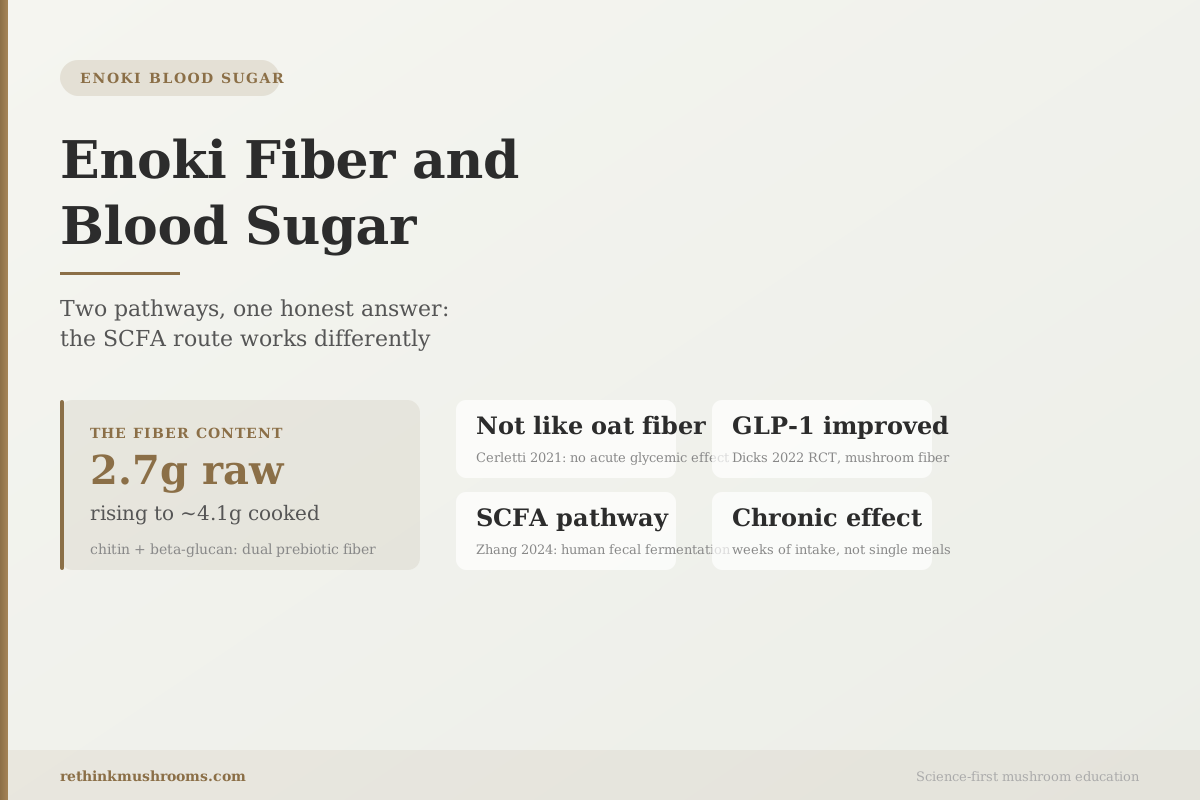
2.7g fiber per 100g raw
Enoki mushrooms provide meaningful dietary fiber, but a 2021 review of human trials found that fungal beta-glucans do not produce the acute glycemic benefit seen with oat and barley beta-glucans. The blood sugar effect works through a different, slower mechanism.
Cerletti et al., Nutrients, 2021
~4.1g cooked
cooking removes water and concentrates enoki fiber per gram; dried enoki powder is more concentrated still
SCFA pathway
Zhang et al. (2024) confirmed that F. velutipes polysaccharides resist digestion and are fermented to short-chain fatty acids by human gut bacteria
GLP-1 improved
Dicks et al. (2022) found mushroom fiber raised GLP-1 secretion and satiety in a human RCT, without direct postprandial glucose reduction
Cerletti et al., Nutrients, 2021
 View as image ↗
The claim you will see on many sites, that eating mushrooms blunts the blood sugar spike after a meal, is more complicated than it sounds. Cerletti and colleagues reviewed the available human clinical evidence in 2021 and found that fungal beta-glucans do not significantly improve glycemic response or lipid profiles in human trials, despite being structurally similar to the oat and barley beta-glucans that do work for acute blood sugar control. This is a finding most mushroom content either does not know about or chooses not to mention.
The story does not end there. Enoki mushrooms do contain dietary fiber, and that fiber does affect metabolic health, just not through the mechanism most people assume. The effect runs through the colon, not through the stomach. It depends on gut bacteria producing short-chain fatty acids, and it accumulates over weeks of consistent intake rather than showing up in a glucose reading ninety minutes after dinner.
Understanding the distinction between acute glycemic blunting (what oat fiber does in the stomach) and the slower SCFA-microbiome pathway (what enoki fiber appears to do in the colon) is the key to evaluating the evidence correctly. For the broader context on what enoki is and what makes it notable as a food, what is enoki mushroom covers the species and its research history.
Key Takeaways
- Enoki mushrooms contain approximately 2.7g dietary fiber per 100g raw, rising to about 4.1g per 100g cooked as water is removed; the fiber is primarily chitin (insoluble cell wall fiber) and beta-glucan (soluble polysaccharide)
- Cerletti et al. (2021) reviewed human clinical trials and found that fungal beta-glucans, unlike oat and barley beta-glucans, do not significantly reduce postprandial glucose or improve lipid profiles in human subjects
- The difference in mechanism: oat beta-glucan forms a viscous gel in the stomach that physically slows glucose absorption acutely; mushroom chitin and beta-glucan work through fermentation in the colon, a slower and more systemic route
- Zhang et al. (2024) confirmed that F. velutipes polysaccharides resist human digestive enzymes and are fermented by human fecal microbiota to produce short-chain fatty acids
- Short-chain fatty acids (especially propionate and butyrate) improve insulin sensitivity through multiple downstream pathways, but this benefit builds over weeks of consistent dietary intake, not within a single meal
- Dicks et al. (2022) found that oyster mushroom fiber significantly increased GLP-1 secretion and reduced hunger in a randomized controlled trial, without a significant direct reduction in postprandial blood glucose; this is the closest available human analogue for enoki
How Much Fiber Enoki Actually Contains (And What Cooking Does to It)
Raw enoki mushrooms contain approximately 2.7 grams of dietary fiber per 100 grams. This fiber is composed of two distinct structural types. Chitin is the insoluble fiber that makes up the cell walls; it resists digestion entirely and reaches the colon intact. Beta-glucan is a soluble polysaccharide that partially dissolves in water. The two types ferment at different rates in the colon, which shapes how enoki affects gut bacteria and short-chain fatty acid production over time.
Cooking changes the fiber density per gram, not the total fiber in the mushrooms. When enoki is boiled, steamed, or stir-fried, it loses water. A 100-gram serving of cooked enoki contains less water than 100 grams of raw enoki, so the fiber content per 100 grams rises to approximately 4.1 grams. The actual fiber molecules are not destroyed by typical cooking temperatures; they are simply more concentrated in a smaller mass.
Dried enoki powder is the most concentrated form. Dehydration removes nearly all water, and dried enoki can contain 10 grams or more of fiber per 100 grams. For anyone using enoki as a deliberate fiber supplement rather than primarily as a food, dried powder offers a higher dose in less volume.
Frozen enoki, a common preparation in East Asian hot pot cooking, retains most of its fiber content. The freeze-thaw cycle breaks open cell walls and softens the texture. This may increase the accessibility of chitin to gut bacteria (the physical barrier protecting the chitin from fermentation is partially disrupted), though specific scientific data on frozen enoki fiber fermentability is limited.
A practical comparison helps put the numbers in context. A 50-gram portion of fresh enoki, a generous amount as a side dish or soup addition, provides about 1.4 grams of fiber. A 100-gram serving provides 2.7 grams. Half a cup of cooked oatmeal provides about 2 grams of fiber. Enoki is not a high-fiber food in the way that legumes or psyllium are. Its prebiotic significance comes from the specific fermentability of its chitin and beta-glucan rather than from sheer fiber volume. For a deeper look at what chitin specifically does in the digestive tract, see enoki chitin and digestive health.
Why Mushroom Beta-Glucan Does Not Work Like Oat Beta-Glucan
This is the finding that changes how you should interpret every other claim about mushrooms and blood sugar.
Cerletti and colleagues (2021) reviewed the available human clinical evidence on the health effects of edible mushroom components and concluded that fungal beta-glucans do not significantly improve postprandial glycemic responses or cholesterol levels in human trials.[1]
The contrast with oat and barley beta-glucan is direct and worth understanding in mechanistic terms. Oat beta-glucan reduces postprandial glucose through viscosity. When it dissolves in the stomach, it forms a thick, gel-like solution that coats the intestinal wall and slows the rate at which glucose crosses into the bloodstream. The effect happens in the stomach and small intestine within an hour of eating, and it produces measurable blunting of the post-meal glucose curve. This mechanism has been replicated in enough human trials that regulatory agencies in the United States and European Union have approved health claims for oat beta-glucan specifically for glycemic response.
Mushroom beta-glucan is also a polysaccharide made from glucose units, but the pattern in which those units are linked together is structurally different. Mushroom beta-glucan has a different branching pattern and molecular weight distribution from oat beta-glucan. As a result, it does not form the same viscous gel in the stomach. The physical mechanism that gives oat beta-glucan its acute glucose-blunting property does not transfer to fungal beta-glucan.
What Cerletti's review found is not that mushroom fiber is inert. It identified a mechanism gap: mushroom fiber's effects on metabolic health appear to be mediated through the gut microbiome (a slower, systemic pathway) rather than through immediate viscous slowing of glucose absorption in the small intestine. These are genuinely different mechanisms that operate at different timescales. Oat beta-glucan is evaluated correctly by measuring its effect on a post-meal glucose curve. Enoki beta-glucan and chitin should be evaluated differently, by measuring microbiome composition, short-chain fatty acid levels, and insulin sensitivity over weeks.
The Blood Sugar Pathway That Does Work: Fermentation and SCFAs
The route through which enoki fiber appears to influence blood sugar regulation runs through the colon, not through the stomach.
Zhang and colleagues (2024) conducted a comprehensive evaluation of F. velutipes polysaccharides that established the key structural properties relevant to this mechanism.[2] Using simulated human digestive conditions followed by fermentation with actual human fecal microbiota, they confirmed that these polysaccharides resist breakdown in the stomach and small intestine and pass to the colon intact. Once in the colon, gut bacteria ferment them and produce significant quantities of short-chain fatty acids: primarily acetate, propionate, and butyrate. The use of human fecal microbiota rather than rat gut bacteria is an important methodological detail; it confirms that human gut bacteria can actually carry out this fermentation, not just the gut bacteria of rodents.
Short-chain fatty acids are the primary currency through which dietary fiber affects metabolic health. They are not abstract laboratory compounds.
Propionate travels from the colon to the liver via the portal vein, the blood vessel connecting the intestines to the liver, where it suppresses the liver's own glucose production. When propionate signal is present, the liver produces less glucose independently, reducing the background contribution to fasting glucose levels over time.
Butyrate is the preferred energy source for colonocytes, the cells lining the colon wall, and it has broader effects on insulin signaling in peripheral tissues. Higher butyrate availability is consistently associated with improved insulin sensitivity in both experimental and observational research.
Acetate contributes to satiety signaling in the hypothalamus, the brain region that regulates hunger, suppressing appetite through a route separate from the gut hormones like GLP-1.
Su and colleagues (2023) demonstrated that F. velutipes polysaccharides selectively increased Bifidobacterium and Lactobacillus populations in mouse models while measurably elevating SCFA levels.[3] These bacterial genera are among the most well-characterized beneficial gut residents, consistently linked to better glucose tolerance and reduced metabolic inflammation in human observational studies. The specificity matters: enoki's fiber is not just providing a generic fermentable substrate but enriching the particular bacterial communities most associated with metabolic benefit.
The timing point is critical. None of these SCFA-mediated effects occur in the 90 minutes after eating. They build over days and weeks of consistent fiber intake. This is why comparing enoki to oat beta-glucan for the acute glucose spike is the wrong test. For more on how the fermentation pathway works in enoki specifically, see enoki and short-chain fatty acid production in the gut.
What the Only Human Mushroom Trial Showed (And What It Didn't)
No randomized controlled trial has tested enoki mushrooms specifically for postprandial glucose response in humans. The closest available evidence comes from a related species.
Dicks and colleagues (2022) conducted a randomized crossover trial adding 150 grams of fresh oyster mushrooms (Pleurotus ostreatus) to a standardized high-carbohydrate meal and measuring several outcomes: postprandial blood glucose, insulin response, GLP-1 secretion, and self-reported hunger ratings.[4] Oyster mushrooms share a similar fiber profile with enoki, both containing chitin and beta-glucan as the primary fiber types.
The results were nuanced in ways that matter for how you read them.
The mushroom meal produced significantly higher GLP-1 levels compared to the control meal. GLP-1 (glucagon-like peptide-1) is a hormone secreted by cells in the small intestine in response to food. It stimulates the pancreas to release insulin in proportion to how much glucose is present, slows gastric emptying, and signals fullness to the brain. Higher GLP-1 secretion in response to a meal is considered a beneficial metabolic response. The drugs that have produced dramatic improvements in diabetes and weight management (the class that includes semaglutide, marketed as Ozempic and Wegovy) work by amplifying and extending this exact GLP-1 signal.
Hunger ratings were also significantly lower at multiple time points after the mushroom meal.
What the trial did not find: a significant reduction in postprandial blood glucose. GLP-1 went up, hunger went down, but the glucose curve itself was not significantly different between conditions.
The honest interpretation: the mushroom meal produced a hormonal environment associated with better metabolic health (higher GLP-1, lower hunger) without directly reducing the glucose number in this single-meal trial. This result is consistent with the two-pathway framework. The GLP-1 and satiety effects, which operate through gut cell signaling in the small intestine, are detectable within one meal. The effects that operate through the SCFA-microbiome route require weeks to accumulate and would not be visible in a single-meal crossover design.
Enoki is not oyster mushroom. Extrapolating from one species to another has real limits, and a direct enoki human trial could produce different results. But the shared fiber profile makes Dicks 2022 the most informative human data currently available.
Gut Bacteria Shifts and Why Consistency Matters More Than One Meal
Hao and colleagues (2021) investigated what F. velutipes polysaccharides do to gut microbiome composition and intestinal barrier integrity in a mouse model of gut disruption.[5] They found that supplementation shifted the microbiome toward commensal (beneficial resident) bacterial species and preserved the tight junction proteins between intestinal cells.
Tight junction proteins matter for blood sugar regulation in a way that is not immediately obvious. When the barrier between the intestinal interior and the bloodstream breaks down, fragments of gut bacteria called lipopolysaccharides (LPS) enter circulation. LPS is a component of the outer membrane of certain bacterial species; in the bloodstream, it triggers low-grade, chronic inflammation. This inflammation impairs the ability of insulin receptor proteins on muscle and liver cells to respond to insulin, contributing to insulin resistance over time.
A gut barrier supported by prebiotic feeding of commensal bacteria produces less LPS leakage into circulation. Enoki fiber's role in preserving tight junction proteins, at least in the Hao 2021 mouse model, suggests a contribution to the anti-inflammatory gut environment that underpins better long-term metabolic health.
The consistency point follows from the biology. Gut barrier integrity and microbiome composition are states that shift over weeks of dietary pattern. A serving of enoki once a week is unlikely to produce measurable changes in LPS levels or microbiome composition. Regular inclusion of enoki as part of a consistent high-fiber diet is the framing that makes these mechanisms meaningful. For more on the microbiome composition shifts that enoki fiber drives, see enoki and gut bacteria composition.
What the Evidence Means in Practice
The honest summary: enoki mushrooms are not a functional substitute for oat fiber if the goal is acute blood sugar reduction after a high-carbohydrate meal. Adding enoki to a bowl of white rice is not going to produce a meaningfully lower glucose peak at ninety minutes.
What the evidence supports is a different and more nuanced claim. Enoki's fiber (both chitin and beta-glucan) reaches the colon intact, feeds bacteria that produce short-chain fatty acids, and shifts the microbiome toward bacterial populations associated with improved insulin sensitivity and reduced metabolic inflammation. This is a meaningful metabolic benefit. It is also a chronic, diet-pattern-level effect that requires consistent intake to accumulate.
A few practical details follow from the research. Eating enoki as part of a mixed meal (with protein, fat, and fiber from other sources) slows overall gastric emptying more than eating enoki alone, extending the time food spends in the small intestine and allowing more GLP-1 secretion from gut cells. The 50 to 100 gram serving range that fits naturally into soup, stir-fry, or hot pot is practically achievable, and the fiber dose at that range (1.4 to 2.7 grams) is meaningful contribution to total daily fiber intake.
Cooking method matters less than consistency of intake. Cooked enoki provides slightly more fiber per 100 grams than raw because water removal concentrates the fiber, and softened cell walls may make chitin more accessible to gut bacteria. But the difference between raw and cooked is not likely to be clinically significant at typical serving sizes.
The gap that would most change this picture is a human randomized controlled trial testing enoki fiber specifically, over multiple weeks, with fasting glucose and insulin sensitivity as primary outcomes. That trial has not been done.
The Bottom Line
Enoki mushrooms contain 2.7g dietary fiber per 100g raw, composed of chitin and beta-glucan. A 2021 review of human trials found that mushroom beta-glucans do not produce the acute glycemic benefits seen with oat beta-glucans, because mushroom fiber works through colon fermentation rather than stomach viscosity. The SCFA-producing pathway is supported by in vitro and animal data, and the closest human analogue trial found improved GLP-1 and satiety but not direct glucose reduction in a single meal. The metabolic benefit from enoki fiber is real but operates over weeks of consistent intake rather than within any single eating occasion.
Frequently Asked Questions
Sources & References
- 1RTHM-00676·Cerletti, Chiara et al. (2021). “Edible Mushrooms and Beta-Glucans: Impact on Human Health..” Nutrients.Study breakdown →PubMed →↩
- 2RTHM-02037·Zhang, Yao et al. (2024). “Comprehensive evaluation of Flammulina velutipes residues polysaccharide based on in vitro digestion and human fecal fermentation..” International journal of biological macromolecules.Study breakdown →PubMed →↩
- 3RTHM-01793·Su, Anxiang et al. (2023). “Effects of Flammulina velutipes polysaccharides on gut microbiota composition and metabolism in vitro fermentation..” Food science and biotechnology.Study breakdown →PubMed →↩
- 4RTHM-00753·Dicks, Lisa et al. (2022). “Fortifying a meal with oyster mushroom powder beneficially affects postprandial glucagon-like peptide-1, non-esterified free fatty acids and hunger sensation in adults with impaired glucose tolerance: a double-blind randomized controlled crossover trial..” European journal of nutrition.Study breakdown →PubMed →↩
- 5RTHM-01363·Hao, Yuting et al. (2021). “Flammulina velutipes polysaccharide improves C57BL/6 mice gut health through regulation of intestine microbial metabolic activity..” International journal of biological macromolecules.Study breakdown →PubMed →↩