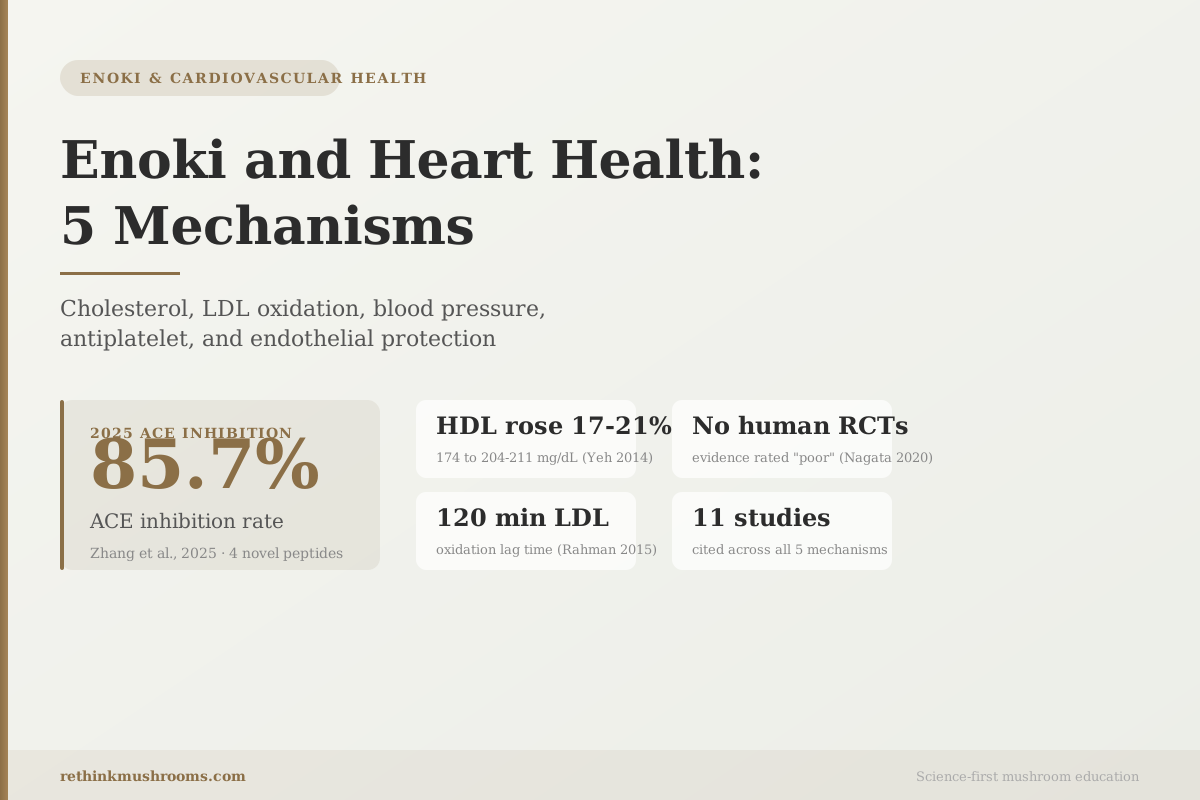
Enoki & Cardiovascular Health
85.73% ACE inhibition rate
Four novel ACE-inhibitory peptides from enoki protein hydrolysates achieved 85.73% angiotensin-converting enzyme inhibition in a 2025 study, targeting the same enzyme that a major class of blood pressure drugs blocks.
Zhang et al., 2025
5 mechanisms
distinct cardiovascular pathways: cholesterol, LDL oxidation, blood pressure, antiplatelet, endothelial
HDL rose
from 174 to 204-211 mg/dL in hamsters fed enoki (Yeh et al., 2014)
No human RCTs
systematic review found mushroom cardiovascular evidence inconclusive in humans, though lipid and blood-pressure benefits are plausible (Krittanawong et al., 2021)
Zhang et al., 2025
 View as image ↗
The heart health evidence for enoki mushrooms is both more specific and more limited than most consumer coverage suggests. More specific: researchers have identified at least five distinct mechanisms by which enoki compounds interact with the cardiovascular system, from cholesterol metabolism to blood pressure regulation to the protection of artery-wall cells. More limited: a 2021 systematic review concluded that mushroom consumption has not been shown to conclusively affect cardiovascular risk factors in humans, meaning the mechanisms are real but their clinical translation has not been rigorously tested in people.
A 2021 prospective study of dietary mushroom intake paired a US national cohort (NHANES) with a meta-analysis of five cohorts totaling more than 600,000 people; the meta-analysis found mushroom consumption associated with lower all-cause mortality, though the single-cohort result on its own did not reach statistical significance.[2] This is a signal about mushrooms broadly, not enoki specifically, but it provides population-level motivation to take the mechanistic research seriously. The mechanistic research explains plausible reasons why this population signal might exist. Together, they make a case that is honest about its evidence level while still substantive.
This article covers all five cardiovascular mechanisms documented in enoki research, with the specific studies and numbers behind each one. For the enoki species overview, what is enoki mushroom covers the full context.
Key Takeaways
- Enoki mushrooms have five documented cardiovascular mechanisms: cholesterol lowering, LDL oxidation inhibition, ACE inhibition (blood pressure), antiplatelet and antithrombotic activity, and endothelial protection via ergothioneine
- A 2014 hamster study found enoki supplementation raised HDL from 174 to 204-211 mg/dL while lowering total cholesterol, triglycerides, and LDL; enoki fiber showed cholesterol-lowering effects comparable to shiitake and maitake fiber in a head-to-head comparison (Fukushima 2001)
- Enoki polyphenols extended LDL oxidation lag time by up to 120 minutes in vitro, directly addressing the step in atherosclerosis where oxidized LDL initiates arterial plaque formation (Rahman 2015)
- Four novel ACE-inhibitory peptides from enoki protein hydrolysates achieved 85.73% ACE inhibition in 2025 research, with IC50 of 0.83 mg/mL (Zhang 2025)
- Ergothioneine from enoki suppressed ICAM-1 and E-selectin expression on human aortic endothelial cells and reduced monocyte adhesion in a 2010 lab study (Martin 2010)
- Wild Flammulina velutipes is cardiotoxic in animals; commercially cultivated white enoki does not carry this risk and is the form relevant to all health research (Mustonen 2018)
The Evidence Framework: What Systematic Reviews Say First
Before covering the five mechanisms, the honest framing comes from Krittanawong and colleagues' 2021 systematic review of mushroom consumption and cardiovascular health, published in The American Journal of Medicine.[1]
Screening more than 1,400 records, the review identified seven prospective studies and found that mushroom consumption may favorably alter lipid profiles — LDL, HDL, total cholesterol, and triglycerides — and is probably associated with lower mean blood pressure. Critically, the authors concluded that mushroom consumption has not been shown to conclusively affect cardiovascular risk factors, reflecting the small number of human studies. The review did not find sufficient evidence to make clinical cardiovascular recommendations.
This framing matters: the five mechanisms below are real, documented at the mechanistic and animal level, but none have been confirmed in adequately powered human clinical trials. The Tang 2016 comprehensive review of F. velutipes established that enoki specifically has antithrombotic, antihypertensive, hypocholesterolaemic, and antioxidant properties across multiple bioactive compound classes.[8] These properties are the research basis for the five mechanisms below.
Evidence Hierarchy
Enoki & the Heart — A Wide Preclinical Base and One Empty Human Rung
Read bottom-up: the five cardiovascular mechanisms rest on molecular and in-vitro work and on animal models, with human evidence only at the observational level for mushrooms in general. Bar width reflects how much direct evidence sits at each tier — narrower toward the top means closer to human outcomes but less data, until the top rung, where enoki-specific human trials simply do not exist.
Molecular & in-vitro mechanisms
evidenceZhang 2025 · Rahman 2015 · Martin 2010 · Kim 2002 · Poniedzialek 2019
Four ACE-inhibitory peptides at 85.73% inhibition; polyphenols extending LDL oxidation lag time by up to 120 minutes; ergothioneine suppressing endothelial adhesion molecules; the highest ACE activity among 20 screened basidiomycetes; and platelet/coagulation screening
Whole-food & animal models
evidenceYeh 2014 · Fukushima 2001 · Luo 2022
Hamsters fed enoki: HDL rose from 174 to 204-211 mg/dL while total cholesterol, triglycerides, and LDL fell. Enoki fiber raised hepatic LDL-receptor activity in rats; enoki mycelia lowered triglycerides in high-fat-diet mice
Human observational data (mushrooms broadly)
evidenceBa 2021 · Krittanawong 2021
Not enoki-specific: a meta-analysis of five cohorts (>600,000 people) linked mushroom consumption to lower all-cause mortality, and a systematic review found plausible lipid and blood-pressure benefits — but concluded the evidence is not conclusive
Human randomized controlled trial on enoki
gapDoes not yet exist
No RCT has tested enoki on cholesterol, blood pressure, clotting, or any cardiovascular outcome in people. Every mechanism above remains preclinical until this rung is filled
How to read it: the molecular, in-vitro, and animal tiers are wide because independent labs have documented each of the five mechanisms in detail. The human tier is narrower and deliberately hedged — it covers mushrooms in general, not enoki, and rests on observational data rather than experiments. The top rung is empty: no randomized trial has tested enoki on a cardiovascular outcome in people. That empty rung, not the strength of the tiers beneath it, is the honest limit of the enoki heart-health story.
Sources: Krittanawong 2021 [1]; Ba 2021 [2]; Yeh 2014 [3]; Fukushima 2001 [4]; Luo 2022 [5]; Rahman 2015 [6]; Zhang 2025 [7]; Poniedzialek 2019 [9]; Martin 2010 [10]; Kim 2002 [12]. Bar widths are illustrative of evidence depth per tier, not quantitative effect sizes.
Mechanism 1: Cholesterol Lowering via Fiber, Polysaccharides, and Mycosterol
The most studied cardiovascular effect of enoki is cholesterol reduction, with evidence from multiple independent research groups.
Yeh and colleagues fed male hamsters 3 percent enoki mushroom powder or extract for 8 weeks and measured lipid profiles at the end.[3] Total cholesterol, triglycerides, and LDL all fell significantly compared to control. HDL (the "good" cholesterol) rose from 174 mg/dL in the control group to 204-211 mg/dL in the enoki groups. The HDL result is underreported in consumer coverage of this study; most sources focus on LDL reduction but the HDL improvement is arguably the more notable finding.
Fukushima and colleagues (2001) ran a head-to-head comparison of dietary fibers from enoki, shiitake, and maitake mushrooms in rats fed a cholesterol-containing diet.[4] Enoki fiber significantly reduced serum total cholesterol compared to control. Mechanistically, the study found increased hepatic LDL receptor activity in the enoki fiber group, meaning the liver was pulling more LDL out of circulation. This is the same mechanism by which statins are thought to partially work, though through a different upstream pathway.
Luo and colleagues (2022) added more recent evidence that the lipid-modulating effects extend to the mycelial fraction (the root-like fungal filaments, not just the fruiting body used as food).[5] F. velutipes mycorrhizae supplementation at 4 percent reduced plasma and liver triglycerides and altered fatty acid profiles in high-fat diet mice, with changes in lipid metabolism gene expression.
The cholesterol-lowering mechanisms include dietary fiber binding bile acids in the gut, polysaccharides directly modulating lipid metabolism gene expression, and mycosterol competing with dietary cholesterol for intestinal absorption. These are three independent pathways operating in the same direction. For deeper coverage, see enoki and cholesterol reduction: lipid-lowering evidence.
Mechanism 2: LDL Oxidation Inhibition
LDL cholesterol becomes most damaging to artery walls when it is oxidized by free radicals in circulation. Oxidized LDL triggers the macrophage and foam cell formation that begins arterial plaques. Slowing LDL oxidation is a direct upstream cardiovascular intervention.
Rahman and colleagues (2015) tested polyphenolic fractions from F. velutipes against human LDL in a standardized oxidation assay.[6] The enoki polyphenols extended the LDL oxidation lag time by up to 120 minutes, meaning the time before measurable oxidation damage began was lengthened by two hours compared to the unprotected LDL. The specific flavonoids identified in the active fraction included arbutin, epicatechin, phillyrin, apigenin, kaempferol, and formononetin.
The study authors framed the finding directly: since LDL oxidation is the initiating step in atherosclerotic pathogenesis, this represents an upstream intervention at the precise point where plaque formation begins. For fuller coverage, see enoki and endothelial health: vascular protection research.
Mechanism 3: ACE Inhibitory Peptides and Blood Pressure
ACE (angiotensin-converting enzyme) is the enzyme that converts an inactive precursor into angiotensin II, a hormone that constricts blood vessels and raises blood pressure. ACE inhibitor drugs (the "-pril" class: lisinopril, enalapril, etc.) are among the most prescribed cardiovascular medications globally. Food-derived ACE inhibitory peptides that reach this same enzyme are a well-studied area of functional food science.
Enoki mushrooms have a documented history of ACE inhibitory activity. Kim and colleagues first identified this in 2002: among the culture broths of 20 basidiomycetes they screened, Flammulina velutipes produced the highest ACE inhibitory activity, at 52.8 percent.[12] The most recent data, from Zhang and colleagues in 2025, identifies four specific ACE-inhibitory peptides from enoki protein hydrolysates: FAGGP, FDGY, FHPGY, and WADP.[7]
The overall ACE inhibition rate from these peptides was 85.73 percent, with an IC50 of 0.83 mg/mL. Molecular docking analysis confirmed the binding energies of each peptide to the ACE active site (ranging from -9.4 to -10.3 kcal/mol), providing structural confirmation of the inhibitory mechanism.
Important context: these ACE inhibitory peptides were tested in vitro, not in a human blood pressure trial. Food-derived ACE inhibitory peptides typically show reduced potency after full digestion and absorption compared to their in vitro measurements. The in vitro finding is a promising mechanistic signal, not evidence that eating enoki lowers blood pressure in people. For full coverage, see enoki and blood pressure: anti-hypertensive research.
Mechanism 4: Antiplatelet and Antithrombotic Properties
Blood clots form when platelets aggregate and the coagulation cascade is activated. Compounds that reduce platelet aggregation or slow clotting (without causing excessive bleeding) are antithrombotic.
Poniedzialek and colleagues (2019) screened eight edible mushroom species for platelet and coagulation effects in a standardized in vitro assay.[9] The study demonstrated differential antiplatelet and anticoagulant activity across species. Enoki was among the species tested, contributing to the dataset showing that culinary mushrooms broadly have blood-modifying properties in laboratory conditions.
Tang's 2016 comprehensive review of F. velutipes biology formally documented antithrombotic activity as one of enoki's established biological properties, alongside the antihypertensive and cholesterol-lowering effects.[8]
The mechanism is thought to involve polysaccharides and polyphenols inhibiting platelet aggregation pathways in blood. The evidence is entirely in vitro and no human clotting trials for enoki exist. The antiplatelet evidence should not be interpreted as a reason to combine enoki with anticoagulant medications. For full detail, see enoki and blood clot prevention: antiplatelet activity.
Mechanism 5: Endothelial Protection via Ergothioneine
Endothelial cells line every blood vessel. Their inflammation triggers the adhesion of monocytes (immune cells) to artery walls, beginning atherosclerosis. Protecting endothelial cells from inflammation is the most upstream cardiovascular intervention possible.
Martin and colleagues (2010) showed that ergothioneine at concentrations achievable from dietary sources suppressed the inflammation-triggered expression of ICAM-1 and E-selectin (the adhesion molecules that make endothelial surfaces sticky for monocytes) on human aortic endothelial cells, reducing monocyte binding.[10]
Enoki mushrooms contain 0.4–2.0 mg ergothioneine per gram of dry weight, placing them among the significant dietary sources of this compound. Ergothioneine is thermally stable and survives cooking, which means it is present and active in enoki after standard preparation. The connection between eating enoki mushrooms and endothelial protection via ergothioneine is mechanistically plausible but has not been tested in a human vascular study. For full depth, see enoki and endothelial health: vascular protection research.
Safety Note: Wild vs. Cultivated Enoki Is Not the Same Product
Mustonen and colleagues (2018) published animal data showing that wild Flammulina velutipes causes cardiac muscle toxicity.[11] The compound responsible is present at much higher concentrations in the wild brown-capped forest form than in commercially cultivated white enoki grown under controlled indoor conditions.
Commercial white enoki (the thin, bundled variety in sealed plastic bags at grocery stores) is a phenotypically different product from wild Flammulina. All the cardiovascular research above was conducted with cultivated materials. Wild-harvested Flammulina should not be treated as equivalent to commercially cultivated enoki for health purposes.
The Bottom Line
Enoki mushrooms have at least five distinct cardiovascular mechanisms documented in preclinical research: cholesterol lowering through dietary fiber, polysaccharides, and mycosterol; LDL oxidation inhibition by polyphenols extending the lag time by up to 120 minutes; ACE inhibitory peptides achieving 85.73% in vitro inhibition; antiplatelet and antithrombotic properties; and endothelial protection via ergothioneine blocking monocyte adhesion. A 2021 systematic review concluded that human cardiovascular evidence for mushroom consumption remains inconclusive. Commercial cultivated white enoki is safe; wild Flammulina is not. This article is educational and is not medical advice.
Frequently Asked Questions
Sources & References
- 1RTHM-01376·Krittanawong, Chayakrit et al. (2021). “Mushroom Consumption and Cardiovascular Health: A Systematic Review..” The American journal of medicine.Study breakdown →PubMed →↩
- 2RTHM-00674·Ba, Djibril M et al. (2021). “Prospective study of dietary mushroom intake and risk of mortality: results from continuous National Health and Nutrition Examination Survey (NHANES) 2003-2014 and a meta-analysis..” Nutrition journal.Study breakdown →PubMed →↩
- 3RTHM-00663·Yeh, Ming-Yei et al. (2014). “Hypolipidemic and antioxidant activity of enoki mushrooms (Flammulina velutipes)..” BioMed research international.Study breakdown →PubMed →↩
- 4RTHM-00075·Fukushima, M et al. (2001). “Cholesterol-lowering effects of maitake (Grifola frondosa) fiber, shiitake (Lentinus edodes) fiber, and enokitake (Flammulina velutipes) fiber in rats..” Experimental biology and medicine (Maywood.Study breakdown →PubMed →↩
- 5RTHM-01575·Luo, Zhen et al. (2022). “Flammulina velutipes Mycorrhizae Attenuate High Fat Diet-Induced Lipid Disorder, Oxidative Stress and Inflammation in the Liver and Perirenal Adipose Tissue of Mice..” Nutrients.Study breakdown →PubMed →↩
- 6RTHM-00729·Rahman, Mohammad Azizur et al. (2015). “Antioxidative Effects and Inhibition of Human Low Density Lipoprotein Oxidation In Vitro of Polyphenolic Compounds in Flammulina velutipes (Golden Needle Mushroom)..” Oxidative medicine and cellular longevity.Study breakdown →PubMed →↩
- 7RTHM-02218·Zhang, Yajie et al. (2025). “Activity Analysis and Inhibition Mechanism of Four Novel Angiotensin I-Converting Enzyme Inhibitory Peptides Prepared from Flammulina velutipes by Enzymatic Hydrolysis..” Foods (Basel.Study breakdown →PubMed →↩
- 8RTHM-00831·Tang, Calyn et al. (2016). “Golden Needle Mushroom: A Culinary Medicine with Evidenced-Based Biological Activities and Health Promoting Properties..” Frontiers in pharmacology.Study breakdown →PubMed →↩
- 9RTHM-01114·Poniedziałek, Barbara et al. (2019). “The Effect of Mushroom Extracts on Human Platelet and Blood Coagulation: In vitro Screening of Eight Edible Species..” Nutrients.Study breakdown →PubMed →↩
- 10RTHM-00353·Martin, Keith R (2010). “The bioactive agent ergothioneine, a key component of dietary mushrooms, inhibits monocyte binding to endothelial cells characteristic of early cardiovascular disease..” Journal of medicinal food.Study breakdown →PubMed →↩
- 11RTHM-00986·Mustonen, Anne-Mari et al. (2018). “Myo- and cardiotoxic effects of the wild winter mushroom ( Flammulina velutipes) on mice..” Experimental biology and medicine (Maywood.Study breakdown →PubMed →↩
- 12RTHM-00094·Kim, J M et al. (2002). “Optimization of submerged culture conditions for the production of angiotensin converting enzyme inhibitor from Flammulina velutipes..” Journal of industrial microbiology & biotechnology.Study breakdown →PubMed →↩