Mushrooms & Atherosclerosis Prevention
7 ganoderic acids
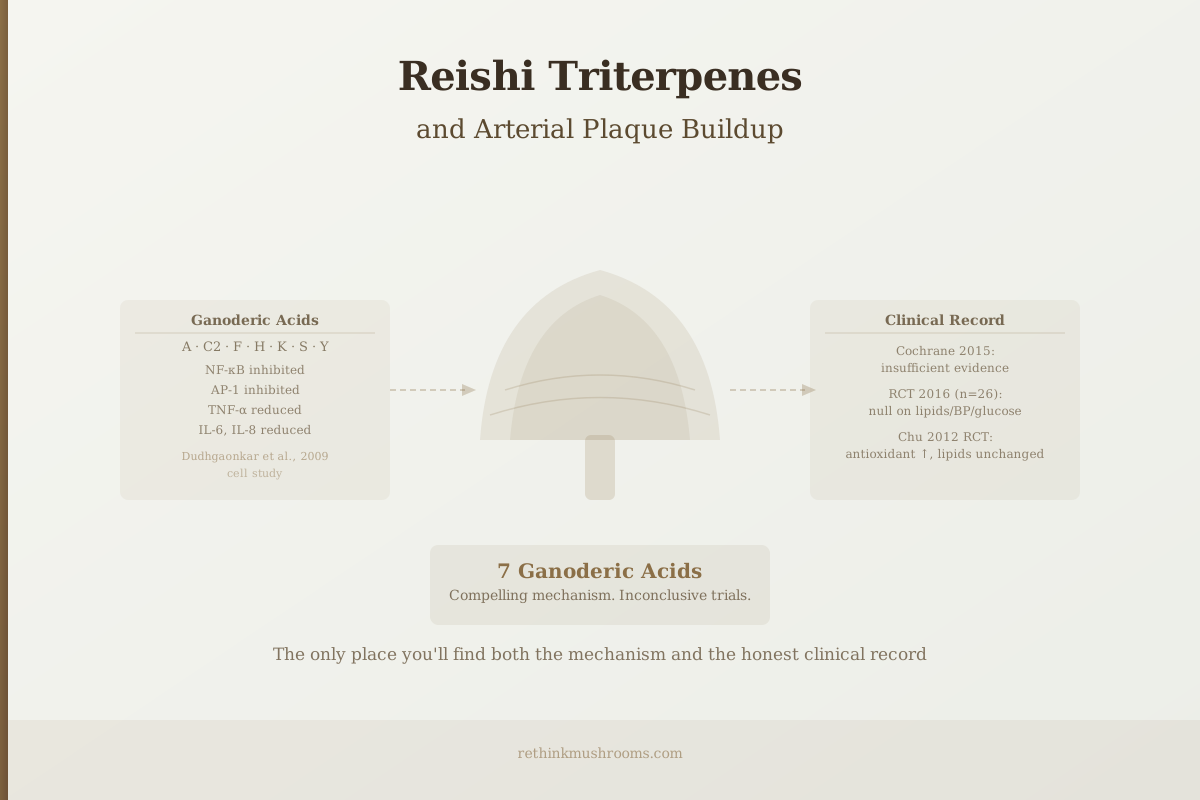
Seven specific ganoderic acids from reishi — A, C2, F, H, K, S, and Y — suppress NF-κB and AP-1 signaling and reduce secretion of pro-atherogenic cytokines TNF-α, IL-6, and IL-8. No competitor article names them.
Dudhgaonkar et al., International Immunopharmacology, 2009
Cochrane
2015 review found insufficient clinical evidence for reishi on CVD risk factors
n=26
the only reishi cardiovascular RCT: no significant improvement in lipids after 16 weeks
LDL oxidation
inhibited concentration-dependently in vitro by reishi — a real but unproven-in-humans effect
Dudhgaonkar et al., International Immunopharmacology, 2009
 View as image ↗
Reishi triterpenes and arterial plaque — every supplement company article you will find on this topic makes the same claims: ganoderic acids lower inflammation, reishi protects against heart disease, the evidence is compelling. What none of those articles tell you is that a 2015 Cochrane systematic review concluded there is insufficient evidence to support using reishi for cardiovascular risk factors, and that the only dedicated RCT — 26 people, 16 weeks — found no statistically significant improvement in blood pressure, lipids, or blood glucose.
This article covers both sides of the evidence: the specific ganoderic acid mechanisms that are compelling and reproducible in cell and animal studies, and the clinical trial record that is short, small, and so far inconclusive. That honesty is the competitive advantage here. Supplement sites never tell you about the Cochrane review. This is the only place you'll find the full picture.
For context on how reishi compares to other mushrooms for cardiovascular protection, Mushrooms That Lower Cholesterol: What the Research Shows covers multi-species evidence including cholesterol data across shiitake, oyster, and others. For the cholesterol-specific reishi mechanism, Reishi and Cholesterol Management: Triterpene Mechanisms covers that angle as a companion piece in the same cardiovascular cluster.
Key Takeaways
- Seven ganoderic acids (A, C2, F, H, K, S, Y) from reishi suppress NF-κB and AP-1 signaling and reduce TNF-α, IL-6, and IL-8 — the pro-atherogenic cytokines that drive arterial plaque inflammation (Dudhgaonkar et al., 2009)
- Reishi inhibited human LDL oxidation in a concentration-dependent manner in vitro, connecting its triterpene content to the specific lipid oxidation mechanism that initiates plaque formation (Rahman et al., 2018)
- A controlled human trial found that reishi improved antioxidant capacity — reducing plasma 8-isoprostane — but did not significantly improve lipid profiles (Chu et al., British Journal of Nutrition, 2012)
- A 2015 Cochrane review concluded that evidence for reishi improving cardiovascular risk factors is insufficient: trials were few, small, and short (Klupp et al., 2015)
- The only dedicated reishi cardiovascular RCT (n=26, 16 weeks) found no statistically significant changes in blood pressure, lipids, or glucose in metabolic syndrome patients (Klupp et al., 2016)
- The gap between compelling mechanism and inconclusive clinical trial is the honest state of reishi cardiovascular evidence — and no competitor article will say so
The Molecular Case: What Ganoderic Acids Actually Do
The reason reishi has attracted cardiovascular research is specific. The ganoderic acids — a family of triterpene compounds unique to Ganoderma lucidum — have documented activity on two of the molecular targets most directly implicated in atherosclerotic plaque formation.
Dudhgaonkar et al. 2009 in International Immunopharmacology tested seven isolated ganoderic acids against two central inflammatory signaling pathways: NF-κB and AP-1.[1] NF-κB is the master switch for pro-inflammatory gene expression — when it activates, cells produce a cascade of inflammatory mediators including the cytokines that recruit immune cells to arterial walls. AP-1 is a complementary transcription factor involved in cell proliferation and inflammation.
The ganoderic acids tested — A, C2, F, H, K, S, and Y — all suppressed both pathways. The downstream readout was what matters for atherosclerosis: reduced secretion of TNF-α, IL-6, and IL-8 from the activated cells. These three cytokines are elevated in the coronary arteries of patients with atherosclerosis. TNF-α drives endothelial cell activation and VCAM-1 expression. IL-6 promotes the acute-phase response and contributes to plaque instability. IL-8 is a potent monocyte chemoattractant — it signals monocytes to migrate toward sites of vascular inflammation.
This is not generic anti-inflammatory data. These specific cytokines act on the specific molecular machinery of atherosclerosis, and seven named ganoderic acids suppressed them through two well-characterized signaling pathways. No competitor article on reishi and heart health names these acids or these pathways.
LDL Oxidation: The Upstream Mechanism
The second mechanistic pillar of reishi's cardiovascular case is LDL oxidation inhibition. Rahman et al. 2018 in the International Journal of Medicinal Mushrooms found that reishi demonstrated concentration-dependent inhibition of human LDL oxidation in vitro.[4]
Oxidized LDL is the proximate trigger for endothelial cell damage and VCAM-1 expression — the chain of events that initiates monocyte recruitment and foam cell formation. If reishi compounds protect LDL from oxidative modification, they interrupt atherosclerosis before the adhesion molecule cascade even begins. The same Rahman 2018 study also showed hypo-cholesterolemic effects in hyperlipidemic animal models, suggesting the polysaccharide and triterpene components together address both LDL quality (oxidation) and LDL quantity (circulating levels).
The Amirullah 2018 systematic review in Food Research International identified reishi as one of the species with multi-mechanism activity: antioxidant, anti-inflammatory, and hypolipidemic pathways all documented across the literature.[6]
Enoki mushrooms provide an interesting comparative point here. Rahman et al. 2015 found that enoki polyphenolic fractions also inhibited human LDL oxidation through a different chemical mechanism — polyphenol radical scavenging rather than triterpene metal chelation.[7] This suggests LDL oxidation inhibition is a broad property of mushroom antioxidants, not unique to reishi.
The detailed breakdown of how the full atherosclerosis cascade is interrupted across multiple mushroom species and compounds is covered in Mushrooms and Atherosclerosis Prevention: Anti-Plaque Research, which places reishi's triterpene mechanism in the context of the Kim 2019 plaque size data and the NHANES mortality studies.
Why the Mechanisms Are Compelling Versus Why the Trials Are Not
Here is the table no supplement company will publish:
| Study | Type | Key Finding |
|---|---|---|
| Dudhgaonkar 2009 | In vitro | 7 ganoderic acids suppress NF-κB, AP-1, TNF-α, IL-6, IL-8 |
| Rahman 2018 | In vitro / animal | Concentration-dependent LDL oxidation inhibition; hypolipidemic in animals |
| Chu 2012 | RCT | Improved antioxidant capacity; lipid profiles unchanged |
| Klupp 2015 | Cochrane review | Insufficient evidence for CVD risk factor improvement |
| Klupp 2016 | RCT, n=26 | No significant change in blood pressure, lipids, or glucose at 16 weeks |
The pattern is consistent with what often happens in nutraceutical research: cell and animal studies produce compelling mechanism data; controlled human trials produce smaller or null results. This gap is not unique to reishi — it appears across many dietary compounds that show strong preclinical cardiovascular signals.
Why might cell studies overestimate human effects? Several reasons. The concentrations of ganoderic acids in cell studies often exceed what is achievable through oral supplementation. Absorption and bioavailability of triterpenes from oral reishi preparations are not well characterized. The human cardiovascular system is more complex than cell culture, with multiple compensatory mechanisms that reduce the measurable impact of any single intervention.
What the Cochrane Review Said — and Why It Matters
The 2015 Cochrane review by Klupp et al. is the highest-quality synthesis of reishi cardiovascular evidence available.[2] Cochrane reviews are designed to minimize bias: they include all available trials meeting quality criteria, assess trial design rigorously, and report conclusions based on the totality of controlled evidence rather than cherry-picked studies.
The conclusion on reishi and cardiovascular risk factors was that available trials were too few, too small, and too short to support clinically meaningful conclusions. The reviewers also flagged inadequate safety data — meaning that at the time of the review, there was not sufficient data even to assess whether reishi supplementation carries risks in cardiovascular patients.
This conclusion does not mean reishi has no effect on cardiovascular risk. It means the evidence base to evaluate that effect in humans did not exist in 2015 and has not substantially grown since.
The 2016 RCT: The Specific Numbers
Klupp et al. 2016 in Scientific Reports conducted the dedicated reishi cardiovascular trial.[3] Twenty-six participants with metabolic syndrome received either reishi extract or placebo for 16 weeks in a double-blind design. Metabolic syndrome is the highest-risk population for cardiovascular outcomes and the most logical target for testing a cardiovascular intervention.
The results: no statistically significant improvements in blood pressure, lipid profiles, or blood glucose. This was not a borderline result — the effect sizes were small and the confidence intervals crossed zero.
The trial's limitations are real. Twenty-six participants is a small sample, and the study may have lacked statistical power to detect modest effects. Sixteen weeks may be too short for dietary interventions to shift atherosclerotic risk factors meaningfully. The dose and preparation of reishi extract may not have optimized bioavailability of the active compounds. These caveats are worth noting — but they cannot convert a null result into positive evidence. The study found what it found.
Where Reishi's Antioxidant Evidence Lands
The one positive human signal is from Chu et al. 2012 in the British Journal of Nutrition.[5] This controlled trial measured plasma 8-isoprostane — a biomarker of oxidative stress and lipid peroxidation — alongside lipid profiles. Reishi supplementation reduced plasma 8-isoprostane: a measurable improvement in systemic antioxidant status. Lipid profiles, however, did not significantly change.
This is the nuance that separates an honest assessment from supplement marketing. Reishi appears to reduce measurable oxidative stress in humans. But the clinical outcome that matters most — lipid profile improvement as a proxy for cardiovascular risk — was not affected. Antioxidant capacity and lipid levels are related but distinct. You can have lower oxidative stress and the same LDL cholesterol.
This partial effect matters for the endothelial damage mechanism covered in this cluster: if reishi reduces systemic lipid peroxidation, it may reduce the oxidized LDL burden that triggers endothelial activation, even without changing total LDL. That is a biologically plausible partial effect that the Chu 2012 data supports. But it is a hypothesis, not a demonstrated outcome.
The Honest Summary on Reishi and Plaque
Reishi triterpenes have specific, named, reproducible activity on the molecular machinery of atherosclerosis. Seven ganoderic acids suppress the inflammatory signaling pathways that drive arterial plaque growth. Reishi inhibits LDL oxidation in cell studies. These are real, well-characterized mechanisms.
The clinical evidence does not yet confirm these mechanisms translate to cardiovascular benefit in humans. One small RCT found null effects on lipid panels. A Cochrane review found the evidence base insufficient. One controlled trial found improved antioxidant capacity but unchanged lipids.
The gap between these two bodies of evidence is normal in nutraceutical research and does not resolve cleanly in either direction. What it means in practice: reishi has the most pharmacologically specific anti-inflammatory cardiovascular mechanism in the mushroom family, and the least clinical trial support for translating that mechanism into human benefit.
The Bottom Line
Reishi's ganoderic acids suppress the specific inflammatory pathways that drive arterial plaque growth, and reishi inhibits LDL oxidation in vitro — but the only dedicated human RCT found no significant changes in cardiovascular risk factors, and a Cochrane review concluded the clinical evidence is insufficient. The mechanism is real; the clinical translation is unproven.
Frequently Asked Questions
Sources & References
- 1RTHM-00152·Dudhgaonkar, Shailesh et al. (2009). “Suppression of the inflammatory response by triterpenes isolated from the mushroom Ganoderma lucidum..” International immunopharmacology.Study breakdown →PubMed →↩
- 2RTHM-00380·Klupp, Nerida L et al. (2015). “Ganoderma lucidum mushroom for the treatment of cardiovascular risk factors..” The Cochrane database of systematic reviews.Study breakdown →PubMed →↩
- 3RTHM-00429·Klupp, Nerida L et al. (2016). “A double-blind, randomised, placebo-controlled trial of Ganoderma lucidum for the treatment of cardiovascular risk factors of metabolic syndrome..” Scientific reports.Study breakdown →PubMed →↩
- 4RTHM-00997·Rahman, Mohammad Azizur et al. (2018). “Evaluation of the Antioxidative and Hypo-cholesterolemic Effects of Lingzhi or Reishi Medicinal Mushroom, Ganoderma lucidum (Agaricomycetes), in Ameliorating Cardiovascular Disease..” International journal of medicinal mushrooms.Study breakdown →PubMed →↩
- 5RTHM-00247·Chu, Tanya T W et al. (2012). “Study of potential cardioprotective effects of Ganoderma lucidum (Lingzhi): results of a controlled human intervention trial..” The British journal of nutrition.Study breakdown →PubMed →↩
- 6RTHM-00937·Amirullah, Nur Amalina et al. (2018). “The potential applications of mushrooms against some facets of atherosclerosis: A review..” Food research international (Ottawa.Study breakdown →PubMed →↩
- 7RTHM-00729·Rahman, Mohammad Azizur et al. (2015). “Antioxidative Effects and Inhibition of Human Low Density Lipoprotein Oxidation In Vitro of Polyphenolic Compounds in Flammulina velutipes (Golden Needle Mushroom)..” Oxidative medicine and cellular longevity.Study breakdown →PubMed →↩