Mushrooms & Cardiovascular Health
58.7% ACE Inhibition
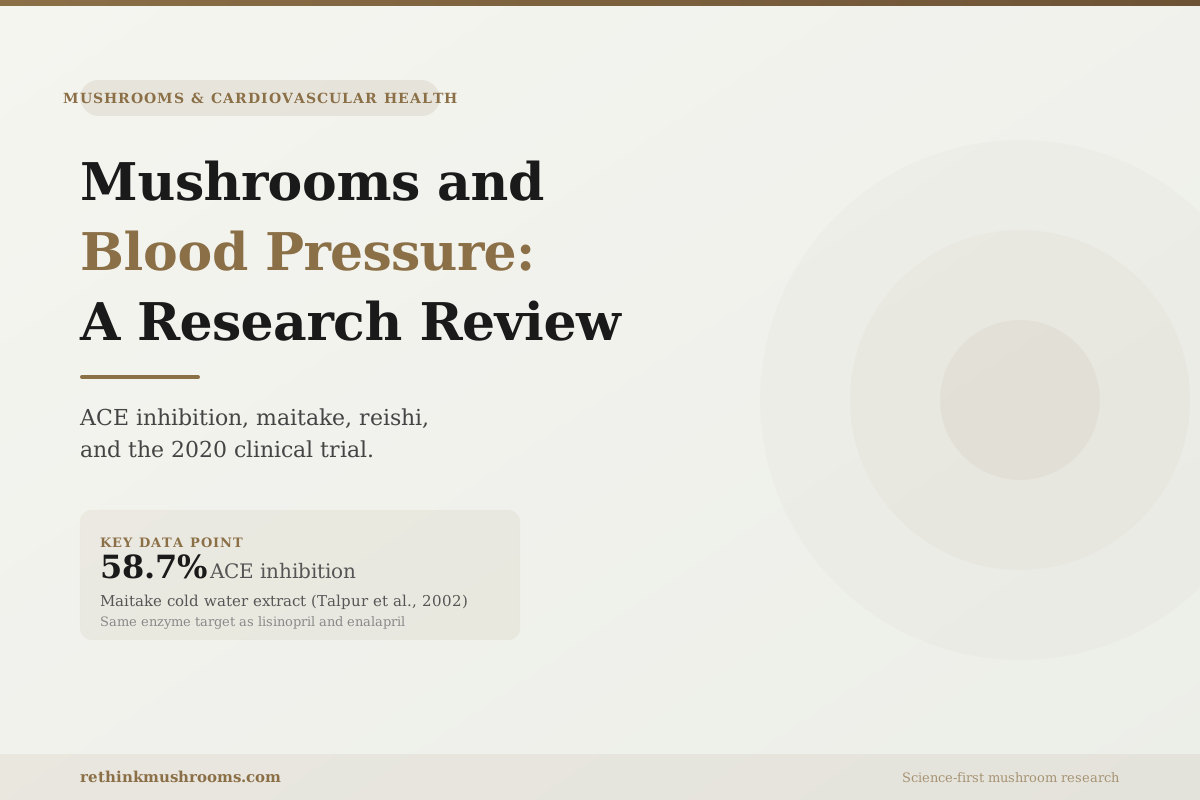
Maitake cold water extract showed 58.7% inhibition of angiotensin-converting enzyme, the molecular target of drugs like lisinopril, in research by Talpur et al. (Molecular and Cellular Biochemistry, 2002).
Talpur et al., Molecular and Cellular Biochemistry, 2002
2020 RCT
a randomized clinical trial found mushroom-enriched diet reduced pregnancy-induced hypertension risk, the only human trial of dietary mushrooms for blood pressure
4 Mechanisms
mushrooms reduce blood pressure through ACE inhibition, potassium, dietary fiber, and anti-inflammatory effects on blood vessel walls
DASH Diet
mushrooms are incorporated in DASH diet frameworks, both proven antihypertensive dietary patterns, per the 2023 Phytotherapy Research review
Talpur et al., Molecular and Cellular Biochemistry, 2002
 View as image ↗
Hypertension, persistently elevated blood pressure, affects roughly one in three adults worldwide and is the leading modifiable risk factor for heart attack and stroke. Treatment relies mostly on medication. The dietary advice associated with blood pressure management, specifically the DASH diet and Mediterranean diet frameworks, tends to focus on sodium reduction, potassium-rich vegetables, and whole grains. What those frameworks also include, and what consumer health content rarely discusses in any detail, is mushrooms.
A 2023 comprehensive review in Phytotherapy Research by Rauf and colleagues confirmed that multiple mushroom species reduce blood pressure through at least four distinct mechanisms, and that mushrooms appear explicitly in DASH diet compositions.[1] The most credible human evidence comes from a 2020 randomized clinical trial in which a mushroom-enriched diet reduced the risk of pregnancy-induced hypertension, a serious complication affecting roughly 10% of pregnancies.[2] The mushrooms blood pressure research base extends back to 1987 and includes animal studies, in vitro mechanism work, and that human trial. For the broader picture of mushrooms and cardiovascular health, the mushroom cardiovascular health guide covers cholesterol, blood thinning, and other mechanisms alongside blood pressure.
Key Takeaways
- Multiple mushroom species reduce blood pressure through ACE inhibition: maitake showed 58.7% ACE inhibition in cold water extract testing (Talpur et al., 2002); reishi peptides reduced blood pressure to levels comparable to the ACE inhibitor drug losartan at 7 weeks in animal research (Tran et al., 2014)
- A 2020 randomized clinical trial by Sun and colleagues found that a mushroom-enriched diet during pregnancy significantly reduced the incidence of pregnancy-induced hypertension, the strongest human evidence in this research base
- Mushrooms appear in DASH diet and Mediterranean diet frameworks, both clinically validated antihypertensive dietary patterns, per the 2023 Rauf comprehensive review in Phytotherapy Research
- The blood pressure-reducing mechanisms of mushrooms include ACE inhibitory peptides, high potassium content (which promotes sodium excretion and vessel relaxation), dietary fiber (which reduces arterial stiffness), and anti-inflammatory effects on blood vessel walls
- Among commercially available species, maitake (Grifola frondosa) and reishi (Ganoderma lucidum) have the most characterized antihypertensive mechanisms; shiitake and maitake together have the oldest animal evidence base, dating from the original Kabir and Kimura studies published in 1987 and 1989
Mushrooms in the DASH Diet: The Blood Pressure Connection Nobody Explains
The DASH diet, which stands for Dietary Approaches to Stop Hypertension, is the most extensively evidence-backed dietary pattern for blood pressure management. Its core features are well-known: high potassium, high magnesium, high fiber, low sodium, low saturated fat. Less well-known is that mushrooms fit within this framework and are explicitly included in the dietary pattern.
The 2023 review by Rauf and colleagues in Phytotherapy Research documented the mechanisms by which mushroom species contribute to antihypertensive dietary patterns.[1] The key bioactive contributors identified include amino acids, dietary fiber, specific proteins, sterols, B vitamins, and minerals, particularly potassium and zinc. Multiple ACE inhibitory compounds were identified across species.
The potassium connection is straightforward. Blood pressure is strongly influenced by the sodium-potassium balance in the body. High dietary potassium promotes renal sodium excretion (the kidneys flush out more sodium when potassium is high), reduces fluid retention, and directly relaxes blood vessel walls through effects on smooth muscle cells. Mushrooms are a meaningful potassium source: 100g of shiitake contains approximately 300mg of potassium; portobello mushrooms contain around 440mg per 100g, comparable to the potassium in a medium banana.
The fiber connection is less obvious but documented: the beta-glucan dietary fiber in mushrooms reduces arterial stiffness through mechanisms related to cholesterol and inflammation. Blood vessels become stiffer as they accumulate cholesterol plaques and as chronic inflammation damages the inner lining. Beta-glucan fiber reduces both. Stiffer arteries require higher blood pressure to push blood through them; less stiff arteries require less pressure.
The anti-inflammatory dimension connects to the inner lining of blood vessels, called the endothelium. Chronic low-grade inflammation damages endothelial cells and reduces their ability to produce nitric oxide, the molecule that signals smooth muscle in vessel walls to relax. Mushroom compounds, including ergothioneine and polysaccharides, reduce systemic inflammation, which indirectly supports endothelial function and vascular flexibility.
The Only Human Clinical Trial: Mushrooms Reduced Hypertension in Pregnancy
The research base for mushrooms and blood pressure is anchored primarily in animal models and in vitro experiments, with one notable exception. A randomized clinical trial published in Food and Nutrition Research in 2020 by Sun and colleagues tested a mushroom-enriched diet against a control diet in pregnant women.[2]
Pregnancy-induced hypertension (high blood pressure that develops during pregnancy, sometimes called gestational hypertension or pre-eclampsia when severe) is a serious complication affecting roughly 10% of pregnancies globally. It increases risk of preterm birth, placental problems, and dangerous outcomes for both mother and fetus. Preventing or delaying its onset has real clinical value.
The trial found that women in the mushroom-enriched diet group had significantly lower incidence of pregnancy-induced hypertension compared to the control group. They also had lower rates of macrosomia, a condition where the baby's birthweight is abnormally high and which is associated with gestational diabetes and delivery complications.
This is a genuine randomized controlled trial with a clinically relevant outcome. Its limitation is population specificity: it was conducted in pregnant women, a population with distinct physiology. The blood pressure-lowering mechanisms involved (potassium, ACE inhibition, anti-inflammation) are generally applicable, but whether the same magnitude of effect would appear in non-pregnant adults cannot be directly extrapolated from this study alone.
What it establishes unambiguously: at dietary intake levels (this was a food-based intervention, not a pharmaceutical extract), mushrooms can produce meaningful blood pressure-related effects in humans in a controlled trial. That is a different category of evidence from animal studies, and it's the data most consumer health content on this topic is missing.
How Mushrooms Inhibit the Same Enzyme That Blood Pressure Drugs Target
The most pharmacologically specific mechanism by which mushrooms reduce blood pressure is ACE inhibition. To understand what that means, a brief explanation of the system it affects.
The renin-angiotensin system is the hormonal cascade that regulates blood pressure through blood vessel tone and fluid balance. When blood pressure drops, the kidneys release a hormone called renin. Renin activates a precursor protein into angiotensin I. Then an enzyme called angiotensin-converting enzyme, or ACE, converts angiotensin I into angiotensin II. Angiotensin II causes blood vessels to constrict, raises blood pressure, and signals the kidneys to retain sodium and water. The most commonly prescribed class of blood pressure medications, ACE inhibitors (drugs like lisinopril, enalapril, and ramipril), works by blocking this enzyme.
Multiple mushroom species contain compounds that inhibit ACE. The most quantified data comes from maitake and reishi.
For maitake, Talpur and colleagues' 2002 study in Molecular and Cellular Biochemistry measured 58.7% ACE inhibition from the cold water extract fraction of maitake powder.[3] This is a substantial inhibition rate; ACE inhibitor drugs typically achieve 70-90% inhibition at therapeutic doses.
For reishi, Tran and colleagues' 2014 study in Molecules identified 11 ACE-inhibitory peptides in reishi auto-digested extract, with four showing potent inhibitory activity at IC50 values between 73.1 and 162.7 micromolar.[4] The IC50 is the concentration needed to reduce enzyme activity by half; a lower number means greater potency. When administered in vivo (in an animal model) over 7 weeks, the reishi extract reduced blood pressure to levels comparable to losartan, a widely used blood pressure medication.
The 2025 comprehensive review of Ganoderma lucidum by Ren and colleagues in Food Science and Nutrition confirmed that ACE inhibition remains a primary antihypertensive mechanism of reishi in current research understanding, alongside anti-inflammatory vascular effects and lipid modulation.[7]
For the detailed mechanistic breakdown of reishi's ACE inhibitory peptides, including the specific amino acid sequences characterized by Wu et al. in 2019, the reishi and hypertension research article covers the full molecular evidence. For maitake's D-fraction mechanism specifically, the maitake D-fraction and blood pressure article goes in depth.
40 Years of Animal Evidence: Why Maitake and Shiitake Still Lead
The animal evidence for mushrooms and blood pressure predates most current interest in functional foods. Kabir and Kimura's 1987 study in the Journal of Nutritional Science and Vitaminology was the first to systematically test both shiitake (Lentinus edodes) and maitake (Grifola frondosa) in spontaneously hypertensive rats, a rat strain bred to develop high blood pressure and widely used as an animal model for hypertension research.[5]
Both species significantly reduced blood pressure compared to controls. Maitake showed a stronger antihypertensive effect than shiitake. Both also reduced plasma lipids. A 1989 follow-up by the same research group confirmed that dietary incorporation of mushrooms (not a concentrated extract, but actual food-level intake) was sufficient to reduce blood pressure in spontaneously hypertensive rats.[6]
The significance of this 40-year-old evidence is its specificity: it was dietary food-level mushroom consumption, not pharmaceutical-grade extracts, that produced the effect. This makes it more relevant to the practical question of whether eating mushrooms regularly has blood pressure effects, as opposed to questions about therapeutic extracts.
The spontaneously hypertensive rat model is imperfect (rodent physiology differs from human physiology in relevant ways), but the consistent results across decades of independent research, combined with mechanistic plausibility from the ACE inhibition and potassium data, builds a convergent evidence case. Single studies rarely establish causation; a pattern of consistent findings across different research groups and model systems carries more weight.
Four Mechanisms: Why Mushrooms Are More Than Just ACE Inhibitors
The Rauf 2023 review in Phytotherapy Research synthesized the mechanisms into a multi-pathway framework that explains why the antihypertensive effect of mushrooms is robust across different species with different polysaccharide profiles.[1]
ACE inhibition through bioactive peptides, as described above, is one mechanism. But several others operate in parallel:
Potassium-mediated vasodilation. Mushrooms are among the richer plant-based sources of potassium. High dietary potassium directly relaxes vascular smooth muscle and promotes renal sodium excretion. This mechanism works independently of ACE inhibition and explains some of the blood pressure effect observed at food-intake levels.
Beta-glucan fiber and arterial stiffness. The same fiber responsible for cholesterol reduction also affects arterial mechanics. Arteries stiffened by inflammation and lipid deposition require higher pressure to carry blood; beta-glucan-driven reductions in cholesterol and inflammation allow arteries to retain flexibility.
Anti-inflammatory endothelial protection. The inner lining of blood vessels produces nitric oxide, a gas that signals blood vessel walls to relax. Chronic inflammation damages endothelial cells and reduces nitric oxide production. Mushroom polysaccharides and ergothioneine reduce inflammatory cytokines in vascular tissue, protecting endothelial function. This anti-inflammatory vascular protection connects to the broader picture of how mushrooms address atherosclerosis prevention.
The multi-mechanism picture also explains why the effect is seen across different mushroom species despite different active compounds: any species with appreciable potassium, beta-glucans, and anti-inflammatory activity will contribute to antihypertensive effects through at least two or three of these pathways, even if ACE inhibitory peptides vary.
For the complete cardiovascular picture, including how blood pressure reduction connects to cholesterol management and the role of reishi triterpenes, the reishi and cholesterol management article covers the overlapping cardiovascular mechanisms.
The Bottom Line
Mushrooms reduce blood pressure through at least four documented mechanisms: ACE inhibitory peptides (maitake at 58.7% ACE inhibition; reishi peptides comparable to losartan), high potassium content, beta-glucan fiber reducing arterial stiffness, and anti-inflammatory effects on blood vessel walls. A 2020 randomized clinical trial found that a mushroom-enriched diet significantly reduced pregnancy-induced hypertension. Mushrooms appear in DASH diet frameworks. All four mechanisms are supported by evidence; the human clinical data remains limited to the 2020 pregnancy trial.
Frequently Asked Questions
Sources & References
- 1RTHM-01774·Rauf, Abdur et al. (2023). “Edible mushrooms as potential functional foods in amelioration of hypertension..” Phytotherapy research : PTR.Study breakdown →PubMed →↩
- 2RTHM-01292·Sun, Linlin et al. (2020). “A mushroom diet reduced the risk of pregnancy-induced hypertension and macrosomia: a randomized clinical trial..” Food & nutrition research.Study breakdown →PubMed →↩
- 3RTHM-00053·Talpur, Nadeem A et al. (2002). “Antihypertensive and metabolic effects of whole Maitake mushroom powder and its fractions in two rat strains..” Molecular and cellular biochemistry.Study breakdown →PubMed →↩
- 4RTHM-00352·Tran, Hai-Bang et al. (2014). “Hypotensive effects and angiotensin-converting enzyme inhibitory peptides of reishi (Ganoderma lingzhi) auto-digested extract..” Molecules (Basel.Study breakdown →PubMed →↩
- 5RTHM-00007·Kabir, Y et al. (1987). “Effect of shiitake (Lentinus edodes) and maitake (Grifola frondosa) mushrooms on blood pressure and plasma lipids of spontaneously hypertensive rats..” Journal of nutritional science and vitaminology.Study breakdown →PubMed →↩
- 6RTHM-00024·Kabir, Y et al. (1989). “Dietary mushrooms reduce blood pressure in spontaneously hypertensive rats (SHR)..” Journal of nutritional science and vitaminology.Study breakdown →PubMed →↩
- 7RTHM-02166·Ren, Sizhu et al. (2025). “A Review of Bioactive Components and Pharmacological Effects of Ganoderma lucidum..” Food science & nutrition.Study breakdown →PubMed →↩