Mushrooms & Cardiovascular Health
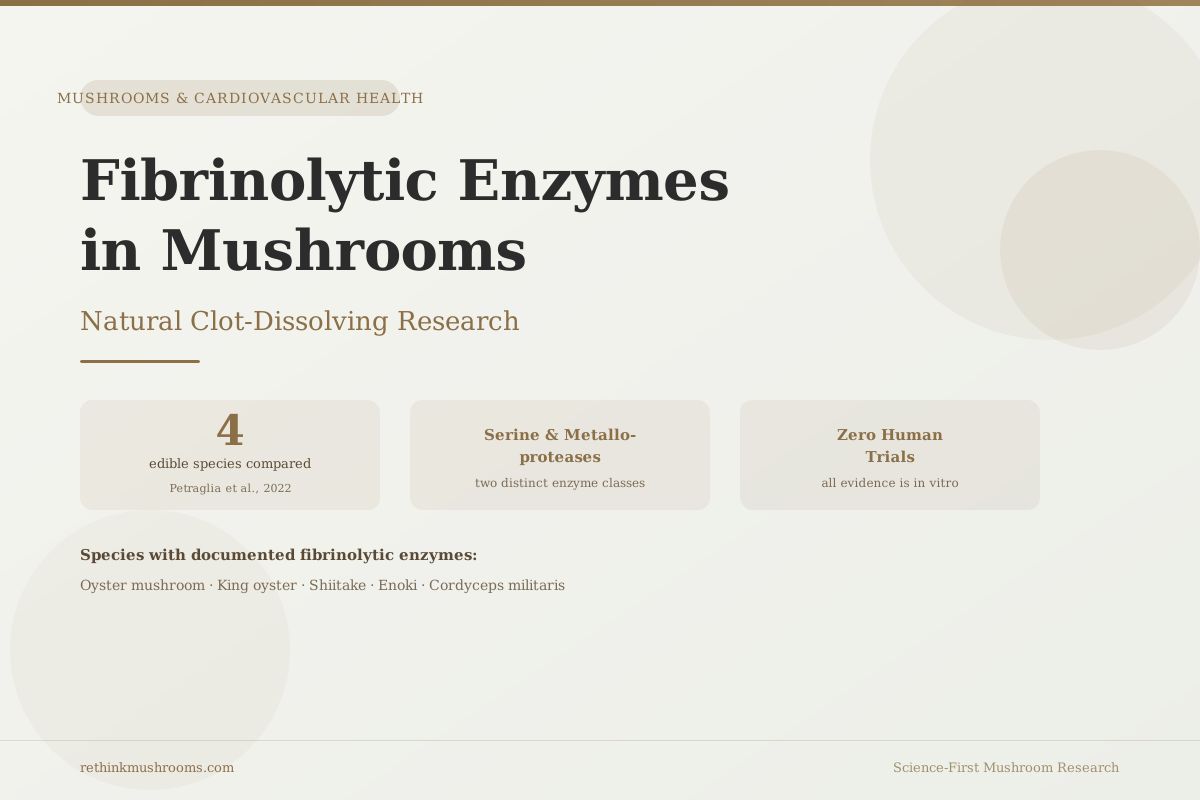
4 species compared
Oyster mushroom led all four edible species tested in fibrinolytic enzyme activity; only Pleurotus species could directly degrade fibrin clots, not just fibrinogen.
Petraglia et al., Molecules, 2022
Serine protease
enzyme class in oyster and enoki
Metalloprotease
shiitake's distinct enzyme class
Zero human trials
all fibrinolytic evidence is in vitro
Petraglia et al., Molecules, 2022
 View as image ↗
"Blood thinning" covers a lot of ground when people talk about mushrooms. Antiplatelet compounds prevent platelets from clumping together. Anticoagulant compounds interrupt the chemical cascade that builds clots. But there's a third category that almost no one discusses: fibrinolytic enzymes in mushrooms, proteins that break down existing blood clots by attacking fibrin directly. Several edible species produce these enzymes, and research over the past two decades has begun cataloging which mushrooms have the highest activity, what enzyme types are involved, and how they differ at the molecular level. For the broader picture on how mushrooms affect heart health, see our overview of mushrooms and cardiovascular research.
The distinction between clot prevention and clot dissolution matters. A compound that stops a clot from forming and a compound that dissolves an existing clot are two entirely different pharmacological categories. Mushroom fibrinolytic enzymes fall into the second category. That's what makes this corner of research genuinely interesting, even if all the current evidence comes from laboratory settings rather than human trials.
Key Takeaways
- Fibrinolytic enzymes dissolve existing blood clots by breaking down fibrin, a mechanistically distinct action from antiplatelet compounds (which prevent clots) and anticoagulants (which interrupt the clotting cascade)
- In a 2022 four-species comparison, Petraglia et al. found oyster mushroom (Pleurotus ostreatus) had the highest fibrinolytic enzyme activity; only Pleurotus species directly degraded fibrin rather than fibrinogen
- Shiitake's fibrinolytic enzyme is a metalloprotease (Choi et al., 2018), a completely different protein class from the serine proteases found in oyster and enoki mushrooms
- In 2020, Katrolia et al. published the first gene-level characterization of a fibrinolytic enzyme from Cordyceps militaris, a 28 kDa protein with confirmed fibrin-degrading capability
- Cordyceps militaris extract also shows antithrombotic effects via cordycepin, a nucleoside analog, but this is an antiplatelet mechanism rather than fibrinolytic (Kwon et al., 2016)
- All current evidence is in vitro; no human clinical trials have tested mushroom fibrinolytic enzymes directly, and cooking likely denatures these proteins before they can act in the body
What Fibrinolytic Enzymes Actually Do (and Why This Is Not the Same as Blood Thinning)
Fibrin is the structural protein that holds blood clots together. When a wound starts to heal, a cascade of reactions converts a circulating protein called fibrinogen into fibrin strands that mesh together and trap platelets, forming the clot. This is an essential process. Without it, cuts won't stop bleeding.
The problem is when clots form inside blood vessels where they don't belong. That's where fibrinolytic enzymes become relevant. A fibrinolytic enzyme breaks the molecular bonds holding fibrin strands together, dissolving the clot's structure from the inside.
This is categorically different from what antiplatelet compounds and anticoagulants do.
Antiplatelet compounds prevent platelets from clumping together at the start of clot formation. Anticoagulants interrupt the enzymatic cascade that converts fibrinogen into fibrin, stopping clots from solidifying. Neither of these dissolves a clot that has already formed.
Fibrinolytic enzymes can. That's the mechanistic distinction, and it's why pharmaceutical thrombolytics (drugs like tPA and streptokinase) are used as emergency treatments for heart attacks and strokes: to dissolve clots actively blocking blood flow.
Mushrooms produce fibrinolytic enzymes naturally. The research question is whether those enzymes are potent enough, stable enough, and bioavailable enough to be therapeutically useful. Based on current in vitro data, some species show meaningful activity, but the path from purified enzyme in a lab to dissolved clot in a human remains uncharted.
For context on the antiplatelet side of mushroom cardiovascular research, see our article on mushroom antiplatelet compounds.
The 2022 Rankings: Oyster Mushroom Leads, but the Fibrin vs. Fibrinogen Gap Matters
The most comprehensive species comparison published to date is Petraglia et al.'s 2022 study in Molecules, which tested four cultivated mushrooms side by side under identical conditions.[1]
The four species were: oyster mushroom (Pleurotus ostreatus), king oyster (Pleurotus eryngii), shiitake (Lentinula edodes), and black poplar mushroom (Agrocybe aegerita).
The activity ranking from highest to lowest: oyster mushroom first, king oyster second, shiitake third, black poplar mushroom last.
But the most important finding wasn't the ranking. It was what each species' enzymes could actually degrade.
Only the two Pleurotus species (oyster and king oyster) were able to directly degrade fibrin. Shiitake and black poplar extracts showed activity against fibrinogen (the circulating precursor protein) but not against fibrin itself.
This distinction has real clinical implications. An enzyme that degrades fibrinogen in the bloodstream may reduce the raw material available for clot formation; that's a preventive effect. An enzyme that degrades fibrin can dissolve a clot that's already built. These are different capabilities, and conflating them leads to overclaiming about what mushrooms can actually do.
The claim that certain mushrooms can "dissolve blood clots" is most accurately applied to the Pleurotus species specifically, based on Petraglia's data.
Four-Species Comparison · Petraglia 2022
Only the Two Pleurotus Species Degraded Fibrin Itself
All four cultivated mushrooms broke down fibrinogen (the soluble precursor), but in the only head-to-head comparison published to date, just oyster and king oyster could degrade fibrin — the protein that holds a formed clot together. That gap is what separates “dissolves an existing clot” from “reduces the raw material for new ones.”
| Species | Activity rank | Degrades fibrin | Degrades fibrinogen | Enzyme class |
|---|---|---|---|---|
| OysterPleurotus ostreatus | 1 | ✓ | ✓ | Serine protease |
| King oysterPleurotus eryngii | 2 | ✓ | ✓ | Not separately characterized |
| ShiitakeLentinula edodes | 3 | − | ✓ | Metalloprotease |
| Black poplarAgrocybe aegerita | 4 | − | ✓ | Not separately characterized |
The nuance: shiitake and black poplar were not inert against fibrin, but only showed measurable fibrin breakdown after extended incubation, whereas the Pleurotus extracts acted on fibrin directly. Enzyme classes were confirmed independently — a serine protease in oyster and a zinc-dependent metalloprotease in shiitake — meaning these species reach the same target through different molecular machinery.
Sources: Petraglia et al. (2022), Molecules 27(23):8145 [ref 1] for the ranking and fibrin-vs-fibrinogen results; Liu et al. (2014) [ref 2] and Choi et al. (2018) [ref 3] for the enzyme-class confirmations. All activity measured in vitro on crude fruiting-body extracts.
Oyster Mushroom's Serine Protease: The Best-Characterized Enzyme Found So Far
Eight years before the Petraglia comparison, Liu et al. isolated and characterized the fibrinolytic enzyme from oyster mushroom culture supernatant.[2]
The enzyme is a serine protease. Serine proteases are a large class of protein-cutting enzymes that use a particular amino acid (serine) in their active site to cleave the bonds between amino acids. Trypsin is a familiar serine protease found in human digestion. The pharmaceutical thrombolytic tPA is also a serine protease. The enzyme Liu's team found in oyster mushroom falls into this same class.
The characterization established that the enzyme directly degraded both fibrinogen and fibrin clots in laboratory conditions. The research team purified and characterized the protein well enough to confirm it as a novel enzyme not previously described from mushroom sources.
What this work established: the fibrinolytic activity seen in oyster mushroom extracts isn't a chemical side effect of other compounds. There is a specific, isolatable protein responsible for it. That's a necessary first step for any subsequent research. You have to know what the active entity is before you can study it systematically.
Shiitake's Metalloprotease: A Completely Different Enzyme With Its Own Activity Profile
Choi et al.'s 2018 study in the International Journal of Medicinal Mushrooms found a fibrinolytic enzyme in shiitake, but it turned out to belong to a completely different protein class than the one in oyster mushroom.[3]
Where oyster mushroom's enzyme is a serine protease, shiitake's is a metalloprotease. Metalloproteases use a metal ion (typically zinc) in their active site rather than an amino acid. This is a fundamental structural difference, not a minor variation. It means different substrates, different inhibitors, and different behavior in biological environments.
The Choi team confirmed the enzyme class using a standard chemical test. They added a metalloprotease inhibitor (1,10-phenanthroline) to the preparation. Fibrinolytic activity stopped. When they removed the inhibitor, activity resumed. That's the definitive test for enzyme class confirmation.
Shiitake's enzyme also showed antithrombotic potential in the same study, suggesting a dual function: dissolving fibrin and reducing the tendency for clots to form.
However, the Petraglia 2022 comparison placed shiitake below both Pleurotus species in overall fibrinolytic activity, and found it couldn't degrade fibrin directly. So shiitake occupies a specific position in this research area: it has a confirmed, well-characterized fibrinolytic enzyme, but that enzyme appears less potent against fibrin specifically than oyster mushroom's and acts on fibrinogen rather than formed clots.
The existence of two mechanistically distinct enzyme classes (serine proteases in oyster and enoki, metalloproteases in shiitake) in closely related mushrooms is biologically notable. It suggests fibrinolytic capability evolved independently across fungal lineages, through different molecular machinery.
Enoki and Cordyceps: Two More Species With Documented Clot-Related Activity
Park et al. published the first characterization of enoki mushroom's fibrinolytic enzyme in 2007, isolating a serine protease from Flammulina velutipes mycelia.[4]
Like oyster mushroom's enzyme, enoki's is a serine protease, placing both in the same enzyme class and distinct from shiitake's metalloprotease. The enzyme was purified from mycelial culture supernatant rather than from the fruiting body most people eat. Whether the fibrinolytic enzyme is present in meaningful amounts in the edible part of the mushroom is a separate question the research doesn't address.
For a more focused look at enoki's cardiovascular properties, see our article on enoki and blood clot prevention.
Cordyceps militaris presents a different picture. Kwon et al.'s 2016 study in BMC Complementary and Alternative Medicine tested a cordycepin-enriched extract across three model systems: ex vivo human platelets, animal, and cell culture. The extract showed antithrombotic and antiplatelet effects in all three.[5] The active compound was cordycepin, a molecule structurally similar to adenosine. Cordycepin works through platelet receptor pathways rather than by dissolving fibrin.
This is an important distinction. Kwon's 2016 work documents Cordyceps as an antiplatelet agent with antithrombotic effects, not a fibrinolytic one. The 2020 gene-cloning work (discussed next) provides the separate fibrinolytic angle for this species.
For a broader look at cordyceps and vascular biology, see our piece on cordyceps and vascular health.
The Pharmaceutical Frontier: Cordyceps Fibrinolytic Enzyme Gets Its Gene Sequenced
In 2020, Katrolia et al. published what they described as the first gene-level characterization of a fibrinolytic enzyme from Cordyceps militaris.[6] The work appeared in the International Journal of Biological Macromolecules.
The team cloned the gene encoding the enzyme and expressed it in a laboratory system, producing a 28 kDa extracellular protein with confirmed fibrin-degrading capability. "Extracellular" means the enzyme is secreted outside the fungal cell into the surrounding environment, the same way many therapeutic enzymes from other sources (including nattokinase from fermented soybeans) work.
Gene cloning is a different order of accomplishment from enzyme purification. Once the gene sequence is known, the protein can theoretically be produced through recombinant expression, using bacteria or yeast as manufacturing systems to generate large, consistent quantities of the enzyme without growing vast amounts of mushrooms. That's how most modern therapeutic proteins are manufactured at scale.
The Katrolia work doesn't prove the Cordyceps fibrinolytic enzyme is therapeutically useful. That would require animal studies, then human trials. But it represents an important prerequisite: establishing the molecular identity of the enzyme clearly enough that it could be tested systematically, optimized through protein engineering, or produced in quantities sufficient for preclinical work.
This is the research area closest to a translatable path toward pharmaceutical use. It starts with Cordyceps.
What In Vivo Research Actually Exists (And What It Does and Doesn't Show)
Most of the fibrinolytic enzyme research above is in vitro: tests of purified enzymes or extracts in laboratory conditions, not in living organisms. The in vivo evidence is sparser, and comes from a different mechanism.
Bian et al.'s 2022 study in Molecules tested a novel polysaccharide (AAP-b2, a 12 kDa fraction) from wood ear mushroom (Auricularia auricula) in a mouse model of carrageenan-induced thrombosis.[7] The polysaccharide inhibited platelet aggregation, shortened the carrageenan-induced black-tail thrombus, and prolonged clotting times (APTT and PT) in the animal model.
This is valuable evidence, but it's important to note exactly what it demonstrates. A polysaccharide is not a fibrinolytic enzyme. Polysaccharides are carbohydrates; enzymes are proteins. The Bian 2022 result reflects antiplatelet and anticoagulant properties (the prolonged APTT and PT are anticoagulant signatures) that Auricularia polysaccharides are well-documented for elsewhere in the literature. It shows an antithrombotic effect but doesn't isolate fibrinolytic enzyme activity as the mechanism.
The honest assessment: no studies have specifically tested mushroom fibrinolytic enzymes in living animals, and no human clinical trials exist. The fibrinolytic enzyme research sits entirely at the level of enzyme characterization and in vitro activity measurement. This places it earlier in the research pipeline than the antiplatelet evidence for mushrooms, which has at least some animal and ex vivo human platelet data behind it.
- Enzyme characterization & in vitro activitycompleted
Purified enzymes from oyster (Liu 2014), enoki (Park 2007) and shiitake (Choi 2018); direct fibrin degradation and a four-species comparison (Petraglia 2022); the Cordyceps enzyme even cloned and expressed recombinantly (Katrolia 2020)
- Animal (in vivo) testing of the enzymesmissing
No study has dosed a purified mushroom fibrinolytic enzyme in a living animal; the one in vivo thrombosis study used an Auricularia polysaccharide (Bian 2022), a different mechanism
- Small human trialmissing
No trial has tested a mushroom fibrinolytic enzyme in people
- Large / replicated RCTmissing
No head-to-head against pharmaceutical thrombolytics exists
- Meta-analysismissing
No human trials to pool
The molecular groundwork is unusually thorough — isolated enzymes, confirmed enzyme classes, in vitro fibrin degradation, and one gene-cloned enzyme ready for recombinant production. But nothing has yet been tested in a living body. That leaves this among the earliest-stage areas of mushroom cardiovascular research, ahead on mechanism but with zero clinical evidence.
Synthesis of references [1]–[7] cited in this article
For the broader context of mushroom blood-clotting research, including stronger antiplatelet evidence, see our article on mushrooms and blood clotting. For the specific story of wood ear's traditional use and modern data, see our piece on wood ear mushroom and blood thinning.
Does Cooking Destroy These Enzymes? What the Evidence Suggests
Fibrinolytic enzymes are proteins. Most proteins lose their functional three-dimensional structure, and with it their biological activity, when heated above roughly 60 to 80 degrees Celsius. Standard cooking methods (sautéing, boiling, roasting) easily exceed this range.
The in vitro research documenting fibrinolytic activity in mushrooms uses purified or semi-purified enzyme preparations from laboratory cultures. Liu's oyster mushroom enzyme was extracted from culture supernatant using column chromatography, a process that concentrates and isolates the protein far beyond anything achievable through normal food preparation. The conditions under which the enzyme shows activity in a test tube are controlled; the conditions in a human digestive system after cooking are not.
This doesn't mean eating mushrooms has no cardiovascular benefit. The antiplatelet and anticoagulant properties of mushroom polysaccharides, documented in wood ear, reishi, and other species, survive cooking because polysaccharides are carbohydrates rather than proteins. They're much more heat-stable. But the specific fibrinolytic enzymes documented in this research are very likely denatured before they could reach the bloodstream intact.
This is a limitation that most coverage of this topic ignores. The research establishes that these enzymes exist and that they are active under controlled laboratory conditions. It does not demonstrate that eating mushrooms delivers meaningful fibrinolytic activity to the body. Those are two very different claims.
Whether pharmaceutical-grade preparations of purified mushroom fibrinolytic enzymes could be delivered effectively, bypassing the cooking and digestion problem, is a separate question that the gene-cloning work on Cordyceps begins to make answerable.
Questions about mushroom supplement safety and drug interactions are covered separately in our article on mushrooms and blood thinners.
Clinical Context
ModerateThis is early laboratory science, not a clot treatment
Concern
Every fibrinolytic finding in this article comes from purified enzymes or extracts in a test tube. No mushroom, mushroom extract, or supplement has been shown to dissolve clots in a living person, and cooking very likely denatures these enzymes before they could act. Treating mushrooms as a substitute for prescribed anticoagulants, antiplatelet drugs, or emergency thrombolytics could be dangerous.
What the research says
Anyone taking blood thinners (warfarin, DOACs, aspirin, clopidogrel), scheduled for surgery, or managing a clotting disorder should talk to a physician or pharmacist before adding concentrated mushroom supplements, since additive effects on bleeding are plausible even where the fibrinolytic mechanism is unproven.
Particularly relevant for: People on anticoagulant or antiplatelet therapy, with bleeding or clotting disorders, or approaching surgery
Synthesis of the in vitro evidence in this article (references [1]–[7]) plus standard anticoagulant-interaction caution; not a clinical guideline.
This article is educational and is not medical advice.
The Bottom Line
Several edible mushrooms produce fibrinolytic enzymes, proteins that can dissolve fibrin clots directly in laboratory conditions, with oyster mushroom showing the highest in vitro activity in the only multi-species comparison published to date. Two distinct enzyme classes have been identified: serine proteases in oyster and enoki, and a metalloprotease in shiitake. The research is mechanistically detailed but clinically early: all evidence is in vitro, no human trials exist, and cooking almost certainly denatures these proteins before they could act in the body. The 2020 gene-level characterization of Cordyceps militaris's fibrinolytic enzyme opens a possible path toward pharmaceutical-scale production and systematic testing.
Frequently Asked Questions
Sources & References
- 1RTHM-01598·Petraglia, Tania et al. (2022). “Edible Mushrooms as Source of Fibrin(ogen)olytic Enzymes: Comparison between Four Cultivated Species..” Molecules (Basel.Study breakdown →PubMed →↩
- 2RTHM-00620·Liu, Xiao-Lan et al. (2014). “Purification and characterization of a novel fibrinolytic enzyme from culture supernatant of Pleurotus ostreatus..” Journal of microbiology and biotechnology.Study breakdown →PubMed →↩
- 3RTHM-00950·Choi, Jun-Hui et al. (2018). “Purification and Antithrombotic Potential of a Fibrinolytic Enzyme from Shiitake Culinary- Medicinal Mushroom, Lentinus edodes GNA01 (Agaricomycetes)..” International journal of medicinal mushrooms.Study breakdown →PubMed →↩
- 4RTHM-00228·Park, Se-Eun et al. (2007). “Purification and characterization of a fibrinolytic protease from a culture supernatant of Flammulina velutipes mycelia..” Bioscience.Study breakdown →PubMed →↩
- 5RTHM-00798·Kwon, Hyuk-Woo et al. (2016). “Antiplatelet and antithrombotic effects of cordycepin-enriched WIB-801CE from Cordyceps militaris ex vivo, in vivo, and in vitro..” BMC complementary and alternative medicine.Study breakdown →PubMed →↩
- 6RTHM-01216·Katrolia, Priti et al. (2020). “Gene cloning, expression and homology modeling of first fibrinolytic enzyme from mushroom (Cordyceps militaris)..” International journal of biological macromolecules.Study breakdown →PubMed →↩
- 7RTHM-00744·Bian, Chun et al. (2022). “A Novel Polysaccharide from AuriculariaAuricula Alleviates Thrombosis Induced by Carrageenan in Mice..” Molecules (Basel.Study breakdown →PubMed →↩