Mushrooms & Cardiovascular Health
1980, New England Journal of Medicine
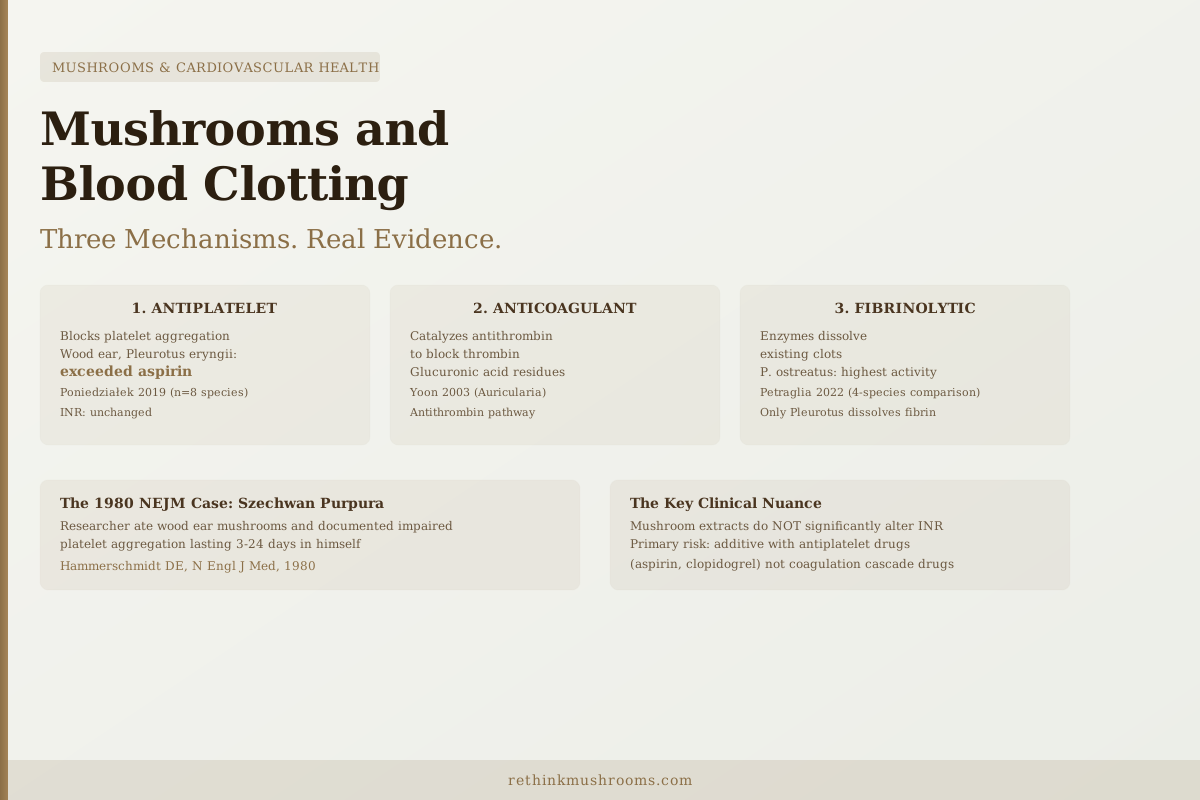
A researcher ate wood ear mushrooms for dinner and found himself unable to form normal platelet plugs for three weeks. He published the case in NEJM. Forty years of research have followed.
Hammerschmidt DE, N Engl J Med, 1980
Exceeded aspirin
Auricularia and Pleurotus eryngii in ADP platelet tests (Poniedziałek 2019)
INR unchanged
mushroom antiplatelet effect does not alter the coagulation cascade
3 mechanisms
antiplatelet, anticoagulant, and fibrinolytic: all distinct
Hammerschmidt DE, N Engl J Med, 1980
 View as image ↗
In 1980, a hematologist named Dale Hammerschmidt noticed something unusual. After eating a Szechwan Chinese dish heavy with Mo-er mushrooms, the wood ear fungus common in East Asian cooking, he found that his blood platelets were not aggregating normally. He measured his own platelet response and documented an effect that lasted three weeks.
He published the case in the New England Journal of Medicine under the title "Szechwan Purpura." It was the first rigorous documentation that eating a specific mushroom produces a measurable antiplatelet effect in a human being.
That 1980 case report launched four decades of research. The finding has been confirmed, extended, and complicated. Several mushroom species affect hemostasis, the body's system for controlling bleeding and clotting, through mechanisms that are more specific and more clinically important than the generic "blood-thinning" label implies.
This article covers what the research shows. For the broader picture on mushrooms and cardiovascular health, including cholesterol effects, see our guide to mushrooms and cardiovascular health.
Key Takeaways
- In 1980, a hematologist documented that eating wood ear mushrooms inhibited his own platelet response for up to three weeks and published the case in the New England Journal of Medicine[1]
- A 2019 screen of eight edible mushroom species found wood ear (Auricularia) and king oyster mushroom (Pleurotus eryngii) exceeded aspirin in a standard platelet aggregation test; critically, none of the mushroom extracts altered prothrombin time or INR, meaning they affect platelets but not the broader coagulation cascade[8]
- Mushrooms affect blood clotting through three mechanistically distinct pathways: antiplatelet activity (blocking platelet clumping), anticoagulant activity (catalyzing antithrombin to deactivate clot-forming enzymes), and fibrinolytic activity (producing enzymes that dissolve existing clots)
- Reishi (Ganoderma lucidum) inhibited platelet aggregation in both laboratory experiments and in human patients, with clinical data from a cohort study[3]
- Cordycepin, the active compound in Cordyceps militaris, demonstrated antiplatelet and antithrombotic effects across three study models simultaneously[6]
- Drug interaction risk from mushrooms is primarily with antiplatelet drugs (aspirin, clopidogrel) rather than anticoagulants that work on the coagulation cascade (warfarin), because mushroom extracts do not significantly alter INR
The 1980 NEJM Story That Started This Research
Hammerschmidt ate a Chinese dish containing wood ear mushrooms and observed over the following days that his platelet aggregation was impaired.[1] His platelets were not releasing serotonin normally when stimulated, a key step in the clotting process. The effect lasted three to twenty-four days.
The finding was not merely anecdotal because Hammerschmidt was a trained hematologist who measured his own blood. He followed up in 1982 with systematic laboratory experiments: Auricularia extracts inhibited platelet aggregation in both human and rat platelet samples, establishing that the active component was a polysaccharide fraction rather than a protein or volatile compound.[2]
This was the first time a specific mushroom species had been connected to human antiplatelet activity through rigorous measurement. The case also introduced a clinically important practical point: the effect persisted for weeks after a single meal, which means timing relative to surgery or medication use matters more than most people assume.
Three Mechanisms, Not One "Blood Thinning" Effect
The term "blood thinning" conflates three mechanistically distinct processes that happen at different points in the clotting system. Understanding them separately matters for assessing clinical implications.
Antiplatelet activity means blocking the clumping of platelets, the small blood cells that form the initial response to an injury. When a blood vessel is damaged, platelets stick to the injury site and to each other, forming a platelet plug. Chemicals like ADP (adenosine diphosphate, the molecular signal that tells platelets to recruit more platelets) and arachidonic acid activate this process. Aspirin works by blocking one of these activation pathways. Some mushroom compounds block overlapping or different pathways.
Anticoagulant activity means interfering with the coagulation cascade, the sequence of protein reactions that converts soluble fibrinogen into fibrin, the insoluble mesh that reinforces a platelet plug into a stable clot. Antithrombin is a protein in the blood that deactivates thrombin, the enzyme that drives this conversion. Warfarin and heparin target this cascade. Certain Auricularia polysaccharides catalyze antithrombin, helping it deactivate thrombin more efficiently.
Fibrinolytic activity is mechanistically opposite to clot formation: fibrinolytic enzymes directly dissolve existing fibrin clots. Several mushroom species produce these enzymes.
These are not synonymous. A compound can have antiplatelet activity without affecting the coagulation cascade (several mushroom extracts fit this description). A compound can catalyze antithrombin without touching platelets. Understanding which mechanism a mushroom species affects determines what its drug interactions and clinical risks actually look like.
Wood Ear and King Oyster Outperform Aspirin in Platelet Testing
The most important single study for this overview was conducted by Poniedziałek and colleagues in 2019 and published in Nutrients.[8] They screened extracts from eight edible mushroom species against human platelet samples using two standard assays: ADP-induced aggregation (the platelet recruitment signal) and arachidonic acid-induced aggregation (the pathway aspirin blocks).
The results were striking: Auricularia auricularia-judae (wood ear) and Pleurotus eryngii (king oyster) showed antiplatelet activity that exceeded aspirin in the ADP-induced test and was comparable to aspirin in the arachidonic acid test. Several other species showed meaningful activity.
The second finding from this study is clinically more important: none of the mushroom extracts significantly altered prothrombin time or the INR (International Normalized Ratio, the standardized test used to monitor blood-thinning medication). Prothrombin time is the main measure of whether the coagulation cascade, the sequence of reactions that converts fibrinogen to fibrin, is being affected.
This means mushroom antiplatelet activity is primarily at the platelet level, not the coagulation cascade level. The drug interaction concern is therefore most acute with other antiplatelet drugs, particularly aspirin and clopidogrel, rather than with coagulation cascade-targeting anticoagulants like warfarin. The risk profile is different from what "blood thinning" generically implies.
An in vivo confirmation arrived with the 2022 Yang study, where a novel Auricularia polysaccharide reduced carrageenan-induced thrombosis (clot formation triggered by a specific inflammatory agent) in an animal model, showing the in vitro antiplatelet effect translates into reduced actual clot formation in a living system.[9]
For a deeper look at how wood ear's specific history as a traditional remedy connects to these modern findings, see our article on wood ear mushroom and blood thinning.
The Anticoagulant Mechanism: Auricularia's Effect on Antithrombin
Beyond platelets, wood ear mushroom contains a second mechanism that targets the coagulation cascade directly.
Yoon and colleagues identified a polysaccharide in Auricularia auricula that catalyzes antithrombin activity.[4] Antithrombin is the body's natural brake on clot formation: it deactivates thrombin, the enzyme that converts fibrinogen into fibrin. The Auricularia polysaccharide enhanced this braking action. The researchers traced the activity to glucuronic acid residues, specific molecular groups on the polysaccharide chain that appear responsible for engaging the antithrombin protein.
This is mechanistically different from the platelet-level antiplatelet activity Hammerschmidt documented. The antithrombin pathway targets the downstream coagulation cascade rather than the upstream platelet recruitment. Compounds that engage antithrombin work by the same general principle as heparin, the intravenous anticoagulant, though through a different molecular structure.
The clinical implication: wood ear mushrooms contain at least two distinct mechanisms that affect hemostasis, one at the platelet level and one at the coagulation cascade level. The Poniedziałek 2019 finding that INR is unchanged suggests the antithrombin mechanism may be relatively weak compared to the platelet effect under the conditions tested, or that the 2019 study's aqueous extracts did not capture the full antithrombin-active fraction. The distinction still matters for assessing risk.
Reishi's Clinical Platelet Data
Ganoderma lucidum (reishi) has the closest thing to human clinical evidence for antiplatelet activity among the commonly used medicinal mushrooms.
Tao and Feng studied Ganoderma's effect on platelet aggregation in both experimental (laboratory) settings and in actual patients.[3] The inhibitory effect was observed in both contexts. This cohort-level evidence is not a randomized trial, but it places reishi's antiplatelet effect closer to human clinical reality than the purely in vitro evidence available for most other species.
A 2018 systematic review by Kozarski and colleagues on mushrooms and atherosclerosis catalogued antiplatelet, anticoagulant, and antithrombotic activities across multiple species.[7] Reishi appears consistently across these summaries as a species with documented hemostatic effects.
The connection to cardiovascular disease is direct: platelet activation is a key step in the development of atherosclerotic plaques, where platelets adhere to damaged arterial walls and contribute to plaque growth. For more on how mushrooms relate to arterial plaque formation, see our article on mushrooms and atherosclerosis prevention.
Cordyceps and the Cordycepin Mechanism
Cordyceps militaris shows antiplatelet activity through a structurally distinct compound: cordycepin, also known as 3'-deoxyadenosine.
Cordycepin is structurally similar to adenosine, a naturally occurring platelet signaling molecule. This structural similarity allows it to interact with adenosine receptors on platelet surfaces and interfere with platelet activation through a pathway that polysaccharides do not target.
Kwon and colleagues demonstrated cordycepin-enriched Cordyceps militaris extract had antiplatelet and antithrombotic effects across three models: ex vivo (in blood drawn from live animals), in vivo (in living animals), and in vitro (in isolated cells).[6] The consistency across all three models makes this one of the more complete mechanistic demonstrations for any single mushroom antiplatelet compound.
For deeper context on Cordyceps and its vascular effects beyond platelets, including nitric oxide and endothelial function, see our article on Cordyceps and vascular health.
Fibrinolytic Enzymes: The Third Mechanism
Several mushroom species produce enzymes that dissolve existing fibrin clots. This is mechanistically opposite to clot prevention: rather than stopping clot formation, fibrinolytic enzymes degrade the fibrin meshwork that gives clots their structure.
Petraglia and colleagues compared fibrinolytic activity across four cultivated species in a 2022 study published in Molecules.[10] Pleurotus ostreatus (oyster mushroom) showed the highest fibrinolytic activity. Pleurotus eryngii was second. Lentinula edodes (shiitake) showed lower activity. The study also documented an important mechanistic distinction: only Pleurotus species directly degraded fibrin itself, while shiitake enzymes primarily degraded fibrinogen (the soluble precursor to fibrin). These are different targets with different clinical implications.
The practical reality of fibrinolytic mushroom enzymes: they are proteins, and proteins are denatured by heat. Cooking likely destroys fibrinolytic activity. The research here is about the biochemistry of what mushrooms produce, not about consuming them as a clot-dissolving food. For a deeper look at fibrinolytic enzyme research and its pharmaceutical implications, see our article on fibrinolytic enzymes in mushrooms.
Drug Interactions: The Practical Consequence
The hemostatic research directly informs clinical practice. A 2009 systematic review by Ulbricht and colleagues of maitake mushroom documented interaction potential with anticoagulant and antiplatelet drugs and recommended caution for patients on warfarin, aspirin, or other blood-thinning medications.[5] Kozarski 2018 documented similar concerns across multiple species.[7]
The Poniedziałek 2019 INR finding shifts how this risk should be framed:[8] because mushroom extracts did not alter prothrombin time or INR in that screening, the primary interaction concern is additive antiplatelet effect with other antiplatelet drugs (aspirin, clopidogrel, prasugrel) rather than with anticoagulants that work on the coagulation cascade. Someone taking warfarin for a cardiac condition and eating large amounts of wood ear mushroom may have less INR interaction than previously feared, but the combination with antiplatelet therapy remains a concern.
The Hammerschmidt 1980 data adds a surgical timing concern: the effect lasted up to twenty-four days after a single exposure.[1] Stopping mushroom supplements days before surgery may not be sufficient if the antiplatelet effect is of similar duration. For a dedicated guide to mushroom-drug interactions and surgery timing, see our article on mushrooms and blood thinners: drug interactions.
The Bottom Line
Mushrooms affect blood clotting through three mechanistically distinct pathways: antiplatelet activity (blocking platelet aggregation), anticoagulant activity (catalyzing antithrombin to suppress the coagulation cascade), and fibrinolytic enzyme production (dissolving existing clots). The evidence spans from a 1980 NEJM case report on wood ear mushroom to a 2019 comparative study showing Auricularia and Pleurotus eryngii exceeded aspirin in platelet inhibition. The critical nuance from the 2019 study: mushroom extracts did not alter INR or prothrombin time, placing the primary drug interaction risk with antiplatelet medications rather than coagulation cascade-targeting anticoagulants. Reishi has human clinical platelet data. Cordyceps acts through cordycepin, a structurally distinct pathway. Anyone on antiplatelet or anticoagulant medication, or approaching surgery, should treat meaningful mushroom supplement use as a potential hemostatic variable.
Frequently Asked Questions
Sources & References
- 1RTHM-00002·Hammerschmidt, D E (1980). “Szechwan purpura..” The New England journal of medicine.Study breakdown →PubMed →↩
- 2. Source details for this reference are not yet available.
- 3. Source details for this reference are not yet available.
- 4. Source details for this reference are not yet available.
- 5. Source details for this reference are not yet available.
- 6. Source details for this reference are not yet available.
- 7. Source details for this reference are not yet available.
- 8. Source details for this reference are not yet available.
- 9. Source details for this reference are not yet available.
- 10. Source details for this reference are not yet available.