Mushrooms & Cardiovascular Health
8 edible species
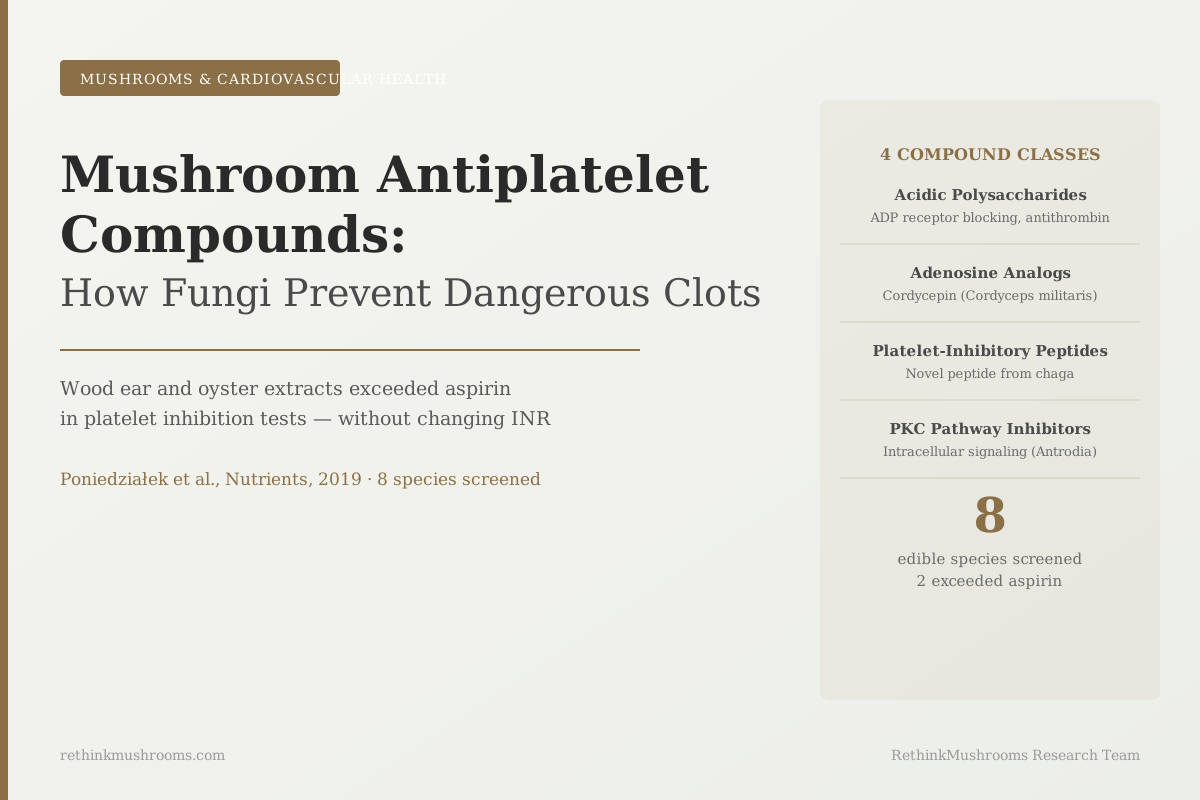
A 2019 in vitro screening study tested eight edible mushroom species against human platelets. Auricularia (wood ear) and Pleurotus eryngii (king oyster) exceeded aspirin in the ADP-induced aggregation test, while leaving prothrombin time and INR completely unchanged.
Poniedziałek et al., Nutrients, 2019
4 classes
of antiplatelet compounds found in mushrooms: polysaccharides, adenosine analogs, cordycepin, and novel peptides
Unchanged INR
mushroom extracts inhibited platelets without altering prothrombin time or the coagulation cascade
Clinical data
Ganoderma lucidum (reishi) showed platelet inhibition in both laboratory and patient studies (Tao et al., 1990)
Poniedziałek et al., Nutrients, 2019
 View as image ↗
When blood platelets clump together (their normal response to a damaged vessel wall), they form the initial plug that stops bleeding. But platelets that activate too easily or too persistently can form clots inside healthy blood vessels, blocking the flow of blood to the heart or brain. This is the mechanism behind most heart attacks and strokes. The compounds that prevent excess platelet activation are called antiplatelet agents, and mushroom antiplatelet compounds represent an increasingly well-documented class of them.
A 2019 study that screened eight edible mushroom species against human platelets found that wood ear and king oyster mushroom extracts exceeded aspirin's effect in the most common platelet aggregation test.[1] The researchers also found that the mushroom extracts produced this effect without altering prothrombin time or INR, the standard measurements of coagulation cascade function. These findings mean mushrooms appear to act specifically on platelets, not on the broader blood clotting pathway, which has distinct clinical implications.
The compounds responsible for these effects come from at least four structurally different compound classes, each working through a different point in the platelet activation sequence. Understanding what those classes are and how they differ is the most useful thing this article can offer.
For the broader cardiovascular context, see our article on mushrooms and blood clotting: anticoagulant and antiplatelet research, and our pillar covering mushrooms and cholesterol research.
Key Takeaways
- Poniedziałek and colleagues' 2019 screening of eight edible species found Auricularia (wood ear) and Pleurotus eryngii (king oyster) exceeded aspirin in ADP-induced platelet aggregation tests, while leaving INR and prothrombin time unchanged
- Mushroom antiplatelet activity comes from at least four distinct compound classes: acidic polysaccharides, adenosine and adenosine analogs, the nucleoside cordycepin from Cordyceps militaris, and novel platelet-inhibitory peptides found in chaga
- The polysaccharide from Auricularia identified by Yoon and colleagues (2003) works through a distinct anticoagulant mechanism: it catalyzes thrombin inhibition via antithrombin, separate from platelet aggregation inhibition
- Kwon and colleagues' 2016 study showed cordycepin-enriched Cordyceps militaris extract inhibited platelets and prevented thrombosis across three separate experimental models (ex vivo, in vivo, and in vitro)
- Hyun and colleagues' 2006 study identified a novel platelet-inhibitory peptide from chaga (Inonotus obliquus), demonstrating that mushroom antiplatelet chemistry extends beyond polysaccharides
- Tao and colleagues' 1990 study provided both experimental and clinical data for Ganoderma lucidum's platelet-inhibiting effects, making it one of the few mushrooms with human as well as laboratory antiplatelet evidence
How Platelet Inhibition Works, and Why Four Compound Classes Matter
When a platelet is triggered by ADP (a chemical released by damaged tissue), a receptor on its surface activates a cascade of internal signals. Those signals cause the platelet to change shape, release its own stored molecules, and bind to fibrinogen to begin aggregating with other platelets.
ADP stands for adenosine diphosphate. It is a small molecule released from damaged cells that acts as an alarm signal, telling nearby platelets to activate and clump. Most current antiplatelet drugs, including aspirin and clopidogrel, block specific receptors in this process. Aspirin disables an enzyme that generates thromboxane A2, one of the internal amplification signals. Clopidogrel blocks one of the two main ADP receptors.
Mushroom antiplatelet compounds interfere with this process at multiple different points. Some block the ADP receptor directly. Some mimic adenosine, which is the molecule that calms platelets after activation. Some disable internal signaling enzymes like protein kinase C. Some work at the level of thrombin inhibition, preventing the enzyme that converts fibrinogen into fibrin.
The distinction matters because compounds that work at different points in the cascade could theoretically provide different coverages, and because compounds targeting one point may or may not affect others. The clinical implication is that mushrooms could have additive effects with pharmaceutical antiplatelet agents that work through the same pathways.
Polysaccharides: The Best-Studied Compound Class
The most extensively studied mushroom antiplatelet compounds are polysaccharides, specifically acidic polysaccharides containing particular sugar residues that interact with platelet receptors or coagulation proteins.
Yoon and colleagues' 2003 study identified a specific polysaccharide from Auricularia auricula (wood ear mushroom) with anticoagulant activity operating through a distinct pathway from direct platelet inhibition.[2] The polysaccharide contained glucuronic acid residues. It inhibited the coagulation cascade by catalyzing the inhibitory effect of antithrombin on thrombin, the enzyme that converts fibrinogen into fibrin clots. The glucuronic acid residues were found to be essential for this activity; versions of the polysaccharide without them lost the effect.
This is a mechanistically distinct pathway from platelet aggregation inhibition. Direct platelet inhibition (blocking ADP-triggered clumping) happens earlier in the clotting process. Antithrombin-mediated thrombin inhibition happens later, preventing the conversion of fibrinogen into fibrin once a platelet plug has formed. The Yoon study established that wood ear polysaccharides can work at both stages, through structurally different mechanisms.
The 2019 eight-species comparison study by Poniedziałek and colleagues provides the most comprehensive evidence on the breadth of antiplatelet polysaccharide activity across edible mushrooms.[1] The study tested extracts from eight species against human platelet aggregation induced by two different triggers: ADP and arachidonic acid. The standard pharmaceutical comparison was aspirin.
Auricularia auricularia-judae (wood ear) and Pleurotus eryngii (king oyster) showed the strongest effects, exceeding aspirin's inhibition in the ADP-triggered test and reaching comparable levels in the arachidonic acid test. The finding that these effects occurred without altering prothrombin time or INR is the study's most clinically important result. Prothrombin time and INR measure coagulation cascade function. The fact that they were unchanged indicates the mushroom extracts were acting specifically on platelets, not on the coagulation factors measured by those tests.
This antiplatelet-without-anticoagulant profile differs from medications like warfarin, which work specifically on coagulation factors and are detected by INR changes. The practical implication is that mushroom polysaccharides may represent a different type of hemostatic risk than warfarin users typically monitor.
Adenosine and Cordycepin: Natural Nucleoside Platelet Inhibitors
Adenosine is a molecule the body produces naturally. It serves as a brake signal in the platelet activation process: when platelet activity is too high, adenosine binds to platelet receptors and suppresses further aggregation. Drugs that mimic adenosine or prevent its breakdown are used clinically to inhibit platelet clumping. Mushrooms contain adenosine and structurally related compounds that appear to work through the same pathway.
Cordycepin, found in Cordyceps militaris, is structurally similar to adenosine with a single modification: it lacks one oxygen atom on the sugar ring. This structural difference makes cordycepin resistant to the enzyme that normally breaks adenosine down. The result is a longer-acting adenosine-like signal.
Kwon and colleagues' 2016 study tested cordycepin-enriched Cordyceps militaris extract across three experimental settings: ex vivo (using blood samples from treated animals), in vivo (measuring thrombosis in living animals), and in vitro (in human platelet samples in the laboratory).[3] The extract demonstrated antiplatelet and antithrombotic effects in all three models. Testing across all three settings strengthens confidence in the finding because it shows the effect is not an artifact of a single experimental design.
The researchers identified cordycepin as the active compound. This is significant because it means the antiplatelet effect is tied to a specific, characterizable molecule rather than an unspecified extract component, making it more tractable for standardization in supplement contexts.
For more on Cordyceps vascular effects beyond platelet inhibition, see our article on Cordyceps and vascular health: endothelial function and nitric oxide.
Peptides: A Compound Class Beyond Polysaccharides
The discovery that mushrooms contain antiplatelet peptides came from an unlikely source: chaga.
Hyun and colleagues' 2006 study isolated and characterized a novel peptide from Inonotus obliquus (chaga) that inhibited platelet aggregation.[4] A peptide is a short chain of amino acids, the building blocks of proteins. Most of the earlier mushroom antiplatelet research focused on polysaccharides. The chaga peptide finding established that the antiplatelet chemistry of mushrooms extends into an entirely different compound class.
This distinction matters for understanding supplement preparations. Polysaccharides and peptides have different stability characteristics, different susceptibility to extraction conditions, and different behavior in the digestive tract. A supplement that extracts and concentrates polysaccharides may not capture the peptide fractions. A product standardized for beta-glucan content will not necessarily contain the platelet-inhibitory peptide from chaga.
The Hyun study is in vitro and uses isolated platelet preparations, so direct translation to dietary effects in humans requires additional research. But it establishes that the antiplatelet chemistry of mushrooms is more structurally diverse than the polysaccharide research alone would suggest.
Signaling Pathways: How Compounds Work From Inside the Platelet
Some mushroom-derived compounds reach past the platelet surface receptors and interfere with the internal signaling machinery.
Lu and colleagues' 2014 study of Antrodia camphorata, a Taiwanese medicinal mushroom, demonstrated antiplatelet effects via the protein kinase C (PKC) pathway.[5] Protein kinase C is an enzyme inside the platelet cell. It relays the activation signal from the surface receptor into the downstream responses that cause shape change, granule release, and aggregation. Blocking PKC is an intracellular strategy: it does not compete with the external receptor trigger but disables the internal amplification step.
This PKC mechanism is distinct from the polysaccharide and adenosine mechanisms described above. Polysaccharides compete with ADP at the surface receptor. Adenosine analogs activate the inhibitory receptor. PKC inhibitors work after both of those steps, inside the cell.
Ganoderma lucidum (reishi) provides the best example in this cluster of research translating from laboratory findings into human patient data. Tao and colleagues' 1990 study documented platelet aggregation inhibition by Ganoderma in both experimental models and clinical patient samples.[6] The study collected both laboratory measurements and observations from patients, making it one of the earliest human-data contributions to the mushroom antiplatelet evidence base. The specific mechanism by which reishi inhibits platelets likely involves multiple compounds, including ganoderic acid triterpenoids acting through adenylyl cyclase pathways in addition to polysaccharide effects.
For more on reishi's vascular effects in the context of cardiovascular disease, see our article on how reishi triterpenes protect against arterial plaque buildup. For the atherosclerosis connection, see mushrooms and atherosclerosis prevention.
What "Exceeded Aspirin" Actually Means
The finding that wood ear and king oyster extracts exceeded aspirin in the ADP test is compelling, but it requires some framing to interpret correctly.
The 2019 Poniedziałek study used in vitro platelet aggregation testing on samples from healthy human donors. The comparison was between extract concentrations and a standard aspirin concentration under controlled laboratory conditions. "Exceeded aspirin" means that at the tested concentrations, the mushroom extracts produced greater inhibition of ADP-triggered platelet clumping than the aspirin solution used in the same experiment.
This is not the same as saying a dietary serving of mushrooms, or a standard supplement dose, produces antiplatelet effects equal to or stronger than an aspirin tablet in a living person. Lab-to-body translation depends on absorption, metabolism, bioavailability, and which specific extract fraction is responsible for the effect. The in vitro result establishes that the compounds have the capacity for strong antiplatelet activity and are worth taking seriously. It does not establish an equivalent dose relationship with aspirin.
The INR/prothrombin finding is the more clinically nuanced result from the same study. It establishes that the antiplatelet effect of these mushroom extracts is specifically platelet-mediated, not coagulation-cascade-mediated. This means mushroom polysaccharides may behave more like antiplatelet drugs (aspirin, clopidogrel) than anticoagulants (warfarin, heparin) in their interaction profile. This distinction matters enormously for anyone taking either drug class.
For the practical drug interaction implications, see our articles on mushrooms and blood thinners: drug interactions, wood ear mushroom and blood thinning, and enoki and blood clot prevention.
The Bottom Line
Mushrooms contain at least four distinct compound classes with antiplatelet activity: acidic polysaccharides (blocking ADP-triggered aggregation and catalyzing antithrombin activity), adenosine analogs (including cordycepin from Cordyceps militaris, working through adenosine receptor pathways), novel peptides (identified in chaga), and compounds that inhibit intracellular signaling enzymes including protein kinase C. The 2019 eight-species screening study found that wood ear and king oyster extracts exceeded aspirin in ADP-induced aggregation tests while leaving INR and prothrombin time unchanged, establishing a specifically antiplatelet, not anticoagulant, mechanism. Most evidence remains preclinical; reishi has the most clinical data.
Frequently Asked Questions
Sources & References
- 1. Source details for this reference are not yet available.
- 2. Source details for this reference are not yet available.
- 3. Source details for this reference are not yet available.
- 4. Source details for this reference are not yet available.
- 5. Source details for this reference are not yet available.
- 6. Source details for this reference are not yet available.