Mushrooms & Cardiovascular Health
8 edible species tested
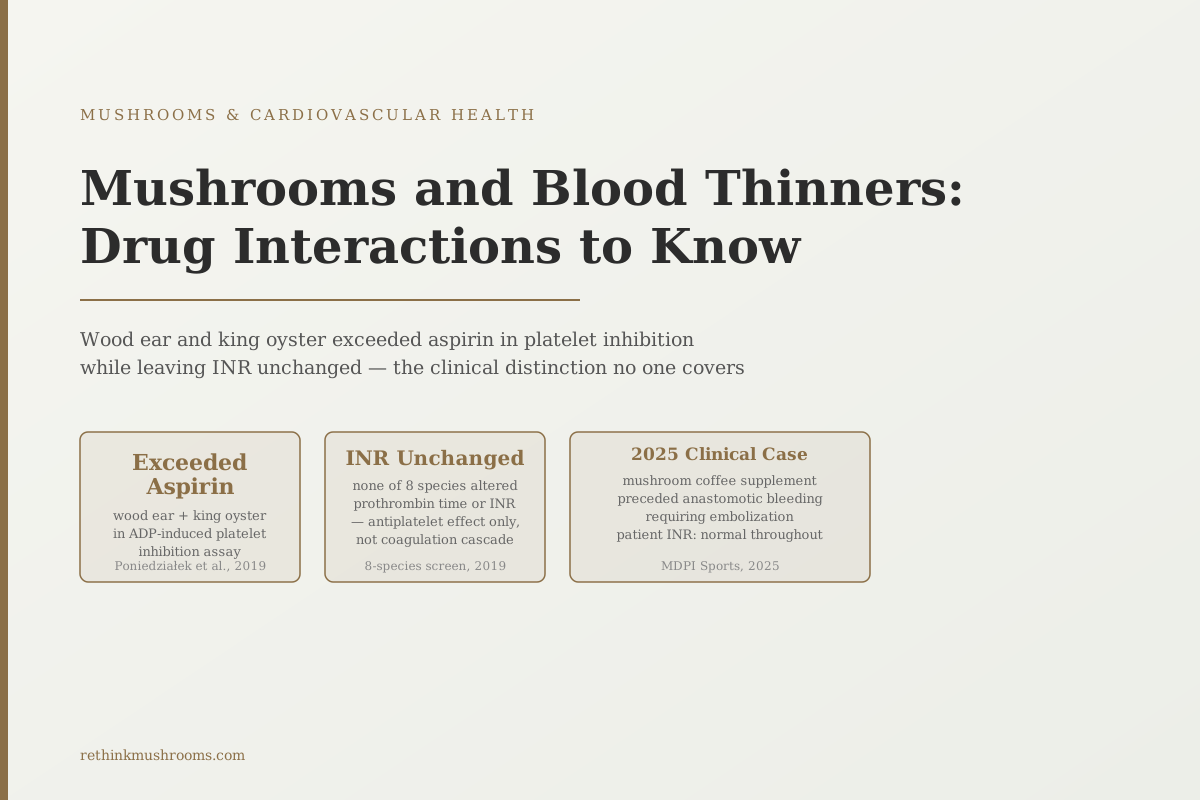
A 2019 human platelet study screened 8 edible mushroom species and found wood ear and king oyster exceeded aspirin's antiplatelet effect while leaving INR and prothrombin time unchanged.
Poniedziałek et al., Nutrients, 2019
Antiplatelet, not anticoagulant
mushrooms inhibit platelet aggregation but do NOT alter the INR coagulation cascade — the key drug interaction distinction
2025 clinical case
mushroom coffee supplement use preceded anastomotic bleeding requiring embolization; patient INR was normal throughout
Reishi: clinical data
Ganoderma inhibited platelet aggregation in both experimental models and clinical patients; intraoperative bleeding case documented (Tao et al., 1990)
Poniedziałek et al., Nutrients, 2019
 View as image ↗
In 2025, a published case report documented a patient whose daily mushroom coffee supplement use preceded unexpected surgical bleeding — a real clinical demonstration of the drug interaction risk that functional mushrooms pose with blood thinners. The patient's INR and standard coagulation tests had been normal throughout, which is precisely why the case matters.
That pattern — normal coagulation labs, abnormal bleeding — captures the most clinically important and least understood aspect of how mushrooms interact with blood thinners. Mushrooms don't thin the blood the way warfarin does. They inhibit platelets. Those are different mechanisms, different coagulation pathways, and they create different interaction risks depending on which drug is involved.
This article covers the specific species, drug classes, and mechanistic distinctions that matter for anyone taking antiplatelet or anticoagulant medications. For the broader cardiovascular research context, see Mushrooms That Lower Cholesterol: What the Research Shows.
Key Takeaways
- A 2019 study testing 8 edible mushrooms against human platelets found wood ear and king oyster exceeded aspirin in ADP-induced platelet inhibition, while none of the 8 species altered INR or prothrombin time (Poniedziałek et al., Nutrients, 2019)
- The INR-sparing nature of mushroom antiplatelet activity means the highest drug interaction risk is additive: mushrooms plus aspirin or clopidogrel stack platelet-inhibiting mechanisms; the risk with warfarin runs through a different, indirect route
- Reishi (Ganoderma lucidum) inhibited platelet aggregation in both experimental and clinical settings in a 1990 clinical study; a separate case of intraoperative bleeding attributed to a Ganoderma supplement has been published (Tao et al., J Tongji Med Univ, 1990)
- Maitake (Grifola frondosa) was specifically flagged in a systematic review as potentially interacting with warfarin, aspirin, heparin, and antiplatelet drugs (Ulbricht et al., J Soc Integr Oncol, 2009)
- Cordycepin, the primary active compound in Cordyceps militaris, showed antiplatelet and antithrombotic effects across three testing models in a 2016 study (Kwon et al., BMC CAM, 2016)
- Standard preoperative coagulation testing (INR, PT/aPTT) does not assess platelet function and will not detect mushroom-induced platelet inhibition; all functional mushroom supplement use should be disclosed to surgical teams explicitly
A 2025 Case Report: When Mushroom Coffee Caused Surgical Bleeding
A 2025 publication in MDPI's Sports described a patient who developed unexpected anastomotic bleeding requiring embolization after surgery. The patient had been consuming a mushroom coffee supplement daily. Standard coagulation markers, including INR, were normal. The bleeding was attributed to the supplement's antiplatelet activity.
The same pattern appeared in a 2014 case involving a Ganoderma supplement: intraoperative bleeding, normal INR. Two cases following the same template — abnormal bleeding, normal coagulation labs — are the clearest available signal that current preoperative screening misses mushroom-related bleeding risk.
Why does this happen? Standard preoperative clotting tests measure the coagulation cascade: the sequence of protein reactions that form fibrin and build clot structure. These tests do not measure platelet function. Platelets are the first responders in bleeding — they plug the wound before the coagulation cascade reinforces the clot. A patient with reduced platelet function from a mushroom supplement will have impaired first-response hemostasis that does not appear in INR, PT, or aPTT results.
The Critical Finding: Mushrooms Inhibit Platelets But Leave INR Unchanged
Poniedziałek and colleagues (2019) conducted the most rigorous species-level comparison of mushroom antiplatelet activity using human blood samples.[1] The study tested extracts from 8 edible mushroom species using two aggregation agonists that mirror different drug mechanisms: ADP (the pathway targeted by clopidogrel) and arachidonic acid, the same pathway aspirin blocks.
Key findings from the 8-species comparison:
- Auricularia auricula-judae (wood ear) and Pleurotus eryngii (king oyster) inhibited ADP-induced aggregation more effectively than aspirin at the concentrations tested
- Activity varied substantially across species, from strong (Auricularia, Pleurotus eryngii) to mild (common grocery varieties)
- None of the 8 species altered prothrombin time or INR
That last finding is the most clinically important thing the study produced. Prothrombin time and INR measure the coagulation protein cascade. Warfarin suppresses factors in this cascade, and INR is the metric used to dose it. Mushrooms don't enter this cascade. Their antiplatelet compounds — polysaccharides, nucleoside analogs, and peptides — work upstream at the platelet level, leaving the coagulation proteins untouched.
The clinical implication: a patient on warfarin who also takes mushroom supplements is unlikely to experience a direct INR elevation. Warfarin dose management is not disrupted through the coagulation cascade. But warfarin-thinned blood combined with reduced platelet function impairs hemostasis through two different mechanisms simultaneously. The bleeding risk is real; it just doesn't appear in INR monitoring.
For a deeper look at the three distinct hemostatic mechanisms in mushrooms (antiplatelet, anticoagulant via antithrombin, and fibrinolytic enzyme activity), see Mushrooms and Blood Clotting: Anticoagulant and Antiplatelet Research.
Which Mushrooms Carry the Most Interaction Potential
| Mushroom | Drug interaction concern | Primary evidence | Mechanism |
|---|---|---|---|
| Wood ear (Auricularia) | High | Exceeded aspirin in ADP test (Poniedziałek 2019) | Antiplatelet polysaccharides; antithrombin-catalyzing fraction |
| King oyster (Pleurotus eryngii) | High | Exceeded aspirin in ADP test (Poniedziałek 2019) | Antiplatelet activity confirmed in human platelet assay |
| Reishi (Ganoderma) | High | Clinical platelet inhibition (Tao 1990); intraoperative case | Antiplatelet in clinical patients; adenosine component |
| Maitake (Grifola frondosa) | Moderate-high | Systematic review flag (Ulbricht 2009) | Documented interaction potential with warfarin, aspirin, clopidogrel |
| Cordyceps militaris | Moderate | Three-model confirmation (Kwon 2016) | Cordycepin (adenosine analog); antiplatelet + antithrombotic |
| Oyster mushroom (Pleurotus ostreatus) | Moderate | Antiplatelet activity confirmed | Antiplatelet compounds; fibrinolytic enzymes add theoretical risk |
| Lion's mane (Hericium) | Low-moderate | Indirect evidence only | Anti-inflammatory pathway; no direct platelet aggregation studies |
Risk levels reflect evidence quality and mechanism specificity, not head-to-head clinical drug interaction trials. Absence of evidence for a species does not imply safety.
Kozarski and colleagues (2018) reviewed the cardiovascular mushroom literature across multiple species and confirmed antiplatelet, anticoagulant, and antithrombotic activities across the mushroom kingdom broadly, not just the highest-profile medicinal species.[2] Current clinical awareness of mushroom antiplatelet activity likely underestimates both the number of species involved and the magnitude of effects in commonly consumed amounts.
Reishi stands out as the species with the strongest combination of evidence quality and real-world clinical cases. Tao and colleagues (1990) documented that Ganoderma lucidum inhibited platelet aggregation in both experimental settings and in clinical patients, making it one of the few mushroom species with human clinical evidence rather than cell models alone.[3] The subsequent intraoperative bleeding case adds clinical grounding to the laboratory finding.
Maitake occupies a particular position because its interaction potential has been flagged at the systematic review level. Ulbricht and colleagues (2009) reviewed maitake research through the lens of drug interactions and specifically identified potential interactions with warfarin, aspirin, heparin, and platelet inhibitors, recommending monitoring in patients taking these medications.[4]
Cordyceps militaris has antiplatelet activity tied to a specific identified compound. Kwon and colleagues (2016) demonstrated that a cordycepin-enriched Cordyceps extract produced antiplatelet and antithrombotic effects across ex vivo, in vivo, and in vitro testing simultaneously.[5] Cordycepin is structurally similar to adenosine, a known endogenous platelet aggregation inhibitor, which explains why it produces this effect. For how cordycepin affects vascular function beyond platelets, see Cordyceps and Vascular Health: Endothelial Function and Nitric Oxide.
Warfarin vs. Aspirin: Why These Are Different Risks
The interaction profile with warfarin and with aspirin differs because the two drug classes target different parts of hemostasis.
Aspirin and clopidogrel (antiplatelet drugs) work specifically on platelet function. Aspirin permanently disables the COX-1 enzyme, reducing platelet activation. Clopidogrel blocks the ADP receptor, the same pathway several mushroom species inhibit. When mushroom antiplatelet compounds are added to aspirin or clopidogrel, the inhibitory effects on platelet aggregation can stack additively. This is where the most direct and clearly additive mushroom drug interaction risk exists.
Warfarin and direct oral anticoagulants (including rivaroxaban, apixaban, and dabigatran) target the coagulation protein cascade, not platelets. Because Poniedziałek 2019 showed mushrooms do not alter INR or prothrombin time, mushrooms are unlikely to directly amplify these drugs' coagulation cascade effects. However, hemostasis is not fully compartmentalized: platelets provide the surface on which coagulation factors assemble and activate. A patient with warfarin-reduced coagulation capacity AND mushroom-reduced platelet function has compromised hemostasis through both pathways simultaneously. The interaction exists; it is indirect rather than through a shared drug mechanism.
The practical clinical consequence is that the 2025 surgical case profile (normal INR, unexpected bleeding) specifically describes a patient on anticoagulation with undetected platelet suppression. Standard warfarin monitoring will not reveal this combination.
For the evidence on wood ear mushroom's two separate hemostatic mechanisms, including the antithrombin-catalyzing polysaccharide that does directly affect the coagulation cascade, see Wood Ear Mushroom and Blood Thinning: The Traditional Remedy With Modern Evidence.
Before Surgery: How Long in Advance to Stop
The surgical bleeding cases provide the strongest reason to stop mushroom supplements before procedures. They also raise the practical question of how far in advance.
Early research on wood ear mushroom documented that a single meal containing the mushroom produced antiplatelet effects lasting several days — measured through serial platelet function testing after a researcher consumed the mushroom and monitored his own platelet response. More recent research has not established a precise washout period across all species and preparations; duration likely varies by species, dose, extract concentration, and individual metabolism.
For comparison, standard guidance for aspirin before elective surgery is 5-10 days because of aspirin's permanent COX-1 blockade in existing platelets (new platelets restore function as older ones are replaced). Functional mushroom antiplatelet effects are mediated by different compounds, and their duration may be shorter or longer depending on the species. Given the documented multi-day duration from early research and the clinical risk established by published bleeding cases, stopping functional mushroom supplements at least 1-2 weeks before elective surgery is a reasonable conservative approach.
The disclosure problem is equally important: patients do not typically consider mushroom coffees, wellness blends, or functional mushroom capsules to be "blood thinners" in the way warfarin or aspirin are perceived. Preoperative intake forms that ask only about "blood thinners" or "anticoagulants" will miss mushroom supplement use. Surgical teams need to ask specifically about functional mushroom products and wellness supplements.
For the full research picture on antiplatelet compounds across mushroom species, see Mushroom Antiplatelet Compounds: How Fungi Prevent Dangerous Clots. For the fibrinolytic enzyme research that adds a third hemostatic mechanism to certain species, see Fibrinolytic Enzymes in Mushrooms: Natural Clot-Dissolving Research.
The Bottom Line
Functional mushrooms inhibit platelet aggregation but do not alter INR or the coagulation protein cascade that warfarin targets. The primary drug interaction risk is additive antiplatelet suppression, most dangerous with aspirin and clopidogrel, and still relevant but indirect with warfarin. Reishi, wood ear, king oyster, maitake, and cordyceps all have documented antiplatelet activity. Two published surgical bleeding cases with normal INR illustrate that standard coagulation testing misses mushroom-induced platelet inhibition. Patients should inform all healthcare providers about functional mushroom supplement use and consider stopping these supplements at least 1-2 weeks before elective procedures.
Frequently Asked Questions
Sources & References
- 1. Source details for this reference are not yet available.
- 2. Source details for this reference are not yet available.
- 3. Source details for this reference are not yet available.
- 4. Source details for this reference are not yet available.
- 5. Source details for this reference are not yet available.