Mushrooms & Cardiovascular Health
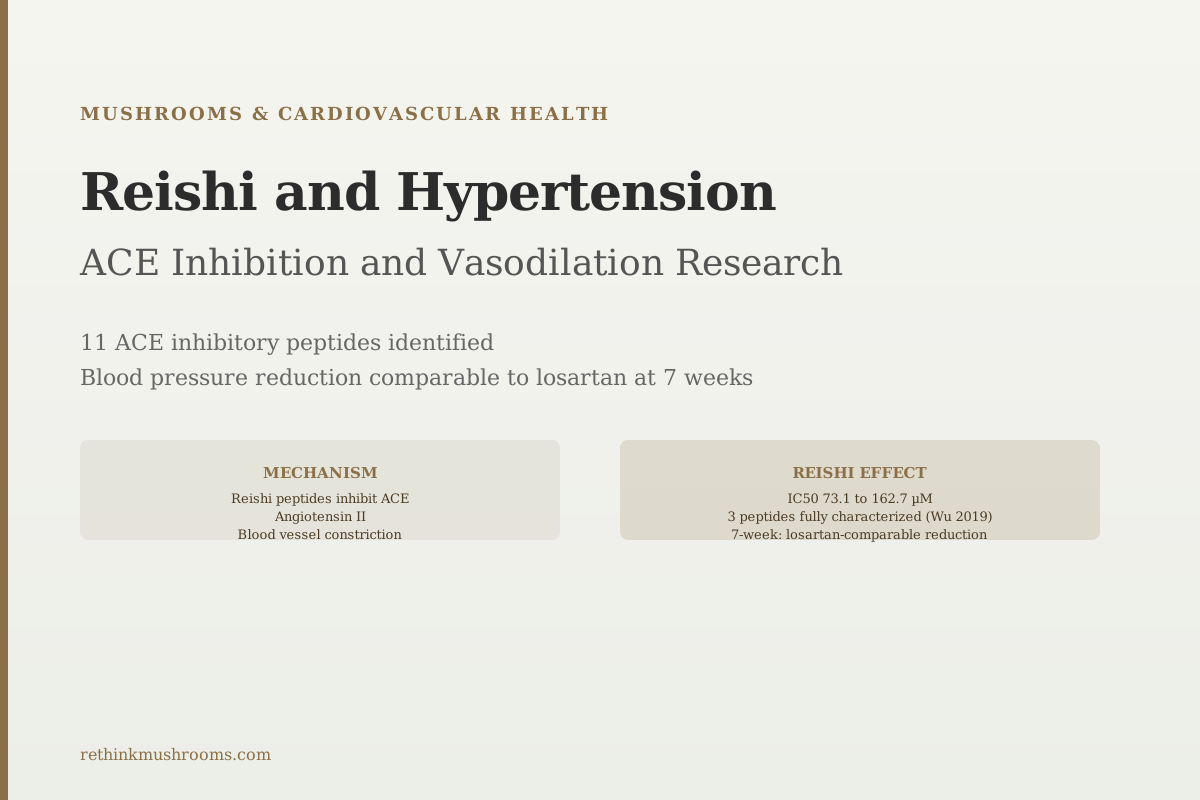
11 ACE inhibitory peptides
Tran and colleagues identified 11 ACE inhibitory peptides in reishi extract; four had IC50 values of 73.1 to 162.7 µM, and at seven weeks, blood pressure reduction reached levels comparable to a standard antihypertensive medication.
Tran et al., Molecules, 2014
3 peptides
further characterized from reishi mycelium with defined amino acid sequences in Wu et al., 2019
IC50 73–163 µM
potency range of the most active ACE inhibitory peptides identified in reishi extract
Losartan-level
blood pressure reduction achieved by reishi extract in the 7-week animal study
Tran et al., Molecules, 2014
 View as image ↗
Reishi mushroom contains a class of bioactive compounds that inhibit angiotensin-converting enzyme, the same enzyme that blood pressure medications like lisinopril target. Researchers have identified specific peptides in reishi with measured ACE inhibitory potency, and one animal study found that reishi extract reduced reishi blood pressure outcomes in hypertensive rats to levels comparable to a standard antihypertensive drug at seven weeks. Understanding what that finding means requires understanding what ACE does and why the drug interaction question it raises cannot be ignored.
For the broader overview of how mushrooms affect cardiovascular health, see Mushrooms That Lower Cholesterol: Evidence and Mechanisms. For a comparison across species, see Mushrooms and Blood Pressure: A Comprehensive Research Review.
Key Takeaways
- Reishi extract contains at least 11 ACE inhibitory peptides; four showed potent ACE inhibition with IC50 values of 73.1 to 162.7 µM; in the same study, reishi reduced blood pressure in hypertensive rats to levels comparable to a standard antihypertensive medication at 7 weeks (Tran et al., Molecules, 2014)
- Three specific antihypertensive peptides were isolated and fully characterized from reishi mycelium with defined amino acid sequences, advancing from extract-level activity to specific bioactive compound identification (Wu et al., JAFC, 2019)
- Reishi also affects blood pressure through neurometabolic pathways in the brain, not just peripheral ACE inhibition; hypertensive rats given oral reishi showed both reduced blood pressure and improved stress response markers in the brain (Shevelev et al., Phytomedicine, 2018)
- A 2025 review confirmed reishi's antihypertensive mechanisms are supported by evidence across in vitro and animal studies, situating blood pressure reduction within a broader cardiovascular protective profile (Ren et al., Food Science & Nutrition, 2025)
- Because reishi contains compounds that work through the ACE pathway, people taking ACE inhibitor medications (lisinopril, enalapril) or angiotensin receptor blockers (losartan, valsartan) should be aware of potential additive blood pressure lowering
- No human clinical trial has directly tested reishi for hypertension; the evidence base is preclinical and mechanistic, not yet clinical
How ACE Drives High Blood Pressure: The Enzyme Reishi Targets
To understand how reishi's peptides work, it helps to understand what raises blood pressure in the first place.
Your kidneys monitor blood pressure continuously. When blood pressure falls, they release a hormone called renin. Renin starts a chain reaction: it converts a blood protein into a molecule called angiotensin I. Angiotensin I is inactive. Then angiotensin-converting enzyme (ACE) converts angiotensin I into angiotensin II. Angiotensin II is the active molecule, and it does two things to raise blood pressure: it constricts blood vessels, narrowing the pipes, and signals the kidneys to hold onto sodium and water, increasing the volume of fluid in those pipes.
This chain is called the renin-angiotensin-aldosterone system, and it is a primary regulator of blood pressure. Blocking ACE at the conversion step prevents angiotensin II from forming. No angiotensin II means less vessel constriction and less sodium retention. Blood pressure comes down.
This is exactly how a class of medications called ACE inhibitors works. Drugs like lisinopril, enalapril, and ramipril inhibit ACE directly. They are among the most prescribed antihypertensive medications in the world.
In 2014, Tran and colleagues found that reishi extract contains naturally occurring peptides that do the same thing.[1] The mechanism is not a vague "cardioprotective effect" or an anti-inflammatory benefit that might reduce blood pressure indirectly. It is direct ACE inhibition by specific peptides found in the mushroom.
A 2023 comprehensive review of mushrooms and hypertension confirmed that ACE inhibitory activity is one of the primary mechanisms through which multiple mushroom species reduce blood pressure, and that reishi is among the species with the most characterized ACE inhibitory compounds.[5]
The ACE Inhibitory Peptides in Reishi: Specific Data Competitors Haven't Translated
Tran and colleagues subjected reishi extract to a process called auto-digestion, essentially using the mushroom's own enzymes to break down its proteins into smaller peptide fragments, then tested which fragments inhibited ACE.[1]
They found 11 peptides with ACE inhibitory activity. Four showed particularly potent inhibition. To express how potent, researchers use a measure called IC50: the concentration of a compound needed to block half of the enzyme's activity. Lower IC50 means more potent inhibition, because less compound is needed to achieve the same effect.
The four most potent reishi peptides had IC50 values ranging from 73.1 to 162.7 µM.[1] For context, many established ACE inhibitory food peptides operate in a similar or slightly higher range. This places reishi's peptides within the range of other food-derived ACE inhibitors that have been studied in pharmaceutical and nutritional research.
Five years later, Wu and colleagues went further.[3] Rather than working with crude extract, they isolated and fully characterized three specific antihypertensive peptides from reishi mycelium. Characterization means they determined the exact amino acid sequence of each peptide, not just its activity. This is important because it is the step that allows researchers to eventually synthesize a compound, test it in isolation, and develop it as a standardized ingredient.
The three peptides Wu's team characterized represented a significant advance from Tran's crude extract findings. The research had moved from "reishi extract inhibits ACE" to "these are the specific molecules in reishi mycelium responsible, and here are their structures."
A 2025 systematic review of Ganoderma lucidum bioactives positioned these findings within a broader cardiovascular protective profile: the antihypertensive peptides are one of several mechanisms through which reishi affects the cardiovascular system, alongside lipid modulation and anti-inflammatory vascular effects.[4]
How Effective Is Reishi Compared to a Blood Pressure Drug? The Seven-Week Animal Study
The most striking data point in the reishi blood pressure literature is from Tran 2014: at seven weeks, blood pressure reduction in hypertensive animals given reishi extract was comparable to losartan.[1]
Losartan is a widely prescribed antihypertensive medication. It works by blocking the angiotensin II receptor, preventing angiotensin II from causing blood vessel constriction even when the enzyme has already produced it. Reishi's ACE inhibitory peptides work one step earlier, blocking ACE from producing angiotensin II in the first place. Both approaches ultimately reduce blood pressure by targeting the same renin-angiotensin pathway from different points.
The fact that the magnitude of blood pressure reduction was comparable across both groups is genuinely interesting. It suggests the reishi peptides are not producing a minor, weak signal. In the animal model tested, the effect size was in the range of an established pharmaceutical agent.
Several important caveats apply. This was a rodent study. Human blood pressure regulation involves more complexity than can be modeled in inbred hypertensive rat strains. The dose used was an extract, not a food-level intake. The duration was seven weeks. No human pharmacokinetic data confirms how well the active peptides survive digestion and reach systemic circulation at meaningful concentrations.
What the data establishes is that the ACE inhibitory activity in reishi extracts is not pharmacologically trivial. The magnitude demonstrated in the animal model warrants human clinical investigation, which has not yet been conducted specifically for reishi in hypertension.
Reishi Also Affects the Brain's Blood Pressure Center, Not Just Blood Vessels
Blood pressure is regulated not only peripherally (by the kidneys, blood vessels, and ACE) but also centrally, by brain regions that govern the stress and autonomic nervous system responses that modulate how blood pressure fluctuates.
Shevelev and colleagues tested whether oral reishi administration in hypertensive rats affected blood pressure through central nervous system pathways in addition to peripheral ACE inhibition.[2] They used the ISIAH strain, a rat line selected specifically for stress-induced arterial hypertension.
The result: oral reishi reduced blood pressure in the ISIAH rats, confirming the antihypertensive effect. It also improved neurometabolic markers. Specifically, the treatment affected stress response pathways in brain tissue in ways consistent with reduced sympathetic nervous system activity.
This finding adds a dimension that is absent from ACE inhibitor drugs. Pharmaceutical ACE inhibitors work entirely through peripheral enzyme inhibition. They do not directly affect brain-mediated blood pressure regulation. Reishi appears to affect both the peripheral ACE pathway and the central nervous system component of blood pressure control simultaneously.
The clinical relevance of this double-mechanism is speculative in humans. But it helps explain why the animal study outcomes appear comparable in magnitude to a pharmaceutical agent that has only one mechanism: reishi may be acting through two pathways at once.
If You Are on Blood Pressure Medication, Read This Before Taking Reishi
The same mechanism that makes reishi interesting for blood pressure creates a risk for people who are already medicated.
If reishi's ACE inhibitory peptides lower blood pressure, and a person is already taking an antihypertensive medication, the two effects could stack. Someone whose blood pressure is already well-controlled by lisinopril, enalapril, or an ARB like losartan could experience additional lowering from reishi supplementation. Blood pressure that drops below a safe level, a condition called hypotension, causes dizziness, lightheadedness, and fainting. In older adults or people with cardiovascular disease, symptomatic hypotension carries real risks.
The magnitude of reishi's effect in any individual is unknown because no human dosing study exists. This means there is no way to predict how much additional lowering a given person would experience when combining reishi with their prescribed medication.
This is a mechanistic concern rather than a documented clinical case series. The risk is derived from how reishi's active compounds work, not from a body of adverse event reports. But the mechanism is specific and real, and no consumer content on reishi blood pressure addresses it.
The 2023 comprehensive review of mushrooms and hypertension noted the importance of mechanistic safety assessment when incorporating antihypertensive mushroom products alongside pharmaceutical treatment, particularly for patients whose blood pressure is already medically managed.[5]
Form, Extract Standardization, and What the Research Cannot Yet Answer
The ACE inhibitory peptides identified in reishi come from both the fruiting body and the mycelium. Tran's work used fruiting body extract; Wu's peptide characterization used mycelium. Both sources contain relevant bioactives.
The activity in studies like Tran 2014 was observed with standardized extracts, not raw mushroom powder or food-level intake. A whole dried reishi mushroom or a low-concentration powder may contain the same peptides, but in concentrations far below those tested in the preclinical studies. The question of how much active peptide reaches the bloodstream after oral ingestion in humans, called bioavailability, has not been measured for reishi antihypertensive peptides in human studies.
Extract standardization matters here. Reishi extracts standardized to triterpene or polysaccharide content do not necessarily have standardized ACE inhibitory peptide content. The ACE inhibitory peptides are a separate bioactive class from the better-known triterpenes and beta-glucans. Products marketed for cardiovascular support often standardize to triterpenes, not peptides.
No clinical dose has been established. The Tran 2014 animal data used an extract in a concentration not directly translatable to human supplement dosing. The human studies that would establish an effective dose range have not been done.
What is known: the specific compounds responsible for ACE inhibition have been identified, their amino acid sequences have been characterized, and their potency has been quantified at levels that produce meaningful effects in animal models. The translation to human clinical use remains uncharted.
For how reishi's other cardiovascular compounds (the triterpenes) affect cholesterol, see Reishi and Cholesterol Management: Triterpene Mechanisms. For the broader context of how mushrooms prevent vascular damage, see Mushrooms and Atherosclerosis Prevention: Anti-Plaque Research. For the maitake comparison, see Maitake D-Fraction and Blood Pressure Regulation.
The Bottom Line
Reishi contains well-characterized ACE inhibitory peptides with preclinical evidence of blood pressure reduction. The seven-week animal study comparison to a standard antihypertensive drug demonstrates that the magnitude of effect is pharmacologically relevant, not trivially small. The neurometabolic angle documented by Shevelev 2018 suggests reishi acts on blood pressure through two mechanisms simultaneously. No human clinical trials have been conducted. The drug interaction risk with antihypertensive medications is mechanistically real and not covered by competitors.
Frequently Asked Questions
Sources & References
- 1RTHM-00352·Tran, Hai-Bang et al. (2014). “Hypotensive effects and angiotensin-converting enzyme inhibitory peptides of reishi (Ganoderma lingzhi) auto-digested extract..” Molecules (Basel.Study breakdown →PubMed →↩
- 2RTHM-00530·Shevelev, Oleg B et al. (2018). “Hypotensive and neurometabolic effects of intragastric Reishi (Ganoderma lucidum) administration in hypertensive ISIAH rat strain..” Phytomedicine : international journal of phytotherapy and phytopharmacology.Study breakdown →PubMed →↩
- 3RTHM-00596·Wu, Qiang et al. (2019). “Isolation and Characterization of Three Antihypertension Peptides from the Mycelia of Ganoderma Lucidum (Agaricomycetes)..” Journal of agricultural and food chemistry.Study breakdown →PubMed →↩
- 4RTHM-02166·Ren, Sizhu et al. (2025). “A Review of Bioactive Components and Pharmacological Effects of Ganoderma lucidum..” Food science & nutrition.Study breakdown →PubMed →↩
- 5RTHM-01774·Rauf, Abdur et al. (2023). “Edible mushrooms as potential functional foods in amelioration of hypertension..” Phytotherapy research : PTR.Study breakdown →PubMed →↩