Blood Pressure
No effect on blood pressure
A 2015 Cochrane systematic review of all randomized controlled trials found no evidence that Ganoderma lucidum supplementation reduces blood pressure in humans.
Klupp et al., Cochrane Database of Systematic Reviews, 2015
34 mmHg
systolic drop in hypertensive rats after 4 hours of reishi extract
ACE peptides
identified in reishi with IC50 values of 73 to 163 µM
0 human trials
have tested maitake for blood pressure in people
Klupp et al., Cochrane Database of Systematic Reviews, 2015
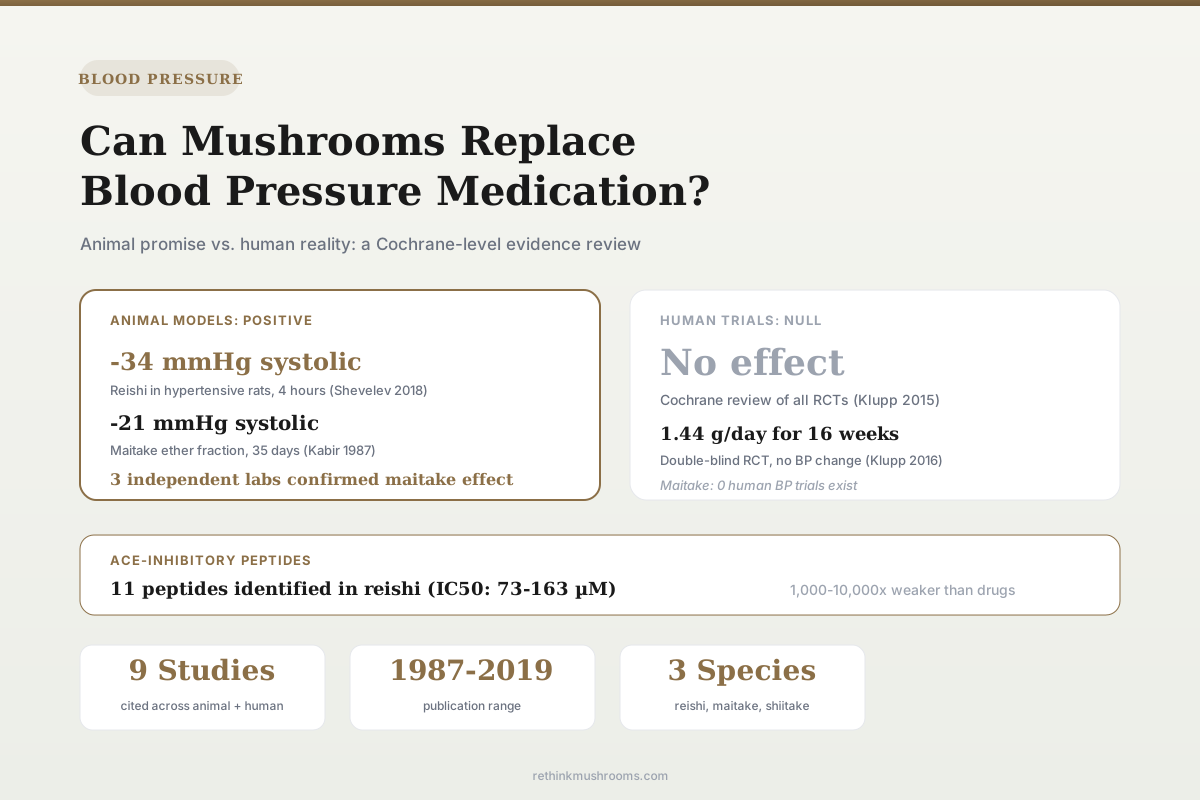 View as image ↗
The short answer is no, not based on current evidence. The long answer explains why the disconnect between promising animal data and null human results matters for anyone considering mushroom supplements for blood pressure management. Reishi (Ganoderma lucidum), maitake (Grifola frondosa), and shiitake (Lentinus edodes) have all demonstrated blood pressure reductions in rodent models of hypertension. When tested in human randomized controlled trials, reishi, the most studied species, has failed to produce significant blood pressure reductions. Maitake and shiitake have never been tested for blood pressure in humans at all.
This article maps the complete evidence landscape: what mushroom compounds lower blood pressure in animals, why ACE-inhibitory peptides from reishi are mechanistically interesting, what human trials have actually measured, and why the gap between preclinical promise and clinical reality is wider here than in most areas of mushroom research. For the broader picture of mushroom cardiovascular research, see mushrooms and blood pressure: a comprehensive research review.
Key Takeaways
- A Cochrane systematic review of all randomized controlled trials found no evidence that Ganoderma lucidum supplementation lowers blood pressure in humans (Klupp et al., 2015)
- A double-blind placebo-controlled trial of 1.44 g/day G. lucidum for 16 weeks in metabolic syndrome patients found no significant changes in blood pressure, lipids, or fasting glucose (Klupp et al., 2016)
- Reishi auto-digested extract reduced systolic blood pressure by 34.3 mmHg (19.5%) in spontaneously hypertensive rats within 4 hours, but no human trial has replicated this acute effect (Shevelev et al., 2018; Tran et al., 2014)
- Eleven ACE-inhibitory peptides were identified in reishi auto-digested extract, with IC50 values ranging from 73.1 to 162.7 µM, several orders of magnitude weaker than pharmaceutical ACE inhibitors (Tran et al., 2014)
- Maitake powder and fractions reduced blood pressure in aging female rats and spontaneously hypertensive rats across three independent studies, but no human blood pressure trial exists (Preuss et al., 2010; Kabir et al., 1987; Talpur et al., 2002)
- Combined shiitake and maitake dietary supplementation reduced blood pressure in hypertensive rats after 9 weeks, with an ether-soluble fraction driving the strongest effect at 21 mmHg systolic reduction (Kabir et al., 1987)
The Cochrane Verdict
Klupp et al. (2015) published the definitive assessment of Ganoderma lucidum for cardiovascular risk factors in the Cochrane Database of Systematic Reviews. The review searched all randomized and controlled clinical trials of G. lucidum supplementation that measured cardiovascular outcomes including blood pressure, lipid profiles, and glycemic markers.[1]
The conclusion was direct: evidence does not support the use of G. lucidum for treatment of cardiovascular risk factors. For blood pressure specifically, pooled analysis showed no significant effect. The reviewers noted that most included trials had high risk of bias, small sample sizes, and inconsistent outcome reporting. This is not an early-stage "too few trials to tell" situation. The Cochrane team reviewed the full available evidence base and found it inadequate in both quantity and quality.
This matters because reishi is the most-studied medicinal mushroom for cardiovascular effects. If the best-funded and most-tested species cannot demonstrate a blood pressure effect in humans, the evidence threshold for less-studied species like maitake and cordyceps is even further from being met.
The Double-Blind Human Trial
Klupp et al. (2016) conducted the most rigorous human test to date. In a double-blind, randomized, placebo-controlled, crossover trial, 84 adults with metabolic syndrome received either 1.44 g/day of G. lucidum extract or matching placebo for 16 weeks per treatment period, with a 4-week washout between phases.[2]
The primary outcomes included blood pressure, fasting lipids, fasting glucose, and glycated hemoglobin. None showed significant differences between the reishi and placebo groups. The study was adequately powered for its primary endpoints and used pharmaceutical-grade G. lucidum extract with verified composition. The null result was clean and not attributable to inadequate dosing, short duration, or poor extract quality.
Chu et al. (2012) ran an earlier controlled intervention trial examining G. lucidum for cardioprotective biomarkers. Twenty-six patients received 1.44 g Lingzhi daily or placebo for 12 weeks in a crossover design. Antioxidant capacity and some inflammatory markers shifted modestly, but blood pressure outcomes did not reach significance.[3] This trial was smaller and less rigorously designed than the Klupp 2016 study but tells the same story: reishi supplementation at standard doses does not measurably lower blood pressure in humans.
Why the Animal Data Looks So Different
The animal evidence is dramatically more positive than the human data, and the reasons for this disconnect are instructive.
Shevelev et al. (2018) tested intragastric administration of G. lucidum extract in the ISIAH rat strain, a genetically hypertensive model. After a single dose, systolic blood pressure dropped significantly within 4 hours, and the effect persisted for 8 hours. At 7 weeks of daily administration, the blood pressure reduction was comparable to losartan, a front-line pharmaceutical antihypertensive.[4]
This is the strongest preclinical finding in the mushroom blood pressure literature, and three factors explain why it does not translate to humans. First, the ISIAH rat is a genetically defined model with a single hypertensive phenotype; human hypertension involves dozens of contributing pathways. Second, intragastric dosing in rodents achieves bioavailability that oral supplementation in humans does not replicate, because the extract concentrations per kilogram of body weight are vastly higher. Third, the rat study measured acute pharmacological effects; human trials measure chronic supplementation, where tolerance, metabolism, and homeostatic compensation blunt initial responses.
Preuss et al. (2010) found that maitake mushroom fractions reduced progressive hypertension in aging female rats over 8 months. The SX-fraction, an alpha-glucan-rich preparation, was the most effective. Blood pressure reductions were accompanied by improved insulin sensitivity and reduced inflammatory markers, suggesting that the antihypertensive effect may be mediated through metabolic improvements rather than direct vascular action.[5]
Kabir et al. (1987) demonstrated that dietary incorporation of both shiitake and maitake mushrooms reduced blood pressure in spontaneously hypertensive rats over 9 weeks. The ether-soluble fraction of maitake was the most active component, reducing systolic pressure by about 21 mmHg compared to control diet. Shiitake alone was less effective than maitake.[6]
Talpur et al. (2002) extended the maitake work with two different rat strains and multiple maitake fractions. Whole maitake powder and its C-fraction and D-fraction all reduced blood pressure in the hypertensive strain, with effects emerging after several weeks of dietary incorporation. The authors proposed that renin-angiotensin system (RAS) modulation was part of the mechanism, supported by the observation that maitake fractions reduced circulating angiotensin II levels in treated animals.[7]
The consistency across three independent groups (Kabir 1987, Talpur 2002, Preuss 2010) using different rat strains, maitake preparations, and study durations is notable. This level of replication in animal models is stronger than what exists for most functional mushroom health claims. The failure point is not preclinical reproducibility; it is the complete absence of human translation. No Phase I pharmacokinetic study has determined whether the active maitake fractions survive human digestion at bioactive concentrations. No Phase II efficacy trial has measured blood pressure as an outcome. The pipeline from bench to bedside has not been initiated.
For more detail on the maitake D-fraction specifically, see maitake D-fraction and blood pressure regulation.
ACE-Inhibitory Peptides: Mechanism Without Clinical Translation
Angiotensin-converting enzyme (ACE) inhibitors are one of the most prescribed drug classes for hypertension. They work by blocking the enzyme that converts angiotensin I to the vasoconstrictor angiotensin II, thereby reducing vascular resistance. Pharmaceutical ACE inhibitors (enalapril, lisinopril, ramipril) have IC50 values in the nanomolar range and decades of clinical outcome data demonstrating reduced cardiovascular events and mortality.
Tran et al. (2014) identified eleven peptides with ACE-inhibitory activity in reishi auto-digested extract. The four most potent had IC50 values of 73.1 to 162.7 µM. This is biologically interesting: the mushroom produces molecules that bind the same enzymatic target as front-line antihypertensives. But the IC50 values are roughly 1,000 to 10,000 times weaker than pharmaceutical ACE inhibitors on a molar basis. The concentration required for therapeutic effect from dietary consumption would far exceed what oral supplementation delivers to the systemic circulation.[8]
Wu et al. (2019) isolated three additional ACE-inhibitory peptides from G. lucidum mycelium: QLVP, QDVL, and QLDL. These were characterized structurally and confirmed as the active antihypertensive components in a mycelial extract. The researchers proposed oral bioavailability through gastrointestinal peptide absorption, but no pharmacokinetic study has measured whether these peptides survive digestion and reach systemic circulation at relevant concentrations in humans.[9]
The oral bioavailability question is critical and consistently unaddressed. Small peptides (4 to 6 amino acids) can sometimes survive gastric digestion and cross the intestinal epithelium, which is why food-derived ACE-inhibitory peptides from dairy and fish have attracted pharmaceutical interest. Whether fungal peptides behave similarly depends on their resistance to pepsin and trypsin, their absorption kinetics, and their half-life in circulation. None of these parameters have been measured for any reishi-derived peptide. Without this data, the ACE inhibition findings remain biochemical observations rather than pharmacological leads.
For how reishi ACE inhibition and vasodilation research fits the broader evidence base, see reishi and hypertension: ACE inhibition and vasodilation research. For related cardiovascular effects from a different mushroom compound, see blood ergothioneine levels and heart disease risk.
What This Means for Medication Decisions
Standard antihypertensive medications (ACE inhibitors, ARBs, calcium channel blockers, thiazide diuretics) have been tested in trials with tens of thousands of patients followed for years, demonstrating reductions in stroke, heart attack, kidney failure, and cardiovascular death. The mushroom blood pressure literature consists of a handful of small rodent studies and two human trials that showed no effect. These are not comparable evidence bases.
The marketing of mushroom supplements for blood pressure management typically cites the animal data and the ACE peptide identification while omitting the null human trials. This is selective evidence presentation that overstates what the research supports. The Cochrane review exists specifically to resolve this kind of discrepancy, and its conclusion was unambiguous: the evidence does not support this use.
The strongest theoretical argument for mushroom supplementation in the context of blood pressure involves indirect metabolic effects. The Preuss maitake data suggests improvements in insulin sensitivity and inflammatory markers alongside blood pressure reduction. Since metabolic syndrome, insulin resistance, and chronic inflammation all contribute to hypertension development, it is possible that long-term mushroom consumption as part of an overall dietary pattern (not as an isolated supplement) could have modest effects on blood pressure through metabolic improvement. This hypothesis has not been tested in any human trial. For how cordyceps might contribute to vascular health through a different pathway, see cordyceps and vascular health: endothelial function and nitric oxide.
The Bottom Line
No mushroom species has demonstrated blood pressure reduction in a human controlled trial. A Cochrane review found no evidence for reishi, the best-studied species. ACE-inhibitory peptides from reishi are mechanistically interesting but 1,000 to 10,000 times weaker than pharmaceutical ACE inhibitors. Maitake and shiitake reduce blood pressure in rodent models through metabolic and vascular pathways, but neither has been tested in human blood pressure trials. The gap between preclinical and clinical evidence is wider here than in most areas of mushroom research.
Frequently Asked Questions
Sources & References
- 1RTHM-00380·Klupp, Nerida L et al. (2015). “Ganoderma lucidum mushroom for the treatment of cardiovascular risk factors..” The Cochrane database of systematic reviews.Study breakdown →PubMed →↩
- 2RTHM-00429·Klupp, Nerida L et al. (2016). “A double-blind, randomised, placebo-controlled trial of Ganoderma lucidum for the treatment of cardiovascular risk factors of metabolic syndrome..” Scientific reports.Study breakdown →PubMed →↩
- 3RTHM-00247·Chu, Tanya T W et al. (2012). “Study of potential cardioprotective effects of Ganoderma lucidum (Lingzhi): results of a controlled human intervention trial..” The British journal of nutrition.Study breakdown →PubMed →↩
- 4RTHM-00530·Shevelev, Oleg B et al. (2018). “Hypotensive and neurometabolic effects of intragastric Reishi (Ganoderma lucidum) administration in hypertensive ISIAH rat strain..” Phytomedicine : international journal of phytotherapy and phytopharmacology.Study breakdown →PubMed →↩
- 5RTHM-00196·Preuss, Harry G et al. (2010). “Maitake mushroom extracts ameliorate progressive hypertension and other chronic metabolic perturbations in aging female rats..” International journal of medical sciences.Study breakdown →PubMed →↩
- 6RTHM-00007·Kabir, Y et al. (1987). “Effect of shiitake (Lentinus edodes) and maitake (Grifola frondosa) mushrooms on blood pressure and plasma lipids of spontaneously hypertensive rats..” Journal of nutritional science and vitaminology.Study breakdown →PubMed →↩
- 7RTHM-00053·Talpur, Nadeem A et al. (2002). “Antihypertensive and metabolic effects of whole Maitake mushroom powder and its fractions in two rat strains..” Molecular and cellular biochemistry.Study breakdown →PubMed →↩
- 8RTHM-00352·Tran, Hai-Bang et al. (2014). “Hypotensive effects and angiotensin-converting enzyme inhibitory peptides of reishi (Ganoderma lingzhi) auto-digested extract..” Molecules (Basel.Study breakdown →PubMed →↩
- 9RTHM-00596·Wu, Qiang et al. (2019). “Isolation and Characterization of Three Antihypertension Peptides from the Mycelia of Ganoderma Lucidum (Agaricomycetes)..” Journal of agricultural and food chemistry.Study breakdown →PubMed →↩