Cordyceps for Diabetes
10 mg/kg Effective Rat Dose
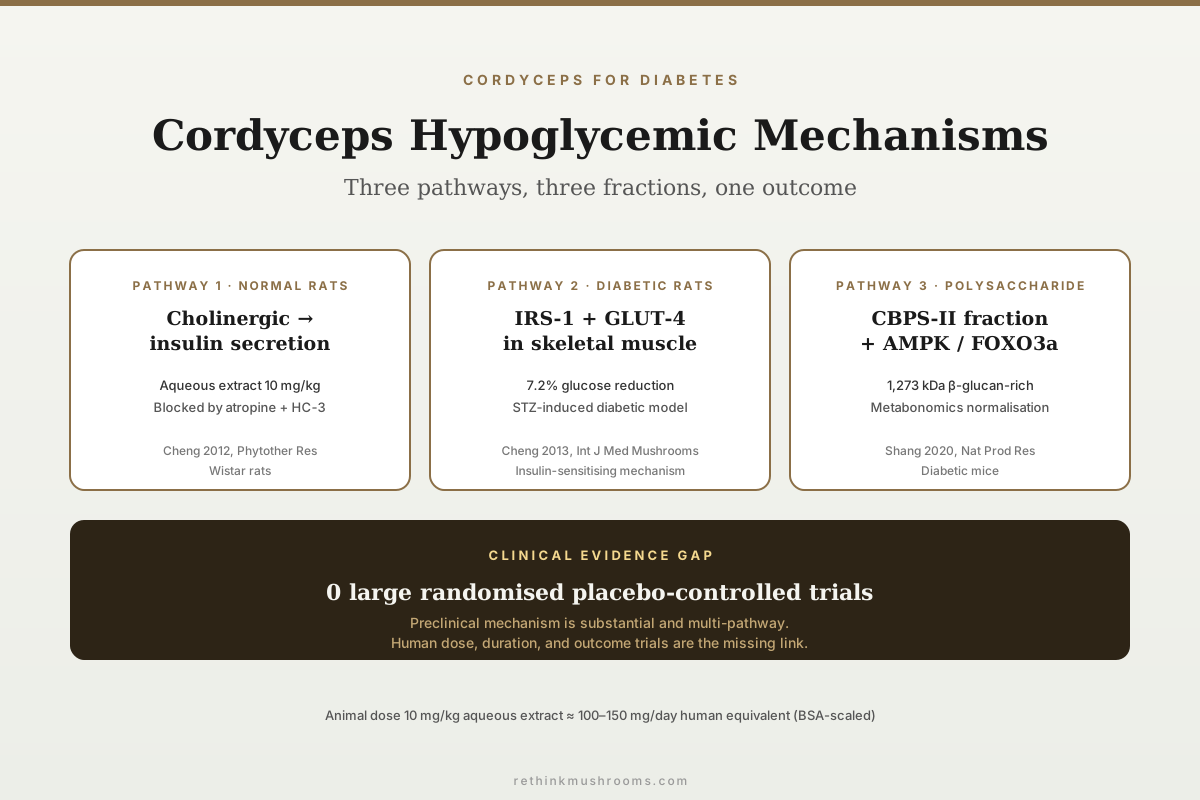
Cordyceps militaris aqueous extract at 10 mg/kg lowered plasma glucose by 21.0% in normal Wistar rats and by 7.2% in streptozotocin-induced diabetic rats. In both models the same research group found the effect ran through cholinergic signalling — atropine abolished it — with IRS-1 and GLUT-4 rising downstream in muscle. Polysaccharide fractions, cordycepin, and gut microbiota shifts add further documented hypoglycemic routes in rodents. Human trials remain sparse.
Cheng et al., Phytotherapy Research, 2012; Int J Medicinal Mushrooms, 2013
21.0% / 7.2%
plasma glucose fall at 10 mg/kg in normal rats (Cheng 2012) and in STZ-diabetic rats (Cheng 2013) respectively
Atropine blocks it
muscarinic blockade abolished the hypoglycemia and the IRS-1/GLUT-4 rise in diabetic rats — the mechanism is cholinergically gated
No human RCT
four reviews converge on the same gap: no adequately powered randomised placebo-controlled trial in people with type 2 diabetes
Cheng et al., Phytotherapy Research, 2012; Int J Medicinal Mushrooms, 2013
 View as image ↗
The cordyceps blood sugar literature has built up across two decades of preclinical work spanning multiple rodent diabetic models, distinct molecular pathways, and fractionated active constituents (aqueous extract, polysaccharide fraction, isolated cordycepin). The consistent finding is that Cordyceps militaris preparations lower blood glucose in both normal and diabetic animals. The most-cited pair of studies, however, is routinely described as showing two different mechanisms in two different models — and that is not what those papers report. Read carefully, they report the same mechanism twice, which is a stronger result and a more useful one. The sparse clinical data do not yet translate any of this into human type 2 diabetes outcomes.[1][2] For the insulin-signalling mechanism deep-dive, see cordyceps and insulin sensitivity: mechanisms and evidence, for the beta-cell angle see cordyceps and pancreatic beta-cell protection: preserving insulin production, and for the current human trial status see cordyceps for type 2 diabetes: clinical trial findings.
Key Takeaways
- Cheng et al. (2012) in Phytotherapy Research found that Cordyceps militaris aqueous extract at 10 mg/kg lowered plasma glucose by 21.0% and increased insulin secretion by 54.5% within 30 minutes in normal Wistar rats, while raising IRS-1 and GLUT-4 in muscle
- Cheng et al. (2013) in International Journal of Medicinal Mushrooms repeated the experiment in streptozotocin-induced diabetic rats: glucose fell 7.2% versus 1.5% in controls, IRS-1 rose 2.9-fold versus actin (control 0.8-fold), and GLUT-4 rose 1.7-fold versus 0.6-fold
- Both papers point to the same upstream trigger. Atropine abolished the hypoglycemia and the IRS-1/GLUT-4 rise in diabetic rats, and atropine or hemicholinium-3 abolished the insulin-secretion and IRS-1/GLUT-4 response in normal rats — the effect is cholinergically gated, not a direct peripheral action
- Yu et al. (2015) independently reproduced the insulin-signalling readout in a high-fat-diet type 2 diabetes model, with IRS-1, phospho-IRS-1, Akt, phospho-Akt and GLUT-4 all raised in skeletal muscle and adipose tissue
- Shang et al. (2020) purified a C. militaris polysaccharide (CBPS-II, 1,273 kDa) and showed 100 mg/kg lowered glucose in diabetic mice while shifting energy, amino-acid and gut-microbial metabolism
- Separate routes exist for the isolated compounds: cordycepin cut blood glucose 47% and raised hepatic glycogen 214% in alloxan-diabetic mice (Ma 2015, intraperitoneal), the water extract inhibited α-glucosidase more strongly than acarbose in vitro (Kim 2017), and both extract and cordycepin remodelled the gut microbiota in high-fat-diet/STZ mice (Liu 2023)
- Not every cordyceps preparation works: solid-state fermented C. sinensis preserved β-cell function and protected kidneys in diabetic mice but produced no obvious improvement in hyperglycemia or insulin resistance (Kan 2012)
- Four reviews (Ashraf 2020; Sharma 2022; Shamim 2023; Zhang 2024) reach the same conclusion — mechanistically rich preclinical base, no adequately powered human randomised controlled trial
The Two Cheng Studies: One Group, Two Models, One Mechanism
The two most-cited papers in this literature come from the same research group, use the same preparation and the same 10 mg/kg dose, and differ only in the animal model. They are frequently summarised as finding "cholinergic insulin secretion in normal rats" and "IRS-1/GLUT-4 muscle signalling in diabetic rats," as though the mechanism changed between models. That summary does not survive contact with the papers. Both studies measured both readouts, and both found the same thing.
Cheng et al. (2012) · Phytotherapy Research
- Population
- Normal (non-diabetic) Wistar rats
- Intervention
- C. militaris aqueous extract, 10 mg/kg — selected after outperforming a higher 100 mg/kg dose
- Comparator
- Saline; plus atropine and hemicholinium-3 blockade arms
- Finding
- Plasma glucose fell 21.0% and insulin secretion rose 54.5% at 30 minutes. Western blotting showed significant increases in IRS-1 and GLUT-4. Atropine or hemicholinium-3 abolished both the insulin-secretion increase and the IRS-1/GLUT-4 elevation — though a hypoglycemic effect was still observed under blockade.
positive Healthy-animal model. Establishes the cholinergic gate, not clinical efficacy.
Cheng et al., Phytotherapy Research 2012;26(8):1173-7 (PMID 22821853)
Cheng et al. (2013) · International Journal of Medicinal Mushrooms
- Population
- Twelve rats with streptozotocin-induced diabetes, randomised to two groups
- Intervention
- C. militaris aqueous extract, 10 mg/kg
- Comparator
- Saline control; plus a 0.1 mg/kg intraperitoneal atropine arm
- Finding
- Blood glucose fell 7.2% with extract versus 1.5% with saline (P < 0.05). IRS-1 signal was 2.9-fold that of actin versus 0.8-fold in controls (P < 0.005); GLUT-4 was 1.7-fold versus 0.6-fold (P < 0.05). Atropine rendered the hypoglycemia and the IRS-1/GLUT-4 elevation non-significant.
positive Twelve animals in the primary comparison — a small study, and the effect size is modest.
Cheng et al., Int J Med Mushrooms 2013;15(3):277-86 (PMID 23662615)
The paired result is the interesting one. In the normal-rat study the extract raised insulin secretion, and blocking cholinergic transmission removed that increase. In the diabetic-rat study — where streptozotocin has destroyed most β-cells and a large insulin-secretion response is not available — the extract still lowered glucose, still raised IRS-1 and GLUT-4, and atropine still abolished all of it. The authors' stated conclusion in the 2013 paper is precisely that "cholinergic activation also was considered to be involved in the hypoglycemic effect of CM in rats with streptozotocin-induced diabetes."
Blockade Ledger
The Same Mechanism, Confirmed Twice — Not Two Different Ones
One research group, one preparation, one dose, two animal models. Both studies measured glucose and insulin signalling, and both ran a pharmacological blockade arm. Reading the blockade rows is what separates “cordyceps is an insulin sensitiser” from the narrower claim the data actually support.
Normal Wistar rats
Cheng 2012 [2]intact β-cells, intact metabolism
10 mg/kg aqueous extract — outperformed the higher 100 mg/kg dose
What was measured
Then blocked with Atropine or hemicholinium-3
Streptozotocin-diabetic rats
Cheng 2013 [1]n = 12, most β-cells destroyed
10 mg/kg aqueous extract vs saline control
What was measured
Then blocked with Atropine 0.1 mg/kg i.p.
The effect is cholinergically gated
In diabetic rats atropine removed the glucose drop outright. In normal rats it removed the insulin and IRS-1/GLUT-4 response while a residual hypoglycemic effect survived — evidence for at least one additional, cholinergic-independent route in animals with intact metabolism.
Does this hold in humans?
untestedA mechanism that depends on intact vagal cholinergic signalling may behave differently in people with diabetic autonomic neuropathy. No study has tested that question in either direction.
Sources: Cheng et al., Int J Med Mushrooms 2013;15(3):277-86 [1]; Cheng et al., Phytotherapy Research 2012;26(8):1173-7 [2]. All values as reported in the published abstracts. Both studies are rodent work; neither establishes an effect size or a dose in people.
What the Atropine Arms Actually Show
Pharmacological blockade is the most informative part of these two studies, and it is the part most often lost in summary. Atropine antagonises muscarinic acetylcholine receptors; hemicholinium-3 depletes presynaptic acetylcholine by blocking choline uptake. Applying either one and re-running the experiment answers a specific question: does the effect require intact cholinergic signalling?
The answer across both papers is yes — with one honest nuance. In diabetic rats, atropine removed the glucose-lowering effect outright. In normal rats, atropine and hemicholinium-3 removed the insulin-secretion increase and the IRS-1/GLUT-4 rise, but the 2012 authors still recorded a hypoglycemic effect under blockade. That residual suggests at least one cholinergic-independent contribution in animals with intact metabolism, which is consistent with the separate routes documented for polysaccharides and cordycepin later in this article.
This matters for translation. A compound whose action depends on intact vagal cholinergic signalling may behave differently in people with diabetic autonomic neuropathy than in healthy rodents. No study has tested that question.
The IRS-1 and GLUT-4 Readout
Both Cheng studies found this readout raised, and in both it collapsed under cholinergic blockade — so within that work it is best read as a downstream consequence of the upstream signal rather than an independent mechanism.
Independent support comes from a different group and a more clinically relevant model. Yu et al. (2015) tested a combination of C. militaris fruiting body and mycelia powder in high-fat-diet-induced type 2 diabetic C57BL/6J mice.[4] Fasting blood glucose and oral glucose tolerance improved through increased insulin sensitivity, with no change in body weight, and protein expression of IRS-1, phospho-IRS-1, Akt, phospho-Akt and GLUT-4 rose in both skeletal muscle and adipose tissue. PPAR-γ expression in adipose tissue improved triglyceride and cholesterol levels alongside.
That model is the better analogue for human type 2 diabetes. Streptozotocin ablates β-cells and produces something closer to type 1 pathophysiology; high-fat-diet induction produces insulin resistance with preserved β-cell mass, which is what most people with type 2 diabetes have. The insulin-signalling finding replicating in that model, from a separate group, is the strongest single piece of mechanistic support in this literature.
Routes That Do Not Depend on the Cholinergic Gate
Whole aqueous extracts contain several classes of active material, and the isolated fractions have their own documented effects.
Polysaccharides. Shang et al. (2020) extracted crude polysaccharide from C. militaris, purified it through Sevag treatment and Sephadex G-100 chromatography to a fraction termed CBPS-II with an average molecular weight of 1,273 kDa, and tested it in streptozotocin-diabetic mice.[3] At 100 mg/kg it effectively reduced blood glucose. Serum clinical chemistry (creatinine, urea nitrogen, triglyceride, total cholesterol) moved toward normal, and ¹H NMR metabonomic profiling identified shifts in glucose, lactic acid, 3-hydroxybutyric acid, creatine, glutamate, valine, leucine, isoleucine and VLDL — implicating energy, amino-acid and intestinal-microbial metabolism.
Cordycepin. Ma et al. (2015) gave cordycepin to alloxan-induced diabetic mice at 8, 24 and 72 mg/kg intraperitoneally for 21 days.[5] At the effective dose, blood glucose fell 47%, hepatic glycogen content rose 214%, and oral glucose tolerance improved significantly; polyphagia and polydipsia were partly relieved, with protection against diabetes-related kidney and spleen injury. The authors attribute the effect to regulation of glucose metabolism in the liver. Note the route: this was intraperitoneal, not oral, which matters for the dosing discussion below.
Direct hepatic and intestinal action. Kim et al. (2017) worked with C. militaris water extract in HepG2 liver cells.[7] The extract drove glucose uptake by raising GLUT2 through HNF-1α, increased AMPK phosphorylation, stimulated glycolysis while inhibiting gluconeogenesis, and stored the absorbed glucose as glycogen via PI3K/Akt/GSK-3β. Separately, it produced greater α-glucosidase inhibition than acarbose — the same enzyme target as that prescription drug, which slows carbohydrate digestion in the gut. This is cell-culture work, so it establishes that the aqueous extract can do these things to a hepatocyte, not that oral dosing achieves the necessary concentrations in a person.
Gut microbiota. Liu et al. (2023) treated high-fat-diet plus streptozotocin type 2 diabetic mice with C. militaris extract or cordycepin and analysed faecal samples by gut microbiome and metabolomic methods.[6] Glucose and lipid metabolism parameters, oxidative stress biomarkers and inflammatory cytokines all fell, alongside a higher Firmicutes/Bacteroidetes abundance. A microbiota-mediated route is notable because it does not require the compound to reach systemic circulation intact.
Preparation Ledger
Eight Studies, Eight Different Interventions
“Cordyceps lowers blood sugar” compresses two species, four preparation types, two administration routes and five animal models into one sentence. Laid out on those axes, the results stop being interchangeable — and one of them points the other way.
C. militaris aqueous extract
Cheng 2012 [2]Glucose −21.0%, insulin secretion +54.5% at 30 min
C. militaris aqueous extract
Cheng 2013 [1]Glucose −7.2% vs −1.5% control; IRS-1 and GLUT-4 raised
Fruiting body + mycelia powder
Yu 2015 [4]Insulin sensitivity improved; IRS-1, pIRS-1, Akt, pAkt, GLUT-4 up in muscle and fat
Purified polysaccharide (CBPS-II, 1,273 kDa)
Shang 2020 [3]Glucose reduced; energy, amino-acid and gut-microbial metabolism shifted
Isolated cordycepin
Ma 2015 [5]Glucose −47%, hepatic glycogen +214% — but route bypasses first-pass metabolism
Extract and cordycepin
Liu 2023 [6]Glucose and lipid parameters, oxidative stress and cytokines down; microbiota remodelled
C. militaris water extract
Kim 2017 [7]GLUT2 up via HNF-1α, AMPK phosphorylated, α-glucosidase inhibition exceeding acarbose
Solid-state fermented mycelium
Kan 2012 [8]β-cell protection and renoprotection, HDL/LDL improved — but no obvious improvement in hyperglycemia or insulin resistance
Reading the ledger: the seven positive rows are not seven confirmations of one product. They test different material at different doses by different routes. The strongest single effect size — cordycepin’s 47% — came from intraperitoneal injection, which oral capsules cannot reproduce. And the one row testing a fermented C. sinensis preparation found no glycaemic benefit at all.
Sources: Cheng 2013 [1]; Cheng 2012 [2]; Shang 2020 [3]; Yu 2015 [4]; Ma 2015 [5]; Liu 2023 [6]; Kim 2017 [7]; Kan 2012 [8]. Every efficacy finding shown is preclinical — rodent or cell line. No row represents human data.
Where the Evidence Does Not Converge
A literature that only ever reports positive results deserves suspicion, so the negative and partial results are worth stating plainly.
Kan et al. (2012) tested an extract of solid-state fermented Cordyceps sinensis mycelium in KK/HIJ diabetic mice fed a high-fat diet for eight weeks, against rosiglitazone as an active comparator.[8] The extract raised HDL/LDL ratios and reduced body-weight gain, protected pancreatic β-cells against streptozotocin toxicity in vitro, enhanced renal Na⁺/K⁺-ATPase activity and reduced mesangial matrix and collagen deposition. But on the endpoint this article is about, the authors report that treatment "did not lead to obvious improvements in hyperglycemia or resistance to insulin."
That is a different species (C. sinensis, not militaris), a different preparation (solid-state fermented mycelium), and a different model — and it failed to lower glucose. Cordyceps is not one intervention. Species, part used, extraction method and dose all vary between the studies summarised above, and the results are not interchangeable across them.
A second caution concerns a mechanism often attributed to cordycepin in popular summaries. Cordycepin does engage AMPK and does engage FOXO3a-family signalling, but not in the same experiment and not as a demonstrated glucose-lowering pathway. Huang et al. (2022) showed cordycepin protecting against diabetes-induced testicular damage through Sirt1/Foxo3a, with oxidative-stress endpoints — a real finding about a complication, not about glycaemic control.[9] Descriptions of an "AMPK–FOXO3a axis lowering blood glucose while upregulating catalase and superoxide dismutase in diabetic tissue" conflate separate studies; no such experiment appears in the indexed literature.
- Cell & Lab Studiescompleted
C. militaris water extract raises GLUT2 via HNF-1α, phosphorylates AMPK, and inhibits α-glucosidase more strongly than acarbose in HepG2 cells (Kim 2017)
- Animal Studiescurrent
Consistent glucose lowering across normal rats, STZ-diabetic rats, alloxan-diabetic mice and high-fat-diet type 2 models, from at least five independent groups (Cheng 2012, 2013; Yu 2015; Ma 2015; Shang 2020; Liu 2023) — with one preparation showing no glycaemic benefit (Kan 2012)
- Case Reports & Early Seriesmissing
No published case series of cordyceps used for glycaemic control in people
- Small Human Trialsmissing
Small open-label reports circulate in regional literature, but none establishes a defined dose, duration or effect size against control
- Large Randomized Trialsmissing
No adequately powered randomised placebo-controlled trial of any cordyceps preparation for type 2 diabetes outcomes
- Meta-Analyses & Systematic Reviewsmissing
Reviews exist (Ashraf 2020; Sharma 2022; Shamim 2023; Zhang 2024) but synthesise preclinical work — there is no pool of human trials to meta-analyse
The animal rung is unusually well populated: multiple models, multiple groups, converging direction, and pharmacological blockade identifying the upstream trigger. Every rung above it is empty. The gap is not that the biology looks weak — it is that the human trials have not been run.
Cheng 2012, 2013; Ma 2015; Yu 2015; Kim 2017; Shang 2020; Kan 2012; Liu 2023; Ashraf 2020; Sharma 2022; Shamim 2023; Zhang 2024
The Clinical Evidence Gap
Zhang et al. (2024) in Frontiers in Pharmacology reviewed cordycepin's structural and pharmacological profile across neoplasms and metabolic disorders including glucose metabolism.[10] Sharma et al. (2022) reviewed cordycepin as a pharmacological metabolite covering cancer, diabetes and hyperlipidemia applications.[11] Ashraf et al. (2020) reviewed cordycepin's nutraceutical and therapeutic potential including anti-diabetic effects.[12] Shamim et al. (2023) cataloged edible mushrooms for diabetes prevention and treatment, placing cordyceps alongside Agaricus, Ganoderma, Grifola, Lentinula, Hericium and Pleurotus.[13]
All four converge on the same framing: the preclinical evidence base is substantial and mechanistically coherent, while the human clinical trial evidence is sparse. Small open-label and single-site trials have been reported in regional literature but have not produced randomised, placebo-controlled, adequately powered data of the kind that would support entry into diabetes treatment guidelines. That gap is not a statement that cordyceps does not work in humans. It is a statement that the trials required to show whether it works, at what dose, in which patients, and with what durability, have not been conducted to the standard modern diabetes care demands.
For the current human trial status review see cordyceps for type 2 diabetes: clinical trial findings.
Dosing and Bioavailability Constraints
The rat studies used 10 mg/kg of aqueous extract. Converting by the standard body-surface-area factor for rat-to-human (divide by 6.2) gives roughly 1.6 mg/kg, or about 110 mg/day of aqueous-extract equivalent for a 70 kg adult. Commercial C. militaris dosing in human use typically runs 1 to 3 grams of mushroom powder or extract per day. That range could plausibly deliver enough extract to engage the mechanisms above, but the relationship between labelled powder dose and actual aqueous-extract active content is not standardised across products, so the conversion should be treated as an order-of-magnitude orientation rather than a target.
Two route caveats limit how far the animal doses transfer. First, the cordycepin findings with the largest effect sizes — Ma et al.'s 47% glucose reduction — used intraperitoneal injection, which bypasses first-pass metabolism entirely. Oral cordycepin faces rapid deamination by adenosine deaminase to the far less active 3'-deoxyinosine, so oral dosing does not deliver the same systemic exposure that produced those numbers. Second, the aqueous-extract and polysaccharide findings face a smaller version of this problem: polysaccharides are not absorbed intact, and their effects are mediated through gut-associated lymphoid tissue and microbiota modulation, which is consistent with the microbiome shifts Liu et al. and Shang et al. both observed. The cholinergic mechanism identified by the Cheng studies sits somewhere between: it was produced by oral feeding in rats, but nothing establishes the human oral dose that would reproduce it.
Interaction risk
ModerateAdditive hypoglycemia with prescription diabetes medication
Concern
Every preparation discussed here was selected for its ability to lower blood glucose in animals. Taken alongside insulin, sulfonylureas, meglitinides or other glucose-lowering drugs, an additive effect is biologically plausible even though no clinical case reports document it. Because no human dose-response data exist, the magnitude of any additive effect in a person is unknown and unpredictable.
What the research says
Cordyceps has a long record of traditional use without signalled serious toxicity, and Ma et al. found no significant effect on body weight or major organs in normal mice even at a 3,600 mg/kg maximum tolerance dose of cordycepin. The concern is interaction, not intrinsic toxicity.
Particularly relevant for: People taking insulin, sulfonylureas, or other antidiabetic medication; anyone with diabetic autonomic neuropathy, given the cholinergic dependence of the main documented mechanism
What to do
Discuss with the prescribing clinician before adding cordyceps, and monitor blood glucose more closely for the first several weeks if it is added. Do not reduce or stop prescribed diabetes medication on the basis of preclinical evidence. This article is research summary, not medical advice.
Cheng 2012, 2013; Ma 2015; Kan 2012; Shamim 2023
What the Evidence Supports and What It Does Not
| Question | Evidence | Confidence |
|---|---|---|
| Do C. militaris aqueous extracts lower blood glucose in rats? | Yes — 21.0% in normal rats (Cheng 2012), 7.2% vs 1.5% control in STZ-diabetic rats (Cheng 2013) | High |
| Does the effect require cholinergic signalling? | In diabetic rats, atropine abolished it; in normal rats, blockade removed the insulin-secretion and IRS-1/GLUT-4 response | Moderate |
| Does the effect involve skeletal muscle insulin signalling? | IRS-1 and GLUT-4 raised in both Cheng studies, and independently in an HFD type 2 model (Yu 2015) | Moderate |
| Do C. militaris polysaccharides have independent hypoglycemic activity? | Yes — CBPS-II at 100 mg/kg active in diabetic mice (Shang 2020) | Moderate |
| Does isolated cordycepin lower glucose? | Yes — 47% reduction in alloxan-diabetic mice, but by intraperitoneal injection (Ma 2015) | Moderate |
| Is there an AMPK–FOXO3a axis lowering glucose and raising CAT/SOD? | No such study exists; AMPK and Sirt1/Foxo3a findings come from separate, non-glycaemic experiments | Not supported |
| Do all cordyceps preparations lower glucose? | No — fermented C. sinensis mycelium showed no obvious hyperglycemia or insulin-resistance improvement (Kan 2012) | Moderate |
| Does oral cordyceps lower blood glucose in humans with type 2 diabetes? | Not adequately tested in randomised controlled trials | None / very low |
| Is cordyceps safe for long-term glucose regulation support? | Long traditional use; no long-term human safety data in diabetic populations | Low |
The Bottom Line
Preclinical evidence for Cordyceps militaris as a blood-sugar-lowering intervention is substantial, and the two most-cited studies say something more specific than they are usually credited with. Cheng et al. (2012) found 10 mg/kg aqueous extract lowered plasma glucose 21.0% and raised insulin secretion 54.5% in normal Wistar rats; Cheng et al. (2013) repeated the experiment in streptozotocin-diabetic rats and found a 7.2% fall versus 1.5% in controls, with IRS-1 at 2.9-fold and GLUT-4 at 1.7-fold versus actin. In both models the effect was cholinergically gated — atropine abolished the hypoglycemia and the IRS-1/GLUT-4 rise in diabetic animals — so this is best read as one mechanism confirmed twice rather than two different mechanisms. Yu et al. (2015) independently reproduced the insulin-signalling result in a high-fat-diet type 2 model. Separate routes exist for the isolated fractions: CBPS-II polysaccharide at 100 mg/kg (Shang 2020), cordycepin at 47% glucose reduction by intraperitoneal injection (Ma 2015), α-glucosidase inhibition exceeding acarbose in HepG2 cells (Kim 2017), and gut microbiota remodelling (Liu 2023). The literature is not uniformly positive: fermented C. sinensis mycelium produced no obvious glycaemic improvement (Kan 2012), and the widely repeated "AMPK–FOXO3a lowers glucose" claim does not correspond to any published experiment. The rat dose converts to roughly 110 mg/day of aqueous-extract equivalent for a 70 kg adult, but the largest cordycepin effects came from intraperitoneal dosing that oral administration cannot reproduce given adenosine deaminase deamination. Four reviews agree the human randomised trial evidence remains absent.
Frequently Asked Questions
Sources & References
- 1RTHM-00281·Cheng, Yu-Wen et al. (2013). “Aqueous extracts of Cordyceps militaris (Ascomycetes) lower the levels of plasma glucose by activating the cholinergic nerve in streptozotocin-induced diabetic rats..” International journal of medicinal mushrooms.Study breakdown →PubMed →↩
- 2RTHM-00246·Cheng, Yu-Wen et al. (2012). “Extracts of Cordyceps militaris lower blood glucose via the stimulation of cholinergic activation and insulin secretion in normal rats..” Phytotherapy research : PTR.Study breakdown →PubMed →↩
- 3RTHM-00653·Shang, Xiao-Lan et al. (2020). “1H NMR-based metabonomics of the hypoglycemic effect of polysaccharides from Cordyceps militaris on streptozotocin-induced diabetes in mice..” Natural product research.Study breakdown →PubMed →↩
- 4RTHM-00412·Yu, Sung-Hsun et al. (2015). “Hypoglycemic Activity through a Novel Combination of Fruiting Body and Mycelia of Cordyceps militaris in High-Fat Diet-Induced Type 2 Diabetes Mellitus Mice..” Journal of diabetes research.Study breakdown →PubMed →↩
- 5RTHM-00396·Ma, Li et al. (2015). “Cordycepin from Cordyceps militaris prevents hyperglycemia in alloxan-induced diabetic mice..” Nutrition research (New York.Study breakdown →PubMed →↩
- 6RTHM-00841·Liu, Xinyuan et al. (2023). “Cordyceps militaris extracts and cordycepin ameliorate type 2 diabetes mellitus by modulating the gut microbiota and metabolites..” Frontiers in pharmacology.Study breakdown →PubMed →↩
- 7RTHM-00477·Kim, Dae Jung et al. (2017). “Increased glucose metabolism and alpha-glucosidase inhibition in Cordyceps militaris water extract-treated HepG2 cells..” Nutrition research and practice.Study breakdown →PubMed →↩
- 8RTHM-00466·Kan, Wei-Chih et al. (2012). “Effects of Extract from Solid-State Fermented Cordyceps sinensis on Type 2 Diabetes Mellitus..” Evidence-based complementary and alternative medicine : eCAM.Study breakdown →PubMed →↩
- 9RTHM-00767·Huang, Tao et al. (2022). “Cordycepin, a major bioactive component of Cordyceps militaris, ameliorates diabetes-induced testicular damage through the Sirt1/Foxo3a pathway..” Andrologia.Study breakdown →PubMed →↩
- 10RTHM-00918·Zhang, Jinming et al. (2024). “Structural and pharmacological insights into cordycepin for neoplasms and metabolic disorders..” Frontiers in pharmacology.Study breakdown →PubMed →↩
- 11RTHM-00795·Sharma, Shivani et al. (2022). “Cordycepin as a Metabolite with Pharmacological Potential: A Review..” International journal of medicinal mushrooms.Study breakdown →PubMed →↩
- 12RTHM-00605·Ashraf, Syed Amir et al. (2020). “Cordycepin for Health and Wellbeing: A Potent Bioactive Metabolite of an Entomopathogenic Cordyceps Medicinal Fungus and Its Nutraceutical and Therapeutic Potential..” Molecules (Basel.Study breakdown →PubMed →↩
- 13RTHM-00850·Shamim, Mohammad Zaki et al. (2023). “Exploring Edible Mushrooms for Diabetes: Unveiling Their Role in Prevention and Treatment..” Molecules (Basel.Study breakdown →PubMed →↩