Cordyceps and Blood Sugar
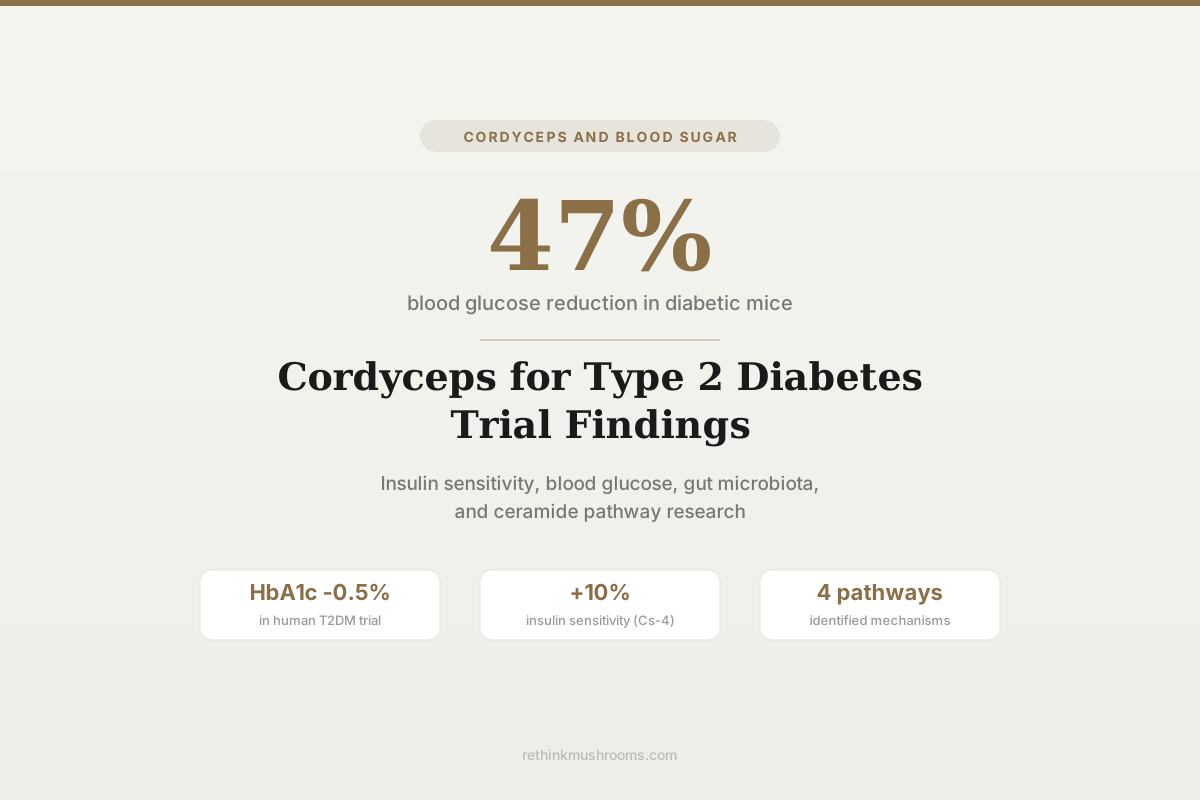
47% blood glucose reduction
Cordycepin from Cordyceps militaris reduced blood glucose by 47% and improved oral glucose tolerance in alloxan-induced diabetic mice over four weeks of daily administration.
Ma et al., Nutrition Research, 2015
HbA1c -0.5%
in 23 T2DM patients after 90 days
Ceramide pathway
cordyceps inhibits de novo synthesis
Gut microbiota
Bacteroidetes ratio restored
Ma et al., Nutrition Research, 2015
 View as image ↗
Type 2 diabetes affects over 500 million adults globally, and conventional pharmacotherapy carries side effects ranging from gastrointestinal distress to hypoglycemia. Cordyceps sinensis and Cordyceps militaris have been investigated across animal models, cell culture studies, and a small number of human trials for their effects on blood glucose, insulin sensitivity, and the metabolic pathways underlying insulin resistance. The evidence spans multiple mechanisms: cholinergic stimulation of insulin secretion, ceramide biosynthesis inhibition, AMPK activation, gut microbiota remodeling, and direct beta-cell protection. For the broader blood sugar evidence across all models, see Cordyceps and blood sugar: hypoglycemic research. For kidney-specific complications of diabetes, see Cordyceps and diabetic kidney disease: nephroprotective effects.
Key Takeaways
- Ma et al. (2015) found that cordycepin at 200 mg/kg reduced blood glucose by 47% in diabetic mice, improved oral glucose tolerance, and increased serum insulin levels while reducing TNF-alpha, IL-6, and total cholesterol
- A clinical study of 23 patients with T2DM found that a cordyceps-based compound (M12CCC at 4.5 g/day) reduced HbA1c by 0.5% after 90 days (p = 0.001) and lowered 2-hour postprandial glucose at 30, 60, and 90 days
- Liu et al. (2023) demonstrated that C. militaris extracts restored Bacteroidetes-to-Firmicutes ratios, reduced fasting blood glucose, and lowered inflammatory cytokines in T2DM mice through gut microbiota modulation
- Li et al. (2022) showed cordyceps inhibits ceramide biosynthesis by suppressing serine palmitoyltransferase, improving insulin sensitivity and reducing hepatic steatosis in high-fat-diet mice
- Balon et al. (2002) reported that Cs-4 at 2 g/kg for four weeks increased whole-body insulin sensitivity by 10% and enhanced skeletal muscle glucose transporter (GLUT-4) content in rats
- Cheng et al. (2012) identified cholinergic activation as a hypoglycemic mechanism: 10 mg/kg C. militaris extract lowered plasma glucose in rats, an effect blocked by atropine and hemicholinium-3
The Human Evidence: A Clinical Trial in T2DM Patients
The most direct human evidence for cordyceps in type 2 diabetes comes from a before-after clinical study by Du and colleagues, published in 2022 in the Journal of Translational Research, that enrolled 30 patients aged 30 to 75 with established T2DM. Participants received a cordyceps-based formulation (M12CCC, Twelve Meridian Cordyceps Correlated Compounds) at 4.5 g/day, taken as 1.5 g dissolved in hot water before each of three daily meals, for 90 consecutive days.
Among the 23 patients with baseline HbA1c above 6.5%, the mean HbA1c declined by 0.5% after 90 days (p = 0.001). Two-hour postprandial glucose (OGTT 2hPG) decreased at 30, 60, and 90 days compared to baseline (all p < 0.01). Fasting plasma glucose did not change, suggesting the compound primarily affected postprandial glucose handling rather than basal glucose production.
Body weight, BMI, triglycerides, total cholesterol, uric acid, muscle mass, fat mass, and visceral fat showed no significant changes over the study period. No serious adverse events were reported.
The limitations are substantial. This was a before-after study without a placebo control group, making it impossible to separate treatment effects from natural disease fluctuation, regression to the mean, or placebo response. The sample was small (23 evaluable patients). The compound was a multi-ingredient formulation, not pure cordyceps. The 0.5% HbA1c reduction, while statistically significant, is modest compared to first-line diabetes medications like metformin (which typically reduces HbA1c by 1.0 to 1.5%). The trial was also published in a lower-tier journal that is not indexed in PubMed or MEDLINE, so it has not passed the same database-level screening as the preclinical studies cited throughout this article, and no study has replicated these results.
Cordycepin and Blood Glucose: The Strongest Animal Evidence
Ma et al. (2015) conducted the most detailed investigation of cordycepin (3'-deoxyadenosine) in a diabetes model. Alloxan-induced diabetic mice received cordycepin at doses of 50, 100, or 200 mg/kg daily for four weeks. At the highest dose, blood glucose dropped by 47%, and oral glucose tolerance improved in a dose-dependent manner.[1]
The metabolic effects extended beyond glucose. Serum insulin increased, indicating either preserved beta-cell function or enhanced insulin release. Total cholesterol, triglycerides, and LDL-cholesterol decreased. Inflammatory markers TNF-alpha and IL-6 were reduced. Liver enzymes AST and ALT returned toward normal values, suggesting hepatoprotective effects alongside glycemic control.
The study also measured liver antioxidant enzymes. Superoxide dismutase (SOD) and glutathione peroxidase (GPx) activities increased in treated mice, while malondialdehyde (MDA, a lipid peroxidation marker) decreased. This antioxidant profile suggests cordycepin protects pancreatic and hepatic tissue from oxidative damage, a process that accelerates beta-cell loss in diabetes.
The limitation: alloxan destroys beta cells through oxidative damage, creating a model that resembles type 1 diabetes more than type 2. The 200 mg/kg dose in mice translates to a human-equivalent dose of approximately 16 mg/kg, or roughly 1,100 mg of pure cordycepin for a 70 kg adult. Whether oral cordyceps supplements deliver this concentration is uncertain given cordycepin's rapid metabolic clearance through adenosine deaminase.
Insulin Sensitivity: The Cs-4 and Ceramide Pathways
Two independent research lines have examined how cordyceps affects insulin sensitivity at the tissue level.
Balon et al. (2002) tested CordyMax Cs-4 in rats at 2 g/kg body weight for four weeks. Whole-body insulin sensitivity, measured by the insulin tolerance test, increased by approximately 10%. Skeletal muscle glucose transporter GLUT-4 protein content was elevated in the Cs-4 group. The effect appeared to act downstream of insulin receptor signaling, enhancing glucose uptake into muscle tissue directly.[2]
Li et al. (2022) identified a more specific mechanism: ceramide biosynthesis inhibition. Myriocin, a compound originally extracted from the Cordyceps-related fungus Isaria sinclairii, is a potent inhibitor of serine palmitoyltransferase (SPT), the first enzyme in the ceramide synthesis pathway. The research team showed that cordyceps extracts containing myriocin-like compounds reduced hepatic ceramide accumulation in high-fat-diet mice, improved insulin sensitivity, and reduced hepatic steatosis (fatty liver).[3]
This ceramide pathway is relevant because ectopic lipid accumulation in liver, muscle, and adipose tissue drives insulin resistance in type 2 diabetes. Ceramides accumulate in response to high-fat diets and obesity, disrupting insulin signaling at the level of Akt/PKB phosphorylation. By blocking ceramide production at its source through SPT inhibition, cordyceps may address one of the root causes of insulin resistance rather than simply lowering blood glucose after the fact. The finding also connects cordyceps to the broader lipotoxicity hypothesis of T2DM pathogenesis. For more on these mechanisms, see Cordyceps and insulin sensitivity: mechanisms and evidence.
The Cholinergic Mechanism: How C. militaris Triggers Insulin Release
Cheng et al. (2012) identified a specific pharmacological pathway through which Cordyceps militaris lowers blood glucose. In normal Wistar rats, aqueous C. militaris extracts at 10 mg/kg lowered plasma glucose and stimulated insulin secretion. The effect was dose-dependent, with 10 mg/kg producing stronger effects than 1 mg/kg or 5 mg/kg.[4]
The key experiment: when rats were pretreated with atropine (a muscarinic receptor antagonist) or hemicholinium-3 (an acetylcholine synthesis inhibitor), the blood glucose lowering effect was abolished. This demonstrated that C. militaris acts through the cholinergic nervous system to stimulate insulin secretion, rather than acting directly on beta cells or peripheral tissues.
Cheng et al. (2013) extended this work by showing that C. militaris extract also activated cholinergic pathways in type 2 diabetic rats, lowering plasma glucose levels through the same muscarinic receptor mechanism. The extract increased phosphorylation of insulin receptor substrate-1 (IRS-1) and Akt in liver tissue, confirming activation of the insulin signaling cascade.[5]
Gut Microbiota: A Newer Research Direction
Liu et al. (2023) investigated cordyceps effects on the gut microbiome in T2DM mice. High-fat-diet plus streptozotocin-induced diabetic mice received either C. militaris extracts or pure cordycepin for several weeks. Both treatments reduced fasting blood glucose, lowered oxidative stress biomarkers, and decreased inflammatory cytokines (TNF-alpha, IL-6, IL-1-beta).[6]
The gut microbiome analysis revealed that diabetic mice had a disrupted Bacteroidetes-to-Firmicutes ratio, a pattern consistently observed in human T2DM. Both cordyceps extract and cordycepin restored this ratio toward normal. Metabolomic profiling identified changes in short-chain fatty acid production and bile acid metabolism. The researchers concluded that gut microbiota modulation was a primary mechanism through which cordyceps ameliorated T2DM, acting through the PI3K/Akt/mTOR signaling pathway.
Shang et al. (2020) added metabolomic depth using NMR-based analysis. A purified Cordyceps militaris polysaccharide (CBPS-II, molecular weight 1,273 kDa) lowered blood glucose in streptozotocin-induced diabetic mice. The NMR metabolomics revealed changes in amino acid metabolism, lipid metabolism, and energy metabolism pathways in treated animals, providing biochemical evidence for the multi-target nature of cordyceps polysaccharides.[7]
Combination Approaches: Fruiting Body Plus Mycelia
Yu et al. (2015) tested a novel combination of Cordyceps militaris fruiting body and mycelia powder in high-fat-diet/streptozotocin T2DM mice. The combination produced hypoglycemic effects, reducing fasting blood glucose and improving glucose tolerance. The researchers proposed that the combined preparation offered complementary bioactive compounds: cordycepin and adenosine concentrated in the fruiting body, polysaccharides more abundant in the mycelia.[8]
Kan et al. (2012) used a different approach: solid-state fermented Cordyceps sinensis extract in KK/HIJ diabetic mice (a genetic model of T2DM). The fermented extract reduced blood glucose and showed renoprotective effects. The authors compared the effects to rosiglitazone (a thiazolidinedione insulin sensitizer) and found that the cordyceps extract had comparable glucose-lowering properties with additional kidney-protective benefits.[9]
Kim et al. (2017) demonstrated another angle: alpha-glucosidase inhibition. C. militaris water extract treated with citric acid showed increased glucose metabolism and potent alpha-glucosidase inhibitory activity. Alpha-glucosidase inhibitors (like acarbose, a prescription diabetes drug) slow carbohydrate digestion, reducing postprandial glucose spikes. The finding suggests cordyceps may share a mechanism with an established drug class.[10]
The Evidence Gap: What Is Missing
The most striking feature of the cordyceps-diabetes literature is the disproportion between animal and human evidence. Over a dozen preclinical studies show glucose-lowering, insulin-sensitizing, and anti-inflammatory effects across multiple animal models. One human trial (uncontrolled, 23 patients) showed a modest HbA1c reduction.
Evidence Hierarchy
Cordyceps & Type 2 Diabetes — An Upside-Down Evidence Pyramid
A normal evidence pyramid is widest at the bottom (mechanisms) and narrows to a single, decisive human trial at the top. Here it is inverted: the mechanistic and animal tiers are crowded with studies, while the tier that would guide real treatment — a placebo-controlled trial in people — is empty. Bar width reflects how much direct evidence exists at each tier, not the size of any effect.
Placebo-controlled human RCT
gapDoes not yet exist
The evidence a clinician would actually act on — a randomised, blinded trial testing cordyceps against placebo on HbA1c or fasting glucose in people with type 2 diabetes — has never been run
Uncontrolled human trial
preliminaryDu 2022 (M12CCC)
One before-after study (23 evaluable patients) reported a 0.5% HbA1c drop over 90 days on a 4.5 g/day multi-ingredient cordyceps compound — no placebo arm, small, unreplicated, and published in a journal not indexed in PubMed
Genetic T2DM animal model
evidenceKan 2012
In KK/HIJ mice — an inbred strain whose insulin resistance resembles human type 2 diabetes more closely than chemically-destroyed beta cells — fermented C. sinensis lowered glucose comparably to the drug rosiglitazone
Chemically-induced diabetic animals
evidenceMa 2015 · Balon 2002 · Cheng 2012/13 · Liu 2023
The densest tier: cordycepin cut blood glucose 47% in alloxan mice, Cs-4 raised insulin sensitivity 10% with more muscle GLUT-4, C. militaris triggered cholinergic insulin release, and extracts restored the gut Bacteroidetes ratio — but alloxan and streptozotocin destroy beta cells, modelling type 1 more than type 2
Cell & mechanistic pathways
evidenceLi 2022 · Kim 2017
The widest, cleanest tier: cordyceps blocks ceramide synthesis at serine palmitoyltransferase to protect insulin signalling, and inhibits alpha-glucosidase to blunt carbohydrate absorption — the same target as the prescription drug acarbose
How to read it: the bars grow wider toward the bottom because the mechanistic and animal literature is deep and converges on several plausible pathways. But every step upward toward a human with diabetes loses evidence — the single human study is small, uncontrolled, and used a multi-ingredient compound, and the controlled trial that would settle the question has never been run. The gap at the top, not the quality of the mechanisms, is the honest limit of the cordyceps–diabetes claim.
Sources: Ma 2015 [1]; Balon 2002 [2]; Li 2022 [3]; Cheng 2012 [4]; Cheng 2013 [5]; Liu 2023 [6]; Shang 2020 [7]; Yu 2015 [8]; Kan 2012 [9]; Kim 2017 [10]; and Du et al. (2022), Journal of Translational Research — the uncontrolled human trial, which is not indexed in PubMed. Bar widths are illustrative of evidence depth per tier, not quantitative effect sizes.
No randomized, placebo-controlled human trial has tested cordyceps or cordycepin as a standalone intervention for T2DM. The animal doses used (50 to 200 mg/kg of cordycepin, 2 g/kg of Cs-4) are substantially higher relative to body weight than typical human supplement doses of 1 to 3 g/day of whole extract. The alloxan and streptozotocin models used in most animal studies destroy beta cells chemically, which does not replicate the insulin resistance and progressive beta-cell failure characteristic of human T2DM. The KK/HIJ genetic model used by Kan et al. more closely resembles human T2DM, but still involves a homogeneous inbred mouse strain without the genetic diversity of human populations.
The supplement quality question also looms large. Cordycepin content varies dramatically between products: wild Ophiocordyceps sinensis, cultivated C. militaris fruiting bodies, fermented mycelium (Cs-4), and combination products all have different bioactive profiles. Without standardized preparations, comparing results across studies is inherently imprecise.
The mechanistic evidence is robust: at least four independent pathways (cholinergic insulin secretion, ceramide inhibition, gut microbiota remodeling, alpha-glucosidase inhibition) have been identified. Whether these pathways produce clinically meaningful glucose control in humans at achievable supplement doses remains the central unanswered question. For how these mechanisms relate to beta-cell preservation specifically, see Cordyceps and pancreatic beta-cell protection: preserving insulin production. For comparisons with other mushroom species studied for diabetes, see Comparing mushroom species for diabetes management.
The Bottom Line
Cordyceps research in type 2 diabetes spans four distinct mechanisms: cholinergic stimulation of insulin secretion, ceramide biosynthesis inhibition, gut microbiota modulation, and alpha-glucosidase inhibition. Animal studies show consistent blood glucose reduction and insulin sensitivity improvements at high doses. The single human trial found a 0.5% HbA1c reduction after 90 days in an uncontrolled study of 23 patients. No placebo-controlled human trial exists, and the gap between robust preclinical evidence and minimal clinical data remains the defining feature of this research area.
Frequently Asked Questions
Sources & References
- 1RTHM-00396·Ma, Li et al. (2015). “Cordycepin from Cordyceps militaris prevents hyperglycemia in alloxan-induced diabetic mice..” Nutrition research (New York.Study breakdown →PubMed →↩
- 2RTHM-00041·Balon, Thomas W et al. (2002). “A fermentation product of Cordyceps sinensis increases whole-body insulin sensitivity in rats..” Journal of alternative and complementary medicine (New York.Study breakdown →PubMed →↩
- 3RTHM-00779·Li, Ying et al. (2022). “Cordyceps inhibits ceramide biosynthesis and improves insulin resistance and hepatic steatosis..” Scientific reports.Study breakdown →PubMed →↩
- 4RTHM-00246·Cheng, Yu-Wen et al. (2012). “Extracts of Cordyceps militaris lower blood glucose via the stimulation of cholinergic activation and insulin secretion in normal rats..” Phytotherapy research : PTR.Study breakdown →PubMed →↩
- 5RTHM-00281·Cheng, Yu-Wen et al. (2013). “Aqueous extracts of Cordyceps militaris (Ascomycetes) lower the levels of plasma glucose by activating the cholinergic nerve in streptozotocin-induced diabetic rats..” International journal of medicinal mushrooms.Study breakdown →PubMed →↩
- 6RTHM-00841·Liu, Xinyuan et al. (2023). “Cordyceps militaris extracts and cordycepin ameliorate type 2 diabetes mellitus by modulating the gut microbiota and metabolites..” Frontiers in pharmacology.Study breakdown →PubMed →↩
- 7RTHM-00653·Shang, Xiao-Lan et al. (2020). “1H NMR-based metabonomics of the hypoglycemic effect of polysaccharides from Cordyceps militaris on streptozotocin-induced diabetes in mice..” Natural product research.Study breakdown →PubMed →↩
- 8RTHM-00412·Yu, Sung-Hsun et al. (2015). “Hypoglycemic Activity through a Novel Combination of Fruiting Body and Mycelia of Cordyceps militaris in High-Fat Diet-Induced Type 2 Diabetes Mellitus Mice..” Journal of diabetes research.Study breakdown →PubMed →↩
- 9RTHM-00466·Kan, Wei-Chih et al. (2012). “Effects of Extract from Solid-State Fermented Cordyceps sinensis on Type 2 Diabetes Mellitus..” Evidence-based complementary and alternative medicine : eCAM.Study breakdown →PubMed →↩
- 10RTHM-00477·Kim, Dae Jung et al. (2017). “Increased glucose metabolism and alpha-glucosidase inhibition in Cordyceps militaris water extract-treated HepG2 cells..” Nutrition research and practice.Study breakdown →PubMed →↩