Lentinan & Shiitake Cancer Research
2,729 patients across 31 RCTs
The largest meta-analysis on injectable lentinan for gastric cancer found a treatment efficacy relative risk of 1.48, meaning lentinan + chemotherapy improved response rates by 48% compared to chemotherapy alone.
Wang et al., Phytomedicine, 2024
5-year survival
Ina 2011: 10.0% (lentinan+S-1) vs 0% (S-1 alone); p=0.04; the most striking single statistic in this evidence base
HR 0.80
Oba 2009 meta-analysis: lentinan + fluoropyrimidines reduced death risk by 20% in 650 unresectable/recurrent gastric cancer patients
30+ years
Lentinan has been a standard adjunct chemotherapy treatment in Japan since the 1985 Ajinomoto approval, one of the longest clinical records for any mushroom compound
Wang et al., Phytomedicine, 2024
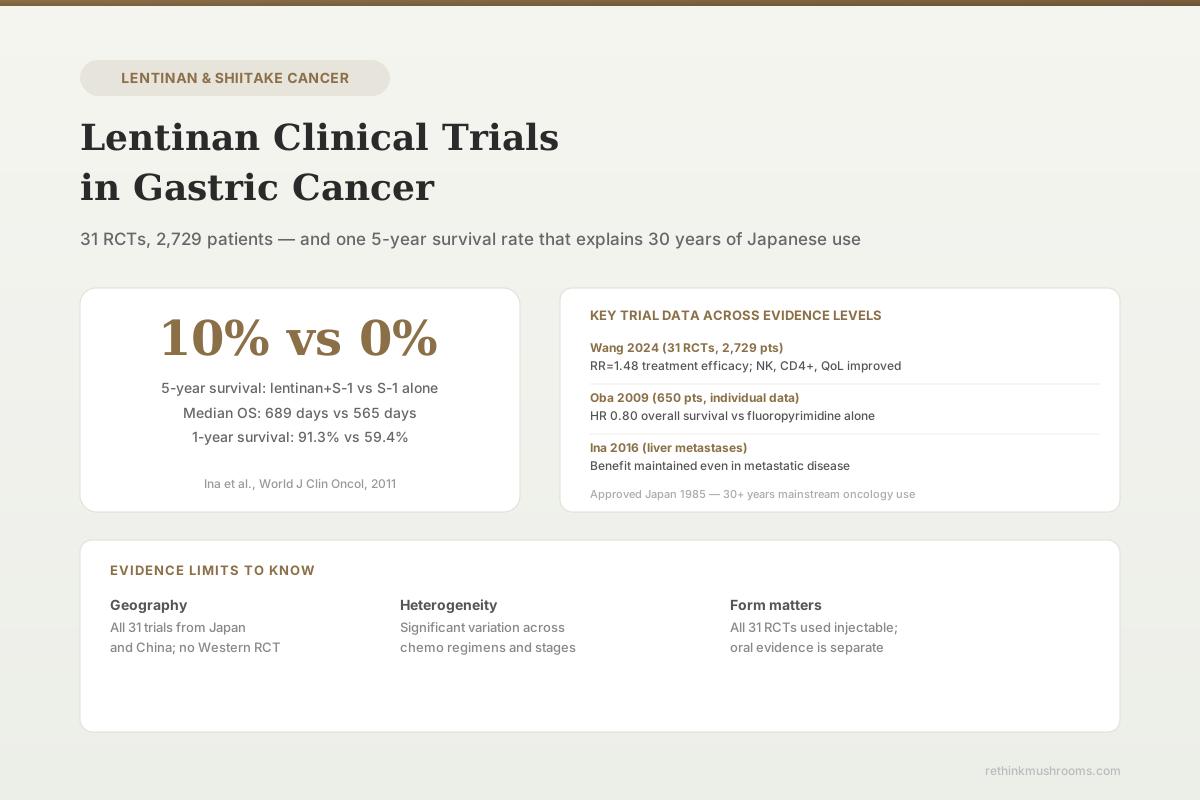 View as image ↗
In a 2011 cohort study, Ina and colleagues divided gastric cancer patients into two groups: one receiving S-1 chemotherapy plus lentinan injections, the other receiving S-1 alone. At five years, 10% of patients in the lentinan group were alive. In the chemotherapy-only group, the five-year survival rate was zero.[3] That single data point, from a modest-sized cohort study, captures why lentinan has remained a fixture in Japanese oncology for over three decades.
This article maps the clinical trial evidence for lentinan in gastric cancer specifically: what the major trials measured, what they found, and what the evidence does and does not support. For the broader context of lentinan's mechanism and Japan approval history, see lentinan: the shiitake compound approved for cancer treatment in Japan.
Key Takeaways
- The 2024 Wang meta-analysis (31 RCTs, 2,729 patients) found injectable lentinan + chemotherapy improved treatment efficacy (RR=1.48, 95% CI 1.36-1.61) and improved CD3+/CD4+ ratios, NK cell counts, and quality of life vs. chemotherapy alone
- Ina et al. (2011) reported the most striking single endpoint in 68 evaluable patients (31 lentinan + S-1 vs. 37 S-1 alone): 5-year survival of 10.0% vs. 0%, 2-year survival of 45.7% vs. 32.7%, and 1-year survival of 91.3% vs. 59.4%; median overall survival 689 vs. 565 days (p=0.0406)
- The Oba 2009 individual-patient meta-analysis (650 patients, unresectable/recurrent gastric cancer) found lentinan + fluoropyrimidines significantly improved overall survival (HR 0.80, 95% CI 0.68-0.95)
- Ina et al. (2016) was a small retrospective case series of 12 patients with gastric cancer and liver metastases: lentinan + S-1 produced a 42% objective response, 83% disease control, and 407-day median survival — evidence of activity in advanced disease, but uncontrolled and hypothesis-generating rather than comparative
- Lentinan has been used as a standard adjunct to chemotherapy in Japan for 30+ years (Ina 2013 review), representing one of the most extensive clinical records for any mushroom compound
- Critical limitations: most trials are from Japan and China; many are small; the 2024 meta-analysis flagged significant heterogeneity; no large Western RCT has replicated these findings
The Clinical Evidence at a Glance
| Study | Design | Patients | Key Finding |
|---|---|---|---|
| Wang et al. 2024 | Meta-analysis, 31 RCTs | 2,729 | RR=1.48 treatment efficacy; improved NK cells, CD4+:CD8+, QoL |
| Oba et al. 2009 | Individual-patient meta-analysis | 650 | HR 0.80 overall survival (fluoropyrimidine-based chemo) |
| Ina et al. 2011 | Cohort | 68 (31 vs 37) | 689 vs 565 days median OS (p=0.04); 5-year survival 10% vs 0% |
| Ina et al. 2016 | Retrospective case series | 12 (liver mets) | ORR 42%, disease control 83%, median OS 407 days (single-arm) |
| Ina et al. 2013 | Systematic review | N/A | 30-year Japan clinical record; standard adjunct since 1985 |
The Foundational Meta-Analysis: Oba 2009 (650 Patients)
The Oba 2009 meta-analysis is the foundational evidence most competitors cite when discussing lentinan for gastric cancer.[2] It pooled individual patient data across multiple trials, a methodologically stronger approach than standard meta-analysis because it enables subgroup analyses and avoids some ecological bias.
The population was patients with unresectable or recurrent gastric cancer, a particularly difficult-to-treat group where overall survival is typically poor. Lentinan was administered alongside fluoropyrimidine-based chemotherapy, the standard Japan gastric cancer regimen at the time.
The primary finding: the hazard ratio for overall survival was 0.80 (95% confidence interval 0.68-0.95). A hazard ratio below 1.0 indicates a survival benefit; 0.80 means approximately a 20% reduction in risk of death at any given time point. The confidence interval did not include 1.0, confirming statistical significance.
For patients and oncologists, a 20% reduction in death risk alongside existing chemotherapy is clinically meaningful, particularly when the intervention is a purified mushroom polysaccharide with an established safety profile rather than an additional cytotoxic drug. The 2009 meta-analysis established the survival benefit foundation on which subsequent research built.
Ina 2011: The Five-Year Survival Difference
The Ina 2011 cohort study is the most cited individual trial for its five-year endpoint, which is rare in unresectable gastric cancer research because five-year survival in this population is uncommon enough to be statistically challenging to measure.[3]
The study compared lentinan intravenous injection combined with S-1 chemotherapy against S-1 alone in gastric cancer patients. S-1 (tegafur/gimeracil/oteracil) is an oral fluoropyrimidine regimen used in Japan as a standard gastric cancer treatment.
The analysis compared 31 patients who received lentinan + S-1 against 37 who received S-1 alone (68 evaluable patients). The primary endpoints were median overall survival and survival at specific time points:
- Median OS: 689 days in the lentinan + S-1 group vs. 565 days in the S-1-alone group (p=0.0406)
- 1-year survival: 91.3% vs. 59.4%
- 2-year survival: 45.7% vs. 32.7%
- 5-year survival: 10.0% vs. 0%
Ina 2011 · Survival Over Time
Survival Rates: Lentinan + S-1 vs. S-1 Chemotherapy Alone
Percent of patients alive at each timepoint in the Ina 2011 cohort (31 received lentinan + S-1; 37 received S-1 alone). The widest gap is at 5 years, where 10% of the lentinan group survived versus none of the chemotherapy-alone group — a striking result from one modest, non-randomized cohort.
A cohort study, not a randomized trial: patient selection and the small sample size add uncertainty, so the gap reflects an association rather than proof that lentinan alone produced it. Median overall survival was 689 vs. 565 days (p = 0.0406).
Source: Ina et al., World Journal of Clinical Oncology (2011), 2(10):339-43 [ref 3], RTHM-00404 (PMID 21994907). Survival rates quoted verbatim from the full text.
The five-year endpoint is striking. In a population where zero patients survived five years without lentinan, 10% survived with it. This does not mean lentinan alone accounts for the difference; confounding factors in a cohort study, patient selection, and the modest sample size all add uncertainty. But the direction and magnitude of effect are consistent with the meta-analysis evidence and have not been contradicted by any subsequent large trial.
The median survival difference (689 vs. 565 days, approximately 4 months) is modest in absolute terms but statistically significant and clinically relevant in an advanced cancer population.
Ina et al. (2011) · World Journal of Clinical Oncology
- Population
- 68 patients with metastatic or recurrent gastric cancer (31 lentinan + S-1 vs. 37 S-1 alone)
- Intervention
- Lentinan intravenous injection added to S-1-based chemotherapy
- Comparator
- S-1-based chemotherapy alone
- Finding
- Median overall survival 689 vs. 565 days (p=0.0406). Survival rates favored lentinan at every timepoint: 1-year 91.3% vs. 59.4%, 2-year 45.7% vs. 32.7%, 5-year 10.0% vs. 0%.
positive The most cited single result in the lentinan gastric-cancer literature — but a non-randomized cohort of modest size, so it shows a strong association rather than proof of causation.
Ina et al., World Journal of Clinical Oncology, 2011 [ref 3], RTHM-00404
Advanced Disease: Ina 2016 and Liver Metastases
A concern with any adjunct therapy is whether it retains activity in the most advanced disease stages, where the tumor burden is highest and the patient's immune system may be most compromised.
Ina and colleagues examined this in a 2016 retrospective chart review at Nagoya Memorial Hospital.[4] Of 138 metastatic gastric cancer patients reviewed, 12 with liver metastases — one of the most difficult presentations, with particularly poor prognosis — were treated with lentinan combined with S-1-based chemotherapy.
In that 12-patient subgroup, lentinan + S-1 produced an objective response rate of 42% (5 of 12) and a disease control rate of 83% (10 of 12), with a median overall survival of 407 days. There was no randomized control arm: this is a small, single-arm case series, so the numbers describe what happened in these patients rather than proving lentinan caused the outcomes. Read that way, the series is best understood as hypothesis-generating evidence that the combination remains active in liver-metastatic disease, not as a controlled demonstration of benefit.
Its practical value is narrow but real: it extends the signal from the controlled evidence into a stage of disease where treatment options are limited, while making clear how far short of a randomized trial this particular data point sits. The immune-activation mechanism that would explain such a benefit is documented in the controlled trials summarized below, not in this small retrospective series.
The 2024 Meta-Analysis: 31 RCTs, 2,729 Patients
The most current and largest evidence synthesis is the Wang 2024 systematic review and meta-analysis, published in Phytomedicine.[1] This study synthesized 31 randomized controlled trials involving 2,729 patients, making it more than four times larger than the 2009 Oba meta-analysis.
The primary outcome, treatment efficacy, (a composite of complete response, partial response, and stable disease) showed a relative risk of 1.48 (95% CI 1.36-1.61, p less than 0.00001). RR=1.48 means patients receiving lentinan + chemotherapy were 48% more likely to achieve a treatment response than those receiving chemotherapy alone.
Secondary outcomes confirmed multiple supporting findings:
- CD3+ lymphocyte count (a marker of T-cell immune activity): significantly improved
- CD4+ lymphocyte count: significantly improved
- CD4+:CD8+ ratio (an indicator of helper T-cell dominance): significantly improved
- NK cell count: significantly improved
- Quality of life scores: significantly improved
The immune parameter findings are particularly important because they connect the clinical outcomes to the proposed mechanism. Lentinan is hypothesized to work by activating immune cells rather than directly killing tumors. The CD4+:CD8+ ratio improvement and NK cell increase document exactly the immune activation that the mechanism predicts.
The Wang 2024 meta-analysis also noted heterogeneity across included trials, which is expected given the range of tumor stages, chemotherapy regimens, and study designs. Heterogeneity means the results cannot be applied uniformly across all patient populations, and subgroup analyses are needed to identify which patients benefit most. That said, the authors' trial-sequential analysis indicated the evidence was sufficient to draw firm conclusions on the main outcomes, and the GRADE certainty was rated "high" or "moderate."
Wang et al. (2024) · Phytomedicine
- Population
- 2,729 gastric cancer patients across 31 randomized controlled trials
- Intervention
- Injectable lentinan added to chemotherapy
- Comparator
- Chemotherapy alone
- Finding
- Treatment efficacy relative risk 1.48 (95% CI 1.36–1.61, p<0.00001). Lentinan also significantly improved CD3+, CD4+, and CD4+:CD8+ ratios, NK cell counts, and quality of life, with no serious adverse effects reported.
positive GRADE certainty 'high' or 'moderate' on the main outcomes, but the trials were predominantly Japanese/Chinese and heterogeneous — the authors call for further RCTs to confirm.
Wang et al., Phytomedicine, 2024 [ref 1], RTHM-02015
The 30-Year Japan Clinical Record
Lentinan was approved in Japan in 1985 by Ajinomoto as an adjunct treatment for gastric cancer. The Ina 2013 systematic review documented the 30-year clinical record that followed, establishing how lentinan became embedded in Japanese oncological practice.[5]
The key point from the review: lentinan in combination with fluoropyrimidine-based chemotherapy has been a standard adjunct treatment in Japan for over three decades. This is not fringe or experimental; it is mainstream oncology practice in the world's third-largest economy. The length of the clinical record provides a safety database that no short-term trial can replicate.
Why is lentinan approved in Japan but not the US or Europe? The answer involves regulatory philosophy rather than evidence quality. Japan's approval process in the 1980s accepted evidence from relatively small clinical trials with surrogate endpoints and quality-of-life measures. US FDA approval at that time required larger phase 3 RCTs with survival endpoints. No Western sponsor has run the large, expensive placebo-controlled RCT that FDA approval would require, because lentinan is unpatentable (it's a natural compound) and the commercial incentive to fund a $50+ million trial is limited.
The shiitake bioactive compound context for lentinan alongside eritadenine and other compounds is covered in shiitake bioactive compounds: lentinan, eritadenine, and beyond.
- Cell & Lab Studiescompleted
Beta-glucan triple-helix structure and immune-receptor binding (Dectin-1, complement) characterize how lentinan activates innate immunity
- Animal Studiescompleted
Tumor-growth suppression and immune activation established lentinan as a biological response modifier before clinical use
- Case Reports & Early Seriescompleted
Retrospective series including Ina 2016 in liver-metastatic disease (12 patients: ORR 42%, median OS 407 days)
- Small Human Trialscompleted
Cohort and randomized trials such as Ina 2011 (median OS 689 vs. 565 days; 5-year survival 10% vs. 0%)
- Large Randomized Trialscurrent
The 31 RCTs pooled by Wang 2024 (2,729 patients) and the Oba 2009 individual-patient meta-analysis (650 patients, HR 0.80) — but almost entirely from Japan and China
- Meta-Analyses & Systematic Reviewscurrent
Wang 2024 (RR 1.48, GRADE high/moderate) and Oba 2009 provide the strongest synthesis; no Western replication exists
Unusually for a mushroom compound, the claim has reached the top of the ladder: multiple RCTs and two meta-analyses show a consistent benefit. What is missing is geographic breadth — no large, well-powered trial outside Japan or China has replicated the finding, which is the main reason Western guidelines have not adopted it.
Aggregate of Wang 2024, Oba 2009, Ina 2011, and Ina 2016 [refs 1–4]
What the Clinical Trials Don't Establish
The lentinan gastric cancer evidence is stronger than almost any natural compound in oncology, but important limitations apply.
Trial quality: The 31 RCTs in the Wang 2024 meta-analysis vary substantially in quality. Many were conducted in Chinese community hospitals rather than major academic centers. Randomization and blinding procedures are not uniformly reported. Publication bias may inflate positive results.
Population specificity: The evidence is almost entirely from Japanese and Chinese patients with specific genetic backgrounds and dietary patterns. Whether these findings generalize to Western populations is untested.
Chemotherapy regimen matching: The benefit appears strongest when lentinan is combined with fluoropyrimidine-based regimens (S-1, 5-FU). Whether lentinan synergizes equally with platinum-based regimens, taxanes, or newer targeted therapies has not been adequately studied.
No Western replication: No large, well-powered RCT has been conducted outside Japan or China. This is the single most important limitation for Western physicians evaluating whether to recommend lentinan.
For comparison of lentinan's evidence base with PSK (krestin), the other approved Japanese cancer immunotherapy compound from turkey tail mushroom, see PSK vs. PSP: comparing turkey tail's two star compounds.
Safety & context — how this evidence applies
ModerateClinical lentinan is a prescription injectable, not a self-directed supplement
Concern
Every survival result on this page comes from injectable lentinan given under oncologist supervision alongside chemotherapy, in Japan and China. It is not the same as an over-the-counter shiitake or beta-glucan capsule, and the trials do not test lentinan as a stand-alone or self-administered cancer treatment. Lentinan is an immune-activating agent, and the studies were run in patients already receiving specialist cancer care.
What the research says
Anyone with cancer should make treatment decisions — including whether an immunomodulator like lentinan has any role — with their treating oncologist, not on the basis of supplement marketing. Stopping or delaying proven chemotherapy in favor of a supplement is the real danger this evidence base can be misread to justify.
Particularly relevant for: People with cancer, on immunosuppressants, or considering mushroom supplements in place of standard care
What to do
Discuss any adjunctive or complementary therapy with your oncology team. This article is educational and is not medical advice.
Framing based on the injectable, physician-administered protocols used across the cited trials (Wang 2024, Oba 2009, Ina 2011/2016)
The Bottom Line
The lentinan gastric cancer trial evidence spans 30+ years, with the 2024 Wang meta-analysis (31 RCTs, 2,729 patients, RR=1.48) as the strongest current synthesis. The Oba 2009 individual-patient meta-analysis (650 patients, HR 0.80) and the Ina 2011 cohort study (5-year survival 10% vs 0%, median OS 689 vs 565 days) provide the most cited specific effect estimates. The evidence base has consistent limitations: predominantly Japanese/Chinese trials of variable quality, lack of Western replication, and heterogeneity in chemotherapy regimens used. Within these limitations, the directional signal across 31 RCTs is consistent and statistically robust.
Frequently Asked Questions
Sources & References
- 1. Source details for this reference are not yet available.
- 2. Source details for this reference are not yet available.
- 3. Source details for this reference are not yet available.
- 4. Source details for this reference are not yet available.
- 5. Source details for this reference are not yet available.