Lentinan & Shiitake Cancer Research
2024 discovery reframes the oral lentinan question
Oral lentinan activates immunity via Dectin-1 receptors on intestinal M cells in Peyer's patches, a separate mechanism from injectable lentinan's systemic immune activation, not simply an inferior one.
Wang et al., Carbohydrate Polymers, 2024
Triple helix required
Falch 2000: lentinan's immunostimulatory activity requires intact triple-helix conformation; denatured or degraded lentinan loses activity, making formulation critical
31 RCTs
all human clinical trials showing survival benefit in gastric cancer used injectable lentinan; no head-to-head injectable vs oral RCT exists
Different mechanisms
Injectable: systemic T-cell and NK activation. Oral: intestinal immunity via M cell → Peyer's patch → Dectin-1 → mononuclear phagocyte activation
Wang et al., Carbohydrate Polymers, 2024
 View as image ↗
The clinical evidence for lentinan in cancer treatment comes almost entirely from the injectable form. The 31 randomized controlled trials summarized in the 2024 Wang meta-analysis all used intravenous or intramuscular lentinan injection. When patients ask whether they can take oral lentinan supplements instead, the conventional answer has been no: systemic bioavailability of oral lentinan is poor, meaning very little of the active compound reaches the bloodstream.
A 2024 mechanistic study challenges the framing of that answer. Wang and colleagues found that oral lentinan is taken up by intestinal M cells, transported into Peyer's patches (lymphoid tissue in the gut wall), and activates immune cells there through Dectin-1 receptors.[1] This is a different mechanism from injectable lentinan's systemic immune activation, not simply a weaker version of the same thing. The question is not "does oral lentinan work as well as injectable" but "does oral lentinan's intestinal mechanism have clinically relevant effects."
For the detailed clinical trial data behind injectable lentinan's gastric cancer evidence, see lentinan clinical trials in gastric cancer: results and outcomes.
Key Takeaways
- Injectable lentinan has the clinical evidence base: a 2024 meta-analysis of 31 RCTs (2,729 patients) found improved treatment efficacy (RR=1.48; Wang et al., Phytomedicine, 2024), and the Oba 2009 individual-patient meta-analysis (650 patients, 5 trials) found an overall survival benefit (HR=0.80, 95% CI 0.68–0.95) in gastric cancer
- Oral lentinan has poor systemic bioavailability but a separate mechanism: absorption via intestinal M cells into Peyer's patches, activating immune cells through Dectin-1 receptors (Wang et al., Carbohydrate Polymers, 2024)
- The triple-helix conformation of lentinan is required for its immunostimulatory activity; denatured or degraded lentinan loses biological activity (Falch et al., Carbohydrate Research, 2000)
- No randomized controlled trial has directly compared injectable vs. oral lentinan in cancer patients
- The "oral lentinan doesn't work" claim confuses systemic bioavailability (low for oral) with intestinal immune activation (active for oral via Peyer's patch pathway)
- Oral superfine-dispersed lentinan has shown clinical evidence in colorectal and pancreatic cancer contexts in Japan, though this evidence is less robust than the injectable gastric cancer data
What Lentinan Is and Why the Form Matters
Lentinan is a beta-1,3/beta-1,6-glucan polysaccharide extracted from shiitake mushrooms (Lentinula edodes). Its immune-activating activity depends entirely on its three-dimensional structure, specifically, a triple helix in which three polysaccharide chains wind around each other.
Falch and colleagues established the structural requirement directly in 2000, showing that the cytokine-stimulating activity of beta-D-glucans requires the intact triple-helix conformation.[2] When lentinan is heated, treated with alkali, or otherwise denatured, the triple helix unfolds into a random coil structure. At that point, the immunostimulatory activity is lost regardless of how much lentinan (by weight) is present.
This structural dependency has two immediate practical implications. First, the processing method used to produce lentinan supplements matters enormously; aggressive extraction or drying that denatures the protein destroys the active compound while leaving the inactive polysaccharide mass intact. Second, injectable lentinan (a purified, quality-controlled pharmaceutical preparation) maintains the triple helix in solution, whereas the structural integrity of commercial oral supplements varies widely and is rarely independently tested.
The Injectable Form: What the Clinical Evidence Shows
Injectable lentinan's clinical record spans over 30 years in Japan and was synthesized in the 2024 Wang meta-analysis of 31 RCTs involving 2,729 patients.[3] The mechanism is systemic: after intravenous or intramuscular injection, lentinan circulates to peripheral lymphoid tissue where it activates macrophages, dendritic cells, natural killer cells, and T cells through pattern recognition receptors including Dectin-1 and Toll-like receptors 2 and 4.
This systemic activation is what drives the clinical effects measured in the gastric cancer trials. The Oba 2009 individual-patient meta-analysis (650 patients from 5 randomized trials) found a hazard ratio of 0.80 (95% CI 0.68–0.95) for overall survival with fluoropyrimidine-based chemotherapy.[4] The Ina 2011 cohort study found significantly longer median overall survival for lentinan plus S-1 chemotherapy than for chemotherapy alone (689 vs. 565 days, P=0.04).[5] The benefit extended to metastatic disease, including gastric cancer with liver metastases in the Ina 2016 study.[6]
The injectable form is a pharmaceutical preparation, produced to pharmaceutical standards, quality-controlled for purity and structural integrity, and administered in a clinical setting by medical professionals. Its bioavailability by injection is essentially 100% of the administered dose.
Why Oral Bioavailability Is Poor, and Why That's the Wrong Frame
The standard explanation for why oral lentinan is less effective than injectable runs: lentinan is a large polysaccharide (molecular weight typically 400-800 kDa) that is poorly absorbed across the intestinal epithelium. Most of the administered dose passes through the gut without entering the bloodstream, so the systemic immune effects measured in injectable trials cannot be replicated.
This explanation is accurate for systemic bioavailability. But it assumes that systemic immune activation is the only way oral lentinan can affect immune function. The 2024 Wang mechanistic study shows this assumption is incorrect.
The 2024 Mechanistic Discovery: Dectin-1 and Peyer's Patches
Wang and colleagues used both in vitro and in vivo methods to trace what happens to oral lentinan after ingestion, focusing on the intestinal immune tissue.[1]
Peyer's patches are specialized lymphoid aggregates embedded in the wall of the small intestine. They are covered by a specific cell type called microfold cells (M cells), which sample antigens from the intestinal lumen and deliver them to immune cells in the underlying lymphoid tissue. Peyer's patches are part of the gut-associated lymphoid tissue (GALT), the intestinal immune system that monitors gut contents for pathogens and foreign particles.
The Wang 2024 study used near-infrared imaging to confirm that orally administered lentinan is absorbed in the small intestine and accumulates within Peyer's patches, with M cells identified as the cells mainly responsible for transporting it there. Dectin-1 is the same receptor that mediates lentinan recognition in systemic immune cells, but here it operates at the intestinal surface rather than in peripheral blood. Using an M cell model plus in vitro and in vivo work, the authors showed that Dectin-1 further mediates uptake of lentinan by mononuclear phagocytes (dendritic cells and macrophages) inside the Peyer's patches.
Once taken up, lentinan promotes the proliferation and differentiation of these mononuclear phagocytes, thereby activating intestinal immune responses. In plain terms: oral lentinan reaches the gut-associated lymphoid tissue and switches on local immune cells there, without needing to enter the bloodstream first.
Wang et al. (2024) · Carbohydrate Polymers
- Population
- In vitro M cell model plus in vivo mouse studies (traceable fluorescent-labeled lentinan)
- Intervention
- Orally administered lentinan
- Finding
- Near-infrared imaging confirmed lentinan absorption in the small intestine and accumulation in Peyer's patches, with M cells transporting it there. Dectin-1 then mediated uptake by mononuclear phagocytes, which proliferated and differentiated to activate intestinal immune responses.
preliminary Establishes a biological pathway for oral lentinan's intestinal immune activity that is independent of systemic bloodstream absorption. It is a pharmacokinetic/mechanistic study, not a cancer-outcome trial.
Wang et al., Carbohydrate Polymers, 2024 [ref 1]
This is a genuinely different mechanism from injectable lentinan's systemic effects. Injectable lentinan activates peripheral NK cells, macrophages, and T cells that circulate throughout the body and can reach tumor tissue. Oral lentinan activates intestinal dendritic cells and macrophages that reinforce local gut immunity. These are complementary rather than redundant effects, and "oral bioavailability is poor" conflates two separate questions: how much lentinan reaches the bloodstream (low), and whether oral lentinan activates immune function at all (yes, via Peyer's patches).
What This Means for Oral Supplements and Whole Shiitake
The Peyer's patch mechanism has implications for interpreting oral supplement research and for the role of dietary shiitake.
In Japan, a form called oral "superfine dispersed lentinan" has been tested clinically for colorectal and pancreatic cancer. The superfine dispersion aims to maximize contact between lentinan and the intestinal surface (including Peyer's patches) by reducing particle size. Clinical evidence from these applications is less robust than the injectable gastric cancer data but suggests measurable immune and clinical benefits.
For commercial oral supplements, the picture is less clear. The triple-helix structural requirement (Falch 2000) means that supplements where extraction or drying has denatured the lentinan contain structurally inactive polysaccharide mass. Without confirming that the lentinan in a supplement retains triple-helix conformation, the amount of lentinan listed on the label is not meaningful. No standardized consumer test currently assesses this.
Eating whole shiitake mushrooms does deliver lentinan in its native structural context, though the quantity per typical serving is lower than therapeutic doses used in Japanese clinical settings. The Peyer's patch activation mechanism may still be relevant for dietary lentinan at food-level doses, though this has not been directly tested. The immune activation observed in studies of regular dietary shiitake consumption is consistent with gut-level immune effects from intact lentinan.
A Direct Comparison: Injectable vs. Oral
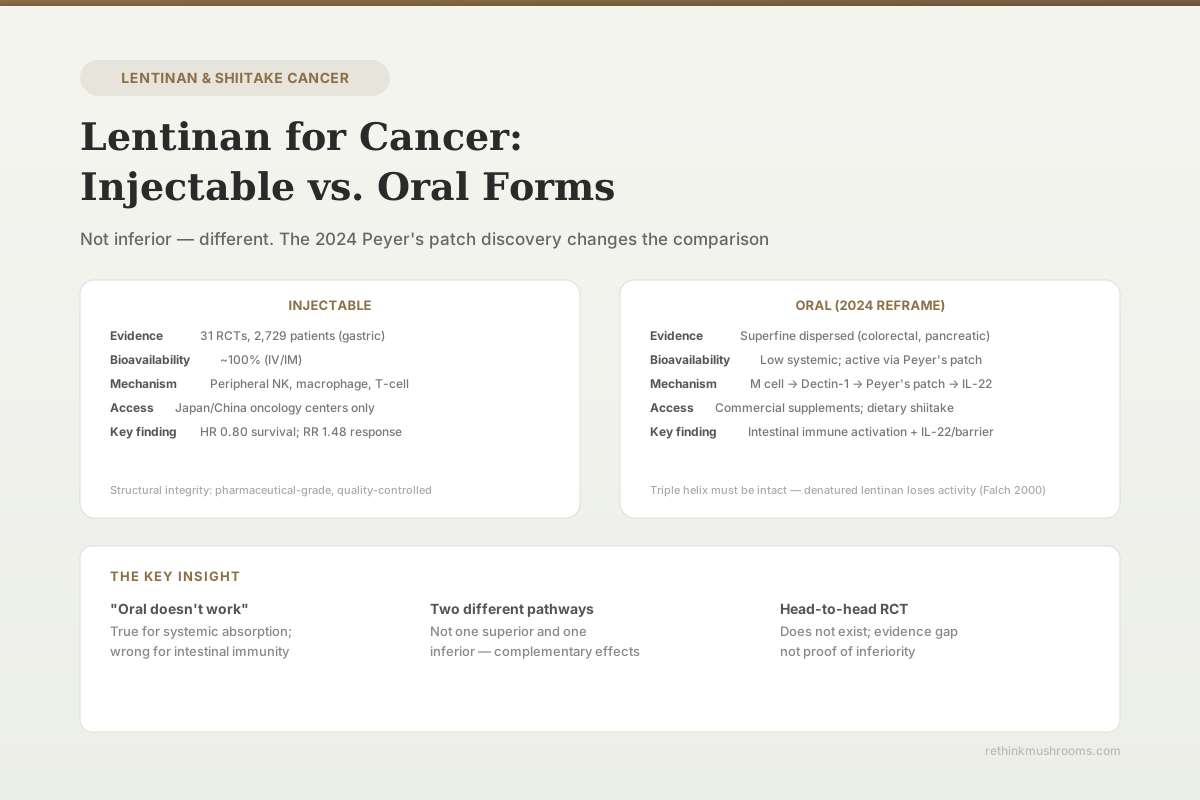
| Feature | Injectable | Oral |
|---|---|---|
| Clinical evidence | 31 RCTs, 2,729 patients (gastric cancer) | Superfine dispersed form in Japan (colorectal, pancreatic); less robust |
| Mechanism | Systemic: peripheral NK, macrophage, T-cell activation | Intestinal: M cell → Peyer's patch → Dectin-1 → mononuclear phagocyte activation |
| Bioavailability | ~100% (IV/IM) | Low systemic absorption; active via Peyer's patch route |
| Structural integrity | Pharmaceutical grade, quality-controlled | Variable; denaturation in processing is common |
| Access | Clinical/oncology setting only | Commercial supplements (quality variable); dietary shiitake |
| Head-to-head RCT vs. injectable | Not conducted | Not conducted |
No direct comparison trial exists. The "injectable works, oral doesn't" framing is historically based on the absence of oral evidence rather than evidence that oral lentinan is ineffective. The 2024 Dectin-1/Peyer's patch mechanism provides a biological rationale for oral lentinan's immune effects that did not exist before that study.
What Patients and Clinicians Should Know
For patients receiving cancer treatment in Japan, injectable lentinan is an available adjunct therapy with 30 years of clinical use and 31 supporting RCTs. It is administered at oncology centers as an intravenous or intramuscular injection, typically weekly.
For patients outside Japan or China, injectable pharmaceutical-grade lentinan is not available as an approved drug. Oral supplements containing lentinan or shiitake extracts are available commercially, but quality control around structural integrity is inconsistent, and no large RCT has established their clinical efficacy for cancer outcomes.
The honest framing: injectable lentinan has strong clinical evidence for gastric cancer outcomes as a chemotherapy adjunct. Oral lentinan activates intestinal immunity through a mechanism independent of systemic bioavailability, but this has not been tested in large cancer outcome trials. Whether the intestinal immune activation mechanism translates to clinical cancer benefits comparable to injectable lentinan remains unanswered.
Medical Context
ModerateLentinan is studied as an adjunct to cancer treatment, never a replacement
Concern
In every clinical trial, lentinan was given alongside conventional chemotherapy, not instead of it. No evidence supports using lentinan or oral shiitake supplements in place of oncologist-directed treatment, and the oral mechanistic findings do not establish that supplements treat cancer in any individual.
What the research says
If you are in cancer care, treat any lentinan or shiitake product as something to raise with your oncology team, not a substitute for treatment. Immune-active compounds can interact with therapy and warrant clinician oversight.
Particularly relevant for: Anyone undergoing or considering cancer treatment
What to do
Talk to your oncologist before adding any lentinan or mushroom supplement during treatment. This article is educational and is not medical advice.
Wang et al., Phytomedicine, 2024 meta-analysis of 31 adjunctive-therapy RCTs [ref 3]
The Bottom Line
Injectable lentinan holds the clinical evidence base for cancer treatment (31 RCTs, 2,729 patients, RR=1.48), while oral lentinan's systemic bioavailability is poor. However, the 2024 Wang study established that oral lentinan activates intestinal immunity via M cell uptake into Peyer's patches through Dectin-1, a mechanism distinct from systemic immune activation. Falch 2000 established that the triple-helix conformation is required for any lentinan immune activity, making structural integrity in supplement production critical. No head-to-head injectable vs. oral RCT has been conducted; the evidence gap for oral lentinan reflects absence of data rather than proven inefficacy.
Frequently Asked Questions
Sources & References
- 1RTHM-02013·Wang, Kaiping et al. (2024). “Insights into oral lentinan immunomodulation: Dectin-1-mediated lymphatic transport from Peyer's patch M cells to mononuclear phagocytes..” Carbohydrate polymers.Study breakdown →PubMed →↩
- 2RTHM-00032·Falch, B H et al. (2000). “The cytokine stimulating activity of (1-->3)-beta-D-glucans is dependent on the triple helix conformation..” Carbohydrate research.Study breakdown →PubMed →↩
- 3RTHM-02015·Wang, Yixuan et al. (2024). “Systematic review and meta-analysis on the efficacy and safety of Injectable Lentinan combined with chemotherapy in the treatment of gastric cancer..” Phytomedicine : international journal of phytotherapy and phytopharmacology.Study breakdown →PubMed →↩
- 4RTHM-00313·Oba, Koji et al. (2009). “Individual patient based meta-analysis of lentinan for unresectable/recurrent gastric cancer..” Anticancer research.Study breakdown →PubMed →↩
- 5RTHM-00404·Ina, Kenji et al. (2011). “Lentinan prolonged survival in patients with gastric cancer receiving S-1-based chemotherapy..” World journal of clinical oncology.Study breakdown →PubMed →↩
- 6RTHM-00787·Ina, Kenji et al. (2016). “Chemo-Immunotherapy Using Lentinan for the Treatment of Gastric Cancer with Liver Metastases..” Medical sciences (Basel.Study breakdown →PubMed →↩