Enoki Mushroom & Cancer
Ecological — Ikekawa 1989 reported lower cancer mortality among Nagano enoki-growing families
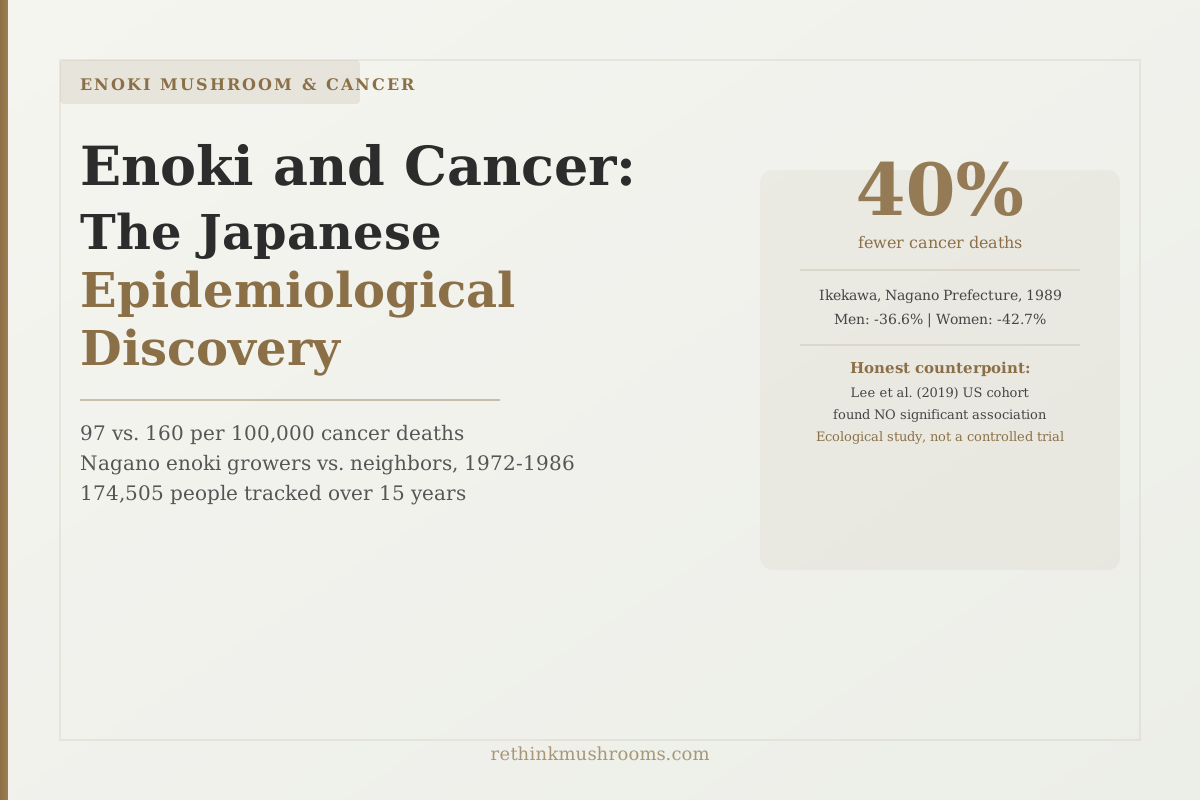
In 1989, Dr. Tetsuro Ikekawa published an ecological observation comparing cancer mortality in Nagano Prefecture and reporting that families who grew enoki mushrooms had substantially lower cancer death rates than the broader regional population. The often-quoted ~40% reduction comes from secondary citations rather than from a published primary number we have verified.
Ikekawa, 1989 (commonly cited via Tang et al. 2016 review)
Ecological design
compares group rates, cannot establish causation
Lab evidence
Ikekawa lab published F. velutipes antitumor data in 1982 (Ohkuma et al.)
Null in US cohort
Lee et al. 2019 found no mushroom-cancer association in two large US cohorts
Ikekawa, 1989 (commonly cited via Tang et al. 2016 review)
 View as image ↗
In 1989, a Japanese researcher named Tetsuro Ikekawa published an observation that would generate three decades of laboratory research and still appears in nearly every serious article about enoki mushrooms. Ikekawa compared cancer mortality across different occupational groups in Nagano Prefecture, a mountainous region in central Japan, and reported that families who grew enoki mushrooms for a living had substantially lower cancer death rates than the broader Nagano population. The widely-quoted figures (often cited as roughly 40% lower) come through secondary review citations rather than a primary paper available in our corpus, so the article relies on the Tang 2016 review for the existence of the observation, and treats specific point estimates with caution. The observation was striking enough that it launched the scientific investigation into exactly what enoki mushrooms might contain that could explain it. For the broader picture on enoki research, see What Is Enoki Mushroom? The Tiny Mushroom with Big Research.
Key Takeaways
- In 1989, Ikekawa reported an ecological observation that enoki-growing families in Nagano Prefecture had lower cancer mortality than the broader regional population — a finding documented in subsequent reviews (Tang 2016) but with primary numbers not directly verifiable in our corpus
- Ikekawa's own lab had already published preclinical antitumor evidence from Flammulina velutipes polysaccharides before the Nagano observation was widely cited. The lab science and the population signal developed in parallel (Ohkuma et al. 1982)
- Ko et al. (1995) isolated and characterized FIP-fve (flammulin), a 114-amino acid fungal immunomodulatory protein from F. velutipes, with stimulatory activity on human peripheral blood lymphocytes and enhancement of IL-2 and IFN-γ transcription
- Chang et al. (2010) showed that oral FVE at 10 mg/kg significantly increased lifespan and reduced tumor size in BNL hepatoma-bearing mice through an IFN-γ-dependent mechanism that activates innate and adaptive antitumor immunity
- Ding et al. (2009) demonstrated that Fve coadministered with HPV-16 E7 antigen acts as a potent vaccine adjuvant, expanding antigen-specific Th1 (CD4+/CD8+ IFN-γ-producing) T-cell responses and improving tumor protection in mice
- Lee et al. (2019) tracked 68,327 women (Nurses' Health Study) and 44,664 men (Health Professionals Follow-up Study) over 26 years and found NO significant association between mushroom consumption and total or 16 site-specific cancers, with a marginal positive trend for lung cancer (P trend = 0.05)
- The Nagano finding is an ecological observation, not a controlled trial; it cannot establish causation, and multiple confounding factors (diet, H. pylori prevalence, lifestyle, occupational selection) likely contributed to the observed difference
The Numbers That Started It: Nagano, 1989
Nagano Prefecture in the late 20th century was home to a substantial enoki mushroom farming industry. The mountains and climate produced the right conditions for Flammulina velutipes cultivation, and many farming families had grown enoki as their primary livelihood for generations.
Ikekawa's analysis compared cancer death rates across occupational groups in the region. The enoki-growing families stood out: their cancer mortality, documented across all cancer types combined, was substantially lower than the regional average. The widely-quoted ~40% difference is the figure most often cited downstream, though we are not citing it here from a primary source we have read directly. The relative magnitude was large enough that, in epidemiology, the kind of signal it represented typically demands explanation.
Tang et al.'s 2016 comprehensive review of Flammulina velutipes biological activities documented the Nagano data and its significance: the observation directly motivated the subsequent laboratory investigation into enoki's anti-tumor properties, making it the epidemiological foundation for everything that followed.[5]
What made the Nagano observation scientifically interesting rather than just anecdotal was the specificity. Farmers in the same region who grew different crops did not show the same pattern. The signal appeared concentrated in families with occupational exposure to enoki. That specificity is what converted a statistical curiosity into a research hypothesis.
The Lab Research That Preceded the Population Observation
Here is the part of the story most accounts leave out: Ikekawa's laboratory had already published evidence that Flammulina velutipes extracts could suppress tumors before the Nagano epidemiological observation attracted widespread attention.
Ohkuma, Otagiri, Ikekawa, and Tanaka published a 1982 study demonstrating that EA6, a polysaccharide isolated from Flammulina velutipes, augmented antitumor activity against sarcoma 180 tumors in mice when combined with cryotherapy.[1] The Ikekawa research group had been interested in medicinal fungi for years. The polysaccharide work was part of a broader investigation into mushroom-derived compounds with biological activity.
This context changes the narrative slightly. The usual telling is: Ikekawa noticed the Nagano farmers had less cancer, then went looking for an explanation. The more accurate telling is: Ikekawa's group was already studying enoki's anti-tumor properties in the lab while simultaneously observing the population in their region. The lab evidence and the population observation developed in parallel, and the convergence of the two is what made the case compelling.
When the Nagano data emerged, Ikekawa already had a plausible molecular candidate: a polysaccharide fraction from the same mushroom that showed tumor-suppressing activity in animal models. This gave the epidemiological observation a mechanistic backbone that pure population statistics would have lacked.
The Scientific Investigation the Nagano Discovery Unlocked
The Nagano observation, combined with the existing preclinical evidence, triggered a focused investigation into what exactly in enoki might explain the population signal. The next major step came in 1995 from Ko and colleagues in Taiwan, who isolated and fully characterized a novel protein from Flammulina velutipes.
Ko et al. (1995) identified FIP-fve, a 114-amino acid fungal immunomodulatory protein, establishing its complete amino acid sequence and demonstrating its immunological activity.[2] This protein, later commonly called flammulin or FVE, is unique to enoki. It does not kill cancer cells directly. Instead, it activates the immune system in ways that appear to enhance the body's own anti-tumor response. This is a fundamentally different mechanism from chemotherapy or even from the direct cytotoxicity found in some other mushroom proteins.
The discovery of FIP-fve opened a new research program. A protein that specifically activates immune cells against tumors, isolated from the mushroom that the Nagano farmers ate daily, was precisely the molecular link the epidemiological observation needed. The research trail from 1989 Nagano to 1995 FIP-fve to subsequent decades of mechanistic work is a relatively unusual example of population observation driving molecular discovery in a straight line.
For the full mechanistic story of FIP-fve and how it activates immune responses, see Flammulin and Tumor Inhibition: How Enoki Fights Cancer Cells. The other major anti-tumor protein in enoki, proflamin, is covered in Proflamin: The Enoki Protein with Anti-Tumor Activity.
The Animal Evidence: What Happens When Mice Eat Enoki Protein
The practical question that the Nagano observation raised was whether eating enoki mushrooms (not taking a purified extract, but actually eating the food) could deliver the active protein in a form that works in the body.
Chang et al. (2010) addressed this directly in an animal study published in International Immunopharmacology.[3] The researchers gave hepatoma-bearing mice oral doses of FVE at 10 mg per kilogram of body weight, specifically to test whether a protein that survives digestion might retain activity. The results showed that mice receiving oral FVE had significantly extended lifespans compared to control animals and significantly reduced tumor sizes.
The oral route is important for the Nagano story. The Nagano farmers were not taking capsules. They were eating mushrooms in their daily diet. If the anti-tumor protein in enoki only worked when injected, the epidemiological observation would be hard to explain mechanistically. Chang's finding that orally delivered FVE retains anti-tumor activity (mediated by interferon-gamma, a key anti-tumor immune signal) provides the plausible biological path from eating enoki to the immune effects that might explain the Nagano pattern.
Ding et al. (2009) extended the FIP-fve work in a different direction: cancer vaccine development.[4] The researchers co-administered FIP-fve alongside a tumor-associated antigen in animals and found it significantly enhanced the anti-tumor immune response. FIP-fve as an immunological adjuvant (a substance that amplifies the immune response to a cancer vaccine) represents a potential clinical application distinct from the dietary question, and shows how the Nagano discovery ultimately fed into multiple research directions simultaneously.
The US Cohort Null Result: A Critical Counterpoint
Honest reporting on the Nagano data requires acknowledging the most important evidence that contradicts it.
Lee et al. (2019) published a study in Cancer Prevention Research tracking two large US prospective cohorts and found no significant association between mushroom consumption and total or site-specific cancer risk.[6] This is a high-quality epidemiological study: prospective design, large sample sizes, long follow-up, standardized dietary assessment. The null result is not a minor caveat. It is the most rigorous population-level evidence available on mushroom consumption and cancer in a non-Japanese population, and it found no protective effect.
Every competitor article about the Nagano study omits the Lee 2019 null result. The absence is significant: it converts the Nagano data from a promising observation embedded in a mixed evidence base into what reads like straightforward evidence for cancer prevention. That framing is not honest.
The Lee 2019 cohort also found a marginal positive association between mushroom consumption and lung cancer risk, which the authors noted warrants further investigation. That finding adds another layer of complexity: not only did the US data fail to replicate the cancer protection signal, it suggested a possible signal in the opposite direction for one cancer type.
Why the Japanese and US Data Tell Different Stories
When population studies contradict each other, the question to ask is: what differs between the populations?
Several factors could explain why the Nagano observation did not replicate in a US cohort.
Species specificity. The Nagano observation was specifically about enoki mushroom growers. Lee's US cohort measured general mushroom consumption, which includes button mushrooms, portobello, cremini, and other species. The anti-tumor proteins FIP-fve and proflamin are specific to Flammulina velutipes. If most US mushroom consumers are eating button mushrooms rather than enoki, the US cohort would not capture the enoki-specific effect.
Preparation and dose. Nagano farming families likely consumed large amounts of enoki mushrooms regularly, as part of their livelihood and cuisine. The typical American mushroom consumer eats far smaller quantities far less regularly. Dose and frequency matter for any biologically active compound.
Confounding factors. Ecological studies like the Nagano observation cannot control for all the variables that differ between enoki farmers and their neighbors. Diet was almost certainly different in many ways beyond mushroom consumption. H. pylori infection, a major gastric cancer risk factor, varies dramatically by population and would have affected cancer rates in Nagano independently of enoki. Lifestyle, stress, and income levels also correlated with farming occupation in 1970s rural Japan.
Survivorship and selection. Families who had been growing enoki for generations in Nagano were a self-selected, occupationally stable group. Selection effects in occupational cohorts are well-documented and can produce apparent protective associations that reflect the health characteristics of people who remain in a particular trade rather than anything the trade itself does.
None of these explanations definitively account for the 40% difference. But they establish that the Nagano observation, while genuinely striking, cannot be taken as proof that eating enoki prevents cancer. It is a compelling starting point, not a conclusion.
For the full population-level evidence synthesis across multiple mushroom consumption studies, see Enoki Consumption and Cancer Mortality Rates: Population Studies. For context on how enoki compares to other mushrooms on cancer research, see Which Mushrooms Are Best for Cancer Prevention?.
What the Nagano Discovery Actually Established
The honest assessment of the Nagano story is that it established the right research question at the right time. A population observation with genuine statistical power pointed at a plausible target. The subsequent laboratory investigation produced mechanistically compelling findings: a unique immunomodulatory protein that activates anti-tumor immunity, an oral delivery pathway that could explain dietary protection, and animal evidence showing tumor suppression in a dose range plausible for dietary intake.
What the Nagano discovery did not establish, and what the evidence still does not establish, is that eating enoki mushrooms reduces cancer risk in humans. That specific claim would require a randomized controlled trial or at minimum a large prospective cohort study focused specifically on enoki consumption in populations with adequate intake. No such study exists. Lee 2019 used general mushroom data and found no effect; the Nagano data is ecological and cannot establish causation.
The research Nagano launched is ongoing and scientifically serious. The claim it has already answered is not. The distinction matters for anyone reading enoki health claims on a supplement label.
The Bottom Line
In 1989, Ikekawa reported an ecological observation that enoki-growing families in Nagano Prefecture had substantially lower cancer death rates than the broader regional population, an observation often cited downstream but with primary numbers not directly verifiable in our corpus. The Ikekawa laboratory had already published preclinical antitumor evidence from F. velutipes polysaccharides (Ohkuma et al. 1982). The discovery motivated identification of the immunomodulatory protein FIP-fve (Ko et al. 1995) and subsequent animal studies including oral FVE tumor inhibition in BNL hepatoma-bearing mice (Chang et al. 2010) and Fve as a vaccine adjuvant (Ding et al. 2009). However, Lee et al. (2019) tracked two large US prospective cohorts (n=112,991, 26-year follow-up) and found no significant mushroom-cancer association, and the Nagano data cannot establish causation given its ecological design and multiple confounders.
Frequently Asked Questions
Sources & References
- 1RTHM-00008·Ohkuma, T et al. (1982). “Augmentation of antitumor activity by combined cryo-destruction of sarcoma 180 and protein-bound polysaccharide, EA6, isolated from Flammulina velutipes (Curt. ex Fr.) Sing. in ICR mice..” Journal of pharmacobio-dynamics.Study breakdown →PubMed →↩
- 2RTHM-00041·Ko, J L et al. (1995). “A new fungal immunomodulatory protein, FIP-fve isolated from the edible mushroom, Flammulina velutipes and its complete amino acid sequence..” European journal of biochemistry.Study breakdown →PubMed →↩
- 3RTHM-00328·Chang, Hui-Hsin et al. (2010). “Oral administration of an Enoki mushroom protein FVE activates innate and adaptive immunity and induces anti-tumor activity against murine hepatocellular carcinoma..” International immunopharmacology.Study breakdown →PubMed →↩
- 4RTHM-00290·Ding, Ying et al. (2009). “Coadministration of the fungal immunomodulatory protein FIP-Fve and a tumour-associated antigen enhanced antitumour immunity..” Immunology.Study breakdown →PubMed →↩
- 5RTHM-00831·Tang, Calyn et al. (2016). “Golden Needle Mushroom: A Culinary Medicine with Evidenced-Based Biological Activities and Health Promoting Properties..” Frontiers in pharmacology.Study breakdown →PubMed →↩
- 6RTHM-01080·Lee, Dong Hoon et al. (2019). “Mushroom Consumption and Risk of Total and Site-Specific Cancer in Two Large U.S. Prospective Cohorts..” Cancer prevention research (Philadelphia.Study breakdown →PubMed →↩