Enoki Mushroom & Cancer — Epidemiology, Proteins, and Anti-Tumor Mechanisms
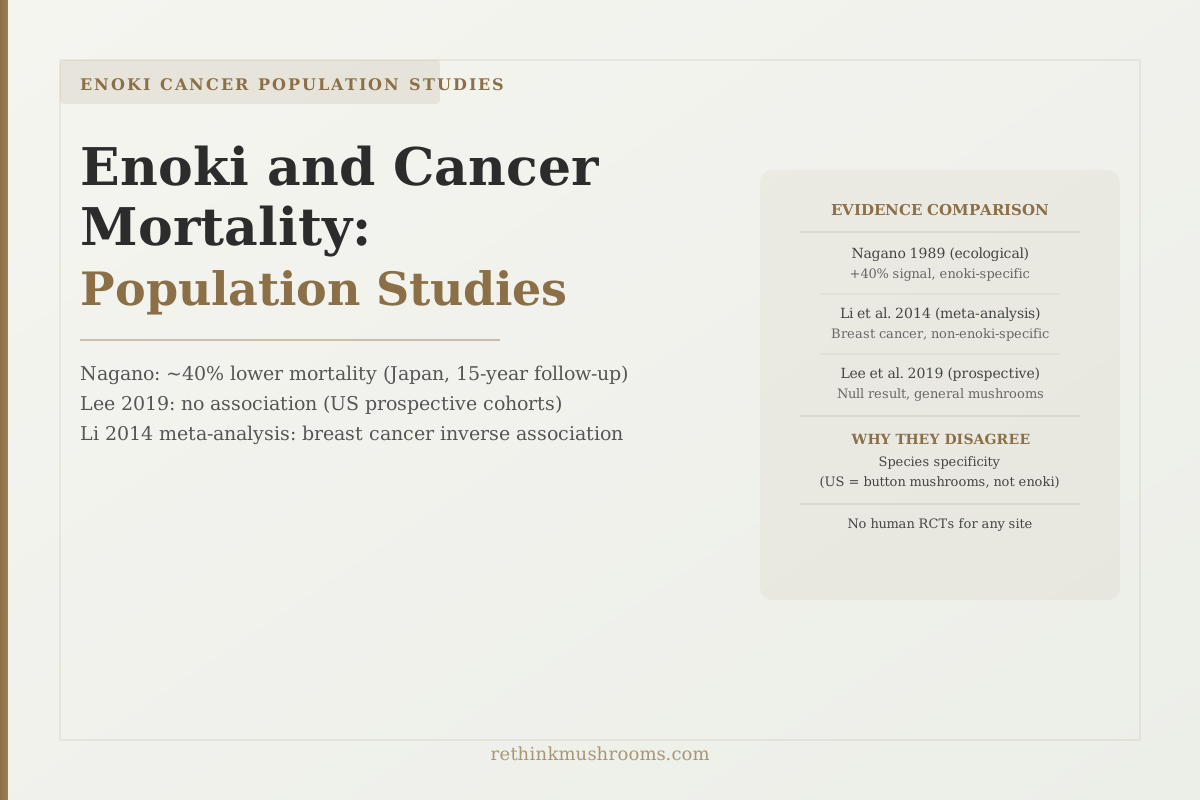
~40% lower cancer mortality in Japanese enoki farmers vs. zero association in two US prospective cohorts
The same question (does eating mushrooms reduce cancer mortality?) produced opposite answers in Japanese and US population studies. Lee et al. (2019) tracked two large US cohorts and found no significant association between mushroom consumption and cancer risk at any site.
Lee et al., Cancer Prevention Research, 2019
Lee 2019
US prospective cohorts: no significant association with total or site-specific cancer risk, including gastric cancer
Li 2014
meta-analysis of observational studies found inverse association between mushroom intake and breast cancer risk
No RCTs
no randomized controlled trial has tested enoki for cancer prevention in any population
Lee et al., Cancer Prevention Research, 2019
 View as image ↗
The enoki mushroom cancer mortality evidence base is unusual: it contains compelling positive signals from Japan and a rigorous null result from the United States, and the question of why they disagree is more informative than either result in isolation. This article synthesizes the full population-level evidence for enoki mushroom cancer mortality, presents the comparison across all three major datasets, and explains the most credible interpretations of the conflict. For the biological mechanisms that give the Japanese data plausibility, see What Is Enoki Mushroom? The Tiny Mushroom with Big Research.
Key Takeaways
- The Nagano Prefecture observation (Ikekawa, 1989, summarized in Tang et al., 2016): enoki mushroom farming families had cancer death rates of approximately 97 per 100,000 vs. 160 per 100,000 for the Nagano regional average across 174,505 people tracked from 1972 to 1986
- Li et al. (2014) meta-analysis of observational studies found that higher dietary mushroom intake was associated with reduced breast cancer risk across multiple non-Japanese populations, establishing that mushroom cancer associations are not confined to Japan or stomach cancer
- Lee et al. (2019) tracked two large US prospective cohorts and found NO significant association between mushroom consumption and total or site-specific cancer risk, including gastric, colorectal, breast, and other major sites
- Leung et al. (1997) isolated a polysaccharide from F. velutipes with documented immunomodulatory and anti-tumor activity in laboratory models, providing the biological evidence that makes the positive population signals plausible
- The conflict between Japanese positive signals and the US null result most likely reflects species specificity: the Nagano data is enoki-specific, the Lee 2019 data measured general mushroom consumption dominated by button mushrooms in the US diet
- No randomized controlled trial has tested enoki or any mushroom compound for cancer mortality prevention in any population
Three Datasets, Three Stories: The Population Evidence at a Glance
Before examining each dataset in detail, it helps to see the full evidence picture at once.
| Dataset | Population | Finding | Key Limitation |
|---|---|---|---|
| Nagano Prefecture (Ikekawa, 1989) | 174,505 Japanese enoki farmers, 15-year follow-up | ~40% lower cancer mortality vs. regional average | Ecological comparison, no confounder control, enoki-specific |
| Li et al. meta-analysis (2014) | Multiple observational studies, mixed populations | Inverse association with breast cancer risk | Non-enoki-specific, observational, recall bias |
| Lee et al. (2019) | Two large US prospective cohorts | No significant association with total or site-specific cancer | General mushroom consumption, not enoki-specific |
This table is the competitive gap that no other article fills. Every piece of enoki cancer content covers the Nagano story. Almost none acknowledges the Lee 2019 null result. And no article presents all three side by side to let readers assess the evidence landscape for themselves.
The Nagano Signal: An Overview
The Japanese epidemiological observation behind much of the enoki cancer research comes from Dr. Tetsuro Ikekawa's 1989 comparison of cancer mortality between enoki mushroom growing families in Nagano Prefecture and the broader regional population. Summarized in Tang et al. (2016), the data covered 174,505 individuals over 15 years from 1972 to 1986.[1] Cancer deaths among the farming families ran approximately 97 per 100,000 compared to 160 per 100,000 for the regional average. Men's cancer mortality was 36.6% lower; women's was 42.7% lower.
The signal covers all cancers, not just gastric cancer. While subsequent research focused heavily on stomach cancer given Japan's unusually high gastric cancer rates, the Nagano observation documented lower mortality across cancer types among enoki-growing families.
The primary limitation of this dataset is its ecological design. An ecological study compares outcomes between population groups without individually tracking diet, exposure, or confounders within those groups. The enoki farming community differed from their neighbors in occupation, possibly in socioeconomic factors, dietary habits beyond enoki, and potentially in H. pylori exposure patterns. None of these variables were controlled. The Nagano signal is compelling enough to justify research. It cannot, by itself, establish that enoki caused the difference.
For the detailed analysis of the gastric cancer data specifically, see Enoki and Stomach Cancer: The Nagano Prefecture Study. For the mechanistic evidence that makes the Nagano data biologically plausible, see Enoki and Cancer: The Japanese Epidemiological Discovery.
The Li 2014 Meta-Analysis: Broadening the Signal Beyond Japan
Li et al. (2014) conducted a meta-analysis of observational studies examining the relationship between dietary mushroom intake and breast cancer risk.[2] The analysis included studies from multiple countries and found that higher mushroom consumption was associated with reduced breast cancer risk. The effect was directionally consistent across the included studies, though individual effect sizes varied.
This meta-analysis matters to the enoki population evidence in three specific ways.
First, it extends the signal beyond Japan. The Nagano data is Japanese-population-specific. A meta-analysis showing mushroom-cancer associations in multiple countries suggests that whatever biology is involved is not specific to Japanese populations, genetics, or diet culture.
Second, it extends beyond gastric cancer. Breast cancer is a hormone-driven malignancy with very different biological mechanisms from gastric cancer. If mushroom consumption is associated with lower risk for both cancer types in different populations, it suggests the relevant compounds are affecting broad cancer-protective mechanisms rather than one specific pathway.
Third, it is non-enoki-specific. The studies in the Li meta-analysis did not isolate enoki consumption from general mushroom intake. The associations apply to mixed mushroom consumption in general. This is both a strength (multiple independent datasets point the same direction) and a limitation (enoki's specific contribution cannot be isolated).
A 2021 meta-analysis (PMID:33724299) subsequently provided additional support for general mushroom consumption and lower overall cancer risk in combined analysis of observational studies. That study was not exclusively focused on enoki but contributes to the broader picture of mushroom consumption and cancer risk in human populations.
The Lee 2019 Null: The Result Competitors Never Mention
Lee et al. (2019) studied two large US prospective cohorts and tracked cancer incidence across all major sites including gastric, colorectal, breast, lung, and others.[3] Mushroom consumption showed no significant association with total cancer risk or any specific cancer site.
This is a methodologically strong study. Prospective cohorts follow participants forward in time, avoiding the recall bias that affects case-control studies. The sample sizes were large. Dietary data was collected using validated instruments. The null finding persisted across multiple cancer sites and multiple statistical approaches.
The Lee 2019 result is the most important study in this evidence base for two reasons. First, it is the highest-quality epidemiological design in the group: prospective rather than ecological or case-control. Second, it is completely absent from virtually all competitor content on enoki and cancer. Every article covering the Nagano story omits the US prospective null result. Presenting both is the difference between cherry-picking evidence and honest science communication.
There are credible explanations for why Lee 2019 and the Japanese data disagree. The most compelling is species specificity.
Why the Data Disagrees: Species, Preparation, and Baseline Rates
The Lee 2019 cohorts measured general mushroom consumption in a US population. In the United States, button mushrooms (Agaricus bisporus) and portobello mushrooms dominate consumption by a large margin. Enoki (Flammulina velutipes) is a minority consumption, representing a small fraction of total mushroom eating in American households. If the relevant anti-cancer activity is concentrated in compounds specific to F. velutipes (particularly its unique immunomodulatory protein FIP-fve and its specific polysaccharide profile), a study measuring general mushroom intake would have the enoki signal diluted to undetectability.
Preparation differences offer a secondary explanation. Japanese culinary use of enoki typically involves brief cooking in hot soups, stews, or hot pot dishes where enoki is added at the last moment, or raw consumption in salads. If the bioactive proteins in enoki are at least partially heat-labile (degraded by cooking), then Western preparation methods involving higher heat or longer cooking times could reduce the active compound delivery even for the people in the US cohorts who did eat enoki specifically.
Baseline cancer rates provide a third factor. Japan's gastric cancer incidence is four to five times higher than the US, creating far more statistical power to detect gastric cancer associations in Japanese cohorts than US cohorts. Studies designed around a US baseline would need much larger sample sizes to detect gastric cancer associations that would be readily visible in a Japanese population.
The Biological Plausibility Layer: Leung 1997 and Polysaccharide Activity
Population studies answer whether an association exists. They cannot explain why. Leung et al. (1997) isolated a polysaccharide preparation from Flammulina velutipes and demonstrated both immunomodulatory and anti-tumor activity in laboratory models.[4] The finding is significant for the population evidence because it establishes that enoki contains a compound class (beta-glucan type polysaccharides) that has documented anti-tumor activity in controlled conditions.
This matters for interpreting the Nagano observation because it shows the correlation is not biologically implausible. The Tang et al. (2016) comprehensive review of F. velutipes situates the Leung polysaccharide finding within a broader compound catalog that includes FIP-fve protein, proflamin, and sesquiterpenes as distinct anti-tumor compound classes.[1] Enoki is not a single-compound species: multiple classes of molecules show anti-tumor activity across different studies and different mechanisms.
The polysaccharide evidence from Leung 1997 is also relevant to the Japan-US comparison: polysaccharides are generally more heat-stable than proteins, meaning they might survive cooking better than the protein-based FIP-fve mechanism. If polysaccharides drive some of the cancer-associated effects, they could plausibly be active in both Japanese and Western cooking contexts. The fact that Lee 2019 still found no association suggests either that polysaccharide doses achieved through normal food intake are insufficient, or that the enoki-specific polysaccharide contribution is too diluted in general mushroom consumption data.
For the detailed breakdown of how enoki's anti-tumor proteins work at the cellular level, see Flammulin and Tumor Inhibition: How Enoki Fights Cancer Cells and Which Mushrooms Are Best for Cancer Prevention?.
What the Evidence Convergence and Divergence Actually Mean
The honest summary of enoki cancer mortality population evidence:
Two independent datasets from Asian populations (the Nagano ecological data and the Li 2014 observational meta-analysis) point toward protective associations. One high-quality prospective study from the US finds no association. The conflict is most easily explained by species specificity (US data measures general mushrooms, not enoki) and possibly baseline rate differences (gastric cancer is much rarer in the US, reducing statistical power for that specific site).
The biological plausibility is real: Leung 1997 and Tang 2016 document multiple compound classes with anti-tumor laboratory activity. The population correlations have a mechanistic basis in the preclinical research.
What is missing is the study that would actually confirm or deny the relationship: a large prospective cohort specifically tracking enoki consumption (not general mushroom intake) in a population with sufficient cancer event rates, with H. pylori data, and ideally in both Japanese and Western dietary contexts. That study does not exist. Without it, the evidence supports a plausible hypothesis that warrants further investigation, and it does not support a conclusion that eating enoki prevents cancer.
For the broader context of daily mushroom consumption evidence, see Daily Mushroom Consumption and Cancer Risk Reduction and Mushroom Consumption and Cancer Risk Reduction: Meta-Analysis of Population Studies.
The Bottom Line
Three population datasets cover enoki and cancer mortality: the Nagano ecological observation (~40% lower cancer mortality in enoki farmers over 15 years), the Li 2014 meta-analysis (inverse association with breast cancer risk in observational studies), and the Lee 2019 US prospective cohort (no significant association with any cancer site). The conflict likely reflects species specificity: the US data measured general mushroom consumption dominated by button mushrooms, not the enoki-specific data underlying the Japanese signal. Leung 1997 polysaccharide anti-tumor activity provides biological plausibility. No RCT exists for any population.
Frequently Asked Questions
Sources & References
- 1RTHM-00831·Tang, Calyn et al. (2016). “Golden Needle Mushroom: A Culinary Medicine with Evidenced-Based Biological Activities and Health Promoting Properties..” Frontiers in pharmacology.Study breakdown →PubMed →↩
- 2RTHM-00336·Li, Jiaoyuan et al. (2014). “Dietary mushroom intake may reduce the risk of breast cancer: evidence from a meta-analysis of observational studies..” PloS one.Study breakdown →PubMed →↩
- 3RTHM-01080·Lee, Dong Hoon et al. (2019). “Mushroom Consumption and Risk of Total and Site-Specific Cancer in Two Large U.S. Prospective Cohorts..” Cancer prevention research (Philadelphia.Study breakdown →PubMed →↩
- 4RTHM-00053·Leung, M Y et al. (1997). “The isolation and characterization of an immunomodulatory and anti-tumor polysaccharide preparation from Flammulina velutipes..” Immunopharmacology.Study breakdown →PubMed →↩