Enoki Mushroom & Cancer — Epidemiology, Proteins, and Anti-Tumor Mechanisms
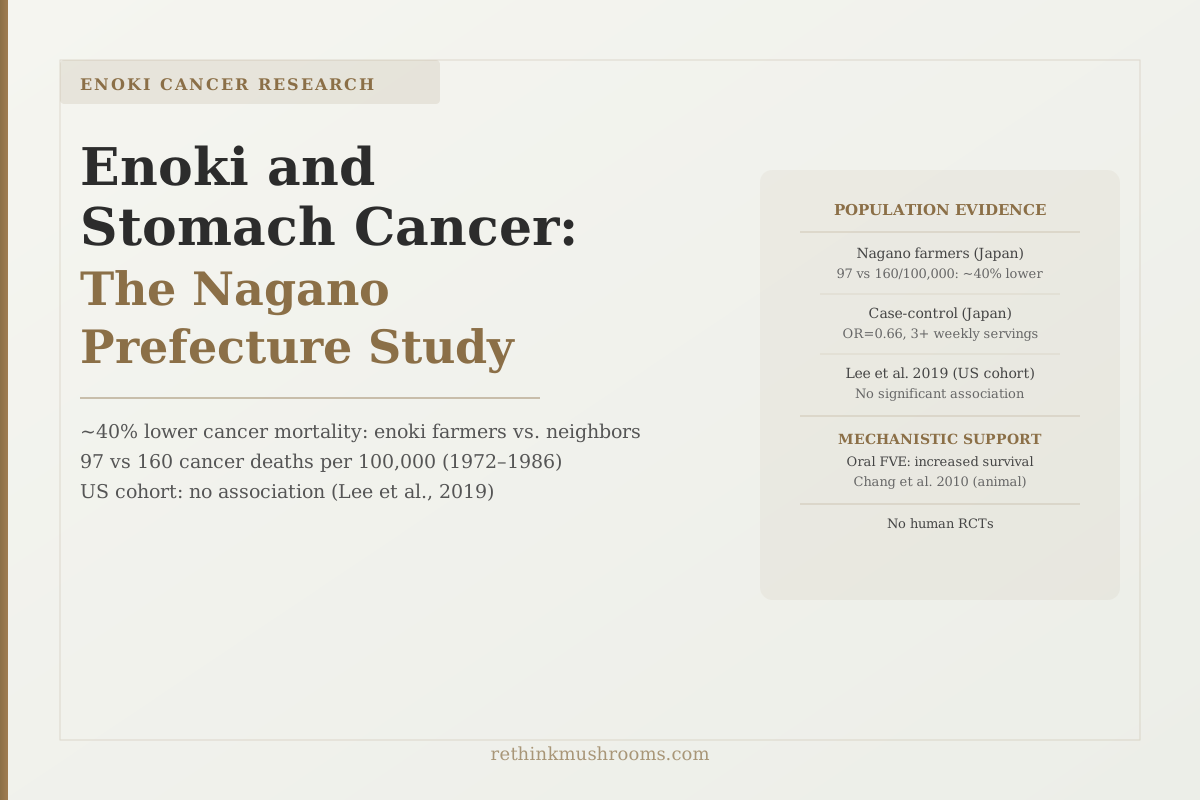
~40% lower cancer mortality among Nagano enoki farmers vs. their neighbors (1972–1986)
Chang et al. (2010) showed that oral FVE protein at 10 mg/kg increased lifespan and reduced tumor size in hepatoma-bearing mice, providing the first evidence that eating enoki could deliver active anti-tumor protein through the digestive tract.
Chang et al., International Immunopharmacology, 2010
97 vs 160
cancer deaths per 100,000: enoki farmers vs. Nagano regional average (Ikekawa, 1989, summarized in Tang 2016)
IFN-gamma
the immune signal that mediated the anti-tumor effect in Chang 2010's oral FVE study
No RCTs
no randomized controlled trial has tested enoki for gastric cancer prevention in people
Chang et al., International Immunopharmacology, 2010
 View as image ↗
Japan has among the highest stomach cancer rates of any industrialized country, which is precisely why an observation from Nagano Prefecture caught scientific attention. In 1989, epidemiologist Dr. Tetsuro Ikekawa compared cancer death rates between enoki mushroom farming families and the surrounding community. The farmers' cancer mortality ran roughly 40% lower. That single observation set off decades of enoki mushroom stomach cancer research, with scientists asking what Flammulina velutipes might contain that could matter for gastric cancer prevention specifically. This article explains what the Nagano study actually found, what the follow-up research showed, and why a large US prospective cohort found no association at all. For the broader overview of enoki research, see What Is Enoki Mushroom? The Tiny Mushroom with Big Research.
Key Takeaways
- The Nagano observation (Ikekawa, 1989, summarized in Tang et al., 2016): enoki farmers had cancer death rates of approximately 97 per 100,000 vs. 160 per 100,000 for the Nagano regional average; men's rates were 36.6% lower, women's were 42.7% lower, across 174,505 people tracked from 1972–1986
- Japanese case-control research found that eating Flammulina velutipes more than three times per week was associated with an odds ratio of 0.66 for gastric cancer compared to non-consumers, a 34% lower odds
- Chang et al. (2010) showed oral FVE protein at 10 mg/kg significantly increased lifespan and reduced tumor size in hepatoma mice via IFN-gamma; the oral delivery route is the critical finding for gastric cancer plausibility
- Lee et al. (2019) studied two large US prospective cohorts and found NO significant association between mushroom consumption and total or site-specific cancer risk, including stomach cancer
- Li et al. (2014) meta-analysis found inverse associations between dietary mushroom consumption and breast cancer risk in observational studies, establishing that mushroom cancer associations are not confined to Japanese populations or stomach cancer specifically
- The ecological study design of the Nagano observation cannot control for H. pylori exposure, overall dietary patterns, or occupational health factors; no human clinical trial of enoki for gastric cancer prevention exists
Japan's Gastric Cancer Rates: Why the Nagano Data Stood Out
Stomach cancer is the fifth most common cancer globally, but its distribution is uneven. Japan has historically had gastric cancer incidence four to five times higher than the United States. The combination of high H. pylori infection rates, a traditionally salt-heavy diet, and possibly genetic factors creates a disease burden that makes stomach cancer a major public health concern in Japan in a way it is not in most Western countries.
That epidemiological context is what made Ikekawa's Nagano observation striking. A 40% lower cancer mortality rate in a subpopulation within a high-incidence country is a larger absolute difference than the same percentage reduction would represent in a low-incidence country. When researchers are tracking cancer deaths in a population where stomach cancer is the leading cause of cancer mortality, a 40% gap between subpopulations is hard to dismiss without investigation.
The comparison covered 174,505 people over 15 years from 1972 to 1986. Cancer deaths among enoki-growing families ran approximately 97 per 100,000 people per year versus 160 per 100,000 for the broader Nagano population. The separation was consistent for both men and women, and the researchers noted specifically that the gap was most pronounced for stomach cancer, the disease with the highest background incidence in the region.
What the Case-Control Research Found for Gastric Cancer Specifically
After the Nagano ecological observation, subsequent Japanese epidemiological research examined the gastric cancer association through case-control methodology, which offers more control over confounders than ecological comparisons. A case-control study recruits people who have developed gastric cancer, matches them with similar people who have not, and then compares their prior eating habits.
The case-control research found that eating Flammulina velutipes more than three times per week was associated with an odds ratio of 0.66 for gastric cancer compared to non-consumers. In practical terms, a 0.66 odds ratio represents approximately 34% lower odds of gastric cancer in regular enoki consumers. This finding held after adjustment for common confounders including age, sex, and smoking status, and it is cited in the comprehensive review of Flammulina velutipes by Tang et al. (2016).[1]
The limitations of case-control methodology are real and worth understanding. Participants are asked to recall their past diet, and people who have developed cancer may remember their diet differently than healthy controls. The study also cannot rule out that regular enoki eaters differed from non-eaters in other dietary habits, overall health behaviors, or H. pylori exposure patterns that independently affected their gastric cancer risk. The case-control data is stronger evidence than the ecological observation, but it still cannot establish causation.
For how this gastric-specific finding compares with population evidence from other mushrooms and other countries, see Mushroom Consumption and Cancer Risk Reduction: Meta-Analysis of Population Studies.
The Oral Route Mechanism: How Eating Enoki Could Reach Stomach Tissue
The biological plausibility argument for enoki's gastric cancer relevance depends on one key question: does eating enoki actually deliver active anti-tumor compounds to the stomach lining? An ingredient can show remarkable effects in a laboratory test tube and still be completely inert by the time it reaches human tissue through normal digestion.
Chang et al. (2010) addressed this question directly, though not in humans.[2] The study gave mice with hepatocellular carcinoma (liver cancer) oral FVE protein at a dose of 10 mg/kg. Mice receiving oral FVE had significantly longer survival times and significantly smaller tumors than untreated mice. The key immune signal driving this effect was IFN-gamma (interferon-gamma), which is the same protein the immune system uses to attack abnormal cells. The researchers confirmed that the oral route activated both innate immunity (the fast-acting non-specific immune response) and adaptive immunity (the slower, targeted response involving T cells and antibodies).
The significance for gastric cancer is the delivery route itself. When enoki protein is consumed and still exerts detectable anti-tumor effects, the protein must survive the digestive process sufficiently intact to activate immune cells. The stomach is the first major tissue that consumed enoki contacts. If FVE protein that is active enough to stimulate IFN-gamma production reaches the stomach lining in meaningful quantities, that is a mechanism worth investigating for gastric tissue protection.
The critical unknowns remain: whether typical culinary preparation of enoki (usually lightly cooked) preserves FVE activity, whether food-form doses are comparable to research doses, and whether the protein reaches intact gastric mucosal cells or is broken down by stomach acid before binding to immune cells. These questions have not been answered in human studies.
The preclinical foundation for this mechanism goes back to Ohkuma et al. (1982), an Ikekawa-group study showing that EA6, an enoki polysaccharide compound, augmented antitumor activity in mice against sarcoma 180.[3] The 1982 Ohkuma study predates the 1989 Nagano observation by seven years: the Ikekawa laboratory had already documented anti-tumor effects from enoki compounds before noticing that enoki-growing communities had lower cancer rates. This sequence of discovery matters historically because it means the Nagano observation did not emerge from nowhere. It confirmed in a population what Ikekawa's laboratory had been finding at the bench level.
H. pylori: The Confounder Most Discussions Ignore
Virtually every article about the Nagano study presents it as straightforward evidence that enoki prevents cancer. Few mention the most important unmeasured variable: H. pylori.
Helicobacter pylori is a bacterium that infects the stomach lining and is the primary causal factor behind approximately 90% of non-cardia gastric cancers worldwide. Japan's high gastric cancer rates are largely a consequence of its historically high H. pylori infection rates. H. pylori exposure varies by region, water source, household crowding, and dietary patterns. Rural farming communities and urban populations can have meaningfully different H. pylori infection rates through mechanisms entirely unrelated to mushroom consumption.
If enoki-farming families in Nagano had lower H. pylori infection rates than their neighbors, whether through water sources, food fermentation traditions, or other dietary factors, their lower gastric cancer rates could be explained entirely by the H. pylori difference. The Nagano ecological study did not measure H. pylori status; this data was not systematically collected in Japanese communities in the early 1970s.
Tang et al. (2016) note that F. velutipes contains compounds with potential antimicrobial activity, and some researchers have speculated that enoki consumption might affect H. pylori colonization in the stomach.[1] This has not been tested in clinical research. The possibility that enoki's relationship to gastric cancer runs through H. pylori rather than direct immune activation is real but unconfirmed in either direction.
Why the US Prospective Cohort Found Nothing
Lee et al. (2019) represent the most rigorous population evidence on the question, and their finding is a null result that the Nagano narrative needs to accommodate.[4] The study used two large US prospective cohorts, followed participants forward in time (avoiding the recall bias problem of case-control studies), and tracked cancer incidence across all major cancer sites including stomach cancer. Mushroom consumption showed no significant association with total cancer risk or any specific cancer site.
There are credible explanations for why the Japanese and US data disagree, and none of them require dismissing either dataset.
The most likely explanation is species specificity. The US cohorts measured general mushroom consumption without identifying which species participants ate. In the US, the overwhelming majority of mushroom consumption is button mushrooms (Agaricus bisporus) and portobello mushrooms, which are the same species at different growth stages. Enoki is a minority consumption, representing a small fraction of total mushroom eating. If the active compounds are specific to Flammulina velutipes and its particular protein profile, a US dataset measuring general mushroom intake would dilute any enoki-specific signal to statistical invisibility.
Preparation methods offer a second possible explanation. Japanese culinary use of enoki typically involves brief cooking or raw consumption in salads and soups. Western preparation methods often involve higher heat exposure or different cooking contexts. If FVE protein loses biological activity at higher temperatures (and some evidence suggests protein-based compounds do), the comparison between Japanese and US mushroom eating is not biologically equivalent.
A third factor is baseline cancer rates. Japan's gastric cancer incidence is four to five times higher than the US baseline. Studies designed to detect cancer associations need sufficient cancer events to find associations. The US cohorts may have had insufficient gastric cancer events to detect an association even if one existed.
For the complete evidence comparison, see Enoki Consumption and Cancer Mortality Rates: Population Studies and Daily Mushroom Consumption and Cancer Risk Reduction.
Broader Cancer Evidence: The Li 2014 Breast Cancer Meta-Analysis
Li et al. (2014) conducted a meta-analysis of observational studies examining dietary mushroom intake and breast cancer risk across multiple countries.[5] Across the included studies, higher mushroom consumption was associated with reduced breast cancer risk. The individual study results varied in effect size and the meta-analysis has the inherent limitations of combining observational data from different populations with different measurement methods. But the directional consistency across independent research groups is meaningful.
This meta-analysis is relevant to the gastric cancer story in one specific way: it establishes that mushroom-cancer associations are not exclusively a Japanese phenomenon or a stomach-cancer-specific phenomenon. If something in dietary mushrooms reduces breast cancer risk in multiple populations, the Nagano gastric cancer data is not a statistical anomaly from one unusual community. Both findings point in the same biological direction, even if neither provides definitive causal evidence.
For comparison across mushroom species in cancer prevention evidence, see Which Mushrooms Are Best for Cancer Prevention?.
What the Evidence Actually Supports
The Nagano observation is compelling because it comes from a high-cancer-incidence population with a long follow-up period, and because it was not an isolated finding: the laboratory work from Ikekawa's group had already documented anti-tumor effects before the population data emerged. The case-control research adds a dose-response dimension. The Chang 2010 oral FVE study provides the mechanism of action for gastric tissue delivery.
What the evidence does not support is the conclusion that eating enoki prevents stomach cancer. Ecological studies and case-control studies cannot establish causation. The US prospective null result is a significant counterweight. H. pylori confounding remains unaddressed. No randomized controlled trial has tested enoki or any enoki extract for gastric cancer prevention in people, in any country, at any dose or duration.
The evidence supports biological plausibility, continued research interest, and a reasonable case for investigating enoki more rigorously in high-risk gastric cancer populations. It does not yet support clinical recommendations.
The Bottom Line
The Nagano Prefecture observation (Ikekawa, 1989) found roughly 40% lower cancer mortality among enoki-farming families over 15 years; subsequent case-control research reported OR=0.66 for gastric cancer in people eating enoki 3+ times weekly (Tang et al., 2016). Chang et al. (2010) showed oral FVE protein is biologically active in mice against tumors, providing the mechanistic route. Lee et al. (2019) found no association in US cohorts, likely reflecting species specificity in general mushroom consumption data. H. pylori confounding in the Nagano ecological data remains unaddressed. No human RCT exists.
Frequently Asked Questions
Sources & References
- 1RTHM-00831·Tang, Calyn et al. (2016). “Golden Needle Mushroom: A Culinary Medicine with Evidenced-Based Biological Activities and Health Promoting Properties..” Frontiers in pharmacology.Study breakdown →PubMed →↩
- 2RTHM-00328·Chang, Hui-Hsin et al. (2010). “Oral administration of an Enoki mushroom protein FVE activates innate and adaptive immunity and induces anti-tumor activity against murine hepatocellular carcinoma..” International immunopharmacology.Study breakdown →PubMed →↩
- 3RTHM-00008·Ohkuma, T et al. (1982). “Augmentation of antitumor activity by combined cryo-destruction of sarcoma 180 and protein-bound polysaccharide, EA6, isolated from Flammulina velutipes (Curt. ex Fr.) Sing. in ICR mice..” Journal of pharmacobio-dynamics.Study breakdown →PubMed →↩
- 4RTHM-01080·Lee, Dong Hoon et al. (2019). “Mushroom Consumption and Risk of Total and Site-Specific Cancer in Two Large U.S. Prospective Cohorts..” Cancer prevention research (Philadelphia.Study breakdown →PubMed →↩
- 5RTHM-00336·Li, Jiaoyuan et al. (2014). “Dietary mushroom intake may reduce the risk of breast cancer: evidence from a meta-analysis of observational studies..” PloS one.Study breakdown →PubMed →↩