Enoki & Blood Sugar
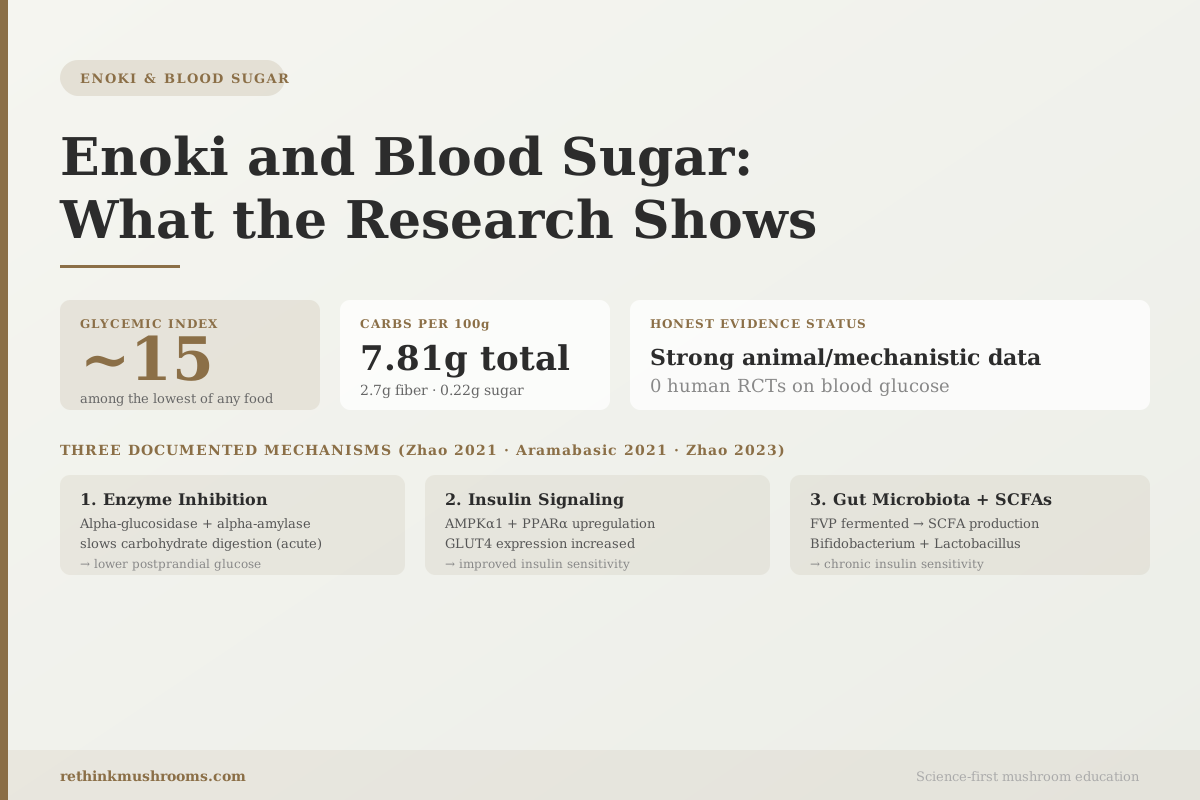
GI ~15, among the lowest of any food
Enoki mushrooms have a very low glycemic index, and animal research shows their polysaccharides can lower blood sugar, reduce insulin resistance, and attenuate metabolic syndrome through at least three distinct pathways. Human clinical trials are still pending.
Tang et al., Frontiers in Pharmacology, 2016 / Zhao et al., Food & Function, 2021
7.81g
carbohydrates per 100g, including 2.7g dietary fiber and only 0.22g sugar
AMPKα1 + PPARα
two insulin-sensitizing pathways upregulated by enoki polysaccharides in a 2021 study
0 human RCTs
no controlled human trials exist specifically on enoki and blood glucose
Tang et al., Frontiers in Pharmacology, 2016 / Zhao et al., Food & Function, 2021
 View as image ↗
Enoki mushrooms (Flammulina velutipes) appear in blood sugar discussions for two different reasons. One is their nutritional profile: very low carbohydrates, meaningful fiber, near-zero sugar, and a glycemic index around 15. The other is their polysaccharides, which animal research shows can lower blood glucose, reduce insulin resistance, and reverse metabolic syndrome markers through mechanisms that involve enzyme inhibition, insulin signaling pathways, and gut microbiota.
The gap between those two facts and human clinical evidence is significant, and this article is honest about it.
For a broad introduction to enoki mushroom bioactive compounds and what makes them clinically interesting, see What Is Enoki Mushroom? The Tiny Mushroom with Big Research.
Key Takeaways
- A 2016 comprehensive review confirmed that enoki dietary fiber, polysaccharides, and mycosterol reduce blood sugar, blood pressure, and cholesterol in documented research (Tang et al., 2016)
- A 2021 animal study found that enoki polysaccharides (FVP) at 0.4mg/g body weight for 12 weeks significantly attenuated metabolic syndrome markers including insulin resistance, with AMPKα1 and PPARα upregulated; fecal microbiota transplant confirmed gut-microbiota as the primary mediator (Zhao et al., 2021)
- Enoki polysaccharides inhibit alpha-glucosidase and alpha-amylase enzymes, which slow carbohydrate breakdown and reduce postprandial glucose entry into the bloodstream (Aramabasic et al., 2021)
- A 2023 study identified a bile acid axis as an emerging third pathway: FVP modulated bile acid profiles in high-fat-diet mice, reducing cholesterol and triglycerides (Zhao et al., 2023)
- Enoki has a glycemic index of approximately 15, with 7.81g carbohydrates and 2.7g fiber per 100g, making it a safe food for people managing blood sugar regardless of the polysaccharide evidence
- No human randomized controlled trials exist specifically testing enoki mushroom against blood glucose outcomes in diabetic or prediabetic populations
What the Research Record Actually Contains
The honest starting point: most of what researchers know about enoki and blood sugar comes from animal models and in vitro studies. The clinical trial literature on enoki specifically for diabetes or blood glucose control in humans is absent.
What does exist is a systematic body of mechanistic research. Tang and colleagues published a comprehensive review of the golden needle mushroom (enoki's most common name in East Asian markets) in Frontiers in Pharmacology, synthesizing the evidence for bioactive components reducing blood sugar, blood pressure, and cholesterol.[1] That review identified dietary fiber, polysaccharides, and mycosterol as the three compound classes driving blood sugar effects, and covered antithrombotic and immune properties alongside metabolic effects.
Das and colleagues, reviewing 23 edible mushrooms specifically for diabetes-relevant activity, explicitly covered enoki: its polysaccharides, vitamin D content, and alpha-glucosidase and alpha-amylase inhibitory activities were identified as the key anti-diabetic mechanisms.[4] Their key limitation note: specific dose and efficacy criteria are absent from the enoki literature because of the lack of clinical trials.
Shamim and colleagues, in a 2023 review of edible mushrooms for diabetes prevention and treatment, similarly identified enoki polysaccharides as preventing insulin resistance, while noting the absence of long-term safety data and clinical dose recommendations.[7]
The consistent message across three systematic reviews: the mechanistic evidence is there. The human trial evidence is not.
The Metabolic Syndrome Study: The Most Specific Animal Data
The most mechanistically detailed animal study on enoki polysaccharides and metabolic health comes from Zhao and colleagues, published in Food & Function in 2021.[2]
Mice fed a high-fat diet to induce metabolic syndrome were given FVP (Flammulina velutipes polysaccharide) at 0.4mg per gram of body weight for 12 weeks. The results were striking across multiple metabolic markers:
- Body weight gain was attenuated
- Insulin resistance was significantly reduced
- Blood triglycerides and cholesterol fell
- Two key insulin-sensitizing signaling proteins were upregulated: AMPKα1 (a cellular energy sensor that improves glucose uptake) and PPARα (a nuclear receptor that regulates fatty acid burning)
The study's most definitive element was a fecal microbiota transplant experiment. The researchers transferred gut bacteria from FVP-treated mice to germ-free mice and found that the metabolic improvements transferred with the bacteria. This confirmed that gut microbiota are the primary mediator of FVP's metabolic effects; the polysaccharides don't directly lower blood sugar, but reshape the gut bacterial community, which then produces signals that improve insulin sensitivity.
This microbiota-mediated mechanism explains why consistent daily consumption matters more than occasional large doses.
How Enoki Polysaccharides Work: Three Documented Pathways
Aramabasic and colleagues published a comprehensive mechanistic review of how mushroom bioactive compounds control blood glucose, covering multiple molecular pathways.[3] For enoki specifically, three pathways have evidence:
Pathway 1: Enzyme inhibition. Alpha-glucosidase is an enzyme in the small intestine that breaks down complex carbohydrates into glucose. Alpha-amylase is a salivary and pancreatic enzyme that begins starch digestion. Both are standard pharmaceutical targets for diabetes management (acarbose, for example, is an alpha-glucosidase inhibitor). Enoki polysaccharides have documented inhibitory activity against both enzymes, meaning they can slow the rate at which carbohydrates from a meal are broken down and absorbed. This is an acute, meal-time effect.
Pathway 2: Insulin signaling. Beyond enzyme inhibition, FVP upregulates GLUT4, a glucose transporter protein that moves glucose from the bloodstream into muscle and fat cells in response to insulin. Greater GLUT4 expression means cells respond more efficiently to insulin; that is the cellular definition of reduced insulin resistance. The AMPKα1 and PPARα upregulation from Zhao 2021 operates through related but distinct mechanisms: AMPK activation improves cellular glucose uptake independent of insulin, while PPARα drives fatty acid oxidation, reducing the lipid accumulation that contributes to insulin resistance.
Pathway 3: Gut microbiota and SCFA production. As the Zhao 2021 fecal transplant data confirmed, FVP's primary metabolic effects are mediated through the gut microbiota. FVP fibers that reach the large intestine are fermented by bacteria to produce short-chain fatty acids, particularly propionate and butyrate. Propionate signals the liver to reduce gluconeogenesis (the production of new glucose). Butyrate improves the insulin sensitivity of gut cells directly and has systemic anti-inflammatory effects. This is a chronic effect that requires sustained daily consumption to maintain.
For deeper coverage of each molecular mechanism and how different FVP fractions contribute, see Enoki Polysaccharides and Glucose Metabolism.
The Bile Acid Mechanism: A Third Pathway from 2023
Zhao and colleagues identified a fourth mechanism in 2023 research on FVP and lipid metabolism in high-fat-diet mice.[8] FVP modulated bile acid profiles in the gut-liver axis, increasing primary bile acids and decreasing secondary bile acids, which altered how the liver processed cholesterol and triglycerides.
Bile acids regulate blood glucose through bile acid receptors (FXR and TGR5) that influence insulin secretion and sensitivity, a pathway well-established in pharmaceutical research but only recently linked to enoki mushroom polysaccharides specifically. This mechanism is distinct from the enzyme inhibition and microbiota pathways, suggesting FVP's metabolic effects operate on multiple levels simultaneously.
This research was conducted in mice and has not been tested in humans. But its identification as a distinct mechanism adds to the picture of enoki polysaccharides as a metabolically active compound class worth studying in controlled human settings.
The Nutritional Profile: Why Enoki Is Safe Regardless of the Mechanism Research
Setting aside the polysaccharide mechanisms, enoki mushrooms' basic nutritional profile makes them appropriate for people managing blood sugar at any evidence level.
Per 100g raw:
- Carbohydrates: 7.81g
- Dietary fiber: 2.7g (net carbohydrates approximately 5g)
- Sugars: 0.22g
- Protein: 2.66g
- Fat: 0.29g
- Calories: 37 kcal
Glycemic index: approximately 15 (measured on a scale where pure glucose = 100; foods below 55 are considered low GI).
Glycemic load (a measure that accounts for portion size as well as GI): negligible for a normal 80-100g serving.
These numbers mean enoki will not spike blood sugar regardless of polysaccharide mechanisms. The fiber content slows gastric emptying. The carbohydrate load is modest. Eaten as part of a mixed meal, enoki adds volume, satiety, and fiber without meaningfully raising the meal's glycemic impact.
For people specifically managing blood sugar, the relevant practical question is whether to consume enoki as a food or to seek a polysaccharide extract. For food-level consumption at normal serving sizes, the glycemic profile is safe. For the documented enzyme inhibition and microbiota effects, the doses in animal research were considerably higher per body weight than typical culinary portions provide.
For a full safety and dosing discussion specifically for diabetic populations, see Enoki for Diabetic Patients: Safety and Evidence.
The Japanese Hot Enoki Diet: What's Being Claimed and What's Studied
Enoki mushrooms have been part of a popular dietary trend in Japan and increasingly in online wellness communities: the "hot enoki diet," which typically involves consuming 50-100g of enoki daily, often in soup, sometimes frozen before cooking (with the claim that freezing breaks down cell walls and increases absorption of beneficial compounds including linoleic acid).
The frozen enoki claim (that freezing increases linoleic acid absorption approximately 13 times compared to fresh enoki) has been repeated in media coverage but is not well-supported in the primary research literature. The biological rationale (cell wall disruption releasing fatty acids) is plausible but has not been tested in a controlled study.
What is well-supported: daily consumption of enoki at the 50-100g range provides meaningful fiber (roughly 2.5-5g), consistent polysaccharide exposure, and a low-calorie addition to meals. Whether this specifically attenuates blood glucose in humans is a clinical question that hasn't been answered.
The animal data at therapeutically relevant doses of FVP suggests that consistent daily exposure matters more than whether the enoki is frozen or not. The microbiota-mediated effects documented in Zhao 2021 require time and regularity, not a single meal event.
Yeh and colleagues found that enoki extract reduced LDL, total cholesterol, and triglycerides in rats on a high-fat diet, while also improving antioxidant markers.[5] Luo and colleagues found that even the root tissue (mycorrhizae) of Flammulina velutipes, when tested separately from the fruiting body, attenuated lipid disorder, oxidative stress, and adipose tissue inflammation in high-fat-diet mice.[6] Together, these studies support the picture that multiple components of the enoki plant have metabolic-protective activity, though all in animal models.
The Honest Picture: Robust Preclinical Evidence, Absent Human Data
Enoki's blood sugar profile is genuinely interesting. Multiple systematic reviews have confirmed the mechanistic evidence. The Zhao 2021 metabolic syndrome study is methodologically strong for an animal trial: 12-week duration, fecal transplant confirmation, specific pathway identification. The bile acid mechanism adds a third distinct pathway.
What none of this constitutes: human clinical evidence that eating enoki mushrooms improves blood glucose, insulin sensitivity, or diabetes outcomes.
For comparison, maitake mushroom has actual human clinical trial data on glucose outcomes through its SX-fraction compound, which provides a useful reference point for what rigorous mushroom-diabetes evidence looks like. For more on that comparison, see Maitake and Type 2 Diabetes: The SX-Fraction Clinical Trials.
The absence of human RCTs for enoki and blood sugar is a real evidence gap. It doesn't mean the animal and mechanistic findings are irrelevant. It means the translation from animal model to human clinical outcome has not been tested. That is a different and more accurate statement than either "enoki lowers blood sugar" or "there's no evidence enoki helps."
The Bottom Line
Enoki mushrooms have one of the lowest glycemic indexes of any food (GI ~15) and a carbohydrate profile that makes them safe for blood sugar management at food-level consumption. Animal research and mechanistic studies document three distinct pathways through which enoki polysaccharides reduce insulin resistance: alpha-glucosidase enzyme inhibition, upregulation of AMPKα1 and PPARα insulin signaling proteins, and gut microbiota modulation that produces insulin-sensitizing short-chain fatty acids. A bile acid axis has been identified as a fourth potential pathway. No human randomized controlled trials exist specifically testing enoki against blood glucose outcomes, which is the key honest limitation across this otherwise promising preclinical evidence base.
Frequently Asked Questions
Sources & References
- 1RTHM-00831·Tang, Calyn et al. (2016). “Golden Needle Mushroom: A Culinary Medicine with Evidenced-Based Biological Activities and Health Promoting Properties..” Frontiers in pharmacology.Study breakdown →PubMed →↩
- 2RTHM-01472·Zhao, Ruiqiu et al. (2021). “Polysaccharide from Flammulina velutipes attenuates markers of metabolic syndrome by modulating the gut microbiota and lipid metabolism in high fat diet-fed mice..” Food & function.Study breakdown →PubMed →↩
- 3RTHM-01322·Aramabašić Jovanović, Jelena et al. (2021). “The Effects of Major Mushroom Bioactive Compounds on Mechanisms That Control Blood Glucose Level..” Journal of fungi (Basel.Study breakdown →PubMed →↩
- 4RTHM-01500·Das, Arpita et al. (2022). “Medicinal Components in Edible Mushrooms on Diabetes Mellitus Treatment..” Pharmaceutics.Study breakdown →PubMed →↩
- 5RTHM-00663·Yeh, Ming-Yei et al. (2014). “Hypolipidemic and antioxidant activity of enoki mushrooms (Flammulina velutipes)..” BioMed research international.Study breakdown →PubMed →↩
- 6RTHM-01575·Luo, Zhen et al. (2022). “Flammulina velutipes Mycorrhizae Attenuate High Fat Diet-Induced Lipid Disorder, Oxidative Stress and Inflammation in the Liver and Perirenal Adipose Tissue of Mice..” Nutrients.Study breakdown →PubMed →↩
- 7RTHM-00850·Shamim, Mohammad Zaki et al. (2023). “Exploring Edible Mushrooms for Diabetes: Unveiling Their Role in Prevention and Treatment..” Molecules (Basel.Study breakdown →PubMed →↩
- 8RTHM-01837·Zhao, Ruiqiu et al. (2023). “Flammulina velutipes polysaccharides regulate lipid metabolism disorders in HFD-fed mice via bile acids metabolism..” International journal of biological macromolecules.Study breakdown →PubMed →↩