Enoki Inflammation and Immunomodulation
3 independent DSS colitis studies, 2 metabolic inflammation studies, 2 immune activation studies (all preclinical)
Nguepi et al. (2023) found that Flammulina velutipes combined with wood ear mushroom reduced DSS-induced IBD severity by suppressing TLR4/NF-κB signaling while also protecting against secondary liver injury, extending enoki's anti-inflammatory evidence beyond the gut.
Nguepi et al., Journal of Nutritional Biochemistry, 2023
IBD/Colitis
strongest condition cluster: 3 independent animal studies with complementary mechanisms (Zhang 2020, Zhao 2020, Nguepi 2023)
Metabolic inflam.
Luo et al. (2022) found enoki mycorrhizae reduced HFD-induced liver and adipose tissue TNF-α, IL-1β in mice
No human RCTs
no randomized controlled trial has tested enoki for any inflammatory condition in people
Nguepi et al., Journal of Nutritional Biochemistry, 2023
 View as image ↗
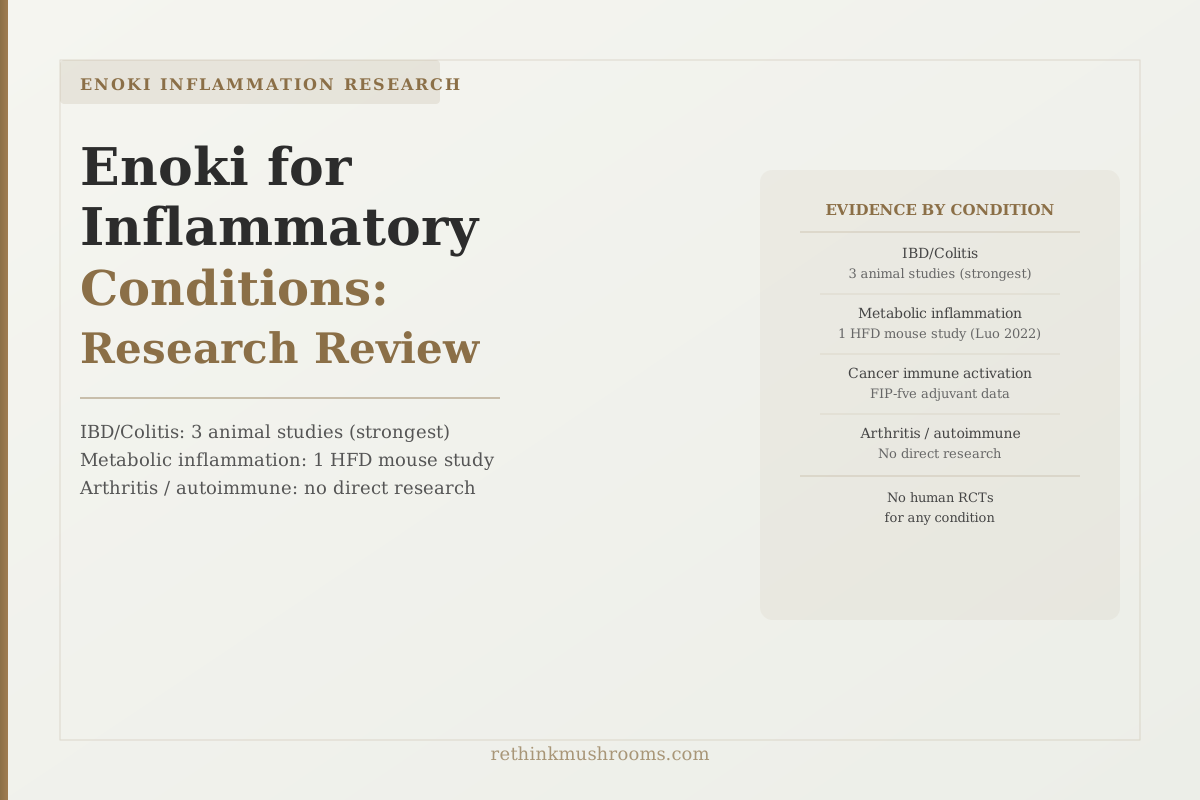
Most articles about enoki and inflammation repeat the same claim: enoki is anti-inflammatory. Few specify which inflammatory conditions have been studied, what kind of studies those are, and what the evidence actually supports versus what it speculates. This article organizes enoki mushroom for inflammation research by condition type, assigning honest evidence grades. The short version: IBD and colitis have three independent animal studies. Metabolic inflammation (fatty liver, adipose) has one strong animal study. Immune-mediated conditions have preclinical immune activation data. No condition has human clinical trial evidence. For the underlying mechanisms behind these effects, see Enoki and Inflammation: Anti-Inflammatory Mechanisms. For the full enoki research overview, see What Is Enoki Mushroom? The Tiny Mushroom with Big Research.
Key Takeaways
- IBD and colitis have the strongest condition-specific evidence for enoki: three independent studies using different polysaccharide compounds all found anti-colitis effects in DSS mouse models (Zhang et al., 2020; Zhao et al., 2020; Nguepi et al., 2023)
- Metabolic inflammation, specifically HFD-induced liver and adipose tissue inflammation, was significantly attenuated by F. velutipes mycorrhizae extract in mice, reducing TNF-α, IL-1β, and hepatic lipid peroxidation (Luo et al., 2022)
- Immune activation evidence from Chang et al. (2010) and Ding et al. (2009) demonstrates that enoki's FIP-fve protein modulates the immune response in cancer models, where immune suppression rather than chronic inflammation is the target condition
- Tang et al. (2016) comprehensive review situates these effects within enoki's full bioactive compound profile, confirming anti-inflammatory activity from both the FIP-fve protein and polysaccharide fractions
- Arthritis, autoimmune disease, and other common inflammatory conditions lack direct enoki research; the anti-inflammatory mechanisms are biologically relevant to those conditions but have not been tested
- No human RCT has tested enoki for IBD, metabolic inflammation, arthritis, or any other specific inflammatory condition; all evidence is preclinical
IBD and Colitis: The Strongest Condition-Specific Evidence
Among the inflammatory conditions with direct enoki research, IBD and colitis have the deepest evidence base. Three independent research groups used the same DSS-induced colitis mouse model and different polysaccharide preparations from F. velutipes, all finding protective effects.
Zhang et al. (2020) tested an enoki polysaccharide fraction in DSS-treated mice and found it reduced colitis severity by restoring gut microbial balance: Lactobacillus and Bifidobacterium populations increased, pathogenic species decreased, and the pro-inflammatory cytokines TNF-α (tumor necrosis factor alpha, a master inflammatory signal) and IL-6 fell significantly.[1] The mechanism was primarily prebiotic: the polysaccharide was feeding beneficial bacteria, which then reduced the gut's inflammatory environment.
Zhao et al. (2020) independently tested a structurally different enoki polysaccharide with a beta-type glycosidic linkage and also found significant colitis protection in DSS mice, this time through a more direct anti-inflammatory mechanism rather than primarily through microbiota restoration.[2] Two different compounds from the same species, same experimental model, convergent protective outcomes through partially different pathways: this convergence matters because it argues against the effects being an artifact of one compound or one research group.
Nguepi et al. (2023) added the most mechanistically specific finding and an important secondary outcome.[3] The study combined F. velutipes with Auricularia polytricha (wood ear mushroom) in an IBD model. The combination suppressed TLR4/NF-κB signaling, the same inflammatory switch that IBD medications target, and reduced TNF-α, IL-6, and IL-1β. The secondary finding: the treated mice also had significantly less liver injury than untreated colitic mice. IBD causes systemic inflammation that affects the liver as well as the gut, and a treatment that protects both organs addresses a real clinical complication.
The honest assessment: these three studies use the DSS colitis model, which is well-validated for studying gut inflammation but does not fully replicate chronic human IBD. No human trial has tested enoki for ulcerative colitis or Crohn's disease. The mechanistic targets (TLR4, NF-κB, TNF-α) are biologically relevant to human IBD, which is why the evidence is worth attention, but a mechanistically relevant finding in mice is not clinical evidence. The three studies also used isolated polysaccharide fractions rather than whole enoki food, so whether eating enoki delivers sufficient polysaccharide concentrations to produce these effects in humans is an additional gap in the evidence chain.
For a deeper analysis of the colitis-specific data, see Enoki and Gut Inflammation: Colitis Research.
Metabolic Inflammation: Fatty Liver and Adipose Tissue
Chronic low-grade inflammation of the liver and adipose (fat) tissue is a defining feature of metabolic syndrome, non-alcoholic fatty liver disease (NAFLD), and obesity-related disease. The inflammatory profile (elevated TNF-α, IL-1β, and reactive oxygen species in liver and adipose tissue) is distinct from the acute gut inflammation in IBD but shares some of the same signaling pathways.
Luo et al. (2022) fed mice a high-fat diet (HFD) to induce metabolic syndrome and tested Flammulina velutipes mycorrhizae extract as an intervention.[4] The mycorrhizae fraction refers to the root-like structures of the enoki organism, distinct from the fruiting body (the part consumed as food). The extract significantly attenuated liver and perirenal adipose tissue inflammation in the HFD mice: TNF-α and IL-1β were reduced in both tissues, hepatic lipid peroxidation markers fell, and the treated mice showed less liver damage compared to untreated HFD controls.
Two things are notable about this study. First, it is the only enoki study specifically targeting the metabolic inflammation profile rather than an infectious or gut-immune inflammatory response. Metabolic inflammation is clinically important: an estimated 25% of adults globally have NAFLD, and elevated liver TNF-α and IL-1β are central to its progression. Metabolic inflammation affects an enormous population globally, which gives this finding potential relevance beyond the IBD data. Second, the mycorrhizae fraction was used rather than the fruiting body. Whether supplementing with or eating standard enoki fruiting bodies delivers the same active compounds as the mycorrhizae extract is not established. The broader Tang et al. (2016) review, which covers the full bioactive profile of F. velutipes, notes that different plant parts and preparation methods yield different compound ratios.[5]
Immune Activation in Cancer-Related Inflammation
Enoki's immunomodulatory research does not fit neatly into "anti-inflammatory." In some contexts, the immune response requires activation rather than suppression. Cancer-related immune suppression and chronic infection create inflammatory environments where the goal is stimulating immunity, not dampening it. Two enoki studies address this angle.
Chang et al. (2010) administered oral FVE (the enoki immunomodulatory protein) to mice with hepatocellular carcinoma and found significant activation of both innate and adaptive immunity alongside tumor volume reduction.[6] Natural killer cell activity increased, IFN-gamma production increased, and tumor growth slowed. The immune activation here is pro-inflammatory in the technical sense: cytokines were elevated, not suppressed. This is appropriate in a cancer context where the immune system needs to attack abnormal cells.
Ding et al. (2009) demonstrated that co-administering FIP-fve with a tumor-associated antigen significantly enhanced the anti-tumor T-cell response compared to the antigen alone, showing FIP-fve can function as an immunological adjuvant.[7] The cancer vaccine implication is that FIP-fve amplifies the immune response to tumor antigens, a finding relevant to cancer immunotherapy research rather than conventional anti-inflammatory treatment.
These findings are categorically different from the IBD and metabolic inflammation data. The same compound that helps suppress the inflammatory response in colitis models activates the immune response in cancer models. This apparently contradictory behavior is well-documented for immunomodulatory compounds that regulate rather than simply suppress or stimulate: their action depends on the existing immune state and the specific signaling context.
For the mechanistic detail on how FIP-fve achieves this dual-context modulation, see Enoki and Flammulin: A Unique Immunomodulatory Protein and Enoki and the Immune System: Immunomodulatory Research.
T-Lymphocyte Activation: General Immune Conditions
Yan et al. (2014) tested F. velutipes mycorrhizae polysaccharides specifically on T-lymphocyte immune function in cell culture.[8] The polysaccharides significantly increased T-lymphocyte proliferation and IL-2 secretion. T-lymphocyte activity is directly relevant to conditions where immune function is reduced, such as after surgery, cancer treatment, or in aging-associated immune decline.
The IL-2 elevation Yan documented supports the broader picture from the FIP-fve research: enoki compounds can enhance T-cell responsiveness through multiple routes. Whether this generalizes to conditions like autoimmune disease, where T-cell activation in the wrong direction causes harm, is entirely unstudied. The research suggests immune activation capacity, not immune regulation appropriate to all inflammatory contexts.
What the Evidence Does Not Cover
Several common inflammatory conditions are absent from enoki's research literature.
Arthritis has no direct enoki research, though the pro-inflammatory signaling pathways (TNF-α, IL-1β, NF-κB) that drive joint inflammation are the same pathways affected in the IBD and metabolic inflammation studies. The biological mechanism is potentially relevant, but the leap from "enoki suppressed NF-κB in gut tissue of colitic mice" to "enoki helps arthritis" is an unvalidated extrapolation.
Autoimmune conditions present a more complex picture. The same immune activation properties that make FIP-fve interesting for cancer immunotherapy could theoretically worsen autoimmune conditions where the immune system is already over-activated. No study has tested enoki in autoimmune disease models. The absence of evidence is not evidence of safety in this context.
Dosing and duration for any of the above conditions cannot be specified from the available research. The studies used isolated polysaccharide fractions or mycorrhizae extracts at defined concentrations. Whether eating standard enoki mushrooms delivers the relevant compounds at effective concentrations is an open question. The Tang 2016 review does not provide human dosing equivalents, and no clinical trial data exists from which to derive them.[5]
For the cross-species mushroom inflammation comparison, see How Mushrooms Fight Inflammation: NF-kB, COX-2, and Beyond and Triterpenes vs. Polysaccharides: Different Anti-Inflammatory Pathways.
Ranking the Evidence by Condition
Based on the available studies, the condition-specific evidence grades are:
IBD/Colitis: Strongest evidence. Three independent animal studies with convergent findings and complementary mechanisms. The TLR4/NF-κB mechanistic pathway is validated as a therapeutic target in human IBD. Translation gap: DSS colitis model to human IBD is significant; no RCT data.
Metabolic inflammation/NAFLD: Single animal study (Luo 2022) in HFD mice with direct hepatic and adipose inflammation markers. Relevant to a large population. Translation gap: mycorrhizae fraction vs. fruiting body; no human data.
Cancer-related immune activation: Two animal/cell studies (Chang 2010, Ding 2009) showing FIP-fve activates anti-tumor immunity. Relevant to a different inflammatory context. Translation gap: no human data, no specified cancer indication.
General immune activation/T-cell function: Cell culture data (Yan 2014) showing IL-2 and T-lymphocyte proliferation. Least specific to a condition; most general evidence.
Arthritis, autoimmune, and other systemic inflammatory conditions: No direct research. Mechanistic plausibility exists but is unvalidated.
The Bottom Line
Enoki mushroom inflammation research organized by condition: IBD/colitis has the strongest evidence, with three independent animal studies (Zhang 2020, Zhao 2020, Nguepi 2023) using different polysaccharide compounds. Metabolic inflammation evidence comes from one HFD mouse study (Luo 2022). Cancer-related immune activation evidence comes from FIP-fve protein studies (Chang 2010, Ding 2009). No condition has human RCT evidence. Arthritis and autoimmune conditions lack direct research. The Tang 2016 comprehensive review contextualizes all findings.
Frequently Asked Questions
Sources & References
- 1RTHM-01312·Zhang, Rongjun et al. (2020). “Polysaccharide from flammuliana velutipes improves colitis via regulation of colonic microbial dysbiosis and inflammatory responses..” International journal of biological macromolecules.Study breakdown →PubMed →↩
- 2RTHM-01316·Zhao, Ruiqiu et al. (2020). “Effects of a β-type glycosidic polysaccharide from Flammulina velutipes on anti-inflammation and gut microbiota modulation in colitis mice..” Food & function.Study breakdown →PubMed →↩
- 3RTHM-01761·Nguepi Tsopmejio, Ivan Stève et al. (2023). “Auricularia polytricha and Flammulina velutipes reduce liver injury in DSS-induced Inflammatory Bowel Disease by improving inflammation, oxidative stress, and apoptosis through the regulation of TLR4/NF-κB signaling pathways..” The Journal of nutritional biochemistry.Study breakdown →PubMed →↩
- 4RTHM-01575·Luo, Zhen et al. (2022). “Flammulina velutipes Mycorrhizae Attenuate High Fat Diet-Induced Lipid Disorder, Oxidative Stress and Inflammation in the Liver and Perirenal Adipose Tissue of Mice..” Nutrients.Study breakdown →PubMed →↩
- 5RTHM-00831·Tang, Calyn et al. (2016). “Golden Needle Mushroom: A Culinary Medicine with Evidenced-Based Biological Activities and Health Promoting Properties..” Frontiers in pharmacology.Study breakdown →PubMed →↩
- 6RTHM-00328·Chang, Hui-Hsin et al. (2010). “Oral administration of an Enoki mushroom protein FVE activates innate and adaptive immunity and induces anti-tumor activity against murine hepatocellular carcinoma..” International immunopharmacology.Study breakdown →PubMed →↩
- 7RTHM-00290·Ding, Ying et al. (2009). “Coadministration of the fungal immunomodulatory protein FIP-Fve and a tumour-associated antigen enhanced antitumour immunity..” Immunology.Study breakdown →PubMed →↩
- 8RTHM-00661·Yan, Zheng-Fei et al. (2014). “Activation effects of polysaccharides of Flammulina velutipes mycorrhizae on the T lymphocyte immune function..” Journal of immunology research.Study breakdown →PubMed →↩