Enoki Inflammation and Immunomodulation
MAP2K3/p38α the specific kinase node FIP-fve activates in T-cells to trigger IL-2 and IFN-gamma production (Gu et al., 2022)
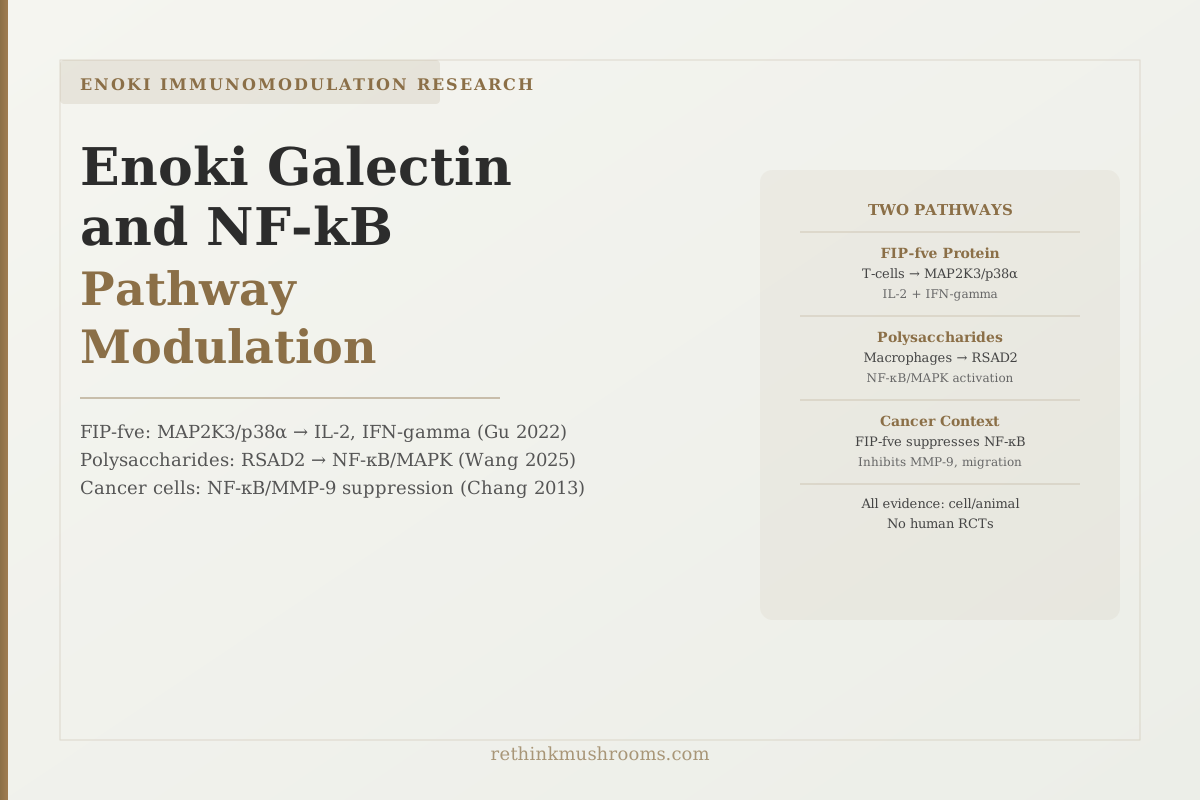
Gu et al. (2022) mapped FIP-fve's signaling to the MAP2K3/p38α (MAPK14) axis with single-kinase precision, establishing the molecular route from enoki protein binding to T-cell immune activation. This 2022 finding gave researchers the exact pathway nodes that earlier studies had identified only at the p38 MAPK level.
Gu et al., Frontiers in Nutrition, 2022
114 amino acids
FIP-fve is a small immunomodulatory lectin isolated from Flammulina velutipes (Ko et al., 1995)
RSAD2/viperin
the novel mediator through which enoki polysaccharides activate NF-κB/MAPK in macrophages, separate from FIP-fve (Wang et al., 2025)
Oral activity
FIP-fve is biologically active after oral administration in mice, increasing macrophage tumoricidal activity and reducing tumor burden (Chang et al., 2010)
Gu et al., Frontiers in Nutrition, 2022
 View as image ↗
FIP-fve is a 114-amino-acid protein from Flammulina velutipes (enoki mushroom) that functions as a lectin, a carbohydrate-binding protein: it agglutinates red blood cells and binds complex cell-surface sugars. It activates T-cells, induces anti-tumor immunity, and in cancer cell contexts, suppresses the same NF-κB signaling it uses to activate immune cells in healthy tissue. The same protein behaves differently depending on the cellular context, which makes FIP-fve's pharmacology more complex than simple anti-inflammatory or pro-inflammatory labels capture. This article covers the full scientific discovery arc of FIP-fve, from its isolation in 1995 to the 2022 kinase-level mechanism and the 2025 parallel pathway discovered for enoki polysaccharides. For the condition-by-condition overview, see Enoki for Inflammatory Conditions: Research Review. For the broader enoki overview, see What Is Enoki Mushroom? The Tiny Mushroom with Big Research.
Key Takeaways
- FIP-fve is a 114-amino-acid fungal immunomodulatory protein and carbohydrate-binding lectin, isolated from F. velutipes by Ko et al. (1995); its 1.7 Å crystal structure revealed a fibronectin type III (FNIII) fold shared across the FIP protein family (including reishi's LZ-8), structurally distinct from mammalian galectins (Paaventhan et al., 2003)
- Wang et al. (2004) established the core FIP-fve signaling mechanism: FIP-fve activates the p38 MAPK pathway in T-cells, inducing IFN-gamma production and T-cell activation
- Gu et al. (2022) achieved single-kinase precision: FIP-fve specifically activates the MAP2K3/p38α (MAPK14) node, driving IL-2 release and T-cell proliferation in Jurkat cell models
- Chang et al. (2013) showed FIP-fve suppresses NF-κB activity and MMP-9 expression in lung cancer cells, inhibiting cancer cell migration and proliferation through the same NF-κB pathway it activates in immune cells
- Chang et al. (2010) demonstrated oral FVE (FIP-fve protein) is biologically active in mice: it activated both innate and adaptive immunity and significantly reduced hepatocellular carcinoma tumor volume
- Wang et al. (2025) discovered a completely distinct second pathway: enoki polysaccharides activate NF-κB/MAPK in macrophages via RSAD2 (viperin), operating independently from FIP-fve's T-cell pathway
FIP-fve's Structure: A Fungal Lectin, Not a Galectin
Lectins are carbohydrate-binding proteins that recognize specific sugar residues on cell surfaces. By binding and crosslinking membrane glycoproteins, they can trigger signaling cascades that regulate immune cell behavior. FIP-fve is a lectin: Ko et al. (1995) showed it agglutinates human red blood cells, and later work confirmed it binds complex cell-surface carbohydrates. This carbohydrate-binding activity is the physical basis for how FIP-fve engages immune cells and initiates the downstream signaling described in the rest of this article.
When researchers solved FIP-fve's crystal structure at 1.7 Å resolution, they found it is not built like a mammalian galectin. Each FIP-fve monomer consists of an N-terminal alpha-helix followed by a fibronectin type III (FNIII) fold, and two monomers assemble into a homodimer through 3-D domain swapping of those helices.[9] This was the first FNIII-fold protein ever described from a fungus. The FNIII fold is a distinct beta-sandwich architecture, not the beta-galactoside-binding fold that defines galectins, so describing FIP-fve as a "galectin" is imprecise. It is a separate class of fungal lectin whose own carbohydrate-binding surface, rather than a galectin recognition domain, mediates its contact with immune cells.
This is why FIP-fve is classified specifically as a fungal immunomodulatory protein (FIP), a family that shares this alpha-helix-plus-FNIII architecture and includes LZ-8 from Ganoderma (reishi), FIP-gts, and related proteins from other medicinal mushrooms (Paaventhan et al., 2003). Enoki's FIP-fve shares this structural fold and dimerization mechanism with the rest of the family despite sequence differences between members, which is what unifies the FIPs as a class.
The Discovery: Ko 1995 and Ko 1997
Ko et al. (1995) isolated FIP-fve from Flammulina velutipes fruiting bodies and determined its complete amino acid sequence.[1] The protein was 114 amino acids long, agglutinated human red blood cells (identifying it as a lectin), and stimulated immune cells in culture. The paper established FIP-fve as a novel fungal immunomodulatory protein and provided the complete sequence that subsequent researchers used to understand its structure and function.
Ko et al. (1997) followed with the molecular cloning and recombinant expression of FIP-fve.[2] Cloning was essential for two reasons. First, it confirmed that the amino acid sequence deduced from the cloned gene exactly matched the sequence determined by direct protein sequencing in 1995, validating the earlier biochemical characterization. Second, recombinant expression means FIP-fve could be produced at scale for experiments rather than extracted from mushroom fruiting bodies, which made mechanistic research practical. Without recombinant production, studying a protein requires continual extraction from biological material, which limits the quantities and purity available for experiments.
The 1995 discovery and 1997 cloning together opened the mechanistic research chain that continued over the next three decades.
The Core Mechanism: Wang 2004 and the p38 MAPK Pathway
Wang et al. (2004) established the key signaling mechanism connecting FIP-fve to immune activation.[3] The researchers showed that FIP-fve specifically induced IFN-gamma production in T-cells through p38 MAPK phosphorylation. IFN-gamma (interferon-gamma) is a cytokine central to adaptive immunity: it activates macrophages, enhances antigen presentation, and is one of the primary signals the immune system uses to coordinate responses against tumors and infected cells.
The p38 MAPK (mitogen-activated protein kinase) pathway is a stress-response signaling cascade that T-cells use to translate activation signals from the cell surface to the nucleus, where gene expression changes produce cytokine output. Wang's finding that FIP-fve specifically activated this pathway, rather than other MAPK pathways like ERK or JNK, directed subsequent mechanistic work toward the p38 MAPK node.
The mechanism Wang identified explains the specificity of FIP-fve's immune activation: it does not broadly stimulate all immune cells indiscriminately. It engages a specific signaling pathway in T-cells that results in a targeted cytokine output (IFN-gamma), which then activates downstream immune responses.
Precision at the Kinase Level: Gu 2022
Gu et al. (2022) narrowed the FIP-fve mechanism to single-kinase precision.[4] Using Jurkat E6-1 cells (a human T-cell line widely used in immunology research), the researchers showed that FIP-fve specifically activates the MAP2K3/p38α (MAPK14) axis. MAP2K3 is the upstream kinase that phosphorylates and activates p38α, the specific p38 MAPK isoform driving the IL-2 release and T-cell proliferation that Gu measured.
This single-kinase identification is the highest-resolution mechanistic picture available for FIP-fve. Earlier research had established "p38 MAPK activation" as the mechanism; Gu 2022 specifies which p38 isoform (MAPK14, also called p38α) and which upstream kinase (MAP2K3, also called MKK3) are the specific nodes in the pathway. In drug discovery language, MAP2K3 and p38α are the targetable molecules. This precision matters for anyone working on FIP-fve as a pharmaceutical lead.
The functional outcomes Gu measured were T-cell proliferation and IL-2 release. IL-2 (interleukin-2) is the primary cytokine driving T-cell expansion after activation. Increased IL-2 means more T-cells are recruited to the immune response. In the context of immune-supported anti-tumor activity, this translates to a larger pool of tumor-targeting T-cells.
FIP-fve and NF-κB: Context-Dependent Signaling
NF-κB is a transcription factor (a protein that turns genes on or off) that controls hundreds of genes involved in immune activation, inflammation, cell survival, and cell proliferation. In immune cells responding to infection or tumors, NF-κB activation drives the pro-inflammatory gene expression that eliminates threats. In cancer cells, NF-κB activation drives genes that promote cell survival, proliferation, and invasion.
FIP-fve's relationship to NF-κB appears to be context-dependent. Chang et al. (2013) tested FIP-fve specifically in lung cancer cells and found it suppressed NF-κB activity and downregulated MMP-9 (matrix metalloproteinase 9, an enzyme cancer cells use to degrade tissue barriers during metastasis).[5] FIP-fve inhibited both lung cancer cell migration and proliferation. The mechanism was NF-κB suppression, the opposite of what happens when FIP-fve activates NF-κB in immune cells responding to threats.
This context-dependent NF-κB behavior is not unique to FIP-fve: it is a characteristic of several immunomodulatory compounds. The same cell signaling machinery serves different purposes in different cell types. In immune cells, NF-κB activation is part of the response against threats. In cancer cells that have co-opted NF-κB for survival and invasion, suppressing NF-κB removes a growth advantage from the malignancy.
The Chang 2013 finding suggests FIP-fve has both immunoactivating properties in normal immune cells (via p38 MAPK in T-cells) and anti-tumor properties in cancer cells (via NF-κB suppression). These are not contradictory: they reflect FIP-fve acting differently on T-cells versus cancer epithelial cells because those cell types have different receptor profiles and signaling contexts.
For how this immunity-cancer relationship functions in practice, see Enoki and Flammulin: A Unique Immunomodulatory Protein.
Oral Activity and In Vivo Evidence
The question of whether a compound works when eaten matters enormously for dietary relevance. Cell culture and isolated protein studies show a mechanism, but not whether the mechanism is accessible through food consumption.
Chang et al. (2010) addressed this directly by administering FVE (FIP-fve protein) orally to mice with hepatocellular carcinoma.[6] Oral FVE at 10 mg/kg significantly activated both innate immunity (peritoneal macrophage tumoricidal capacity increased) and adaptive immunity (tumor-specific splenocyte activity, with MHC class I/II and CD80 upregulated on circulating immune cells). Tumor size in treated mice was significantly lower than in untreated mice, and lifespan increased. Blocking IFN-gamma sharply reduced the anti-tumor effect, confirming that this cytokine, the same endpoint Wang 2004 identified mechanistically, is central to the response.
Oral activity matters for enoki specifically because the question "does eating enoki deliver active FIP-fve to the immune system?" is a prerequisite for any dietary health claim. Chang 2010 does not answer that question for food-form enoki (the doses used were controlled purified protein administration, not enoki mushroom food), but it establishes that FIP-fve can survive oral administration and produce systemic immune effects in mice, which is the biological prerequisite.
Ding et al. (2009) tested FIP-fve's capacity as an immunological adjuvant by co-administering it with a tumor-associated antigen in mice.[7] FIP-fve significantly enhanced the anti-tumor T-cell response compared to the antigen alone. This finding opens a speculative but scientifically interesting direction: FIP-fve as an adjuvant in cancer vaccine formulations, where its T-cell activating properties could amplify the immune response to tumor antigens.
The Polysaccharide Parallel: A Separate Pathway, Same Mushroom
Wang et al. (2025) made a discovery that substantially changes how enoki's immune signaling should be understood.[8] The researchers tested an enoki polysaccharide fraction (FVP-1) on macrophages and mouse spleen cells and found it activated NF-κB and MAPK signaling. The activating agent was not FIP-fve. It was RSAD2, also known as viperin, a protein typically known as an antiviral interferon-stimulated gene in mammalian systems.
Enoki polysaccharides upregulated RSAD2 expression in macrophages, and RSAD2 served as the mediator for the downstream NF-κB and MAPK activation. This is a completely different pathway from FIP-fve's MAP2K3/p38α T-cell mechanism. FIP-fve operates on T-cells through the MAP2K3/p38α kinase axis. Polysaccharides operate on macrophages through RSAD2-mediated NF-κB/MAPK.
Two compounds from the same mushroom, activating immunity through entirely different molecular intermediaries in different cell types, using different receptor-signaling logic. The Wang 2025 finding that RSAD2 (an antiviral innate immunity protein) mediates polysaccharide immunomodulation is genuinely surprising: this protein was not previously known to participate in mushroom polysaccharide signaling. It opens a new research direction into the intersection of fungal polysaccharide immunology and antiviral innate immunity.
For the full polysaccharide pathway analysis, see Flammulina velutipes and Inflammatory Pathway Modulation and Enoki and the Immune System: Immunomodulatory Research.
One Protein, Two NF-κB Directions
How Enoki Modulates NF-κB Through Three Separate Routes
FIP-fve is a lectin, not a galectin: its fibronectin type III fold binds immune-cell surfaces and, depending on the cell, activates immune signaling in T cells or suppresses NF-κB in cancer cells. A separate compound class — enoki polysaccharides — activates NF-κB in macrophages through RSAD2. Reading the three lanes side by side is the fastest way to see why a single mushroom points NF-κB in opposite directions.
The protein switches immune signaling ON in T cells
FIP-fve binds T lymphocytes and fires the MAP2K3/p38α relay, driving IL-2 (proliferation) and IFN-γ (a Th1-skewed response). Kinase inhibitors — gossypetin against MAP2K3 and losmapimod against p38 — abolish the effect, pinning the mechanism to that relay. It stays active after oral dosing in mice and can act as a vaccine adjuvant.
Wang 2004 [3] (p38 MAPK, IFN-γ) · Gu 2022 [4] (MAP2K3/p38α, IL-2) · Chang 2010 [6] (oral activity) · Ding 2009 [7] (adjuvant)
The same protein switches NF-κB OFF in cancer cells
In lung cancer cells FIP-fve does the reverse of its immune-cell role: it suppresses NF-κB activity and downregulates MMP-9, the enzyme tumors use to break through tissue barriers. The result is reduced cancer-cell migration and proliferation. One protein, opposite NF-κB directions, decided by the cell it acts on.
Chang 2013 [5] (NF-κB suppression, ↓MMP-9, lung cancer cells)
A separate compound class, a separate mediator
Enoki polysaccharides are not FIP-fve. The FVP-1 fraction activates macrophages, and the 2025 breakthrough identified RSAD2 (viperin) — a protein previously known only for antiviral defense — as the mediator of the resulting NF-κB/MAPK activation. No prior precedent existed for this route in mushroom immunology.
Wang 2025 [8] (FVP-1 → RSAD2 → NF-κB/MAPK; novel)
Every molecular step shown is established in cell or animal studies. No human randomized controlled trial has evaluated FIP-fve or enoki polysaccharides against any immune or inflammatory endpoint, and the preclinical doses cannot be mapped to a dietary amount of enoki. This is a mechanism map, not an efficacy claim.
Mechanism synthesis; arms from refs [1][3][4][5][6][7][8][9] (see references)
Why No Human Trials Have Been Conducted
FIP-fve's research profile makes it an interesting pharmaceutical candidate: specific mechanism at the kinase level, oral activity in animal models, multi-context NF-κB modulation, demonstrated adjuvant capacity. Why no human trials?
The pathway from in vitro mechanism to human trial is long and expensive. Most pharmaceutical development fails between animal studies and Phase I trials. For a mushroom-derived protein to advance to clinical trials, it needs demonstrated safety in multiple animal species, pharmacokinetic data (how the body processes the compound), standardized preparation, and evidence of stable oral bioavailability. None of this has been publicly documented for FIP-fve.
Additionally, FIP-fve research has been largely academic rather than commercially funded. The commercial mushroom supplement market sells whole-mushroom extracts, not purified FIP-fve protein. Purified protein development at pharmaceutical grade is expensive and time-consuming, and the return on investment for a non-patentable natural compound is uncertain.
The result is a scientifically detailed mechanistic picture with no clinical translation yet. The Gu 2022 MAP2K3/p38α finding is research-level precision with no human confirmation of whether this pathway is meaningfully activated by consuming enoki in any form.
The Bottom Line
FIP-fve is a 114-amino-acid immunomodulatory lectin unique to Flammulina velutipes that activates T-cells via MAP2K3/p38α MAPK (Gu et al., 2022, refining Wang et al.'s 2004 p38 MAPK finding) and suppresses NF-κB in cancer cells (Chang et al., 2013). Oral FVE produces anti-tumor immune activation in mice (Chang et al., 2010). Wang et al. (2025) identified a parallel polysaccharide pathway using RSAD2 as a distinct NF-κB/MAPK mediator in macrophages. No human clinical trials have tested FIP-fve or enoki polysaccharides for immune modulation or inflammatory conditions.
Frequently Asked Questions
Sources & References
- 1RTHM-00041·Ko, J L et al. (1995). “A new fungal immunomodulatory protein, FIP-fve isolated from the edible mushroom, Flammulina velutipes and its complete amino acid sequence..” European journal of biochemistry.Study breakdown →PubMed →↩
- 2RTHM-00051·Ko, J L et al. (1997). “Molecular cloning and expression of a fungal immunomodulatory protein, FIP-fve, from Flammulina velutipes..” Journal of the Formosan Medical Association = Taiwan yi zhi.Study breakdown →PubMed →↩
- 3RTHM-00146·Wang, Po-Hui et al. (2004). “Fungal immunomodulatory protein from Flammulina velutipes induces interferon-gamma production through p38 mitogen-activated protein kinase signaling pathway..” Journal of agricultural and food chemistry.Study breakdown →PubMed →↩
- 4RTHM-01528·Gu, Kefei et al. (2022). “FIP-fve Stimulates Cell Proliferation and Enhances IL-2 Release by Activating MAP2K3/p38α (MAPK14) Signaling Pathway in Jurkat E6-1 Cells..” Frontiers in nutrition.Study breakdown →PubMed →↩
- 5RTHM-00513·Chang, Yu-Chi et al. (2013). “Interruption of lung cancer cell migration and proliferation by fungal immunomodulatory protein FIP-fve from Flammulina velutipes..” Journal of agricultural and food chemistry.Study breakdown →PubMed →↩
- 6RTHM-00328·Chang, Hui-Hsin et al. (2010). “Oral administration of an Enoki mushroom protein FVE activates innate and adaptive immunity and induces anti-tumor activity against murine hepatocellular carcinoma..” International immunopharmacology.Study breakdown →PubMed →↩
- 7RTHM-00290·Ding, Ying et al. (2009). “Coadministration of the fungal immunomodulatory protein FIP-Fve and a tumour-associated antigen enhanced antitumour immunity..” Immunology.Study breakdown →PubMed →↩
- 8RTHM-02206·Wang, Qiuyi et al. (2025). “Flammulina velutipes polysaccharide exerts immunomodulatory function involving RSAD2 to regulate the NF-κB/MAPK signaling pathway in RAW264.7 macrophage cells and in mouse spleen cells..” International journal of biological macromolecules.Study breakdown →PubMed →↩
- 9RTHM-02285·Paaventhan, P et al. (2003). “A 1.7A structure of Fve, a member of the new fungal immunomodulatory protein family..” Journal of molecular biology.Study breakdown →PubMed →↩