Mushrooms and IBD
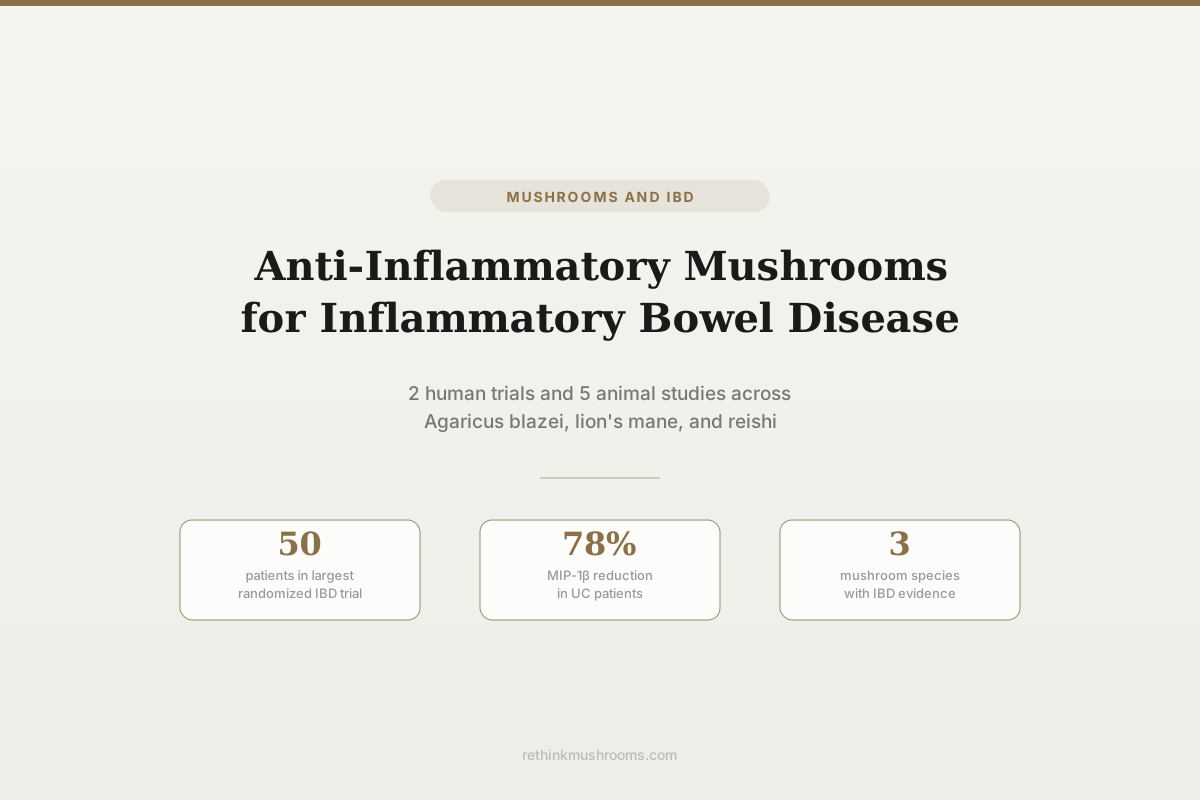
2 human trials
Two human trials and five animal studies have tested medicinal mushroom extracts against inflammatory bowel disease, with Agaricus blazei producing cytokine reductions in both Crohn's disease and ulcerative colitis patients.
Førland et al., Scandinavian Journal of Immunology, 2011
50 patients
largest mushroom-IBD randomized trial
3 species
Agaricus blazei, Hericium erinaceus, Ganoderma lucidum
0 phase III
no large-scale confirmatory trials completed
Førland et al., Scandinavian Journal of Immunology, 2011
 View as image ↗
Inflammatory bowel disease affects an estimated 7 million people worldwide, and the standard treatments (immunosuppressants, biologics, surgery) carry significant side effects. Against that backdrop, two small human trials have tested mushroom extracts in IBD patients, and both found measurable reductions in inflammatory markers. Førland et al. (2011) documented drops in pro-inflammatory cytokines of up to 78% in IBD patients after 12 days of Agaricus blazei extract consumption.[1]
Those numbers are preliminary. The trials were small, and no mushroom extract has completed phase III testing for any form of IBD. But the preclinical pipeline behind those trials is substantial: five animal studies across three mushroom species (Agaricus blazei, Hericium erinaceus, and Ganoderma lucidum) have demonstrated anti-inflammatory, gut-barrier-protective, and microbiota-modulating effects in chemically induced colitis models. This article reviews what that evidence shows, where it falls short, and why the gap between mouse colitis and human IBD is wider than it appears. For the broader context on mushroom beta-glucans and gut inflammation, see that dedicated review.
Key Takeaways
- An Agaricus blazei extract reduced MIP-1beta by 78%, IL-6 by 44%, and IL-1beta by 41% in blood from ulcerative colitis patients after 12 days of oral consumption (Førland et al., 2011)
- A 50-patient randomized trial of AndoSan in Crohn's disease found significant symptom improvement within the treatment group but no significant difference versus placebo (Therkelsen et al., 2016)
- Hericium erinaceus polysaccharide reduced colon tissue damage, suppressed NF-kappaB and MAPK signaling, and shifted gut microbiota composition in DSS-induced colitis mice (Ren et al., 2018)
- Ganoderma lucidum polysaccharide increased short-chain fatty acid production in colitis rats while reducing pathogenic bacteria in both small intestine and cecum (Xie et al., 2019)
- Agaricus blazei polysaccharide maintained intestinal barrier integrity by promoting ZO-1 and occludin tight junction protein expression in DSS-induced colitis mice (Ji et al., 2023)
- All three species share overlapping anti-inflammatory mechanisms: cytokine suppression, gut microbiota remodeling, and intestinal barrier protection
Agaricus blazei: the only species with human IBD data
Cytokine reduction in UC and Crohn's patients
Førland et al. (2011) conducted the first human study of a mushroom extract in IBD patients. Eleven patients with Crohn's disease and ten with ulcerative colitis consumed 60 ml/day of AndoSan, an extract based primarily on Agaricus blazei Murill, for 12 days.[1]
In ulcerative colitis patients, baseline plasma MCP-1 dropped by 40%. In lipopolysaccharide-stimulated blood (a test of immune cell reactivity), reductions were larger: MIP-1beta fell 78%, IL-6 fell 44%, IL-1beta fell 41%, IL-8 fell 30%, G-CSF fell 29%, and GM-CSF fell 17%.[1]
In Crohn's patients, the pattern differed but remained anti-inflammatory: baseline IL-2 dropped 100% and IL-17 dropped 55%. In stimulated blood, IL-1beta fell 35%, MIP-1beta fell 30%, and IL-8 fell 18%.[1]
Faecal calprotectin, a standard clinical marker for intestinal inflammation, decreased in the ulcerative colitis group. This is a relevant finding because calprotectin correlates with endoscopic disease activity and is used clinically to monitor treatment response.
The study had no placebo control, no blinding, and only 21 participants. The cytokine reductions are biologically interesting but cannot establish clinical efficacy.
The Crohn's disease randomized trial
Therkelsen et al. (2016) followed up with a proper randomized, single-blinded, placebo-controlled trial. Fifty patients with symptomatic Crohn's disease consumed either AndoSan or placebo daily for 21 days.[2]
Results were mixed. Within the AndoSan group (n=25), symptom scores improved from baseline mean 5.52 to 4.08 by day 21 (p<0.001). Both genders showed improvement. But the critical comparison, between AndoSan and placebo groups, showed no statistically significant difference (p=0.106). There was a marginal effect for men (p=0.054).[2]
Fatigue, quality of life, calprotectin, and blood parameters were comparable between groups. No adverse effects were reported.
This is the most rigorous mushroom-IBD study published to date, and it failed to demonstrate superiority over placebo on its primary endpoint. The within-group improvement could reflect natural symptom fluctuation, placebo effects, or a real but underpowered signal. With 25 patients per arm, the trial was likely too small to detect a modest effect size. Whether a larger trial would produce different results is unknown. For more on the Agaricus blazei bioactive compounds driving these effects, see that article.
Intestinal barrier protection in mice
Ji et al. (2023) tested Agaricus blazei polysaccharide (ABP) in the DSS-induced acute colitis mouse model, the most widely used preclinical IBD model. Dietary supplementation with ABP alleviated colitis symptoms, inflammatory responses, and oxidative stress.[3]
The barrier-specific findings stand out: ABP promoted expression of ZO-1 and occludin, two tight junction proteins that maintain the physical seal between intestinal epithelial cells. It also increased mucus secretion. When these structures fail in IBD, bacteria cross the intestinal wall and trigger immune responses that perpetuate inflammation.[3]
16S rRNA sequencing showed ABP intervention reversed DSS-induced gut microbiota disruption, and metabolomics indicated metabolic remodeling. This is consistent with the hypothesis that mushroom polysaccharides act as prebiotics, feeding beneficial bacteria that produce short-chain fatty acids and maintain gut homeostasis.
Lion's mane (Hericium erinaceus): three colitis models, consistent results
Three independent groups have tested Hericium erinaceus in chemically induced colitis, each using different extracts and different models. The consistency across studies strengthens the evidence, though all remain preclinical. For the gastroprotective angle, see lion's mane for IBD: gastroprotective evidence.
DSS-induced colitis in mice
Ren et al. (2018) tested a polysaccharide fraction from Hericium erinaceus (HECP) in DSS-induced colitis in C57BL/6 mice. HECP improved clinical symptoms and reduced histological damage scores in a dose-dependent manner.[4]
The mechanistic findings were detailed: HECP downregulated oxidative stress markers (malondialdehyde, myeloperoxidase) while upregulating antioxidant enzymes (superoxide dismutase, catalase). It suppressed both the NF-kappaB and MAPK signaling pathways, two central inflammatory cascades in IBD pathogenesis. Downstream, pro-inflammatory cytokines TNF-alpha, IL-1beta, and IL-6 decreased while anti-inflammatory IL-10 increased.[4]
HECP also shifted gut microbiota composition, increasing Bacteroidetes and decreasing Firmicutes (the DSS model typically produces the opposite shift). This microbiota remodeling may be both a cause and consequence of reduced inflammation.
Qin et al. (2016) independently confirmed anti-colitis effects using an ethanol extract of Hericium erinaceus in DSS-induced colitis mice. Oral administration improved body weight and colon length, decreased intestinal bleeding, reduced myeloperoxidase accumulation, and protected mucosal epithelium.[5]
TNBS-induced IBD in rats
Diling et al. (2017) used a different chemical inducer (TNBS, trinitrobenzene sulfonic acid) and a different species (rats) to test three Hericium erinaceus preparations: polysaccharide extract, alcoholic extract, and whole extract.[6]
All three preparations improved damage activity indices and tissue damage scores. The polysaccharide extract showed the strongest gut-barrier effects, while the alcoholic extract produced the greatest shifts in immune cell populations. T-regulatory cell populations increased and Th17 cells decreased, a shift that favors immune tolerance over the inflammatory responses that drive IBD.[6]
The use of different extract types is informative. Polysaccharides and small molecules from the same mushroom appear to work through partially distinct mechanisms, suggesting that whole-mushroom preparations may have advantages over single-compound extracts. The Th17/T-regulatory balance shift is particularly relevant to IBD, where Th17 overactivation drives tissue damage in both Crohn's disease and ulcerative colitis. Whether Hericium erinaceus produces similar immune cell shifts in human IBD patients has not been tested.
Reishi (Ganoderma lucidum): microbiota remodeling and immune modulation
Gut microbiota and short-chain fatty acids
Xie et al. (2019) tested Ganoderma lucidum polysaccharide (GLP) in DSS-induced colitis in rats. GLP consumption lowered disease activity indices and produced markedly more short-chain fatty acids (SCFAs) in the cecum.[7]
The microbiota analysis revealed increased SCFA-producing bacteria and reduced pathogenic species in both the small intestine and cecum. Gene expression analysis of colonic epithelial cells showed GLP altered expression patterns related to inflammation and barrier function.[7]
SCFAs (butyrate, propionate, acetate) are produced by gut bacteria fermenting dietary fiber and polysaccharides. Butyrate is the primary energy source for colonocytes and has direct anti-inflammatory effects. The ability of mushroom polysaccharides to increase SCFA production may be their most therapeutically relevant mechanism for IBD, because it works through the existing gut ecosystem rather than directly suppressing immunity.
Immune modulation and colitis-associated cancer prevention
Guo et al. (2021) extended the evidence to a combined colitis-cancer model (AOM/DSS), showing that GLP modulated both gut microbiota and immune cell function.[8]
GLP reduced the levels of TNF-alpha, IL-1beta, and IL-6 in colonic lamina propria. It also ameliorated microbiota dysbiosis, increased SCFA production, and alleviated endotoxemia by inhibiting TLR4/MyD88/NF-kappaB signaling.[8]
The cancer-prevention angle is relevant because chronic IBD is a risk factor for colorectal cancer. If mushroom polysaccharides reduce both inflammation and tumorigenesis in the same model, they may address two linked aspects of IBD pathology. This remains a preclinical observation in a chemically induced model, not evidence of cancer prevention in humans with IBD. For how adaptogenic mushrooms affect stress responses, including reishi, see that review.
Shared mechanisms across mushroom species
A 2020 review by Hetland et al. examined the overlapping anti-inflammatory mechanisms of Agaricus blazei, Hericium erinaceus, and Grifola frondosa (maitake).[9]
Three mechanisms recur across species:
Pro-inflammatory cytokine suppression. All three species reduce TNF-alpha, IL-1beta, IL-6, and other pro-inflammatory mediators. The upstream pathways differ (NF-kappaB for Hericium, TLR4/MyD88 for Ganoderma, direct cytokine modulation for Agaricus), but the downstream effect converges on reduced inflammatory signaling.
Gut microbiota remodeling. Mushroom polysaccharides, primarily beta-glucans, resist digestion and reach the colon intact, where they serve as fermentation substrates for beneficial bacteria. This prebiotic effect increases SCFA production and shifts the Firmicutes/Bacteroidetes ratio toward profiles associated with reduced inflammation.
Intestinal barrier support. Tight junction protein expression (ZO-1, occludin, claudins) increases with mushroom polysaccharide treatment across multiple studies and species. Mucus production also increases. Both effects help maintain the physical barrier that prevents bacterial translocation and the immune activation that drives IBD flares.
These shared mechanisms raise the possibility that mushroom polysaccharides work primarily through their prebiotic effects on gut bacteria rather than through direct immunomodulation. If so, the specific mushroom species may matter less than the polysaccharide dose and structure.
Why animal colitis models overpredict human efficacy
The DSS and TNBS models used in these studies create acute, chemically induced inflammation that resolves when the chemical is removed. Human IBD is chronic, relapsing, and driven by autoimmune mechanisms that these models do not fully replicate.
Timing mismatch. Animal studies typically test mushroom extracts given before or simultaneously with the colitis-inducing chemical. Human IBD patients have established, ongoing disease. Preventing inflammation is mechanistically different from resolving it.
Microbiota differences. Mouse and rat gut microbiota differ from human microbiota in composition and diversity. The prebiotic effects observed in rodents may not translate to the same bacterial shifts in human guts, where the baseline ecosystem is more complex and individually variable.
Dose translation. The doses used in animal studies, when scaled to human body weight, often exceed what would be practical or safe for daily consumption. Whether the human-equivalent doses are achievable with commercially available mushroom supplements is rarely addressed.
The RCT reality. The Therkelsen 2016 trial is the most informative data point. Despite promising preclinical and open-label human data, the randomized controlled trial failed to show a statistically significant benefit over placebo. This is the typical trajectory for natural product research: strong animal data, encouraging pilot studies, and then equivocal results in controlled trials.
None of this means mushroom extracts are ineffective for IBD. It means the evidence is not yet strong enough to draw conclusions about clinical utility. For a broader overview of the anti-inflammatory mechanisms at play, see mushrooms and IBD: anti-inflammatory mechanisms in Crohn's and colitis, and for a general introduction to the topic, mushrooms for IBD: can they help Crohn's and ulcerative colitis?
The path forward likely requires larger, multi-center randomized trials with longer treatment durations, standardized mushroom extract preparations with defined polysaccharide content, and biomarker-driven patient selection. The Therkelsen trial's marginal result in male patients (p=0.054) hints that certain subpopulations may respond differently, but exploring this requires sample sizes far beyond what has been attempted.
The Bottom Line
Three mushroom species (Agaricus blazei, Hericium erinaceus, and Ganoderma lucidum) have demonstrated anti-inflammatory, barrier-protective, and microbiota-modulating effects in animal models of inflammatory bowel disease. Two human trials of Agaricus blazei extract in IBD patients showed cytokine reductions but the only randomized controlled trial (n=50, Crohn's disease) failed to achieve statistical significance versus placebo. Shared mechanisms across species center on polysaccharide-mediated prebiotic effects, but the translation from chemically induced animal colitis to human autoimmune IBD remains unvalidated.
Frequently Asked Questions
Sources & References
- 1RTHM-00213·Førland, D T et al. (2011). “Effect of an extract based on the medicinal mushroom Agaricus blazei Murill on expression of cytokines and calprotectin in patients with ulcerative colitis and Crohn's disease..” Scandinavian journal of immunology.Study breakdown →PubMed →↩
- 2RTHM-00451·Therkelsen, Stig Palm et al. (2016). “Effect of the Medicinal Agaricus blazei Murill-Based Mushroom Extract, AndoSanTM, on Symptoms, Fatigue and Quality of Life in Patients with Crohn's Disease in a Randomized Single-Blinded Placebo Controlled Study..” PloS one.Study breakdown →PubMed →↩
- 3RTHM-00831·Ji, Zhong-Hao et al. (2023). “Agaricus blazei Polysaccharide Alleviates DSS-Induced Colitis in Mice by Modulating Intestinal Barrier and Remodeling Metabolism..” Nutrients.Study breakdown →PubMed →↩
- 4RTHM-00529·Ren, Yilin et al. (2018). “Polysaccharide of Hericium erinaceus attenuates colitis in C57BL/6 mice via regulation of oxidative stress, inflammation-related signaling pathways and modulating the composition of the gut microbiota..” The Journal of nutritional biochemistry.Study breakdown →PubMed →↩
- 5RTHM-00442·Qin, Mingming et al. (2016). “Anti-Inflammatory Effects of Ethanol Extract of Lion's Mane Medicinal Mushroom, Hericium erinaceus (Agaricomycetes), in Mice with Ulcerative Colitis..” International journal of medicinal mushrooms.Study breakdown →PubMed →↩
- 6RTHM-00470·Diling, Chen et al. (2017). “Extracts from Hericium erinaceus relieve inflammatory bowel disease by regulating immunity and gut microbiota..” Oncotarget.Study breakdown →PubMed →↩
- 7RTHM-00598·Xie, Jinli et al. (2019). “Ganoderma lucidum polysaccharide improves rat DSS-induced colitis by altering cecal microbiota and gene expression of colonic epithelial cells..” Food & nutrition research.Study breakdown →PubMed →↩
- 8RTHM-00690·Guo, Cuiling et al. (2021). “Ganoderma lucidum polysaccharide modulates gut microbiota and immune cell function to inhibit inflammation and tumorigenesis in colon..” Carbohydrate polymers.Study breakdown →PubMed →↩
- 9RTHM-00620·Hetland, Geir et al. (2020). “Antitumor, Anti-Inflammatory and Antiallergic Effects of Agaricus blazei Mushroom Extract and the Related Medicinal Basidiomycetes Mushrooms, Hericium erinaceus and Grifola frondosa: A Review of Preclinical and Clinical Studies..” Nutrients.Study breakdown →PubMed →↩