Mushrooms & Gut Health
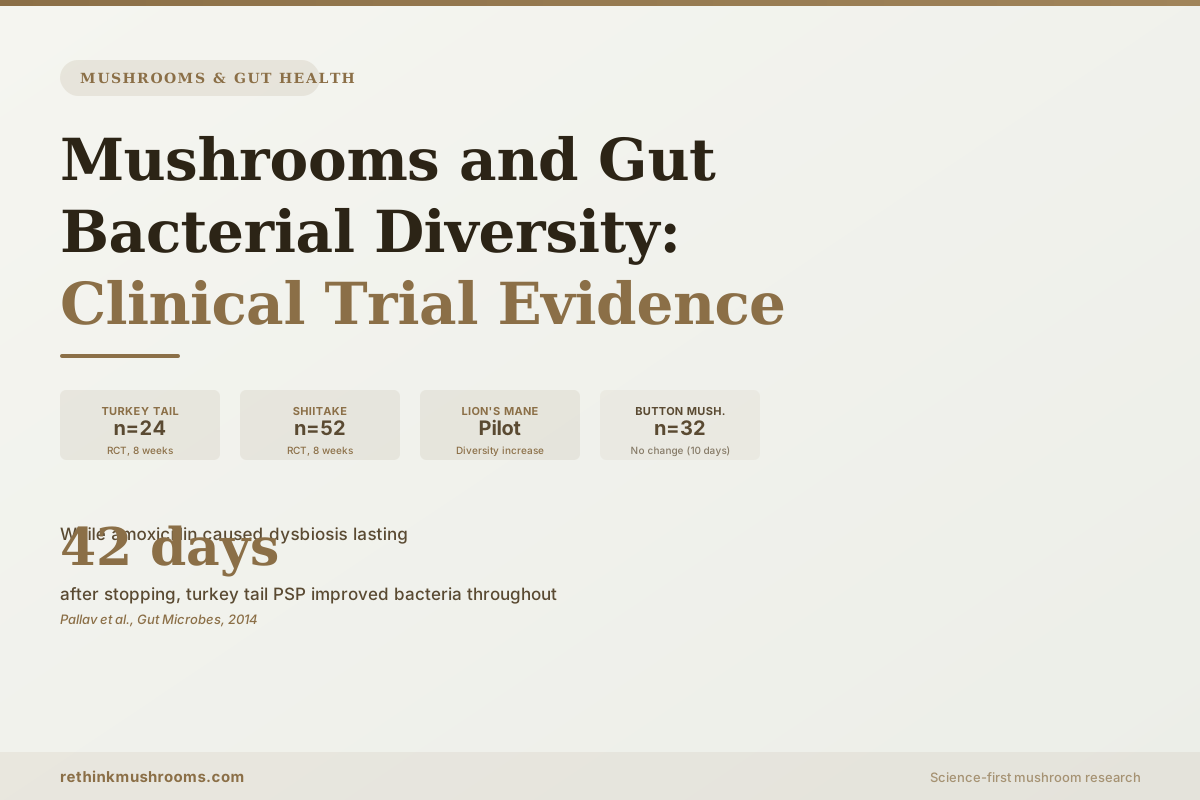
42 days after stopping antibiotics, gut disruption persisted. Turkey tail PSP improved bacteria throughout.
The most striking finding in mushroom gut research: while amoxicillin created persistent dysbiosis for six weeks after stopping, turkey tail PSP consistently increased beneficial bacteria without disrupting the microbiome at all.
Pallav et al., Gut Microbes, 2014
n=52
shiitake beta-glucan RCT shifted colonic microbiota composition versus placebo — including Akkermansia muciniphila and SCFA-producing genera — though the primary cholesterol endpoint was null (Morales et al., 2021)
0
significant SCFA or fermentation changes after 10 days of button mushrooms, even though phylum composition did shift. The result that shows species and duration decide the effect (Hess et al., 2018)
4+
human clinical trials on mushrooms and gut microbiota; turkey tail and shiitake have the strongest RCT evidence
Pallav et al., Gut Microbes, 2014
 View as image ↗
While taking antibiotics, an 8-week study measured what happened to the gut bacteria of two groups: one taking turkey tail polysaccharide and one taking amoxicillin. The antibiotic group showed dramatic disruption, including increases in Escherichia and Shigella, that persisted for 42 days after they stopped taking it. The turkey tail group showed consistent increases in beneficial Bifidobacterium and Lactobacillus throughout. No disruption. No lasting harm.
That finding from Pallav and colleagues (2014) represents the most striking data point in the clinical literature on mushroom consumption and bacterial diversity, and no major competitor health site uses it. This article assembles the full clinical evidence picture, including the human RCTs, the pilot data, and a critical null-on-function result that competitors consistently omit. For the foundational explanation of how mushrooms act as prebiotic substrates in the gut, see mushrooms as prebiotics: how they feed your gut bacteria.
Key Takeaways
- Turkey tail PSP consistently increased Bifidobacterium and Lactobacillus over 8 weeks in a human RCT, while amoxicillin caused dysbiosis that persisted 42 days after stopping (Pallav et al., Gut Microbes, 2014; n=24)
- Shiitake beta-glucan (3.5g/day for 8 weeks) shifted colonic microbiota composition differently from placebo in a randomized double-blind trial, with genera including Akkermansia muciniphila and SCFA-producers correlating with cholesterol-related biomarkers — though the trial's primary cholesterol endpoint was null and the clinical significance was not fully established (Morales et al., European Journal of Nutrition, 2021; n=52)
- Whole-food shiitake consumption increased salivary secretory immunoglobulin A (sIgA), a mucosal immunity marker, alongside gains in immune cell activity (γδ-T cells +60%, NK-T cells doubled) in a 4-week RCT in healthy adults (Dai et al., Journal of the American College of Nutrition, 2015; n=52)
- Lion's Mane consumption increased gut bacterial alpha diversity and upregulated SCFA-producing bacteria (including Faecalibacterium prausnitzii) while downregulating pathobionts in a 7-day pilot (n=13); the microbiota shifts correlated with blood markers including LDL, uric acid, ALP, and creatinine (Xie et al., Nutrients, 2021)
- A 10-day protein-matched crossover trial found NO change in SCFA concentrations, breath hydrogen, stool frequency, or fecal pH from Agaricus bisporus (button mushrooms) — but the mushroom diet did shift phylum-level composition (more Bacteroidetes, less Firmicutes) and raised stool weight, showing button mushrooms alter the gut without changing SCFA output in 10 days (Hess et al., Nutrients, 2018; n=32)
- No human clinical trials exceeding 3 months exist for any mushroom species and gut microbiota outcomes; long-term evidence is a gap in this entire research area
Mushroom Consumption and Bacterial Diversity: The Clinical Evidence Summary
For readers who want the full picture in one place before the detail:
| Species | Study | Type | Sample | Key finding |
|---|---|---|---|---|
| Turkey tail (PSP) | Pallav 2014 | RCT | n=24 | Bifidobacterium and Lactobacillus increased; amoxicillin caused lasting disruption, PSP did not |
| Shiitake (beta-glucan) | Morales 2021 | Double-blind RCT | n=52 | Colonic microbiota shifted vs placebo (incl. Akkermansia, SCFA-producers); cholesterol endpoint null |
| Shiitake (whole food) | Dai 2015 | RCT | n=52 | Salivary sIgA and immune cell activity increased |
| Lion's Mane | Xie 2021 | Pilot | n=13 | Alpha diversity and SCFA-producers increased; correlated with LDL, uric acid, ALP |
| Button mushroom | Hess 2018 | Crossover RCT | n=32 | Composition shifted (Bacteroidetes up, Firmicutes down); NO SCFA change in 10 days |
The pattern across these studies: mushroom species with high beta-glucan or heteropolysaccharide content, given at doses sufficient to reach the colon, over durations of 4 weeks or longer, produce measurable prebiotic-direction shifts in specific beneficial bacteria and their metabolites. Button mushrooms given for 10 days shifted the broad phylum balance but did not move SCFA output or the targeted beneficial genera. Species, dose, and duration are the decisive variables, not mushroom consumption in general.
Turkey Tail PSP vs. Amoxicillin: The Most Striking Comparison in the Human Data
In the Pallav 2014 trial, 24 healthy volunteers were assigned to take either polysaccharopeptide or PSP from turkey tail (Trametes versicolor), or amoxicillin, over 8 weeks.[1] PSP is a non-digestible polysaccharide complex derived from turkey tail; it is distinct from PSK (polysaccharide-kretschmar, a related compound used in cancer immunotherapy), though the two share structural similarities.
The PSP group showed consistent increases in Bifidobacterium, a family of bacteria associated with healthy gut function, reduced gut inflammation, and better immune responses, and Lactobacillus species, the fermentation-active bacteria commonly linked to probiotic health effects. The PSP group also showed reductions in Clostridium species, which include various strains that can produce inflammatory compounds and have been associated with gut dysbiosis.
The amoxicillin group told a different story. During antibiotic treatment, Escherichia and Shigella increased substantially (both can be pathogenic when overgrown), while beneficial bacteria declined. What distinguishes this study from a standard comparison is the follow-up period: the microbiome disruption from amoxicillin persisted for 42 days after the participants stopped taking the antibiotic. At the last measurement point, the microbiome had still not returned to baseline.
The PSP group showed no equivalent disruption at any timepoint.
This comparison matters not because turkey tail reverses antibiotic damage (that was not tested), but because it illustrates the scale of contrast between a compound that shifts gut bacteria toward a prebiotic-consistent pattern and one that causes lasting disruption. The study was small at n=24 and used an older microbiome analysis method (bTEFAP rather than the 16S rRNA sequencing now standard in the field), which limits the resolution of species-level data. Within those limits, the directional finding is consistent with the prebiotic mechanism.
For more on Turkey Tail's specific gut bacteria effects from the species angle, see how turkey tail changes gut bacteria composition.
Shiitake in Two Human RCTs: Akkermansia and Gut Immune Signals
Shiitake has two separate human clinical trials addressing gut microbiota, which gives it the most layered direct human evidence in this area.
The first is the Morales 2021 randomized double-blind trial, which randomized 52 adults with untreated mild hypercholesterolemia to receive a beta-glucan-enriched shiitake extract (10.4 g/day of the mixture, delivering 3.5 grams per day of fungal beta-glucans) or placebo for 8 weeks.[2] The trial's primary aim was cholesterol lowering, and on that endpoint it was null: no significant differences in lipid or cholesterol parameters versus placebo, and no inflammatory or immunomodulatory changes. What it did show was that the beta-glucan modulated colonic microbiota composition differently from placebo, with several genera — including Akkermansia muciniphila and short-chain-fatty-acid producers such as Ruminococcaceae and Subdoligranulum — shifting and correlating with cholesterol-related biomarkers.
Akkermansia muciniphila is a bacterium that lives in the mucus layer of the gut wall and acts as a keystone species for metabolic health. Its abundance is consistently inversely correlated with obesity, type 2 diabetes, and markers of cardiometabolic dysfunction in observational studies; lower Akkermansia levels are associated with metabolic disease risk, and higher levels are protective. The Morales finding is worth noting because a shift toward Akkermansia and SCFA-producing taxa from a dietary beta-glucan in a human RCT is a plausible mechanistic signal — but the authors themselves cautioned that the precise significance of this microbiota modulation was not fully elucidated, and it occurred without a matching improvement in the cholesterol outcomes the trial was designed to move.
The other genera involved (Ruminococcaceae and Subdoligranulum among them) are associated with producing short-chain fatty acids (SCFAs), metabolic compounds that serve as fuel for the cells lining the gut wall, lower colonic pH to suppress pathogens, and produce anti-inflammatory signals that reach systemic circulation. Their movement in a fiber-fed direction is consistent with a prebiotic effect, even though the trial did not translate that into its cholesterol endpoints.
The second shiitake trial comes from Dai and colleagues in 2015.[3] This study had 52 healthy young adults eating 5 to 10 grams of dried shiitake as whole food daily for 4 weeks. The primary endpoint was immune function: gamma-delta T cell proliferation increased by 60% (p<0.0001), and NK-T cell levels doubled (p<0.0001), both with greater activation-receptor expression. Relevant to mucosal defense specifically, secretory immunoglobulin A (sIgA) — measured in saliva in this trial — also increased. sIgA is an antibody that coats mucosal surfaces and acts as a first-line defense against pathogens; salivary sIgA is a general marker of mucosal immunity rather than a direct readout of the gut lining. Mucosal immunity is closely linked to microbiota quality, and sIgA increases can be a downstream consequence of microbiota-stimulated immune training. The Dai trial did not measure gut bacterial composition, so it does not directly evidence a microbiota shift — but the immune signal connects whole-food shiitake consumption to improved mucosal immune function in humans.
For a broader comparison of which mushroom species have the strongest prebiotic credentials, see which mushrooms are the best prebiotics? A species comparison.
Lion's Mane and Diversity: A Pilot Linking Bacteria to Blood Markers
A 2021 pilot study by Xie and colleagues examined short-term lion's mane (Hericium erinaceus) consumption in a small human sample: 13 healthy adults took H. erinaceus powder daily for 7 days, with gut microbiota profiled by 16S rRNA sequencing before and after.[4]
On microbiota composition, lion's mane consumption increased alpha diversity, a measure of how many different species of bacteria exist in a sample and how evenly they are distributed. Higher alpha diversity is generally associated with a more resilient microbiome and better long-term gut health. More specifically, several SCFA-producing bacteria increased in relative abundance — including Faecalibacterium prausnitzii, Eubacterium rectale, and Fusicatenibacter saccharivorans — while several pathobionts (such as Bacteroides caccae and Romboutsia timonensis) decreased.
The second dimension is a metabolic one. The microbiota shifts correlated with several routine blood chemistry markers: low-density lipoprotein (LDL), uric acid, alkaline phosphatase (ALP), and creatinine. These are correlations in a small, uncontrolled pilot, so they establish no cause and effect and no clinical benefit — but they are consistent with the broader hypothesis that diet-driven microbiota changes can register in systemic metabolic markers.
The lion's mane data is pilot-level, not RCT-level evidence: 13 people, 7 days, no placebo group. It belongs in an honest evidence hierarchy below the shiitake and turkey tail RCTs. But the alpha diversity and SCFA-producer findings make it worth monitoring as larger, controlled trials are conducted.
For lion's mane's gut-related research from the intestinal barrier angle, see lion's mane and leaky gut: intestinal barrier integrity research.
10 Days of Button Mushrooms: Composition Moved, Function Did Not
The Hess 2018 crossover trial is one of the most instructive results in this cluster, because it separates two things that get conflated: a shift in which bacteria are present versus a shift in what they produce.[5]
Hess and colleagues enrolled 32 healthy adults in a randomized crossover design. Participants ate either a diet where protein came primarily from Agaricus bisporus, the common button mushroom, or a diet where protein came from meat, for 10 days each. The diets were matched for protein content. At the end of each period, the researchers measured short-chain fatty acid concentrations in stool, breath hydrogen (a proxy for colonic fermentation activity), stool frequency, fecal pH, stool weight, and fecal bacterial composition.
The functional and fermentation markers did not budge: there were no significant differences in stool SCFA concentrations, breath hydrogen, stool frequency, consistency, or fecal pH between the mushroom and meat periods. But the composition did move. The mushroom diet produced a significantly different fecal microbiota, with greater abundance of Bacteroidetes (p=0.0002) and lower abundance of Firmicutes (p=0.0009), and it raised average stool weight (p=0.002).
So button mushrooms over 10 days were not inert — they shifted the broad phylum balance of the microbiota and increased stool bulk. What they did not do, in that window, was change the SCFA output or fermentation activity that the stronger turkey tail and shiitake trials associate with a prebiotic effect. That distinction is the useful lesson. Several features of this trial design limit its ability to detect the targeted, metabolite-level shifts seen with beta-glucan-rich species:
First, 10 days is a short exposure. The Pallav 2014 turkey tail trial ran for 8 weeks, and the Morales 2021 shiitake trial also ran for 8 weeks. The functional, SCFA-level changes that mark a prebiotic effect typically emerge after 2 to 4 weeks of consistent exposure, so a 10-day crossover can register a compositional shift (as it did here) without yet moving the metabolite output.
Second, Agaricus bisporus has lower beta-glucan content per gram than shiitake or turkey tail. The active prebiotic substrates that reach the colon and selectively ferment depend on fiber composition, and button mushrooms are not the species with the strongest clinical data.
Third, short-chain fatty acid output specifically may require longer-duration or higher-dose exposure to shift meaningfully. The Hess trial was designed to test protein substitution, not targeted prebiotic dosing.
Including this result matters because it forces precision: the evidence for mushrooms and gut bacterial diversity is not "mushrooms improve gut health," and it is not "button mushrooms do nothing" either. It is more specific — button mushrooms can shift which bacteria dominate within days, but the metabolite-level, prebiotic-direction changes come from particular species (turkey tail, shiitake), at meaningful doses, over at least 4 to 8 weeks of consistent consumption. That is a more defensible and more useful statement.
What the Systematic Review and Evidence Gaps Tell Us
The highest-level synthesis of clinical evidence on fungal beta-glucans comes from a 2021 systematic review by Vlassopoulou and colleagues, published in Food and Function, which examined randomized controlled trials across immune, metabolic, and gut health endpoints.[6] A systematic review of RCTs sits at the top of the evidence hierarchy because it assembles and evaluates multiple controlled trials, rather than reporting a single study's findings.
The review confirmed that fungal beta-glucans produce consistent effects in RCT data but also identified a limitation that applies directly to this article's conclusion: most trials are short (under 12 weeks) and use relatively modest sample sizes. The evidence base is promising but not yet mature enough to support strong dose-response conclusions or long-term safety assessments.
The most significant gap across all current human evidence on mushrooms and gut bacterial diversity is duration. The longest human feeding trials in this cluster (Pallav 2014 and Morales 2021) both ran for 8 weeks. What happens to gut microbiota composition with consistent mushroom consumption over 6 months, 12 months, or longer is simply not known from human data. Whether the bacterial shifts documented at 8 weeks are maintained, amplified, or returned to baseline with continued or discontinued use is also unanswered.
What the existing human trials establish: turkey tail PSP and shiitake beta-glucan consistently shift gut bacterial composition in favorable, prebiotic-consistent directions over 8 weeks. Lion's Mane shows early signals in pilot data. Button mushrooms over 10 days shift the broad phylum balance but not the same metabolite-level prebiotic effects. No mushroom species has a long-term human gut microbiota trial. For the cluster articles covering specific aspects of this evidence in depth, see how mushrooms change your gut microbiome: research review, turkey tail and gut bacteria: the most-studied prebiotic mushroom, and mushroom consumption and microbiome alpha diversity: human feeding trial data.
- Cell & Lab Studiescompleted
Extensive in vitro fermentation and beta-glucan/dectin-1 receptor work across mushroom species
- Animal Studiescompleted
Numerous rodent studies show turkey tail and shiitake polysaccharides reshape gut microbiota and raise SCFA production
- Case Reportsmissing
Not a meaningful tier for a dietary/microbiome question
- Small Human Trialscurrent
Pallav 2014 (turkey tail PSP, n=24, 8 wk); Morales 2021 (shiitake beta-glucan, n=52, 8 wk); Dai 2015 (shiitake whole food, n=52, 4 wk); Hess 2018 (button mushroom, n=32, 10 d); Xie 2021 (lion's mane pilot, n=13, 7 d)
- Large Randomized Trial (200+)missing
No large-scale RCT for any mushroom species on gut microbiota outcomes
- Meta-Analysismissing
Vlassopoulou 2021 systematically reviewed fungal beta-glucan RCTs, but trials are too few, short, and heterogeneous for a pooled microbiota estimate
The human evidence rests on a handful of small trials, all 8 weeks or shorter. Turkey tail and shiitake show the most consistent prebiotic-direction shifts; button mushrooms move composition but not SCFA output in 10 days; lion's mane has one 7-day pilot. No large or long-term human trial exists, so conclusions are directional, not definitive.
Assessment based on published human trials and the Vlassopoulou et al. (2021) systematic review, 2014–2021
The Bottom Line
The human clinical evidence on mushroom consumption and gut bacterial diversity is modest in volume but directionally consistent. Turkey tail PSP and shiitake beta-glucan produced measurable bacterial shifts in 8-week human RCTs — turkey tail raising Bifidobacterium and Lactobacillus, shiitake modulating colonic composition toward Akkermansia and SCFA-producers (though its cholesterol endpoint was null). Button mushrooms shifted phylum balance in a 10-day crossover trial but did not change SCFA output. No mushroom species has a long-term human microbiota trial. Species choice, dose, and duration are the variables that determine whether — and what kind of — measurable effect occurs.
Frequently Asked Questions
This article is for education only and is not medical advice. It summarizes early human research on mushrooms and gut bacteria; it does not establish that any mushroom treats or prevents a disease. Doses and durations described are the ones used in the cited trials, not recommendations. Talk to your doctor before adding mushroom supplements, especially if you are pregnant, immunocompromised, taking antibiotics or other medications, or managing a metabolic or gastrointestinal condition.
Sources & References
- 1RTHM-00630·Pallav, Kumar et al. (2014). “Effects of polysaccharopeptide from Trametes versicolor and amoxicillin on the gut microbiome of healthy volunteers: a randomized clinical trial..” Gut microbes.Study breakdown →PubMed →↩
- 2RTHM-01408·Morales, Diego et al. (2021). “Modulation of human intestinal microbiota in a clinical trial by consumption of a β-D-glucan-enriched extract obtained from Lentinula edodes..” European journal of nutrition.Study breakdown →PubMed →↩
- 3RTHM-00368·Dai, Xiaoshuang et al. (2015). “Consuming Lentinula edodes (Shiitake) Mushrooms Daily Improves Human Immunity: A Randomized Dietary Intervention in Healthy Young Adults..” Journal of the American College of Nutrition.Study breakdown →PubMed →↩
- 4RTHM-01458·Xie, Xiao-Qian et al. (2021). “Influence of Short-Term Consumption of Hericium erinaceus on Serum Biochemical Markers and the Changes of the Gut Microbiota: A Pilot Study..” Nutrients.Study breakdown →PubMed →↩
- 5RTHM-00963·Hess, Julie et al. (2018). “Impact of Agaricus bisporus Mushroom Consumption on Gut Health Markers in Healthy Adults..” Nutrients.Study breakdown →PubMed →↩
- 6RTHM-01451·Vlassopoulou, Marigoula et al. (2021). “Effects of fungal beta-glucans on health - a systematic review of randomized controlled trials..” Food & function.Study breakdown →PubMed →↩