Lion's Mane and Gut Health
3 tight junction proteins restored by lion's mane polysaccharides: claudin-1, occludin, and ZO-1
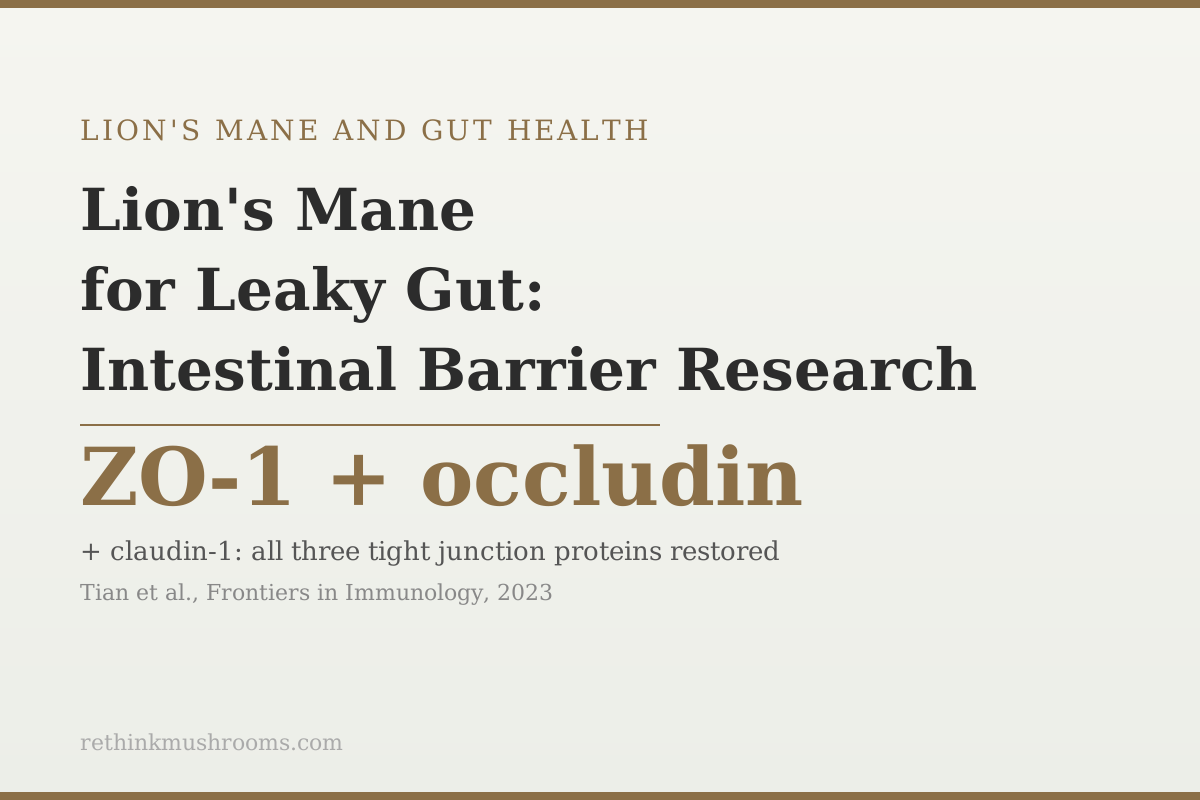
Tian and colleagues (2023) showed that H. erinaceus polysaccharides restored all three primary tight junction proteins in immunocompromised mice with intestinal barrier damage. Claudin-1, occludin, and ZO-1 are the molecular components that physically maintain intestinal barrier integrity. This is the mechanistic evidence for lion's mane's effect on leaky gut.
Tian et al., Frontiers in Immunology, 2023
Cynomolgus monkeys
Ren et al. (2023) confirmed intestinal barrier protection in a primate ulcerative colitis model, the highest-organism preclinical evidence for lion's mane gut barrier effects
Bidirectional link
intestinal barrier integrity and gut microbiota composition are mutually reinforcing; lion's mane polysaccharides improve both simultaneously (Ren 2018, Diling 2017)
n=13 human pilot
Xie et al. (2021) documented gut microbiota changes from short-term lion's mane in 13 human subjects, the only available human evidence for lion's mane gut effects
Tian et al., Frontiers in Immunology, 2023
 View as image ↗
"Leaky gut" has become one of the most heavily marketed terms in the supplement industry. The underlying biology is real: intestinal hyperpermeability, caused by degradation of tight junction proteins in the gut lining, allows bacterial products, food antigens, and inflammatory molecules to pass from the gut into the bloodstream, contributing to systemic inflammation. The marketing version inflates this into a universal cause of every health complaint.
The scientific question is specific: do lion's mane compounds restore the tight junction proteins that physically maintain intestinal barrier integrity? Tian and colleagues (2023) measured exactly this. They found that lion's mane polysaccharides restored claudin-1, occludin, and ZO-1, the three primary tight junction proteins, in mice with cyclophosphamide-induced intestinal barrier damage. This is the molecular-level evidence behind the "gut repair" claims. For the broader lion's mane overview, see what is lion's mane mushroom: a science-based overview.
Key Takeaways
- "Leaky gut" is technically intestinal hyperpermeability: degradation of claudin-1, occludin, and ZO-1 tight junction proteins that physically seal the gaps between intestinal epithelial cells
- Tian and colleagues (2023) showed H. erinaceus polysaccharides restored all three primary tight junction proteins (claudin-1, occludin, ZO-1) in cyclophosphamide-immunocompromised mice with intestinal barrier injury
- Ren and colleagues (2023) confirmed intestinal barrier protection effects in cynomolgus monkeys with ulcerative colitis, the highest-organism preclinical evidence for lion's mane gut barrier effects
- Intestinal barrier integrity and gut microbiota composition are bidirectionally linked: dysbiotic microbiota damage tight junctions; damaged tight junctions worsen dysbiosis; lion's mane polysaccharides improve both simultaneously (Diling 2017, Ren 2018)
- Xie and colleagues (2021) documented gut microbiota composition changes in 13 human subjects after short-term lion's mane consumption, providing directional human evidence consistent with the preclinical mechanistic studies
- All tight junction protein restoration evidence is preclinical; no randomized trial has specifically tested lion's mane's effects on intestinal permeability in human patients with leaky gut diagnoses
What "Leaky Gut" Actually Means: The Tight Junction Biology
The intestinal lining is a single layer of epithelial cells separated by tight junction complexes, which are multi-protein structures that physically seal the gaps between adjacent cells. When these junctions are intact, only specific molecules (nutrients, electrolytes) cross the epithelium through controlled transport processes. When tight junctions degrade, the intestinal epithelium becomes permeable to larger molecules that should not enter the bloodstream: bacterial lipopolysaccharides, partially digested food proteins, and inflammatory mediators.
Three proteins are central to tight junction integrity:
Claudin-1 is a transmembrane protein that forms the paracellular seal between cells. Its downregulation is directly associated with increased intestinal permeability.
Occludin is another transmembrane tight junction protein that works alongside claudins to maintain the barrier. Inflammatory conditions that downregulate occludin (via TNF-alpha signaling, for example) directly damage gut barrier function.
ZO-1 (zonula occludens-1) is a scaffolding protein that anchors the transmembrane proteins to the cell's internal cytoskeleton. Without adequate ZO-1, the tight junction complex loses structural integrity even if claudins and occludin are present.
Measuring these three proteins is how researchers specifically demonstrate whether a compound restores intestinal barrier integrity, as opposed to making general "helps the gut" observations.
The Tian 2023 Tight Junction Data: The Specific Mechanistic Evidence
Tian and colleagues (2023) designed their study to specifically test whether lion's mane polysaccharides could restore intestinal barrier integrity in mice with chemotherapy-induced immunocompromise.[1]
Cyclophosphamide is an immunosuppressive drug that damages the intestinal epithelium, causing increased permeability and disrupting gut immune function. This creates a model of intestinal barrier injury that is clinically relevant: cancer patients undergoing chemotherapy commonly experience gut barrier damage and its downstream consequences.
The polysaccharide treatment produced restoration of all three key tight junction proteins. Claudin-1, occludin, and ZO-1 expression levels in the intestinal epithelium were significantly higher in polysaccharide-treated animals than in untreated cyclophosphamide controls. Intestinal histology showed improved mucosal structure alongside the protein-level changes.
This is the specific molecular evidence that distinguishes lion's mane's gut effects from generic claims. The study did not just measure whether mice felt better. It measured the proteins that form the physical barrier, showing their restoration at the protein expression level. This is as mechanistically direct as preclinical evidence gets.
The Primate Model: Ren 2023
Ren and colleagues (2023) tested H. erinaceus mycelium-derived polysaccharide in cynomolgus monkeys with ulcerative colitis, a model that is physiologically closer to human IBD than any mouse model.[2]
The primate model confirmed intestinal barrier protection effects consistent with the mouse data. Colitis severity was reduced, gut microbiota composition shifted toward healthier profiles, and markers of intestinal integrity improved in polysaccharide-treated animals.
Primate data is not common in preclinical lion's mane research. Most studies use rodent models. The fact that Ren 2023 used cynomolgus monkeys, and found consistent results, strengthens the case that the barrier protection effects will translate to human physiology more than mouse-only data can establish.
How Microbiota and Barrier Integrity Are Linked
The gut microbiome and intestinal barrier integrity are not independent systems. They co-regulate each other through multiple mechanisms:
Beneficial bacteria produce short-chain fatty acids (like butyrate) that directly support tight junction protein expression. When beneficial bacteria are depleted and pathogenic bacteria overgrow, butyrate production falls, tight junction proteins degrade, and the barrier becomes more permeable.
Increased intestinal permeability in turn creates conditions that further favor pathogenic bacteria: when bacterial products like LPS enter the bloodstream, systemic inflammatory responses feed back into the gut and further damage the mucosal environment.
Lion's mane polysaccharides appear to interrupt this cycle at multiple points. Diling and colleagues (2017) showed that lion's mane extracts relieve IBD by simultaneously regulating immunity and reshaping gut microbiota.[3] Ren and colleagues (2018) showed polysaccharide treatment in a mouse colitis model reduced inflammation through NF-kB pathway inhibition while also improving microbiome composition.[4]
The mechanism makes biological sense: polysaccharides from lion's mane function as prebiotics (selectively feeding beneficial bacteria) while simultaneously providing the direct tight junction restoration demonstrated by Tian 2023. The two effects reinforce each other.
The Human Evidence: Xie 2021 Pilot Study
Xie and colleagues (2021) conducted a pilot study measuring the effects of short-term lion's mane consumption in 13 human subjects, tracking serum biochemical markers and gut microbiota composition before and after the intervention.[5]
Thirteen participants without a control group is the smallest and least rigorous form of evidence. It cannot establish efficacy, control for placebo effects, or generate reliable effect size estimates. What it can do is document whether the gut microbiota changes seen in animal models appear in humans after short-term consumption.
The study found measurable gut microbiota composition changes that were directionally consistent with the animal studies: shifts toward healthier microbial profiles. The pilot data does not confirm therapeutic benefit for leaky gut or IBD. It provides the first human data point showing that lion's mane consumption can reach the gut microbiome and produce measurable changes there, consistent with its polysaccharide mechanism.
Gravina 2023: Clinical Context for GI Applications
Gravina and colleagues (2023) published a comprehensive review of H. erinaceus in gastrointestinal diseases in the World Journal of Gastroenterology, documenting the centuries of GI application alongside the modern preclinical evidence base.[6]
The clinical review provides the framing that connects isolated preclinical studies to the broader picture. Lion's mane's GI effects are not a recent discovery; they are the modern molecular characterization of effects that traditional medicine practitioners observed empirically over centuries. The tight junction data, the colitis models, and the microbiome studies provide the mechanistic explanation for why traditional GI applications produced the effects practitioners observed.
Marketing Claims vs. What the Evidence Shows
The honest evidence summary for lion's mane and leaky gut:
What is supported: Lion's mane polysaccharides restore tight junction proteins (claudin-1, occludin, ZO-1) in a mouse model of intestinal barrier injury (Tian 2023). This has been confirmed directionally in a primate colitis model (Ren 2023). Gut microbiota changes consistent with barrier support have been observed in animal models (multiple studies) and in a small human pilot (Xie 2021).
What is not supported: No randomized controlled trial has tested lion's mane specifically in human patients with diagnosed intestinal hyperpermeability. "Leaky gut" as a clinical diagnosis covers a range of conditions with different severities and causes; the animal model evidence does not automatically map onto any specific human condition.
The honest guidance: The molecular evidence is specific and mechanistically credible. The clinical translation is not yet established. Someone with diagnosed IBD, intestinal hyperpermeability, or chemotherapy-induced gut damage has a legitimate mechanistic reason to be interested in lion's mane polysaccharides. The claim that it will specifically resolve their condition is unsupported by clinical trial evidence.
The Bottom Line
"Leaky gut" is intestinal hyperpermeability caused by degradation of claudin-1, occludin, and ZO-1 tight junction proteins. Tian 2023 showed H. erinaceus polysaccharides restore all three proteins in cyclophosphamide-immunocompromised mice, providing the mechanistically specific evidence for intestinal barrier repair. Ren 2023 confirmed barrier protection in cynomolgus monkeys. Diling 2017 and Ren 2018 established that polysaccharides simultaneously improve gut microbiota and reduce colonic inflammation in mouse IBD models, through interconnected mechanisms. Xie 2021 provided directional human pilot data. No randomized clinical trial has tested lion's mane specifically in human intestinal permeability.
Frequently Asked Questions
Sources & References
- 1. Source details for this reference are not yet available.
- 2. Source details for this reference are not yet available.
- 3. Source details for this reference are not yet available.
- 4. Source details for this reference are not yet available.
- 5. Source details for this reference are not yet available.
- 6. Source details for this reference are not yet available.