Lion's Mane (Hericium erinaceus)
1985 — the year of the only double-blind human trial of Hericium erinaceus in chronic atrophic gastritis, a two-page preliminary report whose numerical results are not retrievable from the indexed record (Xu 1985)
Lion's mane is one of the few medicinal mushrooms with a documented traditional indication for a specific stomach condition, and one of the few with any human trial at all. But that trial is nearly forty years old and reports no usable numbers, and everything published since has been cell culture and animal work.
Xu et al., Chinese Medical Journal, 1985; Gravina et al., World Journal of Gastroenterology, 2023
TCM record
Hericium erinaceus is used in traditional Chinese medicine for chronic superficial gastritis and for symptoms related to gastric ulcers, as noted in the pharmacology literature (Shang 2013, Liu 2016)
~1 log
reduction in H. pylori stomach colonisation in mice given lion's mane ethanolic extract, alongside blocked adhesion and suppressed interleukin-8 in gastric epithelial cells (Wang 2019)
no modern RCT
no randomized controlled trial since 1985 has tested lion's mane for gastritis; every quantified finding available today is preclinical
Xu et al., Chinese Medical Journal, 1985; Gravina et al., World Journal of Gastroenterology, 2023
 View as image ↗
Gastritis is inflammation of the stomach lining, and it is common enough that most people will experience some form of it. It ranges from mild acute irritation after alcohol or NSAID use to chronic conditions including chronic superficial gastritis and the more serious chronic atrophic gastritis, in which the stomach lining progressively loses its acid-producing glands.
Traditional Chinese medicine recognised Hericium erinaceus as a treatment for stomach complaints centuries before any laboratory analysis. What separates this from generic "good for digestion" marketing is the specificity of the traditional claim: the pharmacology literature records its use for chronic superficial gastritis in particular, and for symptoms related to gastric ulcers.
The evidence picture is unusual, and it is frequently described incorrectly in both directions. It is not true that no human has ever been studied — a double-blind trial was published in 1985. It is also not true that lion's mane has been shown to treat gastritis in people: that 1985 trial is a two-page preliminary report with no retrievable results, and nothing since has tested it in patients.
For the broader overview of lion's mane research, see What Is Lion's Mane Mushroom? A Science-Based Overview. For the full scope of lion's mane gut health evidence, see Lion's Mane for Gut Health: Gastroprotective Effects and Research.
Key Takeaways
- A double-blind clinical trial of Hericium erinaceus therapy in chronic atrophic gastritis was published by Xu and colleagues in Chinese Medical Journal in 1985 and is indexed under gastritis drug therapy in humans — but it is a two-page preliminary report, no abstract or effect size is retrievable from the indexed record, and it has never been replicated
- Gravina and colleagues (World Journal of Gastroenterology, 2023), a group of Italian gastroenterologists, reviewed the evidence for Hericium erinaceus in gastrointestinal disease and concluded that studies point to therapeutic potential in gastritis and inflammatory bowel disease, with some components showing antineoplastic capability against gastric and colorectal cancer
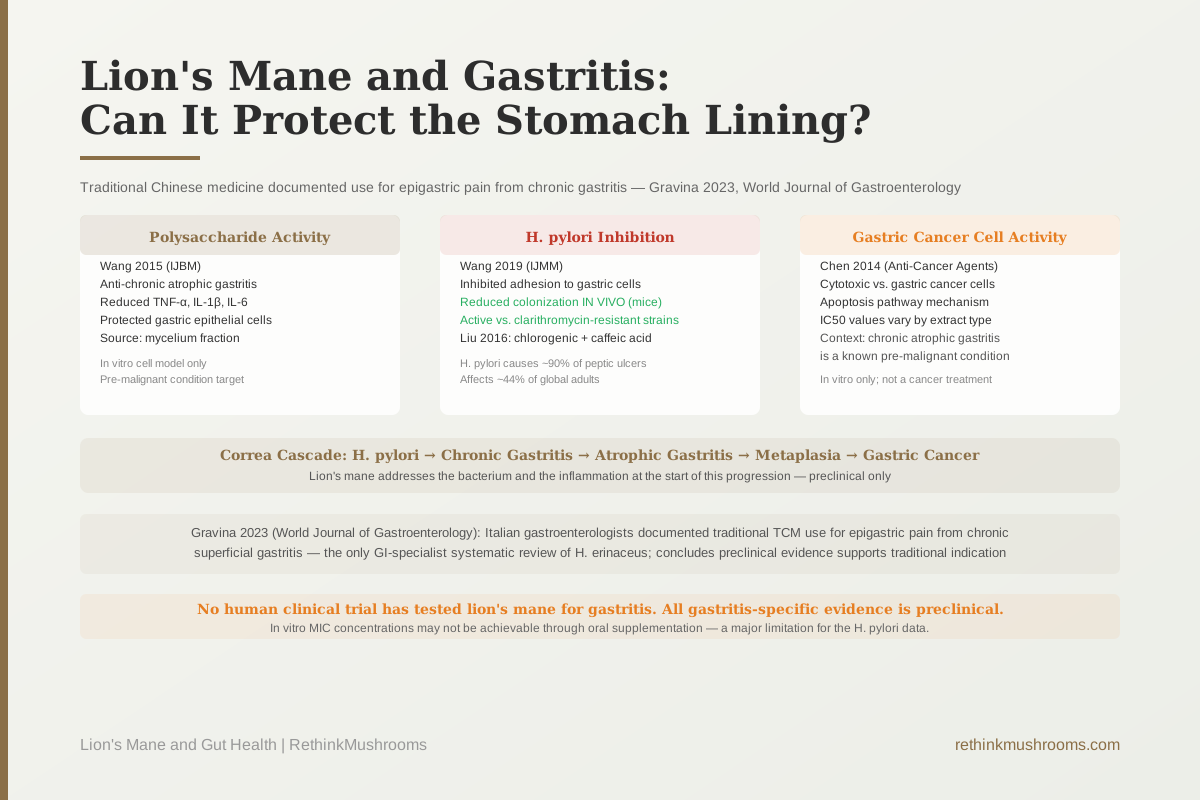
- Wang and colleagues (International Journal of Biological Macromolecules, 2015) isolated EP-1, a roughly 3.1 kDa heteroglycan, from cultured H. erinaceus mycelium; it inhibited the growth of MNNG-transformed human gastric epithelial cells used as a chronic atrophic gastritis model and induced cell-cycle arrest
- Wang and colleagues (International Journal of Medicinal Mushrooms, 2019) found lion's mane ethanolic extract inhibited six H. pylori strains at a minimum inhibitory concentration of about 2 mg/mL, blocked bacterial adhesion to human gastric epithelial cells at non-toxic concentrations, suppressed H. pylori-driven interleukin-8 and oxidative DNA damage in those cells, and lowered stomach colonisation in mice by about 1 log
- Liu and colleagues (Journal of Ethnopharmacology, 2016) isolated the two compounds chiefly responsible for anti-H. pylori activity from petroleum ether fractions: 1-(5-chloro-2-hydroxyphenyl)-3-methyl-1-butanone and 2,5-bis(methoxycarbonyl)terephthalic acid, with MICs as low as 6.25 µg/mL
- Li and colleagues (Journal of Ethnopharmacology, 2014) showed H. erinaceus culture-broth extracts were cytotoxic to gastric cancer cells and inhibited tumour growth in xenograft mice more effectively and less toxically than 5-fluorouracil, a finding relevant because chronic atrophic gastritis is a recognised precancerous condition
- No modern randomized controlled trial has tested lion's mane for gastritis or stomach ulcers; apart from the 1985 report, all gastritis-specific evidence is from cell culture and animal models
What Gastritis Does to the Stomach Lining
The stomach lining is a dynamic tissue under constant chemical stress. Every meal requires the stomach to secrete hydrochloric acid and pepsin, and the lining must protect itself from its own digestive chemistry. The mucus layer and the tight junctions between gastric epithelial cells are the primary defences.
Gastritis occurs when this protection fails or is overwhelmed. The most common causes are Helicobacter pylori infection, NSAID use, alcohol, and autoimmune conditions. When gastric epithelial cells are damaged, the immune system responds with inflammation, and signalling molecules such as interleukin-8 recruit further immune cells into the mucosa.
In acute cases, the lining heals once the irritant is removed. In chronic cases, the inflammation persists. Chronic superficial gastritis affects the surface layers but leaves the deeper acid-producing glands intact. Chronic atrophic gastritis is more serious: it progressively destroys the glands that produce stomach acid and intrinsic factor. That destruction carries two downstream consequences — impaired digestion and nutrient absorption, and, in H. pylori-associated cases, an increased risk of gastric cancer.
Understanding this progression matters for evaluating the lion's mane research, because that research is not testing "stomach comfort" in a vague sense. Its targets are specific: the inflammation that drives chronic gastritis, the bacterium that causes most of it, and the transformed cells that appear at the end of the process.
The Traditional Record and the Gastroenterology Review
A 2023 review by Gravina and colleagues in the World Journal of Gastroenterology stands apart from the general mushroom health literature.[1] It was written by Italian gastroenterologists at the University of Campania and published in a GI-specific journal, which gives it a different kind of clinical credibility than reviews appearing in general nutrition or alternative medicine publications.
The review sets out to analyse the available evidence on the digestive therapeutic potential of Hericium erinaceus and the molecular mechanisms that might underlie it. Its assessment is that several studies highlight therapeutic potential for gastrointestinal disorders such as gastritis and inflammatory bowel disease, and that some components of the mushroom appear to possess strong antineoplastic capabilities against gastric and colorectal cancer.
It is worth being precise about what this review is. It is indexed as a review, not a systematic review, and it does not report pooled effect estimates. It is a specialist synthesis of a preclinical literature, and its value is that gastroenterologists looked at that literature and judged it worth taking seriously — not that it demonstrates clinical efficacy.
The specific traditional indication is documented more directly in the pharmacology literature. Shang and colleagues open their 2013 study by noting that H. erinaceus "is used extensively in traditional Chinese medicine to treat chronic superficial gastritis," while observing that the underlying pharmaceutical mechanism was not yet understood.[2] Liu and colleagues similarly record its use in Chinese traditional medicine for symptoms related to gastric ulcers. These are documented historical indications with a specific condition attached, which is what makes them testable rather than decorative.
The One Human Trial, and Why It Settles Less Than It Sounds
Most writing on this topic asserts that no human trial of lion's mane for gastritis exists. That is incorrect, and the correction matters — though not in the direction supplement marketing would prefer.
In 1985, Xu and colleagues published "A double-blind study of effectiveness of hericium erinaceus pers therapy on chronic atrophic gastritis. A preliminary report" in Chinese Medical Journal.[3] It is indexed as a clinical trial, carries the double-blind method descriptor, and is catalogued under gastritis and atrophic gastritis drug therapy in adult, middle-aged, male and female human subjects.
Xu, Liu, Liu, Chen, Liao, Xu, Jiang, Wang, Lu (1985) · Chinese Medical Journal
- Population
- Adult and middle-aged men and women with chronic atrophic gastritis
- Intervention
- Hericium erinaceus preparation, administered double-blind
- Comparator
- Blinded control
- Finding
- Indexed as a double-blind clinical trial of plant extract therapy for chronic atrophic gastritis. The paper is a two-page preliminary report; no abstract is available in the indexed record, and sample size, effect size and outcome measures cannot be retrieved from it.
preliminary A trial existing is not the same as a trial reporting a usable result. Nearly forty years on, it has not been replicated, extended, or superseded by any modern randomized controlled trial.
Xu CP et al., Chin Med J (Engl). 1985;98(6):455-6. PMID 3932005
This single citation does more work than it first appears to, in both directions. It establishes that the traditional indication was considered serious enough to be tested formally, in a controlled design, in the country where the traditional use originated. It also demonstrates how thin the human evidence remains: a two-page preliminary report from 1985, with no retrievable numbers, is the entire human clinical record for this condition.
What the Polysaccharide Actually Did
The most direct laboratory evidence on gastritis itself comes from Wang and colleagues, published in the International Journal of Biological Macromolecules in 2015.[4]
The researchers screened cultured Hericium erinaceus mycelium and isolated a polysaccharide they named EP-1, purifying it through ethanol precipitation, hollow-fibre ultrafiltration and ion-exchange chromatography. EP-1 has a molecular weight of approximately 3,100 Da and is a heteroglycan built from glucose, mannose and galactose, with a backbone of α-D-Glc(1→3) and β-D-Glc(1→3).
They then tested it against a chronic atrophic gastritis cell model. The model uses MC cells: human gastric mucosa epithelial (GES-1) cells transformed with MNNG, a chemical carcinogen, to reproduce the cellular changes of chronic atrophic gastritis. The findings were that EP-1 significantly inhibited the growth of these MC cells and interfered with them by inducing cell-cycle arrest.
That result is worth reading carefully, because it is routinely described inaccurately. EP-1 was not shown to shield healthy epithelial cells from damage, and no inflammatory cytokines were measured in this study. What it did was suppress the proliferation of transformed cells in a model of the atrophic, precancerous state — an anti-proliferative effect on abnormal cells, not a demonstration of mucosal protection.
Chronic atrophic gastritis matters beyond stomach discomfort: it is classified as a precancerous condition, so an agent that restrains the growth of transformed gastric epithelial cells is mechanistically interesting. Whether the concentrations used in these wells bear any relationship to what oral supplementation delivers to the stomach lining has not been tested.
H. pylori: The Bacterium Behind Most Chronic Gastritis
Helicobacter pylori is a gram-negative bacterium that colonises the gastric mucosa. Hooi and colleagues' 2017 systematic review and meta-analysis in Gastroenterology, pooling 184 studies across 62 countries, estimated that approximately 4.4 billion people worldwide carried the infection in 2015, with regional pooled prevalence ranging from 24.4% in Oceania to 70.1% in Africa. H. pylori is responsible for the large majority of chronic gastritis cases, is the principal cause of peptic ulcers, and is classified by the International Agency for Research on Cancer as a Group 1 carcinogen for gastric cancer.
Any compound that suppresses H. pylori is, by mechanism, a candidate gastroprotective agent for the most common form of chronic gastritis. This is where most of the lion's mane gastric research has concentrated.
Wang and colleagues published the most complete account in the International Journal of Medicinal Mushrooms in 2019.[5]
Wang, Zhang, Maier, Zhang, Maier (2019) · International Journal of Medicinal Mushrooms
- Population
- Six H. pylori strains, AGS human gastric epithelial cells, and C57BL mice
- Intervention
- Ethanol-based Hericium erinaceus extract
- Comparator
- Untreated controls; E. coli as a selectivity check
- Finding
- Minimum inhibitory concentration of about 2 mg/mL across all six strains, with H. pylori survival in PBS falling by 3 logs at that concentration. The extract blocked adhesion to AGS cells even at concentrations that harmed neither the bacterium nor the cells. H. pylori-driven interleukin-8 fell significantly (P < 0.01), returning to near-background at 1.0 mg/mL, and the 3-fold rise in host 8-oxo-guanine, a marker of oxidative DNA damage, was abolished at 2 mg/mL. Treated mice carried a mean stomach load of 6 × 10⁴ CFU/g, about 1 log below controls.
narrow-scope Genuinely multi-layered preclinical evidence — antibacterial, anti-adhesion, anti-inflammatory and DNA-protective — but the highest reach is a mouse colonisation model. No human eradication data exists.
Wang G et al., Int J Med Mushrooms. 2019;21(1):1-11. PMID 30806251
Three details deserve emphasis. First, adhesion was blocked at concentrations that affected neither bacterial nor host cell viability, meaning the effect is not simply the extract being toxic to everything — and adhesion is the first step in colonisation, since the bacterium must bind the lining before it can establish infection. Second, the interleukin-8 result is the clearest evidence in the whole literature that lion's mane damps the inflammatory response in gastric tissue; it belongs to this study, not to the polysaccharide work. Third, the 8-oxo-guanine finding speaks directly to the article's title question: H. pylori infection tripled oxidative DNA damage in host cells, and the extract abolished that increase.
It is equally important to note what is absent. This study tested six H. pylori strains and reports no data on antibiotic-resistant isolates. Claims that lion's mane works against clarithromycin-resistant H. pylori do not come from this paper, and we could not locate a primary source supporting them.
Potency by Preparation · Lower Is Stronger
What It Takes to Inhibit H. pylori in a Dish
Minimum inhibitory concentration is the lowest extract concentration that stops bacterial growth in culture. Every bar below is a published MIC for a lion’s mane preparation against H. pylori. Note the scale is logarithmic: the most purified compound is roughly 300-fold more potent by weight than the crude extract, which means a potency figure is only meaningful alongside the preparation it came from.
Ethanol extracts, 12 of 14 mushroom species
< 3 mg/mLScreen of 14 species against 2 laboratory strains and 9 clinical isolates
Crude ethanolic extract, H. erinaceus
~2 mg/mLSimilar inhibition across all 6 H. pylori strains tested; 3-log survival drop in PBS at this concentration
Ethyl acetate fraction, H. erinaceus
62.5 - 250 ug/mL9 clinical isolates; IC50 73.0 and minimum bactericidal concentration 200 ug/mL against ATCC 43504
Bi3+ - polysaccharide complex (BiHEP)
20 ug/mLComparable inhibition to colloidal bismuth subcitrate, the standard clinical bismuth preparation, at lower bismuth content
1-(5-chloro-2-hydroxyphenyl)-3-methyl-1-butanone
12.5 - 50 ug/mLIsolated from the petroleum ether fraction; weak cytotoxicity against K562 cells
2,5-bis(methoxycarbonyl)terephthalic acid
6.25 - 25 ug/mLMost potent isolate reported; identified by 1H and 13C NMR from the same fraction
These are concentrations achieved in culture wells and, in one case, an agar dilution assay — not doses delivered to a human stomach. No study has established what concentration an oral lion’s mane supplement produces at the gastric mucosa, which is the gap between every bar on this chart and a clinical effect.
Source: Shang et al. (2013), Int J Med Mushrooms; Zhu et al. (2014), Carbohydr Polym; Liu et al. (2016), J Ethnopharmacol; Wang et al. (2019), Int J Med Mushrooms
Which Compounds Do the Work
Knowing that lion's mane inhibits H. pylori is useful. Knowing which molecules are responsible is more useful, because it determines which preparations could plausibly carry the activity.
Liu and colleagues addressed this directly in the Journal of Ethnopharmacology in 2016, explicitly framing the work as an attempt to verify the traditional indication.[6] They concentrated an ethanol extract of H. erinaceus fruiting bodies on macroporous resin, then partitioned it with petroleum ether and chloroform and separated fractions on a silica gel column.
The activity tracked to the petroleum ether fraction. From it they isolated and identified, by ¹H and ¹³C NMR, two pure compounds as the main components responsible for anti-H. pylori activity: 1-(5-chloro-2-hydroxyphenyl)-3-methyl-1-butanone, with an MIC of 12.5–50 µg/mL, and 2,5-bis(methoxycarbonyl)terephthalic acid, with an MIC of 6.25–25 µg/mL. Both showed only weak cytotoxicity against the K562 human cell line.
This is a different picture from the one usually presented. The active molecules are small aromatic compounds recovered in a non-polar solvent fraction, not the phenolic acids commonly named in popular summaries, and the study's conclusion identifies two specific isolates rather than a diffuse synergy among many compounds.
Shang and colleagues' earlier screen supports the same conclusion from another angle.[2] Testing extracts of 14 mushroom species against two laboratory H. pylori strains and nine clinical isolates, they found ethanol extracts of 12 species inhibited growth at under 3 mg/mL, while the ethyl acetate fraction of H. erinaceus reached MICs of 62.5–250 µg/mL against the clinical isolates, with a half-maximal inhibitory concentration of 73.0 µg/mL and a minimum bactericidal concentration of 200 µg/mL against ATCC 43504. Notably, H. erinaceus extract inhibited H. pylori and Staphylococcus aureus but had no effect on two E. coli strains, indicating selectivity rather than generalised antibacterial toxicity.
A fourth line of work is more translational than it first appears. Zhu and colleagues prepared complexes of H. erinaceus polysaccharides with bismuth, producing an MIC of 20 µg/mL against H. pylori — comparable to colloidal bismuth subcitrate, the bismuth preparation used clinically, but at lower bismuth content.[7] They also confirmed that the polysaccharides on their own had definite inhibitory effects. Since bismuth is a real component of H. pylori eradication regimens, a bismuth-sparing complex is a more concrete development path than most mushroom research offers.
Three Compound Classes · Three Different Targets
“Lion’s Mane” Is Not One Agent in the Stomach
The gastric research does not describe a single substance doing a single thing. Three chemically unrelated groups of molecules produced the three findings — and they come from different parts of the mushroom, survive different extractions, and act on different targets. A product carrying one class does not necessarily carry the others.
Polysaccharide
EP-1 — ~3.1 kDa heteroglycan of glucose, mannose and galactose
From
Cultured mycelium
Target
Chronic atrophic gastritis cell model
Captured by
Ethanol precipitation, ultrafiltration, ion exchange
Inhibited growth of MC cells — human gastric epithelial GES-1 cells transformed with MNNG to model chronic atrophic gastritis — and induced cell-cycle arrest.
Small aromatic compounds
1-(5-chloro-2-hydroxyphenyl)-3-methyl-1-butanone and 2,5-bis(methoxycarbonyl)terephthalic acid
From
Fruiting body
Target
Helicobacter pylori
Captured by
Petroleum ether and ethyl acetate fractions of an ethanol extract
Direct, concentration-dependent growth inhibition of laboratory strains and clinical isolates. A bismuth-polysaccharide complex matched standard clinical bismuth at lower bismuth content.
Erinacine diterpenoids
Erinacine A and erinacine S
From
Cultured mycelium
Target
Gastric cancer cell lines
Captured by
Ethanol extract, chromatographic isolation
Erinacine A reduced viability and invasiveness of TSGH 9201 cells with increased ROS. Erinacine S induced apoptosis in cancer but not normal cells and slowed tumour growth in xenograft mice.
None of the three classes has been tested in a modern human trial for gastritis. The practical consequence is that a supplement standardised to beta-glucan content carries no information about its erinacine or aromatic-compound content, and vice versa.
Source: Shang et al. (2013); Zhu et al. (2014); Wang et al. (2015); Liu et al. (2016); Kuo et al. (2017); Tung et al. (2021)
The practical implication is not that one extract type is best. It is that the gastric findings come from chemically unrelated fractions — a water-soluble mycelial polysaccharide, non-polar small aromatics from the fruiting body, and mycelial diterpenoids — so no single product specification captures all of them, and a supplement standardised on beta-glucan content tells you nothing about the compounds that produced the H. pylori data.
The Gastric Cancer Connection
One downstream consequence of untreated chronic gastritis, particularly H. pylori-associated atrophic gastritis, is gastric cancer. The progression is well characterised as the Correa cascade: chronic H. pylori infection leads to chronic active gastritis, then atrophic gastritis, then intestinal metaplasia, then dysplasia, and finally gastric cancer in a subset of patients.
Li and colleagues published the most substantial study here in the Journal of Ethnopharmacology in 2014.[8] Working with two extracts from H. erinaceus culture broth, HTJ5 and HTJ5A, they identified 22 compounds and tested the extracts against liver, colon and gastric cancer cell lines. Against gastric cancer NCI-87 cells the IC50 values were 5.00 ± 0.22 and 4.50 ± 0.14 mg/mL. The work then went further than cell culture: in SCID mice bearing tumour xenografts, oral HTJ5 and HTJ5A at 500 and 1000 mg/kg/day showed significant antitumour efficacy across all four models without host toxicity, and were more effective and less toxic than 5-fluorouracil at its maximum tolerated dose.
This study is frequently miscited — attributed to "Chen" and to Anti-Cancer Agents in Medicinal Chemistry. It is Li and colleagues, in the Journal of Ethnopharmacology, and its in vivo component is routinely omitted.
Two later studies identified specific compounds and mechanisms. Kuo and colleagues showed that erinacine A, isolated from the ethanol extract of H. erinaceus mycelium, reduced viability and invasiveness of TSGH 9201 gastric cancer cells with increased reactive oxygen species, and used proteomic analysis to identify the differentially expressed proteins involved.[9] Tung and colleagues found that erinacine S induced apoptosis with increased ROS in gastric cancer cells but not in normal cells, inhibited tumour growth in a xenograft mouse model, raised FasL and TRAIL protein levels while lowering PCNA and cyclin D1, and acted through epigenetic histone H3 methylation.[10]
The apoptosis evidence that is often attached to the 2014 study properly belongs to these two: they, not Li and colleagues, demonstrated programmed cell death, and Tung's finding that normal cells were spared is the more meaningful detail.
There is also one piece of human data in this vicinity, though it is not about lion's mane. Ba and colleagues pooled 3,900 gastric cancer cases and 7,792 controls from 11 studies in the Stomach Cancer Pooling Project and found that higher mushroom consumption was associated with lower gastric cancer risk, with a relative risk of 0.82 (95% CI 0.71–0.95) comparing highest to lowest intake.[11] This is observational, concerns mushroom consumption in general rather than Hericium erinaceus, and cannot establish causation — but it is the only human dataset connecting mushrooms to this endpoint.
None of this supports a claim that lion's mane treats or prevents gastric cancer. Xenograft models are a long way from clinical oncology, and many compounds that kill cancer cells in a dish never become useful therapies. The findings are relevant in the gastritis context for a narrower reason: the same mushroom that acts on chronic atrophic gastritis models also acts on the cells that appear at the end of that progression, which makes the mechanisms worth continued study rather than worth acting on.
What the Evidence Does and Doesn't Say
Claim by Claim · How Far the Evidence Actually Reaches
Six Claims, Six Different Evidence Levels
These claims are often repeated together as though they rested on the same footing. They do not. Each row shows the strongest evidence that exists for that specific claim, and what stops it from going further.
“Lion’s mane has been used for stomach complaints for centuries”
Historical recordDocumented traditional Chinese medicine use for chronic superficial gastritis and for symptoms related to gastric ulcers, noted in the pharmacology literature and reviewed by gastroenterologists.
Limit: A record of use is not evidence of effect.
Refs 1, 2“It improves chronic atrophic gastritis in patients”
Human, but unquantifiableOne double-blind clinical trial in adults, indexed under gastritis drug therapy, published 1985 in Chinese Medical Journal.
Limit: A two-page preliminary report. No abstract, sample size or effect size is retrievable from the indexed record, and it has never been replicated.
Ref 3“It acts on the biology of chronic atrophic gastritis”
Cell cultureA mycelial polysaccharide inhibited growth of MNNG-transformed human gastric epithelial cells used as a chronic atrophic gastritis model, and induced cell-cycle arrest.
Limit: One cell model, no animal or human confirmation, and the effect is anti-proliferative rather than a demonstration of mucosal protection.
Ref 4“It suppresses H. pylori, the cause of most chronic gastritis”
AnimalGrowth inhibition of laboratory strains and clinical isolates, blocked adhesion to gastric epithelial cells, suppressed interleukin-8 and oxidative DNA damage in those cells, and about a 1-log lower stomach colonisation in mice.
Limit: Highest reach is a mouse colonisation model. No human eradication data of any kind.
Refs 2, 5, 6, 7“It has activity against gastric cancer cells”
AnimalConcentration-dependent cytotoxicity against gastric cancer lines, tumour growth inhibition in xenograft mice, and apoptosis induction that spared normal cells.
Limit: Xenograft models are a long way from treating or preventing cancer in people, and this is a downstream endpoint, not gastritis.
Refs 8, 9, 10“Eating mushrooms lowers gastric cancer risk”
Human, but not lion’s manePooled analysis of 3,900 gastric cancer cases and 7,792 controls across 11 studies: relative risk 0.82 (95% CI 0.71-0.95) for highest versus lowest mushroom consumption.
Limit: Observational, about mushroom consumption in general, not lion’s mane, and cannot establish causation.
Ref 11Nothing in this table reaches the level that would justify using lion’s mane in place of gastritis treatment. The single human trial is nearly forty years old and reports no retrievable numbers; everything with usable data is preclinical.
Source: Xu et al. (1985); Shang et al. (2013); Zhu et al. (2014); Li et al. (2014); Wang et al. (2015); Liu et al. (2016); Kuo et al. (2017); Wang et al. (2019); Tung et al. (2021); Ba et al. (2023); Gravina et al. (2023)
What the research establishes:
- A double-blind human trial of H. erinaceus in chronic atrophic gastritis was conducted and published in 1985, but reports no retrievable numerical results (Xu 1985)
- H. erinaceus has a documented traditional indication for chronic superficial gastritis and for gastric ulcer symptoms, and gastroenterologists reviewing the field consider the preclinical evidence to indicate therapeutic potential in gastritis (Shang 2013, Gravina 2023)
- The mycelial polysaccharide EP-1 inhibited growth of MNNG-transformed gastric epithelial cells in a chronic atrophic gastritis cell model and induced cell-cycle arrest (Wang 2015)
- Ethanolic extract inhibited six H. pylori strains at about 2 mg/mL, blocked adhesion at non-toxic concentrations, suppressed interleukin-8 and oxidative DNA damage in gastric epithelial cells, and reduced mouse stomach colonisation by roughly 1 log (Wang 2019)
- Two small aromatic compounds from the petroleum ether fraction are the main anti-H. pylori actives, with MICs as low as 6.25 µg/mL, and activity is selective for H. pylori over E. coli (Liu 2016, Shang 2013)
- Bismuth-polysaccharide complexes matched clinical bismuth potency at lower bismuth content (Zhu 2014)
- Culture-broth extracts and the erinacine diterpenoids showed cytotoxicity, apoptosis induction and xenograft tumour suppression in gastric cancer models (Li 2014, Kuo 2017, Tung 2021)
What the evidence does not establish:
- That lion's mane supplementation treats, prevents or improves clinical gastritis outcomes in humans — the 1985 trial cannot support this, and nothing since has tested it
- That lion's mane eradicates or reduces H. pylori in people, at any dose
- That any of the in vitro concentrations are achievable at the gastric mucosa through oral supplementation
- That lion's mane is active against antibiotic-resistant H. pylori; this frequently repeated claim has no primary source we could identify
- Any effect on the clinical symptoms of gastritis — epigastric pain, bloating, nausea — in controlled human studies
- Any comparison with standard care, whether proton pump inhibitors or H. pylori eradication regimens
Clinical context
ModerateGastritis and H. pylori require medical diagnosis and treatment
Concern
Chronic atrophic gastritis is a precancerous condition, and untreated H. pylori infection raises gastric cancer risk. Substituting a supplement for eradication therapy, or self-treating persistent stomach symptoms, allows a treatable and monitorable condition to progress. Persistent epigastric pain, vomiting, black stools or unexplained weight loss are indications for prompt medical assessment, not for supplementation.
What the research says
H. pylori is diagnosed with established tests and eliminated with proven antibiotic regimens, and atrophic gastritis is followed with endoscopic surveillance. No lion's mane preparation has been shown to do either. Nothing in this research base supports delaying or replacing that care.
Particularly relevant for: Anyone with diagnosed or suspected gastritis, peptic ulcer disease, or H. pylori infection
What to do
Discuss any mushroom supplement with the clinician managing your gastrointestinal care, particularly alongside eradication therapy or acid-suppressing medication.
This article is educational and is not medical advice. Evidence base: Xu 1985; Gravina 2023; Wang 2019
- Cell studiescompleted
Chronic atrophic gastritis cell model, H. pylori cultures and clinical isolates, gastric cancer lines (Wang 2015; Shang 2013; Liu 2016; Zhu 2014; Li 2014; Kuo 2017)
- Animal studiescompleted
Mouse H. pylori colonisation and gastric cancer xenograft models (Wang 2019; Li 2014; Tung 2021)
- Case reportsmissing
No published case reports of lion's mane use in gastritis
- Small human trialcurrent
One double-blind trial in chronic atrophic gastritis, 1985, published as a two-page preliminary report with no retrievable results (Xu 1985)
- Large RCTmissing
No randomized controlled trial has tested lion's mane for gastritis in the modern literature
- Meta-analysismissing
No trials exist to pool. The only meta-analytic human data concerns mushroom consumption and gastric cancer risk generally (Ba 2023)
The evidence stalled in an unusual place. Cell and animal work is comparatively deep and mechanistically specific, and a human trial does exist — but it is from 1985, reports nothing usable, and no one has repeated it. The ladder has a rung occupied near the top and a gap immediately beneath it.
Xu 1985; Shang 2013; Zhu 2014; Li 2014; Wang 2015; Liu 2016; Kuo 2017; Wang 2019; Tung 2021; Ba 2023; Gravina 2023
The gap between these results and human clinical benefit is real. Lion's mane's gastric activity is mechanistically coherent, chemically identified, and supported by a traditional use record and by gastroenterologists willing to review it seriously. What is missing is the study that would make it actionable: a modern controlled trial in gastritis patients. The 1985 report shows someone once thought that trial was worth running. Nobody has run it again.
For the H. pylori evidence in detail, see Hericium erinaceus and H. pylori: Antimicrobial Properties. For the intestinal barrier and leaky gut research, see Lion's Mane and Leaky Gut: Intestinal Barrier Integrity Research. For the downstream cancer implications, see Lion's Mane and Gastric Cancer: A Traditional Use Meets Modern Research.
The Bottom Line
Lion's mane has a documented traditional Chinese medicine indication for chronic superficial gastritis and gastric ulcer symptoms, and Italian gastroenterologists reviewing the field in the World Journal of Gastroenterology concluded the preclinical evidence points to therapeutic potential in gastritis (Gravina 2023). A double-blind human trial in chronic atrophic gastritis was published in 1985, but it is a two-page preliminary report with no retrievable results and has never been replicated (Xu 1985). The quantified evidence is preclinical: a mycelial polysaccharide inhibited growth of transformed gastric epithelial cells in a chronic atrophic gastritis model (Wang 2015); ethanolic extract inhibited six H. pylori strains at about 2 mg/mL, blocked adhesion, suppressed interleukin-8 and oxidative DNA damage, and cut mouse colonisation by roughly 1 log (Wang 2019); two small aromatic compounds were identified as the main antibacterial actives at MICs as low as 6.25 µg/mL (Liu 2016, Shang 2013); and culture-broth extracts plus the erinacines suppressed gastric cancer cells and xenograft tumours (Li 2014, Kuo 2017, Tung 2021). No modern randomized controlled trial has tested lion's mane for gastritis, and the widely repeated claim that it works against clarithromycin-resistant H. pylori has no primary source.
Frequently Asked Questions
Sources & References
- 1RTHM-01700·Gravina, Antonietta Gerarda et al. (2023). “Hericium erinaceus, a medicinal fungus with a centuries-old history: Evidence in gastrointestinal diseases..” World journal of gastroenterology.Study breakdown →PubMed →↩
- 2RTHM-00304·Shang, Xiaodong et al. (2013). “In vitro anti-Helicobacter pylori effects of medicinal mushroom extracts, with special emphasis on the Lion's Mane mushroom, Hericium erinaceus (higher Basidiomycetes)..” International journal of medicinal mushrooms.Study breakdown →PubMed →↩
- 3RTHM-00005·Xu, C P et al. (1985). “A double-blind study of effectiveness of hericium erinaceus pers therapy on chronic atrophic gastritis. A preliminary report..” Chinese medical journal.Study breakdown →PubMed →↩
- 4RTHM-00408·Wang, Mingxing et al. (2015). “A polysaccharide from cultured mycelium of Hericium erinaceus and its anti-chronic atrophic gastritis activity..” International journal of biological macromolecules.Study breakdown →PubMed →↩
- 5RTHM-00592·Wang, Ge et al. (2019). “In Vitro and In Vivo Inhibition of Helicobacter pylori by Ethanolic Extracts of Lion's Mane Medicinal Mushroom, Hericium erinaceus (Agaricomycetes)..” International journal of medicinal mushrooms.Study breakdown →PubMed →↩
- 6RTHM-00436·Liu, Jian-Hui et al. (2016). “Anti-Helicobacter pylori activity of bioactive components isolated from Hericium erinaceus..” Journal of ethnopharmacology.Study breakdown →PubMed →↩
- 7RTHM-00363·Zhu, Yang et al. (2014). “Preparation, characterization, and anti-Helicobacter pylori activity of Bi3+-Hericium erinaceus polysaccharide complex..” Carbohydrate polymers.Study breakdown →PubMed →↩
- 8RTHM-00614·Li, Guang et al. (2014). “Anticancer potential of Hericium erinaceus extracts against human gastrointestinal cancers..” Journal of ethnopharmacology.Study breakdown →PubMed →↩
- 9RTHM-00884·Kuo, Hsing-Chun et al. (2017). “A Comparative Proteomic Analysis of Erinacine A's Inhibition of Gastric Cancer Cell Viability and Invasiveness..” Cellular physiology and biochemistry : international journal of experimental cellular physiology.Study breakdown →PubMed →↩
- 10RTHM-01448·Tung, Shui-Yi et al. (2021). “Apoptotic mechanisms of gastric cancer cells induced by isolated erinacine S through epigenetic histone H3 methylation of FasL and TRAIL..” Food & function.Study breakdown →PubMed →↩
- 11RTHM-00815·Ba, Djibril M et al. (2023). “Mushroom consumption and risk of gastric cancer: a pooled analysis within the stomach cancer pooling project and a combined meta-analysis with other observational studies..” European journal of cancer prevention : the official journal of the European Cancer Prevention Organisation (ECP).Study breakdown →PubMed →↩