Lion's Mane (Hericium erinaceus)
Spontaneous monkey UC model: Hericium polysaccharide attenuated colitis pathology and reshaped the gut microbiota (Ren 2023)
Ren and colleagues tested Hericium erinaceus mycelium-derived polysaccharide in cynomolgus monkeys with spontaneous ulcerative colitis and found attenuated UC pathology, reduced inflammation and diarrhea, improved nutritional status, enhanced intestinal function, and a reshaped gut microbiota.
Ren et al., Molecular Nutrition & Food Research, 2023
spontaneous UC
the cynomolgus monkeys in Ren 2023 developed ulcerative colitis spontaneously rather than through chemical induction, which is what makes it a closer analogue to human disease than standard rodent models
3 mechanisms
gut microbiota modulation, NF-κB inflammatory pathway suppression, and intestinal barrier maintenance, each demonstrated in animal studies
no human IBD data
no trial has tested lion's mane in people with IBD; the only human study is a 13-person, 7-day pilot in healthy adults that measured microbiota and blood chemistry
Ren et al., Molecular Nutrition & Food Research, 2023
 View as image ↗
The title of this article says what most supplement content will not: the lion's mane evidence for inflammatory bowel disease is preclinical. It comes from rodent and primate models, plus a single 13-person pilot study in healthy volunteers. No randomized controlled trial has tested lion's mane for Crohn's disease or ulcerative colitis. This needs to be stated clearly because IBD is a serious, progressive condition for which standard medications (aminosalicylates, immunosuppressants, biologics) have documented efficacy and well-characterized risks. Supplements are not substitutes.
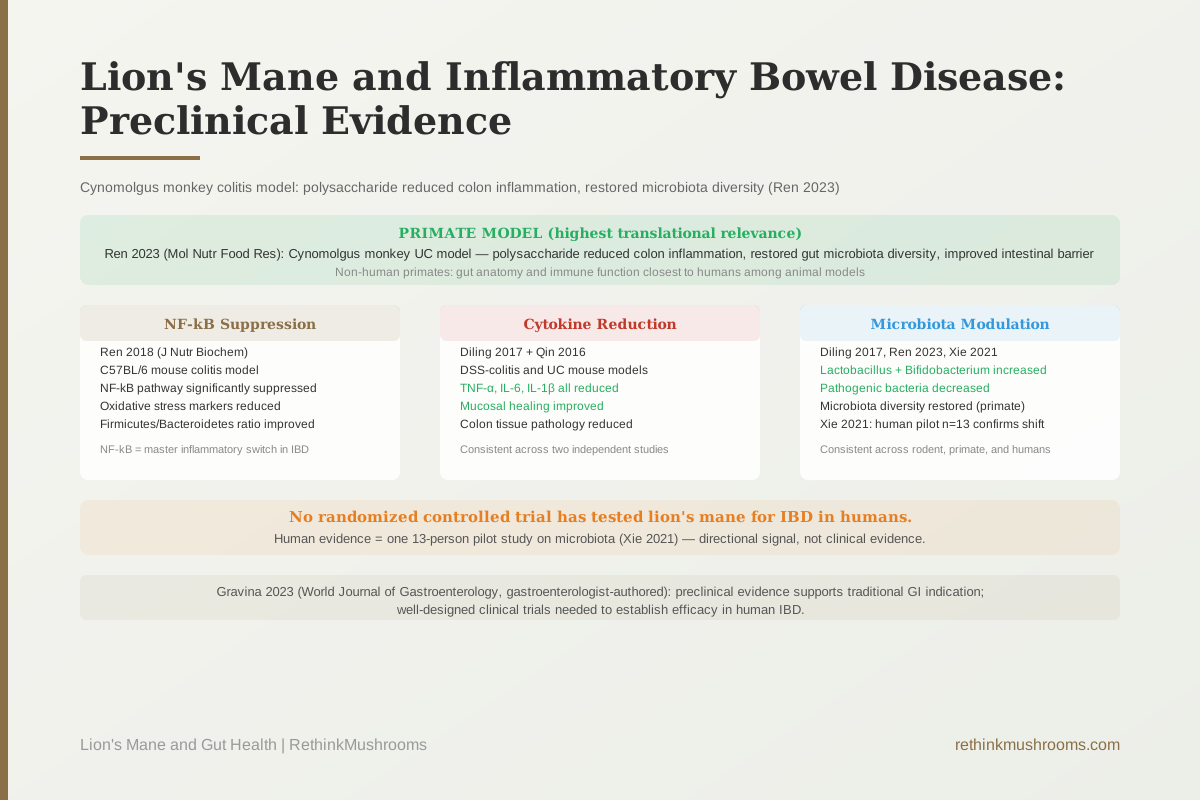
What the preclinical evidence shows is worth knowing about. Three distinct mechanisms have been identified across four animal studies spanning three different disease models, including one primate study: lion's mane suppresses the NF-kB inflammatory signaling pathway, reduces the pro-inflammatory cytokines that drive IBD flares, and modulates gut microbiota composition. The studies overlap rather than each covering a single mechanism, and because they used different induction methods in different species, their agreement carries more weight than four repetitions of one model would. They converge on the question the IBD research field cares about most: what drives gut inflammation and what might reduce it.
For the broader overview, see What Is Lion's Mane Mushroom? A Science-Based Overview. For the lion's mane gut health evidence base including the H. pylori and gastritis data, see Lion's Mane for Gut Health: Gastroprotective Effects and Research.
Key Takeaways
- Ren and colleagues (Molecular Nutrition and Food Research, 2023) gave Hericium erinaceus mycelium-derived polysaccharide to cynomolgus monkeys with spontaneously occurring ulcerative colitis and found attenuated UC pathology, reduced inflammation, fewer episodes of diarrhea, improved nutritional status, enhanced intestinal function, and a reshaped gut microbiota; the spontaneous primate model is the most translationally relevant animal evidence available
- Ren and colleagues (Journal of Nutritional Biochemistry, 2018) found that Hericium polysaccharide improved clinical symptoms in DSS-colitis C57BL/6 mice, blocked phosphorylation of NF-kB p65 and IkB-alpha, lowered oxidative stress markers (nitric oxide, malondialdehyde, myeloperoxidase), suppressed IL-6, IL-1beta and TNF-alpha, reversed DSS-induced gut dysbiosis, and maintained intestinal barrier integrity
- Diling and colleagues (Oncotarget, 2017) found that H. erinaceus extracts relieved TNBS-induced colitis in rats through a dual mechanism, with the polysaccharide fraction acting as a prebiotic and the alcoholic fraction showing bactericidin-like and immunomodulatory activity; damage-activity, morphology and tissue-damage scores plus myeloperoxidase all improved
- Qin and colleagues (International Journal of Medicinal Mushrooms, 2016) found that lion's mane ethanol extract at 250 and 500 mg/kg/day improved body weight and colon length, reduced intestinal bleeding and myeloperoxidase, protected the mucosal epithelium, and lowered TNF-alpha, IL-1beta and IL-6 in DSS-colitis mice
- Xie and colleagues (Nutrients, 2021) ran a 13-person, seven-day pilot in healthy adults and found increased gut microbiota alpha diversity, more short-chain-fatty-acid-producing bacteria and fewer pathobionts, with changes correlating to blood chemistry indices; the study enrolled no IBD patients and measured no gut inflammation markers
- No randomized controlled trial has tested lion's mane for Crohn's disease or ulcerative colitis; the title of this article accurately describes the current state of the evidence: preclinical
What IBD Is: The Chronic Gut Inflammation Problem
Inflammatory bowel disease is an umbrella term for two chronic conditions: ulcerative colitis, which involves continuous inflammation limited to the colon and rectum, and Crohn's disease, which can affect any part of the digestive tract from mouth to anus with patchy, transmural inflammation.
Both conditions involve dysregulated immune activity in the gut. In healthy gut tissue, the immune system maintains a careful balance: responding to genuine threats like pathogens while tolerating the trillions of bacteria that normally inhabit the intestine. In IBD, this tolerance breaks down. The immune system attacks the gut lining, producing chronic inflammation that damages the intestinal epithelium, disrupts the gut barrier, and eventually causes fibrosis or structural changes that impair gut function.
The NF-kB pathway is a key mediator of IBD inflammation. NF-kB is a signaling protein that acts as a master switch for pro-inflammatory gene expression: when activated, it turns on the genes encoding TNF-alpha, IL-1 beta, IL-6, and dozens of other inflammatory mediators. In IBD, NF-kB is chronically overactivated. Suppressing NF-kB is one of the mechanisms by which biologics like infliximab reduce IBD activity.
Gut microbiota dysbiosis is the other central IBD feature. IBD patients consistently show reduced microbial diversity, lower levels of protective species like Lactobacillus and Bifidobacterium, and higher levels of pathogenic species. Whether the dysbiosis causes IBD or results from it is still being investigated; the current view is that both are true and that dysbiosis and inflammation are bidirectionally reinforcing.
This background matters for evaluating the lion's mane evidence: the three mechanisms identified in preclinical studies (NF-kB suppression, cytokine reduction, microbiota modulation) are directly relevant to the known pathophysiology of IBD.
The Primate Evidence: The Most Translationally Relevant Data
The most compelling animal study for lion's mane and IBD is from a 2023 paper by Ren and colleagues in Molecular Nutrition and Food Research, which used cynomolgus monkeys rather than the rodents that most preclinical IBD research relies on.[1]
Why does the species matter? Cynomolgus monkeys are non-human primates with gut anatomy, gut microbiota composition, and immune function that are substantially closer to humans than mouse models. Drug candidates that work in rodent IBD models fail in human trials at a high rate; primate models provide an additional validation step that reduces this gap.
But the more important detail is one that most summaries of this study get backwards. The monkeys were not given colitis. They already had it. The first half of the Ren 2023 paper is devoted to validating that ulcerative colitis occurs spontaneously in cynomolgus monkeys, using postmortem bowel evaluation, inflammatory markers, fecal occult blood testing, and nutritional status parameters. The authors are explicit about why this matters: existing models are "generated with chemical agents mainly in rodents, which are unable to recapitulate the human occurrence."
The researchers then supplemented these monkeys with Hericium erinaceus mycelium-derived polysaccharide. The reported results: significantly attenuated UC pathology, reduced inflammation, improved nutritional status, a lower incidence of diarrhea, enhanced intestinal function, and a reshaped gut microbiota. The authors' conclusion is that the polysaccharide "can effectively restore UC in monkeys" and shows promise as a precision nutritional supplement for UC management.
One point of precision worth holding onto: the paper reports that the microbiota was reshaped, not that diversity was restored to a specific healthy benchmark. The distinction matters because "restored diversity" is a stronger claim than the study makes.
Ren et al. (2023) · Molecular Nutrition & Food Research
- Population
- Cynomolgus monkeys with spontaneously occurring (non-chemically-induced) ulcerative colitis, confirmed by postmortem bowel evaluation, inflammatory markers and fecal occult blood testing
- Intervention
- Hericium erinaceus mycelium-derived polysaccharide supplementation
- Comparator
- Not specified in the abstract; the paper reports change against the untreated UC state rather than describing a separate control arm
- Finding
- Attenuated UC pathology, reduced inflammation, lower incidence of diarrhea, improved nutritional status, enhanced intestinal function and a reshaped gut microbiota.
preliminary Strong model, but an animal study with no reported sample size in the abstract, no blinding described, and no human follow-up.
Ren et al., Molecular Nutrition & Food Research, 2023 (RTHM-01776, PMID 36443636)
The primate study does not prove efficacy in human IBD. But it substantially increases the biological plausibility relative to rodent-only evidence and moves the evidence one step closer to human translation.
Three Rodent Studies, Three Different Models
The primate data sits on top of a consistent finding in three independent rodent studies. It is worth being precise about what each one actually used, because the three studies do not share a model: two used dextran sulfate sodium in mice, one used trinitrobenzenesulfonic acid in rats. Convergent findings across different models are stronger evidence than repetition within one, so the differences are a feature here rather than a footnote.
NF-kB Suppression, Cytokine Reduction, and Dysbiosis Reversal
Ren and colleagues published a 2018 study in the Journal of Nutritional Biochemistry using a DSS-induced colitis model in C57BL/6 mice, testing a purified Hericium erinaceus polysaccharide with a molecular weight of 86.67 kDa.[2]
This is the most mechanistically detailed of the rodent studies. Clinical symptoms improved. Oxidative stress markers fell, including nitric oxide, malondialdehyde, and myeloperoxidase. The secretion of IL-6, IL-1 beta, and TNF-alpha was suppressed, as was expression of COX-2 and iNOS. On the signaling side, the polysaccharide blocked phosphorylation of NF-kB p65 and its inhibitor IkB-alpha, along with the MAPK and Akt pathways.
The microbiota finding is reported at the level of the whole community rather than a single ratio: the polysaccharide reversed DSS-induced gut dysbiosis and maintained intestinal barrier integrity. The study does not report a Firmicutes-to-Bacteroidetes ratio, and any summary that attributes one to it is adding a specific the paper did not measure.
Dual Immune and Microbiota Regulation, in Rats
Diling and colleagues published a 2017 study in Oncotarget, and this one differs from the others in two ways that are routinely misreported: it used rats, not mice, and inflammation was induced with a TNBS enema at 150 mg/kg, not DSS.[3] Extracts were administered for two weeks.
Damage activity scores, colonic mucosal morphology, tissue damage index, and myeloperoxidase activity all improved significantly against the model group. The mechanistic finding is the interesting part: the researchers prepared polysaccharide, alcoholic, and whole extracts separately and found they did different jobs. The polysaccharide fraction appeared to act as a prebiotic, while the alcoholic extract showed bactericidin-like and immunomodulatory effects. The paper's overall conclusion is that H. erinaceus extracts promote the growth of beneficial gut bacteria and improve host immunity.
Note what this study does not name: it reports beneficial gut bacteria in general terms rather than identifying specific genera such as Lactobacillus or Bifidobacterium, and the abstract does not report TNF-alpha or IL-6 figures. Those specifics come from other studies in this set, not this one.
Cytokine Reduction and Mucosal Protection
Qin and colleagues published a 2016 study in the International Journal of Medicinal Mushrooms using an ethanol extract of lion's mane.[4] Twenty C57BL/6 mice received 2% DSS in drinking water for seven days to induce acute intestinal inflammation, then were given the ethanol extract orally at 250 or 500 mg/kg/day.
Treated animals showed significantly improved body weight and colon length and decreased intestinal bleeding relative to DSS controls. Myeloperoxidase accumulation in colon tissue fell, neutrophil and lymphocyte infiltration was attenuated, and the mucosal epithelium was protected. Mechanistically, the extract suppressed TNF-alpha, IL-1 beta, and IL-6 in colon tissue while adjusting nitric oxide, malondialdehyde, and superoxide dismutase in serum.
This study used an ethanol extraction rather than a polysaccharide fraction, which matters: it suggests the anti-inflammatory activity is not confined to the polysaccharides alone. Taken with Diling's fraction-by-fraction comparison, the picture is of several classes of compound contributing through different routes.
The Human Signal: What 13 People Showed
The closest evidence to human IBD comes from a pilot study by Xie and colleagues published in Nutrients in 2021.[5]
The study recruited 13 healthy adults to consume H. erinaceus powder as a dietary supplement for seven days. Microbiota composition was profiled by 16S ribosomal RNA gene sequencing, and blood was assessed by routine hematological examination and serum biochemical markers. The findings:
- Alpha diversity within the gut microbiota community increased
- Several short-chain fatty acid producing bacteria became more abundant, specifically Kineothrix alysoides, Gemmiger formicilis, Fusicatenibacter saccharivorans, Eubacterium rectale, and Faecalibacterium prausnitzii
- Three pathobionts were downregulated: Streptococcus thermophilus, Bacteroides caccae, and Romboutsia timonensis
- These microbiota shifts correlated with blood chemistry indices including alkaline phosphatase, LDL, uric acid, and creatinine
Three limitations need stating plainly, because this study is frequently described in ways it does not support. First, 13 people over seven days, with no control group, is a directional signal and nothing more. Second, the participants were healthy adults, not IBD patients, so the results are not evidence of IBD treatment. Third, and most often misreported: this study did not measure gut inflammation markers at all. The blood work was general biochemistry, not inflammatory endpoints. The authors themselves frame the microbiota changes cautiously, as possible "physiological adaptations" to short-term supplementation.
What the study does establish is narrower but still relevant: lion's mane consumption shifts the gut microbial environment toward SCFA-producing species, and SCFA production is, in other research, associated with reduced gut inflammation. That is a mechanistic link with one inferential step in it, not a demonstration.
A 2025 systematic review by Menon and colleagues in Frontiers in Nutrition assessed 26 studies on H. erinaceus, comprising five randomized controlled trials, 15 laboratory studies, three pilot clinical trials, one cohort study, one case report, and one computer analysis.[7] The review followed PRISMA guidelines, used the ROBIS tool for quality assessment, and was preregistered on PROSPERO. On gut health specifically, it found that H. erinaceus increased gut microbiota diversity and the abundance of SCFA-producing bacteria, thereby reducing inflammation and protecting gut health. Worth noting for this article's purposes: the five RCTs it identified assessed cognition and mood, not IBD.
What IBD-Specific Evidence Means in Context
A 2023 review by Gravina and colleagues in the World Journal of Gastroenterology set out to analyse the available evidence on the digestive therapeutic potential of Hericium erinaceus and the possible underlying molecular mechanisms.[6] The review notes that several studies have highlighted therapeutic potential for gastrointestinal disorders including gastritis and inflammatory bowel diseases, and that some components appear to have antineoplastic activity against gastric and colorectal cancer.
Two things are worth being careful about here. This is a narrative review rather than a systematic review with a registered protocol, so it carries less methodological weight than the Menon 2025 systematic review. And that a gastroenterology journal published a review of the evidence tells you the topic is taken seriously by the specialty; it does not by itself constitute a clinical endorsement.
What is missing is the same thing that has been missing all along: an RCT enrolling IBD patients, testing lion's mane against placebo or standard of care, measuring clinical disease activity scores (CDAI for Crohn's, Mayo Score for UC), and following patients long enough to detect sustained remission or prevention of relapse.
- Molecular mechanismcompleted
NF-kB p65 and IkB-alpha phosphorylation blocked; COX-2 and iNOS expression reduced. Measured in vivo in DSS-colitis mice (Ren 2018), not in cell culture
- Animal studiescompleted
Four studies across three models: DSS mice (Ren 2018, Qin 2016), TNBS rats (Diling 2017), and spontaneous UC in cynomolgus monkeys (Ren 2023)
- Case reports in IBD patientsmissing
None published
- Pilot human studycurrent
13 healthy adults, seven days, microbiota and blood chemistry only (Xie 2021). No IBD patients enrolled, no inflammatory endpoints measured
- Randomized controlled trial in IBDmissing
None. The five RCTs identified in the Menon 2025 systematic review assessed cognition and mood
- Meta-analysis of IBD trialsmissing
Not possible without trials to pool
The animal tier is unusually well populated for a supplement, and the spontaneous primate model is genuinely strong. But the human tier contains one seven-day pilot in healthy volunteers. No person with IBD has been studied taking lion's mane in a published trial.
Ren 2023 (RTHM-01776); Ren 2018 (RTHM-00999); Diling 2017 (RTHM-00866); Qin 2016 (RTHM-00817); Xie 2021 (RTHM-01458); Menon 2025 (RTHM-02145)
What the Evidence Does and Doesn't Establish for IBD
Three mechanisms supported by preclinical evidence:
- NF-kB inflammatory pathway suppression: phosphorylation of NF-kB p65 and IkB-alpha blocked, with reduced downstream cytokines, COX-2, iNOS, and oxidative stress markers, in DSS-colitis mice (Ren 2018)
- Pro-inflammatory cytokine reduction (TNF-alpha, IL-6, IL-1 beta): demonstrated with a purified polysaccharide (Ren 2018) and independently with an ethanol extract (Qin 2016), suggesting the anti-inflammatory effect is not confined to a single compound class
- Gut microbiota modulation: dysbiosis reversal in DSS mice (Ren 2018), promotion of beneficial gut bacteria in TNBS rats (Diling 2017), a reshaped microbiota in spontaneous-UC monkeys (Ren 2023), and increased SCFA-producing species in healthy human volunteers (Xie 2021)
Five studies, zero IBD patients
What Each Lion’s Mane IBD Study Actually Tested
These five papers are usually summarised as one finding. They are not one finding: they used four different subjects and three different induction routes, and the only study in humans enrolled nobody with inflammatory bowel disease.
Ren et al., 2023
Cynomolgus monkeys
How disease arose
None — colitis arose spontaneously
What was measured
Attenuated UC pathology, less inflammation, fewer diarrhea episodes, better nutritional status, enhanced intestinal function, reshaped microbiota
The abstract reports no sample size, no dose and no blinding. "Reshaped" the microbiota is not the same claim as "restored diversity".
Ren et al., 2018
C57BL/6 mice
How disease arose
Dextran sulfate sodium (DSS)
What was measured
NF-κB p65 and IκB-α phosphorylation blocked; IL-6, IL-1β, TNF-α, COX-2, iNOS suppressed; NO, MDA, MPO down; dysbiosis reversed; barrier integrity maintained
Reports no Firmicutes-to-Bacteroidetes ratio, despite that figure being widely attributed to this paper.
Diling et al., 2017
Rats
How disease arose
TNBS enema, 150 mg/kg
What was measured
Damage activity, colonic mucosal morphology and tissue damage index scores improved; MPO down; polysaccharide fraction prebiotic, alcoholic fraction bactericidin-like and immunomodulatory
Rats and TNBS, not mice and DSS — this study is routinely miscited as a DSS mouse model. Names no specific bacterial genera.
Qin et al., 2016
20 C57BL/6 mice
How disease arose
2% DSS in drinking water, 7 days
What was measured
Body weight and colon length improved, intestinal bleeding down, MPO down, mucosal epithelium protected, TNF-α / IL-1β / IL-6 suppressed at 250 and 500 mg/kg/d
Ethanol extract rather than isolated polysaccharide, so this tests a different preparation than Ren 2018.
Xie et al., 2021
13 healthy adults
How disease arose
No disease — healthy volunteers
What was measured
Gut microbiota alpha diversity up; SCFA-producing species up; three pathobionts down; changes correlated with ALP, LDL, uric acid and creatinine
Seven days, not two weeks. No control group. No participant had IBD, and no inflammatory endpoint was measured at any point.
The mechanistic tier is genuinely well populated, and agreement across three different induction models is more persuasive than repetition within one. The gap is at the top: no published study has given lion’s mane to a person with Crohn’s disease or ulcerative colitis.
Sources: Ren et al., 2023 (RTHM-01776, PMID 36443636); Ren et al., 2018 (RTHM-00999, PMID 29677563); Diling et al., 2017 (RTHM-00866, PMID 29156761); Qin et al., 2016 (RTHM-00817, PMID 27481156); Xie et al., 2021 (RTHM-01458, PMID 33800983)
What the evidence does not establish:
- Any clinical efficacy in human Crohn's disease or ulcerative colitis patients
- Whether the animal model doses translate to achievable human oral doses
- Any effect on the standard IBD clinical outcomes: disease activity scores, endoscopic remission, steroid-free remission rates
- Any safety data in IBD patients specifically, or interaction data with standard IBD medications (immunosuppressants, biologics)
- Any reduction in human gut inflammation markers, which no published lion's mane study has measured
Safety
CriticalLion's Mane Is Not a Substitute for IBD Treatment
Concern
IBD is a progressive, relapsing immune-mediated disease. Untreated or undertreated inflammation causes cumulative bowel damage, and in ulcerative colitis raises long-term colorectal cancer risk. Substituting a supplement for aminosalicylates, immunosuppressants, or biologics, or delaying escalation during a flare, risks permanent harm that no preclinical mechanism offsets.
What the research says
Nothing in the preclinical evidence supports using lion's mane in place of, or as a reason to reduce, prescribed IBD therapy. Every study described in this article was conducted in animals or in healthy volunteers. No dosing regimen has been established for people with IBD.
Particularly relevant for: Anyone with diagnosed Crohn's disease or ulcerative colitis, and anyone with active GI symptoms that have not been evaluated
What to do
Discuss any supplement with your gastroenterologist before starting it, particularly if you take immunosuppressants or biologics, where interaction data for lion's mane does not exist. This article is research summary, not medical advice.
Disease-course statements reflect standard IBD clinical background; evidence-status statements from Gravina et al., World Journal of Gastroenterology, 2023 (RTHM-01700) and Menon et al., Frontiers in Nutrition, 2025 (RTHM-02145)
The IBD evidence for lion's mane is the most mechanistically coherent of any functional mushroom for this indication. It is not clinical evidence. For people with IBD who are interested in lion's mane as an adjunct, the honest framing is: the mechanism is biologically plausible, the primate data is encouraging, and no trial has tested it in IBD patients.
For the related intestinal barrier and leaky gut evidence, see Lion's Mane and Leaky Gut: Intestinal Barrier Integrity Research. For the downstream colorectal cancer research in the context of IBD, see Lion's Mane and Colorectal Cancer: Antiproliferative Research.
The Bottom Line
Lion's mane polysaccharide and extracts reduce inflammatory bowel disease markers through three mechanisms in animal models: NF-kB suppression (Ren 2018), pro-inflammatory cytokine reduction (Ren 2018, Qin 2016), and gut microbiota modulation (Ren 2018, Diling 2017, plus Ren 2023 in cynomolgus monkeys). The strongest preclinical evidence is Ren 2023, which supplemented cynomolgus monkeys with spontaneously occurring ulcerative colitis rather than chemically induced disease, and reported attenuated pathology and a reshaped microbiota. The rodent work spans two different induction methods, DSS in mice and TNBS in rats, which strengthens the convergence. The only human study (Xie 2021, Nutrients) gave 13 healthy adults lion's mane for seven days and found increased microbiota diversity and more SCFA-producing bacteria; it enrolled no IBD patients and measured no inflammatory endpoints. No human IBD trial exists.
Frequently Asked Questions
Sources & References
- 1RTHM-01776·Ren, Zhengyu et al. (2023). “Hericium erinaceus mycelium-Derived Polysaccharide Alleviates Ulcerative Colitis and Modulates Gut Microbiota in Cynomolgus Monkeys..” Molecular nutrition & food research.Study breakdown →PubMed →↩
- 2RTHM-00529·Ren, Yilin et al. (2018). “Polysaccharide of Hericium erinaceus attenuates colitis in C57BL/6 mice via regulation of oxidative stress, inflammation-related signaling pathways and modulating the composition of the gut microbiota..” The Journal of nutritional biochemistry.Study breakdown →PubMed →↩
- 3RTHM-00470·Diling, Chen et al. (2017). “Extracts from Hericium erinaceus relieve inflammatory bowel disease by regulating immunity and gut microbiota..” Oncotarget.Study breakdown →PubMed →↩
- 4RTHM-00442·Qin, Mingming et al. (2016). “Anti-Inflammatory Effects of Ethanol Extract of Lion's Mane Medicinal Mushroom, Hericium erinaceus (Agaricomycetes), in Mice with Ulcerative Colitis..” International journal of medicinal mushrooms.Study breakdown →PubMed →↩
- 5RTHM-01458·Xie, Xiao-Qian et al. (2021). “Influence of Short-Term Consumption of Hericium erinaceus on Serum Biochemical Markers and the Changes of the Gut Microbiota: A Pilot Study..” Nutrients.Study breakdown →PubMed →↩
- 6RTHM-01700·Gravina, Antonietta Gerarda et al. (2023). “Hericium erinaceus, a medicinal fungus with a centuries-old history: Evidence in gastrointestinal diseases..” World journal of gastroenterology.Study breakdown →PubMed →↩
- 7RTHM-00943·Menon, Arya et al. (2025). “Benefits, side effects, and uses of Hericium erinaceus as a supplement: a systematic review..” Frontiers in nutrition.Study breakdown →PubMed →↩