Lion's Mane and Gut Health
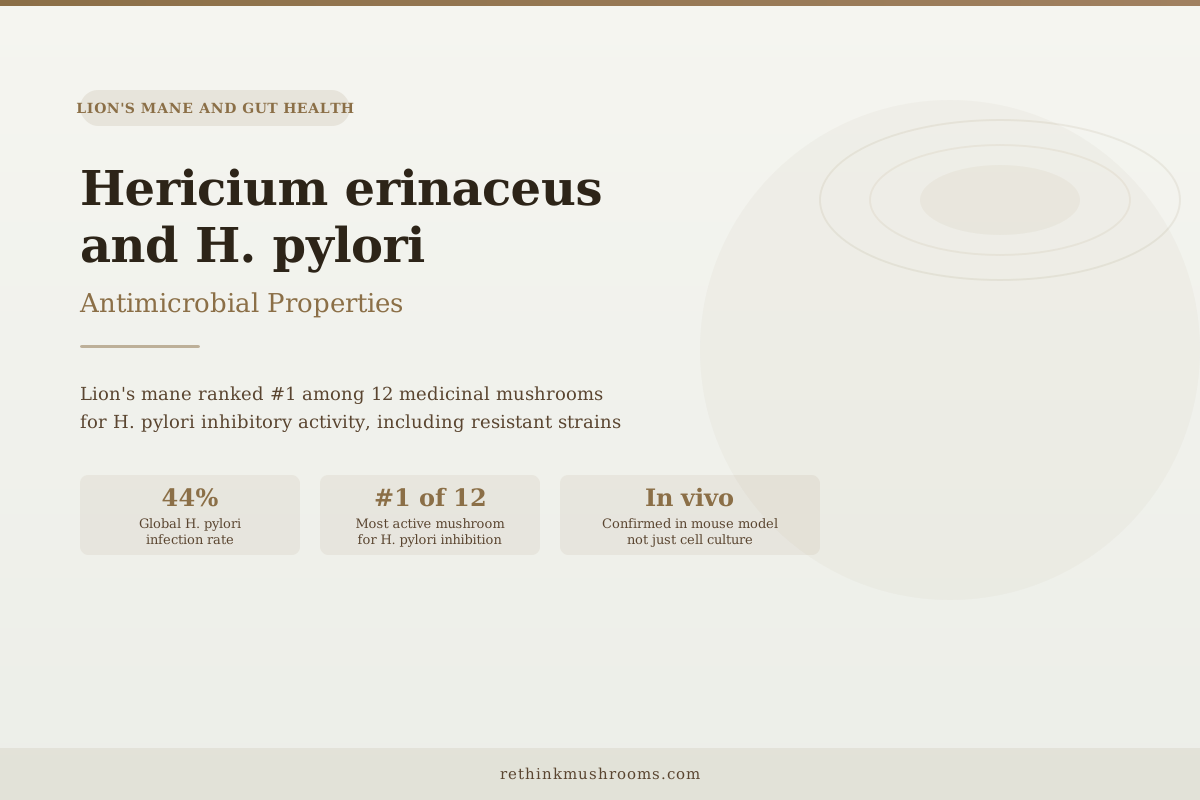
44% global infection rate
Helicobacter pylori infects roughly 44% of the global adult population and causes 90% of duodenal ulcers. Lion's mane showed the strongest anti-H. pylori activity among 12 medicinal mushrooms tested, including activity against antibiotic-resistant strains.
Shang et al., International Journal of Medicinal Mushrooms, 2013
12 mushrooms
lion's mane ranked highest for H. pylori inhibition in comparative testing (Shang 2013)
Resistant strains
active against clarithromycin-resistant H. pylori, a growing clinical problem (Wang 2019)
In vivo
significant H. pylori colonization reduction confirmed in mouse model, not just cell culture (Wang 2019)
Shang et al., International Journal of Medicinal Mushrooms, 2013
 View as image ↗
Helicobacter pylori is not a minor pathogen. It colonizes the stomach lining of an estimated 44% of adults worldwide, making it one of the most prevalent bacterial infections in human history. It causes most gastric and duodenal ulcers, contributes to chronic gastritis, and is classified by the World Health Organization as a Group 1 carcinogen, meaning it definitively causes stomach cancer in humans.
The standard treatment is a combination of antibiotics and acid suppressors called triple therapy or quadruple therapy. It works, but antibiotic resistance is rising, and eradication failures are increasingly common in many parts of the world.
Lion's mane mushroom has been studied specifically for its activity against H. pylori, and the research (all of it preclinical) is more specific and rigorous than most consumer content suggests. This article covers what that research actually found.
Key Takeaways
- Shang et al. (2013) screened 12 medicinal mushrooms for H. pylori inhibitory activity; lion's mane (Hericium erinaceus) showed the highest activity of all 12 species, with a minimum inhibitory concentration of approximately 2 mg/mL
- Wang et al. (2019) demonstrated both in vitro inhibition of H. pylori adhesion to human gastric epithelial cells and in vivo reduction of H. pylori colonization in a mouse model
- The Wang 2019 study also showed activity against clarithromycin-resistant H. pylori strains, which is clinically relevant given that clarithromycin resistance rates exceed 15-30% in many countries
- Liu et al. (2016) identified the specific bioactive compounds responsible: phenolic acids including chlorogenic acid and caffeic acid showed anti-H. pylori activity with synergistic effects across multiple compounds
- Zhu et al. (2014) demonstrated that complexing Hericium polysaccharide with bismuth (a metal used in standard H. pylori treatment) significantly enhanced antimicrobial activity compared to either agent alone
- No human clinical trial has tested lion's mane for H. pylori eradication; whether the concentrations effective in vitro are achievable through oral supplementation in the human stomach is unknown
H. pylori: Why This Bacteria Warrants Serious Research Attention
Helicobacter pylori is a gram-negative bacterium with a distinctive helical shape that allows it to burrow into the mucus layer protecting the stomach lining. Once established, it uses multiple mechanisms to survive the stomach's extreme acidity: it produces urease, an enzyme that breaks down urea in gastric fluid to create a local ammonia cloud that neutralizes acid around the bacteria.
The infection is typically acquired in childhood, often through contaminated water or person-to-person contact, and without treatment, it persists for life. Most infected people have no symptoms, but the bacteria causes chronic low-grade inflammation of the stomach lining (chronic gastritis) in virtually all carriers. Over decades, this inflammation drives a progression that, in some people, leads to peptic ulcer disease or gastric cancer.
The cancer connection is well-established: chronic H. pylori infection drives a stepwise process from chronic superficial gastritis to atrophic gastritis to intestinal metaplasia to dysplasia to gastric adenocarcinoma. Gastric cancer remains one of the most common causes of cancer death globally, and H. pylori is responsible for the majority of cases.
Standard eradication therapy uses two antibiotics (typically clarithromycin and amoxicillin) plus a proton pump inhibitor for 7-14 days. Eradication rates with standard triple therapy have been declining as antibiotic resistance rises; in some populations clarithromycin resistance exceeds 30%, reducing triple therapy success rates to below 70%.
This is the clinical context within which lion's mane H. pylori research should be understood: interest in natural H. pylori inhibitors exists partly because treatment failures are a real problem.[5]
Among 12 Medicinal Mushrooms, Lion's Mane Ranked First
The most systematic evidence for lion's mane's anti-H. pylori activity comes from a 2013 comparative study by Shang and colleagues, who screened extracts from 12 medicinal mushrooms against multiple H. pylori strains.[1]
The screening measured minimum inhibitory concentration (MIC), which is the lowest concentration of an extract needed to prevent visible H. pylori growth in culture. Lower MIC values mean higher inhibitory potency.
Lion's mane (Hericium erinaceus) showed the highest anti-H. pylori activity of the 12 mushrooms tested. Its MIC was approximately 2 mg/mL, and the inhibitory effects were consistent across multiple H. pylori strains tested in the study.
The comparative context matters. This was not a study designed to show lion's mane works in isolation. It pitted lion's mane against reishi, shiitake, maitake, turkey tail, and other mushrooms with established medicinal reputations. Lion's mane came out on top.
The study also showed that the inhibitory activity was not strain-specific. H. pylori is not a genetically uniform pathogen; different strains have different virulence factors and different susceptibility profiles to antimicrobials. Consistent activity across strains suggests the inhibitory mechanism involves targets that are broadly conserved in the species rather than one that would only work against specific clinical isolates.
In Vivo Evidence: What Happened When Mice Were Given Lion's Mane
The Shang 2013 study established the in vitro baseline. The Wang 2019 study by Wang and colleagues took the evidence one step further: a living organism.[2]
Wang's team first confirmed lion's mane ethanolic extract's ability to inhibit H. pylori adhesion to human gastric epithelial cells in vitro. H. pylori adhesion to the gastric epithelium is the first step in colonization; a compound that blocks adhesion prevents the bacteria from establishing itself in the gastric lining before the infection progresses.
Wang's team then moved to a mouse model of H. pylori infection. Mice were colonized with H. pylori, then treated with lion's mane extract, and gastric tissue was analyzed for bacterial colonization at study end.
The result: mice treated with lion's mane showed significant reduction in H. pylori colonization compared to controls.
The significance of the in vivo finding is its contrast to in vitro data. Many compounds show antimicrobial activity in cell culture but fail to produce measurable effects in living organisms, where the compound must survive digestion, reach adequate concentrations at the target site, and work in the presence of a complete immune system and competing gut flora. Lion's mane extract produced demonstrable effects in a living organism.
The Antibiotic Resistance Angle: Activity Against Clarithromycin-Resistant Strains
The most clinically significant finding in the Wang 2019 study was not the overall anti-H. pylori activity. It was the finding that lion's mane extract showed inhibitory activity against clarithromycin-resistant H. pylori strains.[2]
Clarithromycin is the primary antibiotic in standard H. pylori triple therapy. When H. pylori develops resistance to clarithromycin, standard triple therapy becomes much less effective. Clarithromycin resistance rates vary significantly by region; in parts of Europe and Asia, rates exceed 15-30%, meaning that in those areas, roughly a quarter to a third of patients undergoing standard triple therapy may fail to eradicate the infection.
Failed eradication leaves patients with persistent H. pylori, ongoing gastric inflammation, and the long-term risks that accompany it. Management then requires more complex second-line regimens with different antibiotic combinations that are less well-tolerated and more expensive.
A natural compound that works against clarithromycin-resistant strains is not inhibited by the same resistance mechanism that defeats clarithromycin. This is expected: lion's mane's phenolic acids operate via different molecular targets than macrolide antibiotics, which means resistance to clarithromycin would not be expected to provide cross-resistance to lion's mane compounds.
This does not mean lion's mane is ready to be used in place of antibiotics for H. pylori treatment. It does mean the anti-H. pylori activity of lion's mane is not bypassed by the most common antibiotic resistance mechanism affecting standard H. pylori therapy.
Which Compounds Are Responsible: Phenolic Acids and Synergistic Activity
Shang 2013 demonstrated that the activity existed. Wang 2019 showed it worked in a living organism. Liu and colleagues in 2016 identified which specific compounds in lion's mane are responsible.[3]
Liu's team isolated and tested bioactive components from Hericium erinaceus against H. pylori. The compounds with the most significant anti-H. pylori activity were phenolic acids, specifically chlorogenic acid and caffeic acid.
Phenolic acids are a broad class of plant-derived antimicrobial compounds found in many foods and herbs. They work against bacteria through multiple mechanisms: disrupting bacterial cell membranes, inhibiting bacterial enzyme activity, and reducing the bacteria's ability to form biofilms. Biofilm formation is an important H. pylori survival strategy; H. pylori in biofilm form are substantially harder to eradicate than free-floating (planktonic) bacteria.
Liu's study also found synergistic activity between multiple lion's mane components. Synergy means the combination of two compounds produces a stronger inhibitory effect than either compound alone at equivalent concentrations. When antimicrobial compounds work synergistically, the effective inhibitory activity can be achieved at lower concentrations of each individual component than would be needed if used alone.
This synergy is relevant to the question of whether the concentrations needed for H. pylori inhibition are achievable through oral consumption. If multiple compounds work together at lower effective concentrations, the threshold may be more practically reachable than looking at any single compound in isolation would suggest.
A Novel Approach: Complexing Hericium Polysaccharide With Bismuth
Alongside the extract and phenolic acid research, a 2014 study by Zhu and colleagues explored a fundamentally different approach: complexing Hericium polysaccharide with bismuth, a metallic element with its own anti-H. pylori activity.[4]
Bismuth is already a component of standard H. pylori treatment. Bismuth subsalicylate (the active ingredient in Pepto-Bismol) has been used as an H. pylori treatment for decades, and bismuth-containing quadruple therapy is the recommended second-line regimen when triple therapy fails. Bismuth's anti-H. pylori mechanism includes disrupting the bacterial cell wall and binding to the urease enzyme that H. pylori uses to survive gastric acid.
Zhu's team found that combining Hericium polysaccharide with bismuth ions produced a complex with significantly greater anti-H. pylori activity than either the polysaccharide or bismuth compound alone. The combination showed what appears to be a complementary mechanism: bismuth targets the bacterial enzyme system while the polysaccharide disrupts the bacterial membrane, and together they produce a more potent inhibitory effect.
This research direction represents a pharmaceutical development angle rather than a dietary supplementation angle. Whether a bismuth-complexed Hericium polysaccharide could be developed into a therapeutic form suitable for human use is a separate question from whether eating lion's mane mushrooms or taking lion's mane supplements affects H. pylori in people.
How Gastroenterologists Review This Evidence
In 2023, Gravina and colleagues at Italian universities published a comprehensive review of Hericium erinaceus across gastrointestinal diseases in the World Journal of Gastroenterology, a peer-reviewed gastroenterology journal with high academic standing.[5]
Their conclusions on H. pylori: the preclinical evidence for lion's mane inhibiting H. pylori is meaningful, with activity confirmed in vitro across multiple strains and in vivo in animal models. They positioned the H. pylori data as part of a broader evidence base supporting traditional H. erinaceus uses for gastrointestinal conditions, while noting that clinical translation requires human trials.
The Gravina 2023 review is notable because it was written by gastroenterologists, published in a gastroenterology journal, and takes the lion's mane GI evidence seriously rather than dismissing it. It represents what the medical community specializing in gut health thinks of this research when they examine it rigorously.
For the broader gastroprotective picture, including lion's mane's effects on gastric lining integrity beyond H. pylori, see Lion's Mane and Gastritis: Can It Protect the Stomach Lining?. For the complete gut health overview, see Lion's Mane for Gut Health: Gastroprotective Effects and Research.
What the Research Cannot Yet Tell Us
- Cell-culture studiescompleted
Inhibition across multiple H. pylori strains; MIC ~2 mg/mL, highest of 12 mushrooms (Shang 2013); active compounds identified as phenolic acids (Liu 2016).
- Animal studiescompleted
Reduced H. pylori colonization in a mouse model, including clarithromycin-resistant strains (Wang 2019).
- Human trials (small)missing
No human clinical trial has tested lion's mane for H. pylori eradication or reduction.
- Large randomized trialsmissing
Not conducted.
- Meta-analysismissing
Not possible without human trials.
The evidence is consistent and biologically plausible at the cell-culture and animal-model levels, with the responsible compounds identified. It stops before any human testing. A 2023 gastroenterology review (Gravina) judged the preclinical evidence meaningful while stating that clinical translation still requires human trials.
Shang 2013; Liu 2016; Wang 2019; Gravina 2023
The H. pylori research on lion's mane is preclinical throughout. There is no human clinical trial testing lion's mane for H. pylori eradication, and the gap between in vitro and in vivo preclinical data and human clinical efficacy is substantial.
The specific challenge for H. pylori treatment is pharmacokinetic: the bacteria colonizes the gastric mucosa, embedded in the protective mucus layer. Achieving meaningful antimicrobial concentrations at that specific anatomical location through oral supplementation requires the active compound to survive gastric acid, penetrate the mucus layer, and reach concentrations comparable to the MIC values demonstrated in vitro.
The MIC of approximately 2 mg/mL identified by Shang 2013 for lion's mane extract against H. pylori is not inherently impractical. Whether typical supplementation doses deliver enough of the active phenolic acids to the gastric mucosa at concentrations that match in vitro MIC values in human subjects has not been tested.
The antibiotic resistance finding from Wang 2019 is genuinely clinically interesting. It raises the possibility that lion's mane compounds could complement antibiotic therapy or have a role in populations with high antibiotic resistance rates. This is a reasonable hypothesis that warrants clinical investigation. It is not a confirmed clinical finding.
The summary from a gastroenterology perspective, as Gravina 2023 provides: the preclinical evidence is promising and biologically plausible; it validates traditional uses of Hericium for gastric conditions; it justifies clinical investigation; it does not yet justify therapeutic claims in humans.
For context on how lion's mane gut research connects to intestinal barrier function and broader gut immunity, see Lion's Mane and Leaky Gut: Intestinal Barrier Integrity Research and Lion's Mane and Inflammatory Bowel Disease: Preclinical Evidence. For the connection between chronic H. pylori gastritis and gastric cancer risk, see Lion's Mane and Gastric Cancer: A Traditional Use Meets Modern Research.
Medical Guidance
ModerateH. pylori is a treatable, cancer-linked infection — do not self-treat it with supplements
Concern
H. pylori is a WHO Group 1 carcinogen and a leading cause of peptic ulcers and gastric cancer. The lion's mane evidence here is entirely preclinical (cell-culture and mouse studies); no human trial has shown it eradicates or reduces H. pylori in people. Substituting a supplement for proven eradication therapy risks leaving an active, cancer-linked infection untreated.
What the research says
Confirmed H. pylori infection should be managed by a clinician with evidence-based eradication therapy (antibiotics plus acid suppression), followed by test-of-cure. Lion's mane has no established role as a treatment or as a replacement for that therapy.
Particularly relevant for: Anyone with diagnosed or suspected H. pylori infection, peptic ulcer symptoms, or a family history of gastric cancer.
What to do
Discuss any supplement use with the clinician managing your H. pylori; do not delay or stop prescribed eradication therapy.
Gravina 2023, World Journal of Gastroenterology
This article is educational and is not medical advice.
The Bottom Line
Lion's mane (Hericium erinaceus) has been shown in multiple preclinical studies to inhibit Helicobacter pylori, the bacterium responsible for most gastric ulcers and a major gastric cancer risk factor. Shang et al. (2013) found lion's mane to be the most active anti-H. pylori mushroom among 12 species tested (MIC ~2 mg/mL); Wang et al. (2019) confirmed inhibitory activity in a mouse model and showed efficacy against clarithromycin-resistant strains. Liu et al. (2016) identified phenolic acids (chlorogenic acid, caffeic acid) as the primary responsible compounds. All evidence is preclinical. No human clinical trial has tested lion's mane for H. pylori eradication, and whether oral supplementation achieves effective concentrations at the gastric mucosa in people is unknown.
Frequently Asked Questions
Sources & References
- 1. Source details for this reference are not yet available.
- 2. Source details for this reference are not yet available.
- 3. Source details for this reference are not yet available.
- 4. Source details for this reference are not yet available.
- 5. Source details for this reference are not yet available.