Agaricus blazei & Cancer Immunity
100 patients
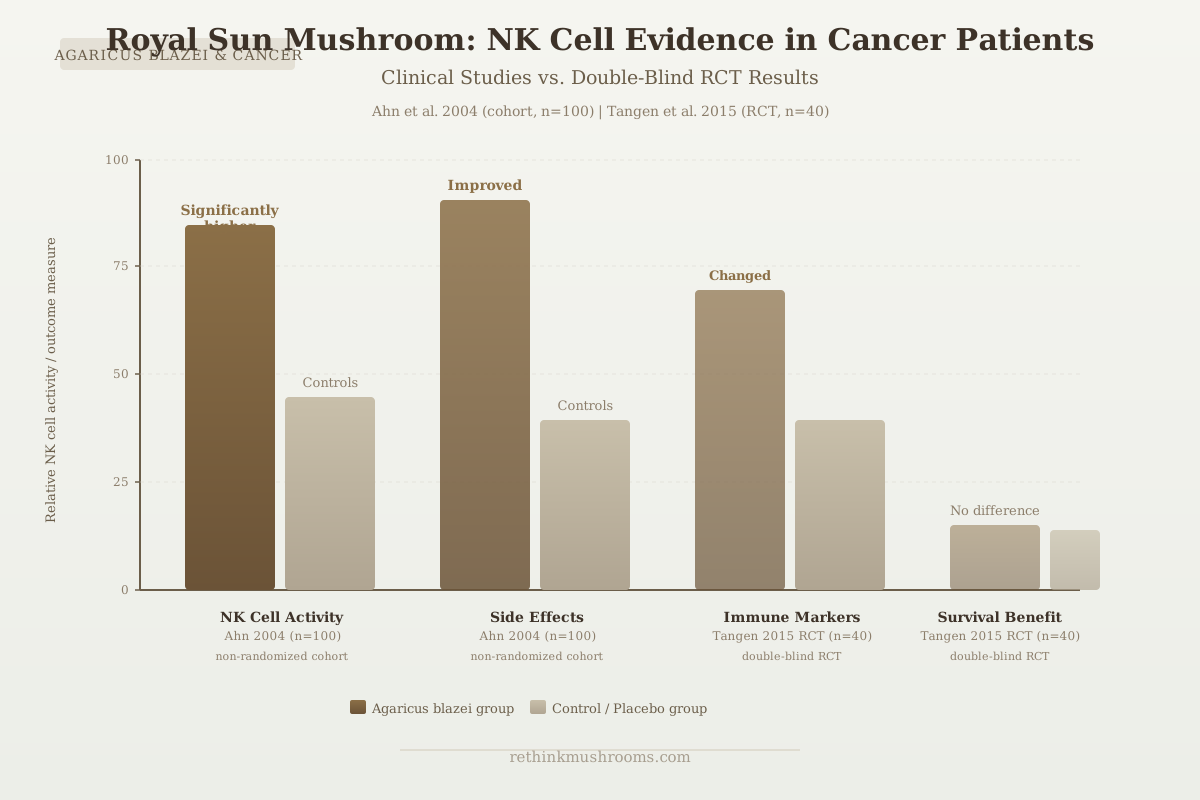
In a 2004 controlled study of gynecological cancer patients undergoing chemotherapy, those who received a standardized Agaricus blazei extract showed significantly higher NK cell activity and improved chemotherapy side effects compared to controls.
Ahn et al., Int. J. Gynecological Cancer, 2004
IL-12
the signaling molecule confirmed by knockout mouse experiments as the required trigger for Agaricus blazei NK cell activation
No
clinical survival benefit found in the only double-blind RCT (Tangen 2015, n=40) despite documented immune changes
2024
most recent anti-tumor immune data: peritoneal metastasis prevention in colorectal cancer models (Xu et al.)
Ahn et al., Int. J. Gynecological Cancer, 2004
 View as image ↗
Natural killer cells are the immune system's first-response tumor patrol. They circulate through blood and tissue, scanning for cells that display the molecular signals of cancer or viral infection, and kill them directly without waiting for prior sensitization to a specific target. Chemotherapy suppresses NK cell activity as a side effect, which partly explains why cancer patients undergoing treatment become more vulnerable to infection and, potentially, to residual tumor cells that the immune system would ordinarily detect.
The question of whether Agaricus blazei, the Royal Sun mushroom, can counter this chemotherapy-induced NK cell suppression was directly tested in human cancer patients in 2004. The results were the strongest direct human evidence for NK cell enhancement from any medicinal mushroom supplement, and they remain underreported two decades later. This article covers that study, the mechanistic evidence explaining how the effect works, the double-blind trial that found immune changes without clinical survival benefit, and what the full picture of evidence actually supports. For a broader introduction to the mushroom itself, see What Is Agaricus blazei? The Royal Sun Mushroom Explained.
Key Takeaways
- A 2004 controlled study of 100 gynecological cancer patients found significantly higher NK cell activity in those receiving ABMK (Agaricus blazei Murill Kyowa extract) versus controls during chemotherapy, alongside improvements in appetite loss, hair loss, emotional instability, and general weakness (Ahn et al., Int. J. Gynecological Cancer, 2004)
- The NK cell activation pathway runs through interleukin-12 (IL-12): Agaricus blazei stimulates immune cells to produce IL-12, which then triggers NK cells to activate and increase their cancer-killing capacity; this was confirmed by IL-12 knockout mouse experiments that abolished the NK activation effect (Yuminamochi et al., Immunology, 2007)
- A 2015 randomized double-blind trial in 40 multiple myeloma patients found significant immunological changes from the Agaricus-based extract AndoSan, including Treg cell increases and KIR gene expression shifts, but no significant clinical benefit in treatment response, survival, or time to new treatment (Tangen et al., BioMed Research International, 2015)
- A Phase I clinical trial found Agaricus blazei was safe and well-tolerated at doses from 1.8 to 5.4 g/day for six months in 35 cancer patients in remission, with only a 12% adverse event rate mostly involving digestive effects (Ohno et al., 2011)
- In vitro experiments found Andosan extract produced direct cytotoxic effects on human myeloma and leukemia cell lines with dose-dependent cell death — a mechanism separate from NK cell activation (Tangen et al., BioMed Research International, 2017)
- A 2024 study confirmed anti-tumor immune mechanisms for Agaricus blazei polysaccharide in a colorectal cancer peritoneal metastasis model, the most recent data on this question and one not yet covered by any competitor source (Xu et al., 2024)
The 2004 Clinical Study: NK Cell Activity in Gynecological Cancer Patients on Chemotherapy
Ahn and colleagues enrolled 100 gynecological cancer patients who were undergoing chemotherapy at a Korean hospital.[1] The patients were divided into those receiving ABMK (Agaricus blazei Murill Kyowa, a standardized mushroom extract) alongside their chemotherapy, and controls receiving chemotherapy alone. The study measured NK cell activity at multiple time points and tracked chemotherapy-related side effects.
NK cell activity was significantly higher in the ABMK group than in the control group. This finding is clinically meaningful because chemotherapy typically suppresses NK cell function — any intervention that partially offsets that suppression is potentially valuable for a patient trying to maintain immune competence during treatment. The ABMK group also reported significantly better outcomes on four specific chemotherapy side effects: appetite loss, hair loss, emotional instability, and general weakness. All four showed improvement compared to controls.
Several limitations apply to this study and are worth stating directly. It was not randomized in the strict double-blind sense, and assigning patients to supplement groups versus controls in a non-blinded design introduces confounding. The sample of 100 is relatively small for drawing firm conclusions about clinical outcomes like survival or tumor response. The study measured NK cell activity and patient-reported side effects — not whether patients lived longer or responded to chemotherapy more effectively. Those are different outcomes, and the connection between NK cell activity during chemotherapy and long-term clinical benefit is not established by this data alone.
What it does establish: in a group of cancer patients receiving active chemotherapy treatment, daily consumption of a standardized Agaricus blazei extract was associated with measurably higher NK cell activity and self-reported improvements in the side effects that most reduce quality of life during treatment. This is the most direct human evidence for the NK cell enhancement claim attributed to Agaricus blazei in supplement marketing, and naming the study and stating its design makes the evidence more legible than vague claims.
How Agaricus blazei Activates NK Cells: The IL-12 Pathway With Knockout Mouse Proof
Understanding exactly how Agaricus blazei raises NK cell activity matters for evaluating the evidence. A finding that "X raises NK cells" could mean many things mechanistically, and not all mechanisms are equally well-evidenced or equally likely to translate to clinical effects.
Yuminamochi and colleagues used a combination of in vitro experiments and animal models to map the specific signaling route.[2] The pathway begins with beta-glucan components of Agaricus blazei binding to pattern-recognition receptors on innate immune cells (particularly macrophages and dendritic cells). This binding triggers those cells to produce interleukin-12 (IL-12), a signaling protein that functions as a key activator of NK cells. IL-12 then stimulates NK cells to produce interferon-gamma (IFN-gamma), which amplifies their cancer-killing activity.
The definitional experiment in this study was the knockout mouse: mice that had the gene for IL-12 deleted. When these IL-12-deficient mice received Agaricus blazei, NK cell activation was completely abolished. The effect disappeared entirely without IL-12. This is mechanistic proof, not just association: remove the specific molecule the pathway requires, and the effect goes away. This establishes that NK activation from Agaricus blazei runs through IL-12, not through some other parallel route that happens to correlate.
Zhong and colleagues independently confirmed the NK activation and IFN-gamma production in vitro, using murine spleen cell preparations exposed to Agaricus blazei fruiting body fractions.[3] NK cytotoxicity and IFN-gamma both increased significantly in the treated preparations. This in vitro replication from a separate research group, using a different preparation method, adds weight to the mechanistic pathway established by Yuminamochi. For deeper detail on NK cell activation alongside Agaricus blazei's four other immune mechanisms, see How Agaricus blazei Activates Anti-Tumor Immunity.
The Double-Blind Trial: What the AndoSan RCT Found — and What It Didn't
The most rigorous controlled trial of Agaricus blazei in cancer patients is Tangen 2015, and its results require honest handling because they are more complicated than either supplement enthusiasts or skeptics typically present.[4]
Tangen and colleagues ran a randomized double-blind trial in 40 multiple myeloma patients who were undergoing high-dose chemotherapy followed by stem cell transplantation. Participants received either AndoSan (an Agaricus blazei Murill-based extract) or placebo during treatment. The trial measured both immune parameters and clinical outcomes.
What AndoSan DID produce: significant immunological changes. Regulatory T cell counts changed, KIR gene expression (a measure of NK cell receptor activity) shifted, and cytokine profiles moved in ways consistent with immune modulation. The immune system was responding to the supplement.
What AndoSan did NOT produce: significant clinical benefit. Treatment response, overall survival, and time to requiring new treatment showed no significant differences between the AndoSan and placebo groups.
This gap between immunological signal and clinical outcome is important and should not be explained away. Immune activation in a controlled clinical setting does not automatically translate to longer survival or better tumor control. Multiple myeloma is a specific cancer with its own immune escape mechanisms, and the study was small. Forty patients is sufficient to detect large effects but not subtle ones. A larger trial might find a signal that 40 patients cannot detect. But the current evidence says: in the only randomized double-blind trial of Agaricus blazei in cancer patients, immune effects were measurable and survival effects were not.
Understanding why the Ahn 2004 and Tangen 2015 studies can both be accurate without contradiction requires recognizing what they measured. Ahn measured NK cell activity and subjective side effects in patients receiving treatment, not survival outcomes. Tangen measured survival outcomes and found no difference. These are different questions and different endpoints. For a full examination of the chemotherapy adjunct evidence, see Agaricus blazei and Chemotherapy: Adjunct Treatment Evidence.
Safety and Quality of Life in Clinical Trials
Two studies by Ohno and colleagues provide the clearest human safety and quality-of-life data.
The 2011 Phase I trial enrolled 35 cancer patients in remission and gave them Agaricus blazei supplementation at three dose levels (1.8, 3.6, and 5.4 g/day) for six months.[6] Only 12% of participants reported adverse events, and these were predominantly digestive (bloating, loose stools) rather than serious. No dose-limiting toxicity was observed at any of the three levels tested. The trial also measured immune parameters at all doses and found detectable immune modulation across the tested range.
The 2013 follow-up enrolled 44 cancer patients in remission and tracked quality-of-life outcomes over the supplementation period.[7] Significant improvements were found in overall quality-of-life scores including fatigue levels, physical function, and emotional wellbeing. These are patient-reported outcomes rather than objective clinical measures, and "patients in remission taking a supplement" is a different population from "patients undergoing active chemotherapy" — which is where the Ahn 2004 NK data was generated. Still, the consistency across both studies points toward a real quality-of-life signal, which is a meaningful outcome in its own right for patients managing life after cancer treatment.
Two notes of caution apply to the safety picture. The Ohno 2011 Phase I population was in remission, not undergoing active chemotherapy, so these safety data don't necessarily describe safety during aggressive treatment. And while digestive effects were the only adverse events in this trial, case reports in the broader literature have documented liver enzyme elevations in some users of Agaricus blazei products. The clinical picture for liver safety is not settled by the Ohno data alone. For dosing context and safety detail, see Agaricus blazei Dosage Guide: How Much to Take.
Direct Cytotoxicity: The Second Anti-Cancer Mechanism
Separate from the NK cell immune pathway, laboratory experiments have identified a second mechanism by which Agaricus blazei compounds may affect cancer cells: direct killing.
Tangen and colleagues tested Andosan extract directly against human myeloma cell lines and leukemic cell lines in vitro.[5] The extract produced dose-dependent cell death in both cancer cell types. This is cytotoxicity, meaning the extract killed cancer cells directly rather than through immune activation.
The gap between in vitro cytotoxicity and clinical benefit is significant. Cancer cells killed in a lab dish are not the same as cancer cells in a patient whose body has its own complex biology, blood supply, tumor microenvironment, and concurrent treatment. Direct cytotoxicity found in cell culture studies frequently does not translate to clinical efficacy. This data point is worth noting as part of the mechanistic landscape but should not be read as evidence that Agaricus blazei directly kills cancer cells in patients. For the compounds driving these direct effects, including blazein and agarol, see Agaricus blazei Bioactive Compounds: Beta-Glucans and Blazein.
The 2024 Data: Peritoneal Metastasis Prevention in a Colorectal Cancer Model
The most recent experimental data on Agaricus blazei and anti-tumor immunity comes from a 2024 animal study by Xu and colleagues.[8]
The study used a mouse model of intraperitoneal metastasis from colorectal cancer, one of the most clinically dangerous patterns of spread in gastrointestinal malignancy. Animals receiving preventive treatment with Agaricus blazei polysaccharide showed significantly inhibited tumor metastasis, and the inhibition was mediated through anti-tumor immune mechanisms rather than direct toxicity to tumor cells.
Peritoneal metastasis prevention is a specific and clinically meaningful endpoint because peritoneal spread of colorectal cancer is one of the primary reasons survival outcomes worsen after initial treatment. This 2024 study is the first to test Agaricus blazei polysaccharide in a peritoneal metastasis model, and it adds a specific cancer context to the immune activation evidence base that no competitor has yet reported for general audiences.
Animal model results do not directly translate to human outcomes. But the 2024 data extends the experimental scope of Agaricus blazei's anti-tumor immune mechanisms beyond general NK activation into a specific metastasis prevention context, providing a mechanistic reason to study this compound in human colorectal cancer patients who have undergone surgery. A comprehensive synthesis of the evidence including this and earlier studies can be found in Hetland and colleagues' 2020 review, which covers antitumor, anti-inflammatory, and antiallergic effects through the evidence available to that date.[9]
For the broader epidemiological and cancer prevention evidence, see Agaricus blazei and Cancer Prevention: Epidemiological Data. For the full research history across both Brazil and Japan, see Agaricus blazei and Cancer: Research from Brazil and Japan.
The Bottom Line
The human clinical evidence for Agaricus blazei and NK cell enhancement centers on two studies: Ahn 2004, a controlled study of 100 gynecological cancer patients showing significantly higher NK cell activity and better chemotherapy side effects with a standardized extract, and Tangen 2015, a randomized double-blind trial in 40 myeloma patients showing measurable immune changes but no clinical survival benefit. The gap between those two findings is the honest summary of where the evidence stands: immune activation in human patients is measurable and real; clinical survival improvement has not yet been demonstrated in a controlled trial. The IL-12 knockout mouse proof establishes the specific signaling pathway. Safety appears acceptable at studied doses. The 2024 peritoneal metastasis prevention data extends the experimental scope. Whether NK cell enhancement during chemotherapy translates to meaningful clinical improvement requires larger, better-powered trials.
Frequently Asked Questions
Sources & References
- 1RTHM-00066·Ahn, W-S et al. (2004). “Natural killer cell activity and quality of life were improved by consumption of a mushroom extract, Agaricus blazei Murill Kyowa, in gynecological cancer patients undergoing chemotherapy..” International journal of gynecological cancer : official journal of the International Gynecological Cancer Society.Study breakdown →PubMed →↩
- 2RTHM-00125·Yuminamochi, Eri et al. (2007). “Interleukin-12- and interferon-gamma-mediated natural killer cell activation by Agaricus blazei Murill..” Immunology.Study breakdown →PubMed →↩
- 3RTHM-00089·Zhong, Ming et al. (2005). “In vitro augmentation of natural killer activity and interferon-gamma production in murine spleen cells with Agaricus blazei fruiting body fractions..” Bioscience.Study breakdown →PubMed →↩
- 4RTHM-00404·Tangen, Jon-Magnus et al. (2015). “Immunomodulatory effects of the Agaricus blazei Murrill-based mushroom extract AndoSan in patients with multiple myeloma undergoing high dose chemotherapy and autologous stem cell transplantation: a randomized, double blinded clinical study..” BioMed research international.Study breakdown →PubMed →↩
- 5RTHM-00491·Tangen, Jon-Magnus et al. (2017). “Cytotoxic Effect on Human Myeloma Cells and Leukemic Cells by the Agaricus blazei Murill Based Mushroom Extract, Andosan™..” BioMed research international.Study breakdown →PubMed →↩
- 6RTHM-00229·Ohno, Satoshi et al. (2011). “Phase I Clinical Study of the Dietary Supplement, Agaricus blazei Murill, in Cancer Patients in Remission..” Evidence-based complementary and alternative medicine : eCAM.Study breakdown →PubMed →↩
- 7RTHM-00299·Ohno, Satoshi et al. (2013). “Quality of life improvements among cancer patients in remission following the consumption of Agaricus blazei Murill mushroom extract..” Complementary therapies in medicine.Study breakdown →PubMed →↩
- 8RTHM-00916·Xu, Yongzhao et al. (2024). “Preventive intervention with Agaricus blazei murill polysaccharide exerts anti-tumor immune effect on intraperitoneal metastasis colorectal cancer..” International journal of biological macromolecules.Study breakdown →PubMed →↩
- 9RTHM-00620·Hetland, Geir et al. (2020). “Antitumor, Anti-Inflammatory and Antiallergic Effects of Agaricus blazei Mushroom Extract and the Related Medicinal Basidiomycetes Mushrooms, Hericium erinaceus and Grifola frondosa: A Review of Preclinical and Clinical Studies..” Nutrients.Study breakdown →PubMed →↩