Bioactive Compounds in Mushrooms
1985 Japan approves lentinan as a prescription drug for gastric cancer, the first mushroom compound to receive pharmaceutical approval
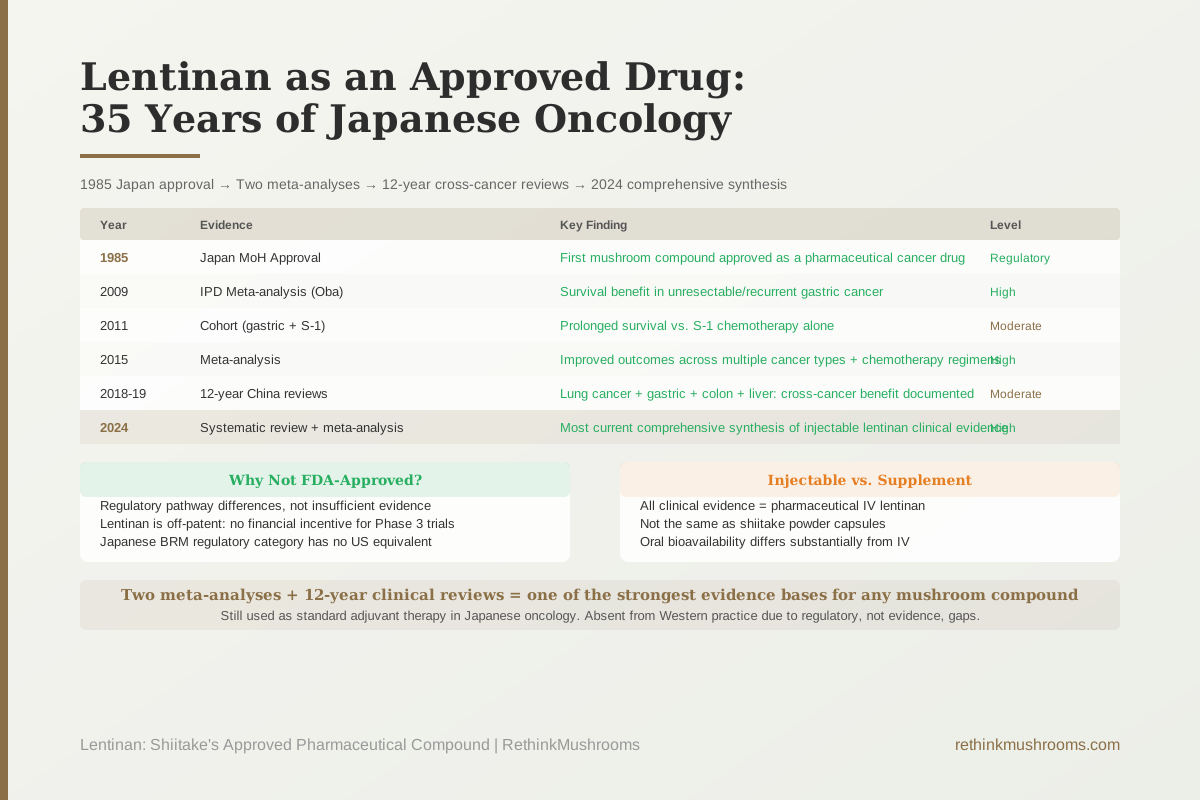
In 1985, Japan's Ministry of Health approved injectable lentinan as an adjuvant treatment for gastric cancer. Forty years of clinical use, two meta-analyses, and 12-year cross-country clinical reviews have since accumulated. Here is the complete evidence trajectory.
Oba et al., 2009 (individual patient meta-analysis); 2024 systematic review and meta-analysis
individual patient data
Oba 2009 used the gold-standard meta-analysis method: pooling data on individual patients, not study averages
injectable only
the approved form is IV-administered pharmaceutical lentinan, not shiitake powder capsules
gastric + lung + colon
lentinan has since been studied across multiple cancer types beyond the original gastric cancer indication
Oba et al., 2009 (individual patient meta-analysis); 2024 systematic review and meta-analysis
 View as image ↗
Most discussions of lentinan in supplement marketing treat it as a promising compound with "some research showing benefits." This framing is inaccurate. Lentinan is an approved drug in Japan. It has been administered intravenously to gastric cancer patients as part of oncology treatment for over 40 years. Its evidence base includes two independent meta-analyses. Twelve-year clinical reviews from China document its expanding use across cancer types.
The gap between this clinical reality and what most health websites communicate about lentinan is significant. This article covers the actual evidence: what lentinan is approved for, what the clinical studies show, why it is not FDA-approved despite the evidence, and what the evidence base means in practice.
For the molecular structure and mechanism of lentinan, see What Are Beta-Glucans? The Most Important Compound in Medicinal Mushrooms.
Key Takeaways
- Japan's Ministry of Health approved injectable lentinan as an adjuvant treatment for gastric cancer in 1985, making it the first mushroom-derived compound to receive pharmaceutical approval anywhere in the world
- Oba and colleagues (2009) conducted an individual patient data meta-analysis, the gold standard of evidence synthesis, confirming a survival benefit from lentinan in patients with unresectable or recurrent gastric cancer
- A 2015 meta-analysis showed that lentinan injection combined with chemotherapy improved outcomes across multiple cancer types and chemotherapy regimens
- A 12-year systematic review of Chinese clinical data on lentinan in lung cancer (2018) and a 12-year review covering multiple cancer types (2019) document expanded clinical use beyond the original gastric cancer indication
- A 2024 systematic review and meta-analysis represents the most current comprehensive clinical evidence summary for injectable lentinan and includes the most recent trial data
- The approved and clinically tested form is pharmaceutical-grade injectable lentinan; this is not the same as shiitake mushroom supplements or oral lentinan capsules, which have different bioavailability profiles and have not been tested in the same clinical contexts
The Evidence Base: Lentinan in Clinical Oncology
The clinical evidence for lentinan in cancer treatment is documented across multiple study types. The following table summarizes the key studies by indication, study type, and finding.
| Cancer | Study Type | Key Finding | Study |
|---|---|---|---|
| Gastric cancer (unresectable/recurrent) | Individual patient meta-analysis | Survival benefit vs. chemotherapy alone | Oba 2009 |
| Gastric cancer + S-1 chemotherapy | Cohort study | Prolonged survival vs. S-1 alone | 2011 |
| Multiple cancers + chemotherapy | Meta-analysis | Improved outcomes across regimens | 2015 |
| Gastric cancer with liver metastases | Cohort study | Clinical benefit in advanced disease | 2016 |
| Advanced gastric cancer | Cohort study | Confirmed efficacy as biological response modifier | 2017 |
| Lung cancer (12 years China data) | Systematic review | Benefit in combination with chemotherapy | 2018 |
| Multiple cancers (12 years China data) | Systematic review | Cross-cancer clinical application documented | 2019 |
| Injectable lentinan (comprehensive) | Systematic review + meta-analysis | Most current synthesis of full clinical evidence | 2024 |
All studies used injectable lentinan combined with chemotherapy or other standard-of-care treatments, not oral supplemental forms.
The 1985 Approval: What It Means That Lentinan Is a Drug
Lentinan was approved by Japan's Ministry of Health in 1985 as an adjuvant therapy for gastric cancer. "Adjuvant" in oncology means treatment given alongside the primary treatment (surgery or chemotherapy) to improve outcomes, typically by reducing recurrence or improving survival.
The approval was based on clinical trial data accumulated through the 1970s and 1980s. Japanese researchers, particularly the groups led by Goro Chihara, had established through the preceding decade that lentinan, a purified beta-1,3/1,6-glucan from Lentinula edodes (shiitake), showed potent anti-tumor activity in animal models and, subsequently, in human clinical trials.
The 1985 approval made lentinan the first mushroom-derived compound to receive pharmaceutical regulatory approval for cancer treatment anywhere in the world. This precedes PSK (polysaccharide-K from Turkey Tail), which was approved in Japan slightly later.
The clinical form approved is injectable: lentinan is administered intravenously, typically at 1-2 mg doses per infusion, given one to three times weekly alongside chemotherapy. This pharmaceutical formulation ensures that the intact polysaccharide reaches systemic immune circulation, bypassing the bioavailability challenges that oral beta-glucans face.
This distinction matters for consumers. Shiitake mushroom supplements and oral lentinan capsules are not the same as the approved injectable product. The clinical evidence described in this article is for the injectable pharmaceutical form.
Oba 2009: The Individual Patient Meta-Analysis
The most methodologically rigorous evidence for lentinan in gastric cancer comes from a 2009 individual patient data meta-analysis by Oba and colleagues.[1]
Individual patient data (IPD) meta-analysis is the gold standard of evidence synthesis. Rather than pooling summary statistics from published studies (the standard meta-analytic approach), IPD meta-analysis collects the original patient-level data from each contributing trial and re-analyzes it using a standardized method. This eliminates a class of statistical artifacts that can distort standard meta-analyses and allows more precise subgroup analysis.
Oba and colleagues pooled individual patient data from trials of lentinan in patients with unresectable or recurrent gastric cancer. The analysis found a statistically significant survival benefit in patients receiving lentinan alongside chemotherapy compared to chemotherapy alone.
Gastric cancer is one of the most lethal cancers globally, particularly in East Asia where it is among the most common cancers diagnosed. Unresectable or recurrent gastric cancer (cancer that cannot be surgically removed or has returned after treatment) has a poor prognosis. A survival benefit in this population, demonstrated through individual patient data, is clinically meaningful.
The Oba 2009 IPD meta-analysis is the single strongest piece of evidence in the lentinan clinical literature, and it is almost entirely absent from Western health content discussions of shiitake or lentinan.
The 2015 Meta-Analysis: Lentinan Across Chemotherapy Regimens
A 2015 meta-analysis examined lentinan injection combined with chemotherapy in the treatment of cancer, expanding beyond the gastric cancer focus of earlier work.[2]
This meta-analysis found that adding lentinan to chemotherapy improved clinical outcomes across multiple cancer types and multiple chemotherapy drug regimens. The finding is relevant because it establishes that lentinan's benefit is not limited to one specific chemotherapy drug combination or one tumor type, a pattern that would suggest nonspecific biological response modification rather than a narrowly specific mechanism.
The 2015 meta-analysis is particularly useful for understanding lentinan as a "biological response modifier" (BRM): a category of compounds that work by modulating the immune system's response to tumors rather than by directly killing cancer cells. BRMs were a significant focus of Japanese oncology research in the 1980s-2000s, and lentinan was the flagship compound in this category.
Contemporary Japanese Clinical Experience
Three cohort studies document lentinan's continued use in Japanese oncology practice across different disease presentations.
A 2011 cohort study examined lentinan combined with S-1 chemotherapy in gastric cancer patients.[3] S-1 (tegafur/gimeracil/oteracil) is a standard oral chemotherapy regimen widely used in Japan for gastric cancer. The study found that patients receiving lentinan alongside S-1 showed prolonged survival compared to patients receiving S-1 alone. This is notable because S-1 is modern chemotherapy; lentinan was showing additive benefit to a contemporary drug, not just older regimens.
A 2016 study extended the picture to gastric cancer with liver metastases, one of the most difficult presentations to treat.[4] Chemo-immunotherapy with lentinan showed clinical benefit even in this advanced disease state, suggesting lentinan's immune-enhancing effects operate even in heavily burdened immune systems.
A 2017 cohort study confirmed lentinan's efficacy as a biological response modifier in advanced gastric cancer patients receiving chemotherapy, adding to the contemporary clinical experience data outside the meta-analysis framework.[5]
Expansion Beyond Gastric Cancer: 12-Year Reviews
The evidence base for lentinan expanded significantly through systematic reviews of Chinese clinical practice, which had adopted lentinan independently of the original Japanese approval context.
A 2018 systematic review compiled 12 years of Chinese clinical data on lentinan as immunotherapy specifically for lung cancer.[6] Lung cancer is a substantially different tumor type from gastric cancer, with different immune microenvironment characteristics. The 12-year Chinese review documents consistent benefit from lentinan combined with chemotherapy across lung cancer subtypes, establishing that lentinan's anti-tumor immune effects are not gastric-cancer-specific.
A 2019 systematic review expanded the lens further, covering 12 years of Chinese clinical studies across multiple cancer types including gastric, lung, colon, and liver cancer.[7] This review is notable for including data on superfine dispersed lentinan (SDLN), an oral formulation specifically developed for colorectal cancer where IV administration is impractical in some settings. The SDLN data represents the most clinically documented oral lentinan form, distinct from crude shiitake supplements.
The 2018 and 2019 reviews collectively establish that lentinan's clinical use in East Asia has extended well beyond the 1985 Japanese approval for gastric cancer, and that evidence for benefit has been accumulated across multiple tumor types in real-world clinical practice.
The 2024 Evidence Update
The most current comprehensive clinical evidence synthesis for injectable lentinan is a 2024 systematic review and meta-analysis covering the published trial data through 2023.[8]
This 2024 meta-analysis represents the largest and most statistically powerful synthesis of the injectable lentinan evidence base. It includes trial data not available when the earlier 2009 and 2015 meta-analyses were conducted and applies contemporary evidence synthesis methodology.
The 2024 systematic review is also notable for its survival and quality-of-life outcome scope, important because cancer adjuvant therapy is evaluated not only on survival extension but also on whether it allows patients to maintain function and comfort during treatment. Lentinan's immune-modulating mechanism is hypothesized to contribute to quality-of-life benefits by reducing chemotherapy-associated immune suppression.
Why Lentinan Is Not FDA-Approved
The most common question about lentinan from Western consumers and clinicians is why a compound with two meta-analyses showing benefit is not approved by the US FDA or European EMA.
The honest answer involves regulatory philosophy, market incentives, and trial design, not lack of evidence.
First, the regulatory pathway that Japan used for lentinan in 1985, classifying it as a biological response modifier under Japanese drug law, does not have a direct equivalent in US regulatory categories for natural polysaccharides. The FDA would require independent Phase 3 trials conducted under its specific protocols and good clinical practice standards.
Second, lentinan is off-patent. The original patents on the purification and clinical formulation have long expired. No pharmaceutical company has a financial incentive to fund the expensive Phase 3 trials that the FDA requires, because any competitor could sell an approved lentinan product without recovering the trial investment. This is the same reason many generic compounds with clinical promise never achieve FDA approval: the economics of drug development require that the approving company recoup its investment through patent protection.
Third, the clinical trials used to support the Japanese approval and subsequent use were conducted primarily in Japan and China, in patient populations with higher baseline gastric cancer rates than Western populations. The FDA has historically required trials conducted in Western populations under FDA oversight for approval decisions.
None of these factors is a statement about the evidence quality. The Oba 2009 individual patient data meta-analysis is methodologically rigorous. The 2024 systematic review synthesizes a substantial evidence base. The absence of FDA approval reflects regulatory and market dynamics rather than a determination that the evidence is insufficient.
What the Evidence Means for Supplement Users
The clinical evidence for lentinan is specifically for pharmaceutical-grade injectable lentinan. This creates a genuine gap between the clinical data and what supplement consumers have access to.
Oral lentinan capsules and shiitake mushroom supplements contain lentinan-type beta-glucans, but at different purity levels, molecular weights, and structural conformations than the pharmaceutical injectable. A 2024 study established that oral lentinan reaches immune cells through a different mechanism than IV administration: Dectin-1-mediated uptake in intestinal Peyer's patches and lymphatic transport, rather than direct blood circulation. This explains why oral forms can produce immunomodulatory effects, but at lower intensity than the injectable.
The honest hierarchy is: injectable pharmaceutical lentinan (clinically approved and studied) is substantially better characterized and documented than oral supplemental lentinan. The clinical benefits documented in the meta-analyses cannot be assumed to translate to oral supplemental forms at commercially available doses.
For a detailed comparison of oral versus injectable lentinan bioavailability, see Oral vs. Injectable Lentinan: Bioavailability Differences. For lentinan's specific immune activation mechanism, see Lentinan's Mechanism of Action: Immune Activation Research.
For comparison with PSK, the other Japan-approved mushroom cancer drug from Turkey Tail, see How PSK Works: Mechanisms of Anti-Cancer Action.
The Bottom Line
Lentinan is an injectable pharmaceutical approved in Japan in 1985 for gastric cancer adjuvant treatment. The evidence base includes: Oba 2009 (individual patient data meta-analysis confirming survival benefit in unresectable/recurrent gastric cancer), a 2015 meta-analysis showing benefit across chemotherapy regimens and cancer types, cohort studies in gastric cancer with S-1 chemotherapy (2011), liver metastases (2016), and as a biological response modifier (2017), 12-year Chinese clinical reviews for lung cancer (2018) and multiple cancer types (2019), and a 2024 systematic review and meta-analysis as the current evidence gold standard. The evidence is for injectable pharmaceutical lentinan, not oral supplements.
Frequently Asked Questions
Sources & References
- 1. Source details for this reference are not yet available.
- 2. Source details for this reference are not yet available.
- 3. Source details for this reference are not yet available.
- 4. Source details for this reference are not yet available.
- 5. Source details for this reference are not yet available.
- 6. Source details for this reference are not yet available.
- 7. Source details for this reference are not yet available.
- 8. Source details for this reference are not yet available.