Bioactive Compounds in Mushrooms
1985: Japan's Ministry of Health approves lentinan, the first mushroom compound ever licensed as a pharmaceutical cancer drug
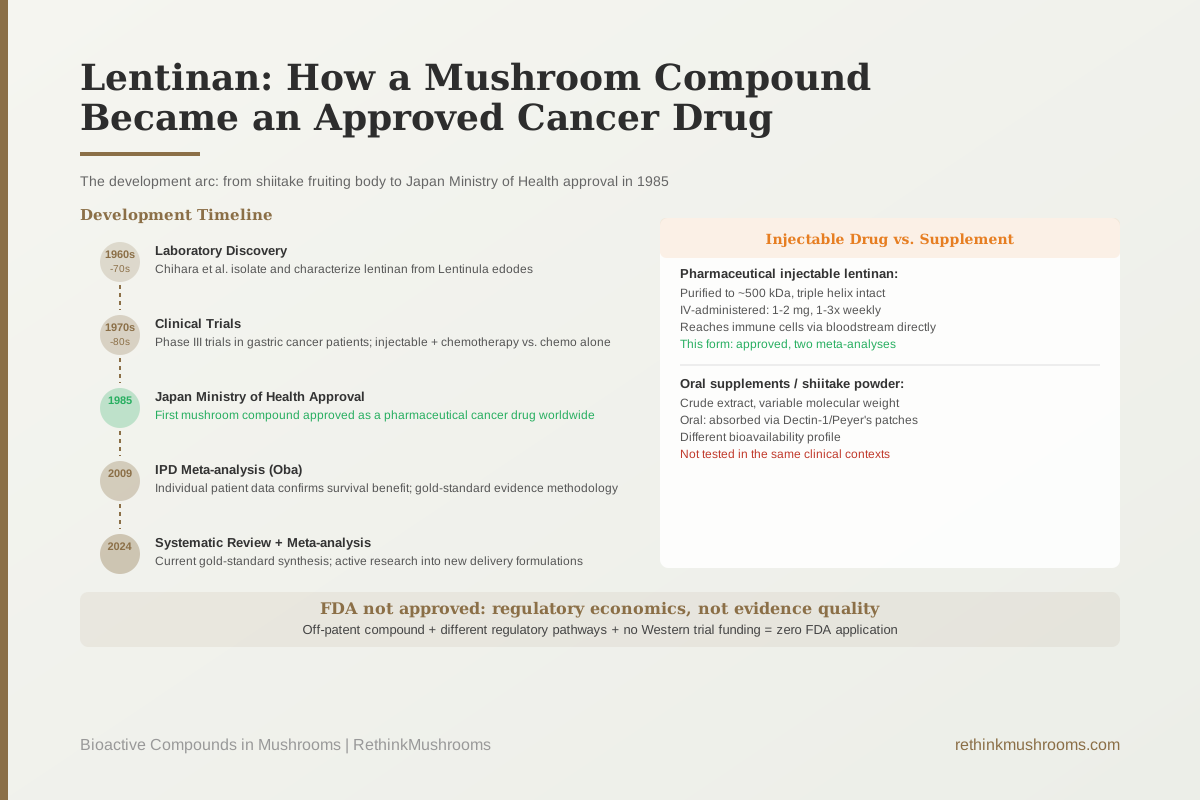
The story of lentinan begins with a culinary mushroom and ends with a drug used in Japanese oncology for four decades. Here is the development path: from laboratory isolation to clinical trial to regulatory approval.
Oba et al., 2009 (individual patient meta-analysis); 2024 systematic review
shiitake
Lentinula edodes, the source of lentinan, consumed as food for centuries before the compound was isolated
beta-1,3-glucan
lentinan's molecular class: a polysaccharide, not a protein; distinct from lentin and from lentinan supplements
IV administration
the approved pharmaceutical form is injectable, not oral: a critical distinction for supplement context
Oba et al., 2009 (individual patient meta-analysis); 2024 systematic review
 View as image ↗
Shiitake mushroom (Lentinula edodes) has been cultivated and consumed in East Asia for at least a thousand years. For most of that history, it was a food and a folk remedy, used in traditional medicine without knowledge of the specific compounds responsible for its effects.
Starting in the 1960s and 1970s, Japanese researchers began systematically isolating and testing shiitake's bioactive constituents. What they found eventually produced something unusual in the natural products world: a pharmaceutical drug.
Lentinan, a purified beta-glucan polysaccharide extracted from shiitake, was approved by Japan's Ministry of Health in 1985 for the treatment of gastric cancer as an adjuvant therapy. It was the first mushroom-derived compound to receive pharmaceutical regulatory approval anywhere in the world and remains one of the few natural polysaccharides licensed as a cancer drug.
For the full clinical evidence trajectory since 1985, see Lentinan as an Approved Drug: 35 Years of Japanese Oncology Experience. For the structural chemistry that explains why lentinan is biologically active, see What Are Beta-Glucans? The Most Important Compound in Medicinal Mushrooms.
Key Takeaways
- Lentinan is a purified beta-1,3-D-glucan (with beta-1,6 branch points) isolated from Lentinula edodes (shiitake) fruiting bodies, with a molecular weight of approximately 500,000 Da; it forms a triple helix in aqueous solution that is essential for its biological activity
- Japanese researchers, particularly Goro Chihara and colleagues, established lentinan's anti-tumor activity in animal models in the 1970s, triggering the clinical trial program that led to the 1985 approval
- Japan's Ministry of Health approved injectable lentinan in 1985 as an adjuvant treatment for gastric cancer, making it the first mushroom compound licensed as a pharmaceutical cancer drug
- The 2009 individual patient data meta-analysis by Oba and colleagues remains the most methodologically rigorous evidence for lentinan, demonstrating survival benefit in unresectable/recurrent gastric cancer
- A 2024 comprehensive review published in the European Journal of Medical Research covered lentinan's mechanisms (TLR, Dectin-1, MAPK-NFkB signaling), clinical applications, and new delivery formulations, reflecting ongoing research interest decades after approval
- The approved and clinically studied form is pharmaceutical-grade injectable lentinan; shiitake mushroom supplements and oral lentinan capsules have different molecular profiles and have not been tested in the same clinical contexts as the injectable drug
What Is Lentinan? A Precise Definition
Lentinan is a purified beta-1,3-D-glucan polysaccharide with beta-1,6-glucan branch points, extracted from the fruiting bodies of Lentinula edodes (shiitake mushroom). Its molecular weight is approximately 500,000 Daltons (500 kDa), making it a high molecular weight polysaccharide.
In aqueous solution, lentinan forms a triple helix: three polysaccharide chains wound around each other in a helical configuration. This triple helix conformation is essential for lentinan's biological activity; chemically degraded or heat-denatured lentinan that loses this tertiary structure shows reduced immunostimulatory activity.
Lentinan should not be confused with lentin, which is a protein (not a polysaccharide) isolated from shiitake with separate antifungal and antiviral properties. Nor should it be confused with generic shiitake extracts or shiitake powder supplements, which contain various lentinan-type compounds at lower purity and potentially different structural conformations than the pharmaceutical preparation.
The compound's name derives directly from the mushroom: Lentinula edodes, the shiitake mushroom species.
The Discovery: How Japanese Researchers Found the Active Compound
The story of lentinan's development runs through postwar Japanese pharmaceutical research, during a period of significant investment in natural product drug discovery.
Researchers studying the pharmacological properties of edible and medicinal mushrooms in the 1960s began testing extracts of shiitake in cancer models. Early studies using crude polysaccharide extracts from Lentinula edodes showed anti-tumor effects in mouse models: animals bearing transplanted tumors that received shiitake extracts showed tumor regression or inhibited tumor growth compared to untreated controls.
The critical next step was isolation and characterization. Rather than testing crude extracts (which contain hundreds of compounds), researchers sought to identify which specific constituent was responsible for the anti-tumor activity. The purification work required separating the polysaccharide fraction, then further purifying it to obtain individual molecular components.
Goro Chihara, working at the National Cancer Center Research Institute in Japan, became the central figure in lentinan's characterization. His group isolated and characterized the specific beta-glucan responsible for the observed anti-tumor activity in the 1970s, established its molecular structure, and demonstrated reproducible anti-tumor effects in standardized animal models.
This foundational work established lentinan as a distinct compound with measurable and reproducible biological activity, which was the prerequisite for moving into clinical trials.
From Laboratory to Clinical Trial
The transition from animal model evidence to clinical trials followed the pattern typical of pharmaceutical drug development, but with the unique context of Japan's regulatory approach to biological response modifiers in the 1970s-80s.
Biological response modifiers (BRMs) were a distinct focus of Japanese oncology research during this period. The concept behind BRMs is that cancer treatment can work not only by directly attacking tumor cells (as chemotherapy does) but also by enhancing the immune system's ability to recognize and fight tumors. BRMs represented a different paradigm from the dominant chemotherapy-focused approach in Western oncology.
Lentinan fit the BRM category precisely: rather than killing cancer cells directly, it appeared to enhance the immune system's response to tumors, improving the body's capacity to suppress tumor growth. This mechanism made it a natural fit for Japan's biological response modifier research program.
Clinical trials of lentinan in gastric cancer patients were conducted through the late 1970s and early 1980s, evaluating its effects when added to standard chemotherapy. These trials compared outcomes (survival, response rates, quality of life) between patients receiving chemotherapy alone and patients receiving chemotherapy plus injectable lentinan.
The results from these trials provided the clinical evidence base that Japan's Ministry of Health evaluated for the 1985 approval decision.
1985: The Approval
Japan's Ministry of Health approved injectable lentinan in 1985 as an adjuvant treatment for gastric cancer. This approval marked a milestone: it was the first time a purified mushroom-derived compound had received pharmaceutical regulatory approval for cancer treatment anywhere in the world.
The approved form was specific and important. Lentinan for clinical use is administered intravenously, typically at doses of 1-2 mg per infusion, given one to three times weekly alongside chemotherapy. This formulation ensures that the purified, structurally intact polysaccharide reaches the immune system directly through the bloodstream, bypassing the bioavailability challenges that large polysaccharides face when taken orally.
The oral bioavailability problem is real: lentinan is a high molecular weight polysaccharide (~500 kDa), and conventional pharmaceutical thinking holds that molecules of this size are not absorbed efficiently through the gastrointestinal tract. The injectable route eliminates this barrier entirely.
The 1985 approval was for gastric cancer specifically. Gastric (stomach) cancer was, and remains, among the most common cancers in Japan and East Asia, which made it the natural focus for a BRM developed in the Japanese research ecosystem.
The Evidence That Supported Approval and the Evidence That Followed
The clinical trials used to support the 1985 approval established that lentinan combined with chemotherapy improved outcomes versus chemotherapy alone in gastric cancer patients. Subsequent research has strengthened and extended this evidence base.
Oba and colleagues published a 2009 individual patient data (IPD) meta-analysis, the most methodologically rigorous form of evidence synthesis.[1] Rather than pooling summary statistics from published trials, the IPD approach collects original patient-level data from each contributing trial and reanalyzes it with standardized methodology. This eliminates a class of statistical biases that can distort standard meta-analyses.
The Oba 2009 IPD meta-analysis found a statistically significant survival benefit from lentinan in patients with unresectable or recurrent gastric cancer. The word "unresectable" means cancer that cannot be surgically removed, which is a severe disease state. Demonstrating a survival benefit in this population using the most rigorous meta-analytic method available strengthened the evidence for lentinan's clinical utility considerably.
A 2011 cohort study extended the evidence to lentinan combined with S-1, a modern oral chemotherapy regimen: patients receiving lentinan alongside S-1 showed prolonged survival compared to S-1 alone.[2] This was important because it established that lentinan's benefit was not limited to older chemotherapy regimens; it added value to contemporary treatments.
A 2019 systematic review of 12 years of Chinese clinical data documented that lentinan use had extended beyond Japan into China and beyond gastric cancer into lung, colon, and liver cancer.[3] This cross-border adoption suggested that the clinical community found the evidence for lentinan convincing enough to incorporate into practice independently of the Japanese regulatory context.
A 2024 comprehensive review in the European Journal of Medical Research covered lentinan's mechanisms (Toll-like receptor and Dectin-1 signaling, MAPK-NFkB cascade), clinical applications across multiple cancer types, and new delivery formulations under investigation, reflecting that research interest in lentinan remains active decades after approval.[4]
The most current comprehensive synthesis is a 2024 systematic review and meta-analysis covering the full injectable lentinan clinical trial literature.[5] This represents the most statistically powerful analysis of the evidence base to date.
Why Lentinan Has Not Been Adopted in Western Oncology
The question that most Western readers have after learning about lentinan is obvious: if it has been approved in Japan since 1985 with a supporting individual patient meta-analysis, why is it not used in oncology elsewhere?
The answer has several components, none of which is "insufficient evidence."
Regulatory pathway differences. Japan used a specific regulatory category for biological response modifiers in the 1980s that facilitated approval under a different framework than the FDA's drug approval process. The FDA would require independent Phase 3 trials conducted under FDA-specific protocols, good clinical practice standards, and with FDA oversight. The trials used for the Japanese approval were not conducted under these requirements.
Patent expiration. Lentinan's patents have long since expired. The original developers cannot recoup the investment required for FDA Phase 3 trials through patent exclusivity; any company could sell an FDA-approved lentinan product, including generic manufacturers who paid nothing for the trials. This eliminates the economic incentive for any company to fund the approval process.
Trial population differences. The clinical trials were conducted primarily in Japanese and Chinese populations, where gastric cancer rates are substantially higher than in Western countries. FDA approval processes have historically required trials conducted in the intended approval population, and Western pharmaceutical companies have not funded gastric cancer-specific lentinan trials in Western populations.
Western oncology culture. The BRM research paradigm was more prominent in Japan and East Asia in the 1980s-2000s than in Western oncology, which was more focused on chemotherapy refinement. Checkpoint immunotherapy (which shares conceptual similarities with the BRM approach) became prominent in Western oncology only in the 2010s.
None of these factors represents a judgment that lentinan's evidence is insufficient. The Oba 2009 individual patient data meta-analysis is a high-quality piece of evidence by international standards.
What This Means for Supplement Consumers
The most common consumer question about lentinan is whether shiitake mushroom supplements containing lentinan-type compounds produce the same benefits documented in the clinical trials.
The honest answer is that they are not the same product, and the evidence does not directly apply to oral supplements.
The pharmaceutical injectable is purified lentinan at a specific molecular weight and structural conformation, delivered directly into the bloodstream at doses of 1-2 mg per infusion. Oral shiitake supplements contain crude extracts with lentinan-type compounds at lower purity, variable molecular weights and structures, delivered through the gastrointestinal tract where large polysaccharides face bioavailability challenges.
A 2024 study established that oral lentinan does reach immune cells through a specific mechanism: Dectin-1-mediated uptake in intestinal Peyer's patches followed by lymphatic transport. This explains how oral beta-glucans produce immunomodulatory effects despite poor conventional bioavailability. But the clinical efficacy demonstrated for injectable lentinan in gastric cancer cannot be assumed to transfer to oral supplemental forms at commercially available doses.
The supplement framing that is consistent with the evidence: shiitake mushrooms and lentinan-containing supplements may support immune function through mechanisms related to those documented for pharmaceutical lentinan; they are not equivalent to the approved drug and have not been tested in cancer patients in the same clinical contexts.
For the comparison with PSK, the other Japan-approved mushroom compound for cancer, see How PSK Works: Mechanisms of Anti-Cancer Action. For how lentinan enhances anti-tumor immunity, see How Lentinan Enhances Anti-Tumor Immunity.
The Bottom Line
Lentinan, a purified beta-1,3-D-glucan from shiitake mushroom (Lentinula edodes), was approved in Japan in 1985 as the first mushroom compound to receive pharmaceutical regulatory approval. Japanese research from the 1970s by Goro Chihara's group established its anti-tumor activity, leading to gastric cancer adjuvant trials. The Oba 2009 individual patient meta-analysis subsequently confirmed survival benefit in unresectable/recurrent gastric cancer. A 2024 systematic review and meta-analysis represents the current gold-standard evidence synthesis. The approved form is injectable pharmaceutical lentinan; oral supplements are a different product class with different bioavailability profiles.
Frequently Asked Questions
Sources & References
- 1. Source details for this reference are not yet available.
- 2. Source details for this reference are not yet available.
- 3. Source details for this reference are not yet available.
- 4. Source details for this reference are not yet available.
- 5. Source details for this reference are not yet available.