Bioactive Compounds in Mushrooms
~500k Da
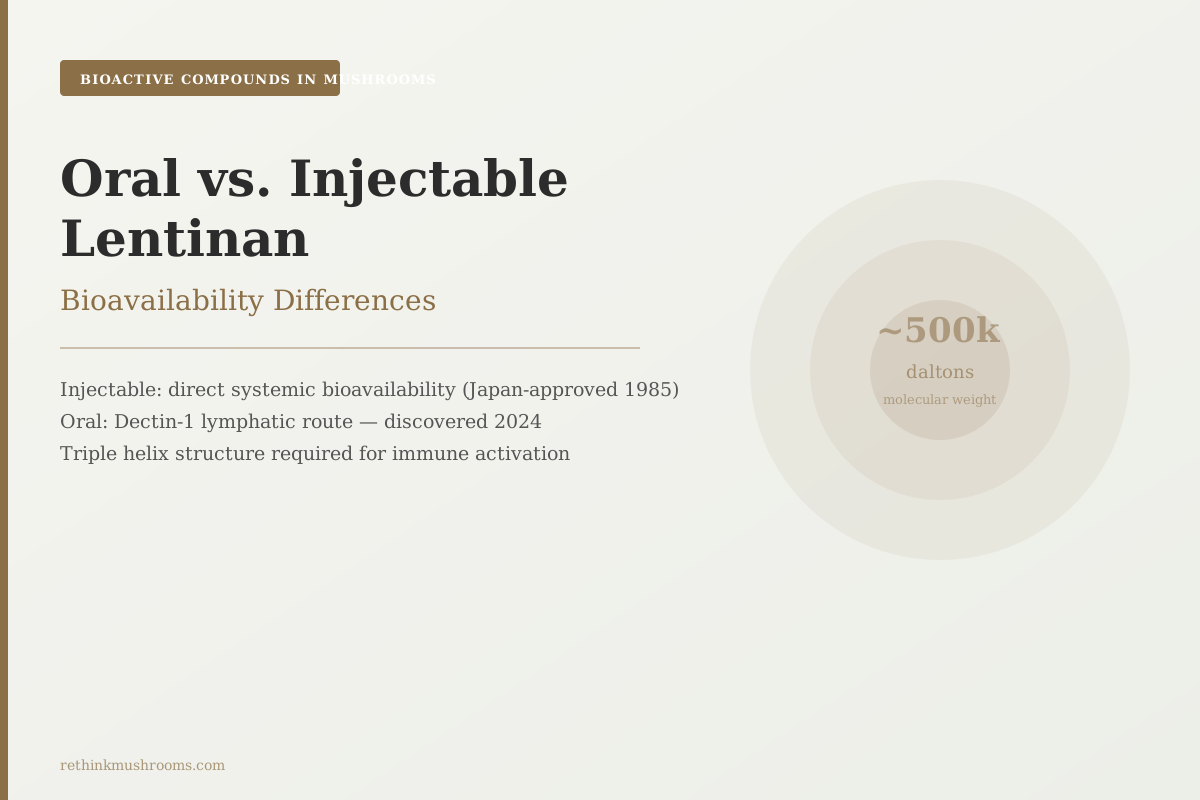
Lentinan's molecular weight of roughly 500,000 daltons made it one of the largest molecules ever used clinically and convinced researchers it could never be absorbed orally. A 2024 discovery about lymphatic transport changes that picture.
2024 systematic review and meta-analysis on injectable lentinan
1985
year Japan approved injectable lentinan for gastric cancer — the first mushroom pharmaceutical
Dectin-1
the gut receptor that allows oral lentinan to enter immune tissue via lymphatic transport, not blood circulation
3 tiers
of oral lentinan evidence: injectable pharmaceutical, superfine dispersed clinical form, and crude supplements
2024 systematic review and meta-analysis on injectable lentinan
 View as image ↗
The practical question behind this article is one that people researching lentinan supplements ask constantly: do the capsules produce the same effect as the injections used in Japanese hospitals? The honest answer requires understanding why lentinan was designed as an injectable drug in the first place, what the 2024 research on oral absorption reveals, and where consumer supplements fit in that picture.
Lentinan is a beta-glucan polysaccharide extracted from shiitake mushrooms. It has been approved in Japan as an adjunct cancer treatment since 1985, administered intravenously. The injectable form bypasses the absorption challenge entirely: lentinan enters the bloodstream directly and reaches immune cells in full structural integrity. Oral forms face a different set of biological obstacles, and until recently the understanding of how oral lentinan reaches immune tissue was incomplete.
This article is part of our guide to beta-glucans and bioactive mushroom compounds. Here we cover why the absorption question matters, what the 2024 research discovered, and the honest hierarchy of evidence from injectable pharmaceutical to supplement capsule.
Key Takeaways
- Injectable lentinan achieves direct systemic bioavailability by entering the bloodstream, bypassing all absorption barriers; this is the form approved in Japan since 1985 for gastric cancer treatment, backed by a 2024 systematic review and meta-analysis confirming its clinical efficacy[5]
- Conventional drug absorption assumes molecules enter the bloodstream through the gut wall — lentinan's high molecular weight (~500,000 daltons) makes this route essentially unavailable, which is why oral bioavailability was long considered poor
- A 2024 study identified the actual oral absorption mechanism: lentinan is taken up via Dectin-1 receptors in Peyer's patches (immune surveillance tissue in the small intestine) and transported via the lymphatic system rather than blood circulation[1]
- The triple helix structure of lentinan must be preserved for immune activation — research from 2000 showed that losing this tertiary structure reduces cytokine-stimulating activity, raising questions about structural stability during GI transit[3]
- Superfine dispersed oral lentinan (SDLN), a micronized clinical form, has produced measurable anti-cancer effects in studies reviewed over 12 years of Chinese clinical data — a more clinically relevant oral form than standard powder capsules[2]
- Consumer shiitake supplements and lentinan capsules sit at the lowest tier of the evidence hierarchy: they may produce some immunomodulatory effects via the newly understood lymphatic pathway, but their lentinan content, structural integrity, and clinical effect magnitude have not been systematically validated
Why Lentinan Was Designed as an Injectable Drug in the First Place
Standard pharmacology assumes that a drug molecule taken orally must cross the gut wall into the bloodstream to become systemically available. The gut wall acts as a selective barrier, allowing small molecules to pass through while blocking large ones. Most pharmaceutical drugs have molecular weights below 1,000 daltons; this range enables efficient absorption through the intestinal wall.
Lentinan's molecular weight is approximately 500,000 daltons. This is not a small molecule. It is 500 times larger than the upper limit for conventional intestinal absorption. By conventional pharmacological reasoning, taking lentinan by mouth should produce no systemic effect because it simply cannot cross the gut barrier.
This reasoning drove the original pharmaceutical development decision. When Japanese researchers confirmed lentinan's anti-tumor and immunostimulatory activity in the 1970s, the only viable path to clinical application was intravenous administration: inject lentinan directly into the bloodstream and bypass the absorption problem entirely. That is the approved form.
A 2024 systematic review and meta-analysis synthesized the clinical evidence for injectable lentinan, pooling survival and quality-of-life outcomes from the trial base that has accumulated over four decades.[5] The injectable form has 40 years of clinical use in Japanese oncology, with a well-characterized pharmacokinetic profile: intravenous dosing delivers lentinan with predictable plasma concentrations, and the immune activation that follows is measurable and reproducible.
The 2024 Discovery: How Oral Lentinan Actually Reaches Immune Cells
The assumption that oral lentinan produces no systemic effect was always partially at odds with observation. Eating shiitake mushrooms — which contain lentinan as part of their cell wall structure — produces measurable changes in immune markers in some studies. If lentinan couldn't be absorbed, what was driving those changes?
A 2024 study identified the mechanism.[1] Oral lentinan is absorbed not through the conventional blood circulation route but through a different pathway: Dectin-1-mediated uptake into Peyer's patches, followed by lymphatic transport.
Unpacking those terms: Peyer's patches are clusters of lymphoid tissue embedded in the wall of the small intestine. They function as immune surveillance stations — sampling the contents of the gut for potential pathogens. They contain specialized immune cells, including macrophages and dendritic cells, that extend sampling arms into the gut lumen and actively capture particles and molecules. These cells carry receptors, including Dectin-1, that are specifically designed to recognize beta-glucan molecules, the cell wall components of fungi.
When oral lentinan reaches the small intestine, Dectin-1-expressing cells in the Peyer's patches capture it through active endocytosis, pulling the molecule inside the cell. Once captured, the lentinan-containing cells enter the lymphatic circulation rather than the blood circulation. Lymph vessels run throughout the body's immune tissue and eventually drain back into the bloodstream at the thoracic duct, near the heart. Lentinan transported this way reaches systemic immune compartments without having to cross the gut barrier as a free molecule.
This explains why oral lentinan can produce immunomodulatory effects even though standard pharmacokinetic models predict it should not. The 2024 study is preclinical, based on cell and tissue work rather than clinical trials. Its significance is mechanistic: it resolves a longstanding puzzle about why oral forms show any activity at all, and it identifies Peyer's patch uptake as the relevant absorption site.
The Triple Helix Problem: Does Oral Lentinan Survive the Stomach?
Understanding that oral lentinan can reach immune cells via Peyer's patches raises a follow-up question: does the lentinan arriving at those patches retain the structural configuration required for immune activation?
Research published in 2000 established that beta-glucan cytokine-stimulating activity depends critically on molecular structure.[3] Lentinan in solution adopts a triple helix configuration — three polysaccharide chains wound around each other, similar in concept to the double helix of DNA but with three chains. This tertiary structure is required for the molecule to bind Dectin-1 and other immune receptors with sufficient affinity to trigger cytokine production. Disrupt that structure and the biological activity decreases substantially.
The stomach is acidic, with pH values between 1.5 and 3.5 during digestion. Polysaccharide triple helices are generally more resistant to acid denaturation than protein structures, but they are not infinitely stable. The relevant question is whether lentinan's triple helix survives intact from ingestion through to the Peyer's patches in the small intestine.
A 2024 comprehensive review in the European Journal of Medical Research addressed delivery formulations for lentinan specifically, noting that new formulation approaches are being developed to improve structural preservation during GI transit.[4] The fact that new formulations are being actively developed suggests that stability during transit is a recognized challenge, not a solved problem. For standard oral lentinan capsules, structural integrity during digestion is not guaranteed and has not been systematically characterized across commercial products.
This structural stability question does not apply to injectable lentinan, which is formulated in sterile solution and enters the bloodstream without GI exposure.
Superfine Dispersed Oral Lentinan: The Clinically Studied Middle Tier
Between injectable pharmaceutical lentinan and crude shiitake supplement capsules sits a form that has actually been tested in clinical settings: superfine dispersed oral lentinan, abbreviated SDLN.
A 2019 review covering 12 years of lentinan clinical studies in China included data on SDLN for colorectal cancer patients.[2] The review covered gastric, lung, colon, and liver cancer clinical data. SDLN is produced through micronization — reducing lentinan particles to extremely small sizes, which increases the surface area in contact with intestinal tissue and may improve the probability of Dectin-1-mediated uptake. The clinical data from the 12-year review showed measurable anti-cancer effects from oral SDLN, making it a more clinically relevant oral form than standard powder capsules.
SDLN is not widely available outside China and is not an approved pharmaceutical anywhere. It represents an intermediate step in oral lentinan formulation development: better absorption than standard capsules, inferior to injectable, and backed by a more substantial evidence base than consumer supplements. The review covering its clinical use provides context for what oral lentinan can achieve under optimized conditions, which is meaningful for interpreting what consumer products might or might not do.
For the broader picture of which cancers lentinan has been studied for, including the oral forms, the lentinan and immune activation mechanism article covers the biological pathways. For comparison with PSK, the other Japan-approved mushroom pharmaceutical, see how PSK works.
The Evidence Hierarchy: From Injectable Pharmaceutical to Shiitake Supplements
The 2024 research and the Chinese clinical data together allow a clear ranking of lentinan forms by evidence quality and absorption certainty:
Tier 1: Injectable pharmaceutical lentinan. Direct intravenous delivery; no absorption barrier; full structural integrity at target tissues; 40+ years of clinical use; approved in Japan; backed by two systematic reviews and meta-analyses and multiple cohort studies.[5] This is the reference standard against which all other forms are measured.
Tier 2: Superfine dispersed oral lentinan (SDLN). Micronized form specifically designed for improved oral absorption; clinical data across multiple cancer types from the 12-year China review; not approved; predominantly available in clinical contexts in China.[2] Measurable clinical effects with lower intensity than injectable.
Tier 3: Standard oral lentinan supplements. Mechanistically plausible via Dectin-1-mediated lymphatic transport;[1] structural integrity during GI transit unverified for most products; lentinan content varies across manufacturers and is not standardized; no clinical data specific to the supplement form at standard supplement doses. The 2024 review noted new delivery formulations being developed to address these gaps.[4]
Tier 4: Dietary shiitake consumption. Whole shiitake mushrooms contain lentinan as part of their cell wall structure. Regular consumption produces measurable immune effects in some human studies, likely via the same Dectin-1 pathway. This is a different context from taking concentrated lentinan for cancer treatment, but it reflects that some oral lentinan activity occurs even from food sources.
What the 2024 Discovery Means for Supplement Buyers
The Dectin-1 lymphatic transport finding validates the conceptual basis for oral lentinan supplements. Oral lentinan can reach immune cells and produce immunomodulatory effects. This is a genuine scientific advance over the prior assumption that oral lentinan was essentially inactive.
What it does not validate: any specific commercial product. The finding establishes the pathway; it does not establish that every lentinan supplement on the market delivers intact triple-helix lentinan to Peyer's patches at clinically relevant concentrations. Product quality varies substantially. Lentinan content on supplement labels is not standardized or independently verified in most markets. Extraction methods differ, and some extraction processes involve conditions that may disrupt the triple helix structure that the 2000 SAR study identified as required for immune activation.[3]
For the cancer treatment use case that the injectable pharmaceutical addresses, the gap between Tier 1 and Tier 3 evidence is clinically significant. The injectable form has 40 years of documented use in oncology with measurable survival data. Consumer lentinan supplements do not have that evidence base, and claiming equivalence would misrepresent both what the 2024 discovery shows and what the clinical literature actually demonstrates.
For general immune support rather than oncology applications, the lower evidence bar means the gap between injectable and oral supplement is less operationally important. The 2024 finding supports that regular oral lentinan may produce genuine immunomodulatory effects — a modest but real form of biological activity.
The lentinan history and drug approval article covers the 40-year clinical record of injectable lentinan in Japanese oncology. For the broader lentinan and anti-tumor immunity evidence, see how lentinan enhances anti-tumor immunity.
The Bottom Line
Injectable lentinan achieves full systemic bioavailability, bypassing all GI absorption barriers, and is backed by 40 years of Japanese clinical use. Oral lentinan was long assumed to be poorly absorbed, but 2024 research identified Dectin-1-mediated uptake into Peyer's patches and lymphatic transport as the actual oral absorption mechanism. The clinical gap between injectable and oral supplement forms remains significant: injectable evidence includes meta-analyses and an approved indication; oral supplement evidence does not. SDLN, the micronized clinical form, sits between these tiers with Chinese clinical data supporting measurable effects.
Frequently Asked Questions
Sources & References
- 1. Source details for this reference are not yet available.
- 2. Source details for this reference are not yet available.
- 3. Source details for this reference are not yet available.
- 4. Source details for this reference are not yet available.
- 5. Source details for this reference are not yet available.