Bioactive Compounds in Mushrooms
Precision regulation not blunt immunostimulation
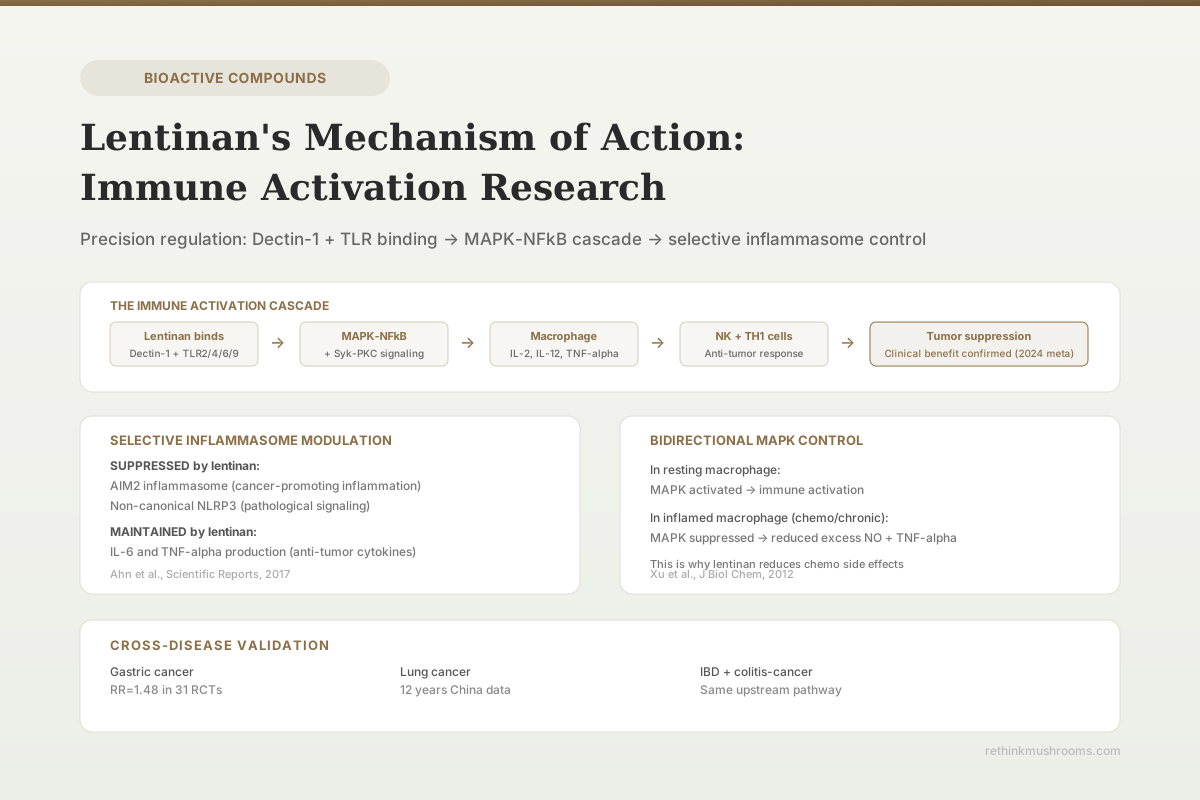
Lentinan selectively activates beneficial immune pathways while suppressing cancer-promoting ones, including AIM2 inflammasome inhibition alongside pro-inflammatory cytokine induction.
2024 review, European Journal of Medical Research
Dectin-1 + TLRs
pattern recognition receptors lentinan binds to on macrophages and dendritic cells to initiate its immune cascade
MAPK-NFkB
primary downstream signaling pathway activated by lentinan after receptor binding, leading to macrophage activation and cytokine production
AIM2 selective
Ahn 2017: lentinan selectively attenuates AIM2 and non-canonical inflammasome (cancer-promoting) while inducing beneficial pro-inflammatory cytokines
2024 review, European Journal of Medical Research
 View as image ↗
Lentinan does not kill cancer cells directly. It has no cytotoxic activity of its own. What it does is alter the immune environment around a tumor, making the immune system more effective at recognizing and attacking cancer cells while the tumor's defenses are weakened. Understanding exactly how this happens requires tracing the full signaling cascade from initial receptor binding to clinical outcome.
This article maps that cascade based on the published mechanistic research. For lentinan's clinical evidence in gastric cancer and its 30-year Japanese approval history, see lentinan as an approved drug: 35 years of Japanese oncology experience. For the broader beta-glucan compound class that lentinan belongs to, see what are beta-glucans.
Key Takeaways
- Lentinan initiates its immune cascade by binding to pattern recognition receptors on immune cells: Dectin-1, TLR2, TLR4, TLR6, and TLR9 on macrophages and dendritic cells
- Receptor binding activates two main downstream signaling pathways: MAPK-NFkB (the primary pro-inflammatory axis) and Syk-PKC, leading to macrophage activation and cytokine release
- Activated macrophages produce IL-2, IL-12, and TNF-alpha, which prime natural killer cells and polarize T helper cells toward the anti-tumor TH1 phenotype
- The 2017 selective inflammasome finding is key: lentinan specifically suppresses AIM2 and non-canonical NLRP3 inflammasome activation (which drive cancer-promoting chronic inflammation) while simultaneously inducing beneficial pro-inflammatory cytokine production
- Lentinan also inhibits MAPK phosphorylation in certain contexts, reducing excess nitric oxide and TNF-alpha production that can cause tissue damage during chemotherapy
- A 2024 review in the European Journal of Medical Research confirmed and extended this receptor-to-signaling-to-immune-cell cascade with new data on lentinan's applications in both inflammatory diseases and tumors
Step 1: Pattern Recognition and Receptor Binding
The immune system identifies foreign material and cellular stress signals through pattern recognition receptors (PRRs). These receptors are expressed on innate immune cells, particularly macrophages and dendritic cells, and they recognize specific molecular patterns associated with pathogens or cellular damage.
Lentinan's triple-helix beta-1,3-glucan structure is recognized as a pathogen-associated molecular pattern (PAMP), looking structurally similar to the cell walls of fungi that the immune system has evolved to detect as threats. The primary receptors that bind lentinan are Dectin-1 (a C-type lectin receptor specialized for beta-glucan detection) and Toll-like receptors TLR2, TLR4, TLR6, and TLR9.
A 2024 comprehensive review in the European Journal of Medical Research mapped the full receptor pharmacology of lentinan, confirming this multi-receptor engagement as the initiating step in its immune cascade.[1]
The binding of lentinan to Dectin-1 is particularly important. Dectin-1 is the beta-glucan specific receptor; it has a carbohydrate recognition domain that physically accommodates the triple-helix structure of lentinan. When Dectin-1 binds lentinan, it activates the Syk kinase pathway (a separate downstream cascade from TLR signaling). When TLR2/4 bind lentinan simultaneously, the two signaling arms (Syk-PKC from Dectin-1, and MyD88-MAPK-NFkB from TLRs) converge and amplify each other.
A foundational 1995 structure-activity study established that the specific molecular architecture of beta-1,3-glucans, their branching pattern and tertiary structure, is what determines whether they stimulate cytokine production at this step.[4] Denatured lentinan that has lost its triple helix does not trigger this receptor recognition properly, which is why structural integrity matters for activity.
Step 2: Downstream Signaling Cascades
Once receptors bind lentinan, two intracellular signaling cascades activate:
MAPK-NFkB pathway: Mitogen-activated protein kinases (MAPK) are enzymes that relay signals from the cell surface to the nucleus, where they alter gene expression. NFkB (nuclear factor kappa-light-chain-enhancer of activated B cells) is a transcription factor that, when activated, drives production of pro-inflammatory cytokines including IL-6, TNF-alpha, and various interleukins. The combination of MAPK phosphorylation and NFkB nuclear translocation produces the macrophage activation state that is central to lentinan's immune effect.
Syk-PKC pathway: This arm, activated by Dectin-1, leads to protein kinase C (PKC) activation and additional signaling through the CARD9-Bcl10-MALT1 complex, which also activates NFkB through a distinct route. The two pathways reinforce each other at the NFkB convergence point.
The 2012 study by Xu and colleagues characterized an additional dimension of this signaling in detail: lentinan beta-glucan from Lentinus edodes inhibited nitric oxide and TNF-alpha production via MAPK pathway suppression in LPS-activated macrophages.[3] This appears contradictory at first: MAPK activation drives cytokine production, but MAPK suppression reduces it. The resolution is context: in a resting macrophage, lentinan activates MAPK to initiate immune activation. In an already-inflamed macrophage (as occurs during chemotherapy or chronic inflammation), lentinan can modulate MAPK to reduce excessive NO and TNF-alpha production. This bidirectional regulation is one feature that distinguishes lentinan from cruder immunostimulants.
Step 3: Macrophage Activation and Cytokine Production
The converging signaling cascades produce a macrophage activation state characterized by:
- Increased phagocytic activity (macrophages become better at engulfing and destroying pathogens and abnormal cells)
- Production of IL-2 and IL-12 (cytokines that prime T cells and NK cells)
- Production of TNF-alpha (a direct anti-tumor cytokine that can induce cancer cell apoptosis)
- Increased expression of MHC class II molecules (enabling macrophages to better present tumor antigens to T cells)
This macrophage activation state shifts the tumor microenvironment. Tumors typically exploit immunosuppressive mechanisms to avoid detection; they recruit regulatory T cells, produce immunosuppressive cytokines, and express checkpoint molecules that turn off immune attack. Activated macrophages produce the cytokine signals that counter these evasions, creating conditions where the tumor is more visible to and attackable by the adaptive immune system.
The 2015 meta-analysis confirming lentinan's clinical immune effects provides the human-level validation: across multiple trials, lentinan significantly increased CD3+ lymphocyte counts, CD4+:CD8+ ratios, and NK cell activity in cancer patients.[5] These measured immune parameters align directly with the mechanism: more T cells, better T helper:suppressor ratio, more NK cells.
Step 4: TH1 Polarization and NK Cell Enhancement
The IL-12 produced by lentinan-activated macrophages has a specific downstream effect on T helper cell differentiation. Naive CD4+ T helper cells can polarize toward either TH1 (pro-inflammatory, anti-tumor) or TH2 (anti-inflammatory, anti-parasite) phenotypes depending on the cytokine environment. IL-12 strongly drives TH1 polarization.
TH1 cells produce interferon-gamma (IFN-gamma), which further activates macrophages (a self-amplifying loop) and directly enhances the killing capacity of cytotoxic CD8+ T cells and NK cells. NK cells (natural killer cells) are innate immune cells that can kill abnormal cells, including cancer cells, without requiring prior antigen sensitization. Their activation and expansion is a key feature of lentinan's clinical immune effects.
This TH1 shift is particularly important in the context of tumors, which typically establish a TH2-dominant, immunosuppressive microenvironment. Reversing TH2 dominance toward TH1 is one of the cellular-level explanations for lentinan's clinical activity as a chemotherapy adjunct.
The Selective Inflammasome Finding: Precision Immunomodulation
The most mechanistically sophisticated aspect of lentinan's immune effects comes from a 2017 study by Ahn and colleagues published in Scientific Reports.[2]
Inflammasomes are multiprotein complexes in immune cells that, when activated, produce IL-1beta and IL-18, cytokines that drive inflammation. There are multiple types of inflammasomes: NLRP3, AIM2, and non-canonical (activated by intracellular LPS). Each has different triggers and roles.
Ahn's group found that lentinan selectively attenuates two inflammasome types (AIM2 and non-canonical NLRP3) while simultaneously inducing production of pro-inflammatory cytokines IL-6 and TNF-alpha through the more conventional NFkB pathway.
The significance: AIM2 inflammasome activation has been linked to chronic inflammation that promotes tumor development. Non-canonical inflammasome signaling drives some pathological inflammatory states. By selectively suppressing these pathways while maintaining the anti-tumor cytokine response, lentinan acts like a calibrated switch rather than a general immune booster.
This selectivity is relevant to lentinan's safety profile. Blunt immunostimulation carries risks; systemic inflammation can damage normal tissue and worsen conditions like autoimmune disease. A compound that activates anti-tumor immunity while downregulating cancer-promoting inflammatory pathways represents a more precise pharmacological profile. The Ahn 2017 finding is the mechanistic basis for this precision, and it is completely absent from mainstream coverage of lentinan.
Beyond Cancer: IBD and the Anti-Inflammatory Dimension
Lentinan's mechanism extends beyond oncology. The same MAPK-NFkB pathway modulation that activates macrophages against tumors also affects intestinal immune homeostasis.
A 2019 systematic review synthesized the evidence on lentinan for inflammatory bowel disease (IBD) and colitis-associated cancer, finding therapeutic effects in both conditions.[6] The mechanism in IBD involves reducing excessive mucosal inflammation while maintaining appropriate immune surveillance. Colitis-associated cancer (cancer arising in the context of chronic IBD) involves a pathway where chronic gut inflammation drives oncogenic transformation; lentinan's ability to reduce this specific type of inflammation while preserving anti-cancer immune capacity explains its potential application in this setting.
Zhang and colleagues' 2018 12-year review of lentinan as immunotherapy for lung cancer documented clinical immune improvements over a sustained period, confirming that lentinan's immune activation is a consistent, reproducible effect across different cancer types, not a gastric-cancer-specific phenomenon.[7]
The consistency of immune activation across gastric cancer, lung cancer, and IBD despite the different tissue contexts, reflects the upstream nature of lentinan's mechanism. Because it acts at the level of innate immune receptors (Dectin-1, TLRs) on macrophages and dendritic cells, its effects are not disease-specific. The immune activation it produces is broadly deployed by the immune system wherever it is needed. For how PSK from turkey tail mushroom compares as a parallel approved Japanese cancer immunotherapy compound, see how PSK works: mechanisms of anti-cancer action.
The Bottom Line
Lentinan activates immunity through a defined receptor-to-signaling-to-immune-cell cascade: Dectin-1 and TLR2/4/6/9 binding triggers MAPK-NFkB and Syk-PKC signaling, producing macrophage activation, IL-2/IL-12/TNF-alpha production, TH1 polarization, and NK cell enhancement. The 2017 Ahn study established that lentinan selectively suppresses AIM2 and non-canonical inflammasome activation while maintaining beneficial pro-inflammatory cytokine induction, demonstrating immune precision rather than blunt stimulation. The same mechanism underlies activity across gastric cancer, lung cancer, and IBD in clinical evidence spanning 12+ years in Japan and China.
Frequently Asked Questions
Sources & References
- 1. Source details for this reference are not yet available.
- 2. Source details for this reference are not yet available.
- 3. Source details for this reference are not yet available.
- 4. Source details for this reference are not yet available.
- 5. Source details for this reference are not yet available.
- 6. Source details for this reference are not yet available.
- 7. Source details for this reference are not yet available.