Agaricus blazei Practical Guide
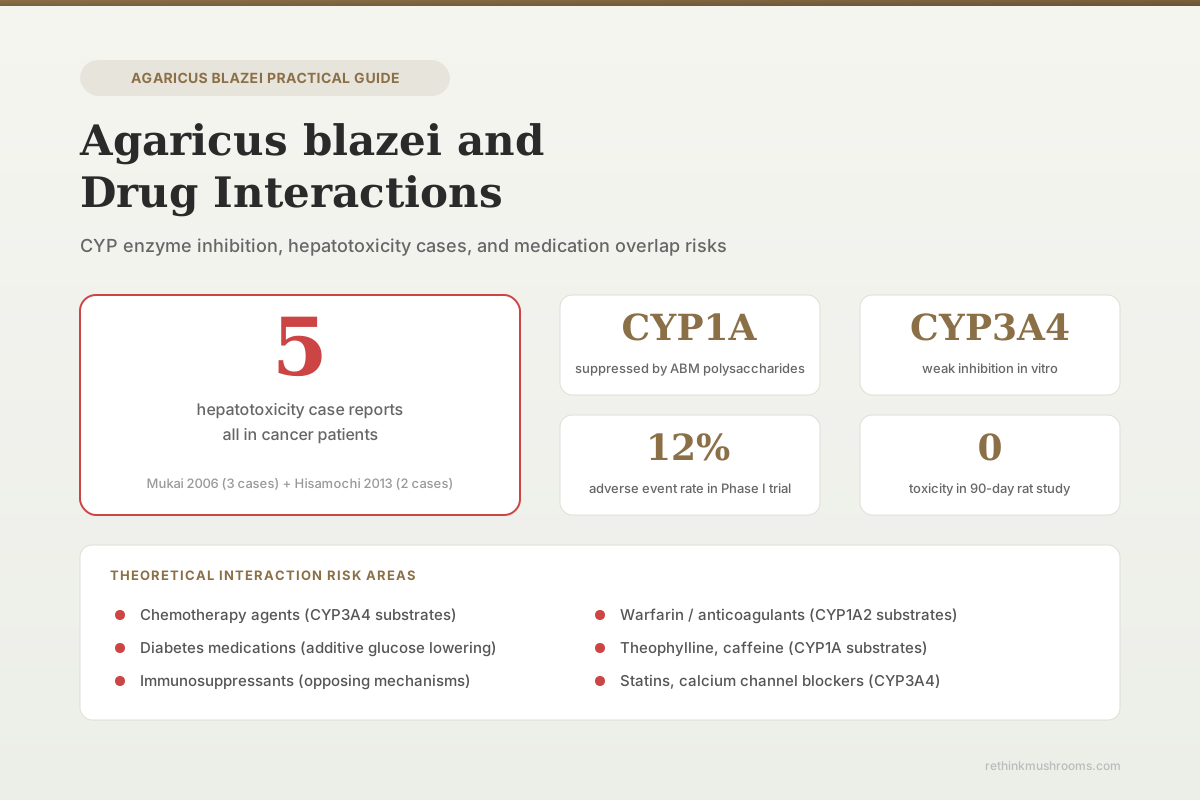
3 hepatotoxicity cases
Three cancer patients developed severe liver damage while taking Agaricus blazei extract; two died of fulminant hepatitis, and one recovered after stopping the supplement.
Mukai et al., Japanese Journal of Clinical Oncology, 2006
CYP1A suppressed
in mouse liver by ABM polysaccharides
12% adverse events
in Phase I cancer survivor trial
No subchronic toxicity
in 90-day rat feeding study
Mukai et al., Japanese Journal of Clinical Oncology, 2006
 View as image ↗
Agaricus blazei drug interactions are poorly studied in humans but signal real concern in several directions. The mushroom inhibits cytochrome P450 enzymes in vitro, has caused liver damage in cancer patients taking it alongside chemotherapy, and lowers blood glucose in ways that could compound with diabetes medications.[1] For an overview of the full safety profile of Agaricus blazei, including adverse event rates from clinical studies, see our dedicated article.
The problem with this evidence is not that it shows Agaricus blazei is dangerous. The problem is that almost none of the interaction data comes from controlled human studies. What we have instead is a small collection of case reports, in vitro enzyme assays, and animal experiments that raise flags without quantifying actual risk.
Key Takeaways
- Agaricus blazei polysaccharides suppressed both constitutive and induced CYP1A expression and enzyme activity in mouse liver (Hashimoto et al., 2002)
- Three cancer patients developed severe hepatic dysfunction while taking ABM extract; two died of fulminant hepatitis (Mukai et al., 2006)
- A Phase I trial of 78 cancer survivors taking 1.8 to 5.4 g ABM daily for 6 months found adverse events in 12%, mostly digestive, with one liver-related allergic reaction (Ohno et al., 2011)
- A 90-day rat feeding study found no subchronic toxicity from ABM aqueous extract at doses up to 2,500 mg/kg/day (Kuroiwa et al., 2005)
- Two additional cases of drug-induced liver injury resembling autoimmune hepatitis were documented in patients taking ABM alongside other supplements (Hisamochi et al., 2013)
- ABM extracts lower blood glucose in diabetic models, creating theoretical interaction risk with insulin and oral diabetes drugs (Hsu et al., 2007)
How Drug Interactions Happen
Most drug interactions occur through two pathways: metabolic enzyme interference and transporter protein disruption.
The cytochrome P450 (CYP) family of enzymes in the liver metabolizes an estimated 70 to 80% of all pharmaceutical drugs. When a supplement inhibits a CYP enzyme, the drugs that enzyme processes accumulate to higher-than-intended blood levels. When a supplement induces (upregulates) a CYP enzyme, drugs are cleared faster than expected, reducing their efficacy. Either scenario can be clinically dangerous, particularly for drugs with narrow therapeutic windows like warfarin, cyclosporine, and certain chemotherapy agents.
P-glycoprotein (P-gp) is a membrane efflux pump that actively pushes drugs out of cells, particularly in the gut and blood-brain barrier. Inhibiting P-gp increases drug absorption and tissue penetration. Firenzuoli et al. (2008) noted that Agaricus blazei extract inhibits both CYP enzymes and P-glycoprotein to a mild degree in vitro, comparable to green tea.[1]
Cytochrome P450 Enzyme Inhibition
CYP1A Suppression in Mice
The most direct evidence for Agaricus blazei affecting drug metabolism comes from Hashimoto et al. (2002), who fed mice polysaccharides isolated from both Agaricus blazei and Lentinus edodes (shiitake).[2]
ABM polysaccharides suppressed both constitutive CYP1A expression and 3-methylcholanthrene-induced CYP1A expression in the liver. The functional consequence was measurable: ethoxyresorufin-O-deethylation (EROD) activity, a standard assay for CYP1A enzyme function, decreased in treated mice. CYP1A enzymes metabolize several drug classes including theophylline, caffeine, clozapine, and certain proton pump inhibitors.
This suppression occurred from oral polysaccharide intake, making it more clinically relevant than studies using isolated compounds injected directly. The polysaccharides responsible are the same beta-glucans studied for immune effects, meaning anyone taking ABM for immune support would also be exposed to the CYP1A-suppressing compounds.
CYP3A4 Inhibition In Vitro
CYP3A4 is the single most important drug-metabolizing enzyme, handling roughly 50% of pharmaceutical drugs including statins, calcium channel blockers, immunosuppressants, and many chemotherapy agents. In vitro testing found that Agaricus blazei extract inhibited CYP3A4 with an IC50 of 1,324 micrograms per milliliter.[1] This is a relatively high IC50, meaning relatively weak inhibition compared to potent CYP3A4 inhibitors like ketoconazole or grapefruit juice. Firenzuoli et al. (2008) considered clinically relevant systemic CYP3A4 interactions unlikely based on this data.
The caveat: in vitro IC50 values do not account for gut-level concentrations, which can be much higher than systemic levels after oral supplementation. Grapefruit juice's most important drug interactions occur in the gut, not the liver, and the same could theoretically be true for ABM extracts.
Diabetes Medications: The Blood Sugar Overlap
Agaricus blazei lowers blood glucose through multiple mechanisms: GLUT-4 upregulation, alpha-glucosidase inhibition, and improved insulin sensitivity.[8] In the only human trial, 1,500 mg daily reduced insulin resistance (HOMA-IR) in type 2 diabetes patients already taking metformin and gliclazide. For full details on these hypoglycemic effects, see our dedicated article.
This creates a pharmacodynamic interaction risk. ABM does not necessarily interfere with how diabetes drugs are metabolized; rather, it may add to their glucose-lowering effect. The Hsu et al. (2007) trial specifically enrolled patients already on metformin and gliclazide without observing hypoglycemic episodes, but the trial was small (72 patients) and only 12 weeks long.[8]
The risk would be highest with sulfonylureas (gliclazide, glipizide, glimepiride) and insulin, which can cause hypoglycemia when their glucose-lowering effect is amplified. Metformin alone rarely causes hypoglycemia, making it a lower-risk combination partner. No study has specifically measured hypoglycemic event rates in patients combining ABM with diabetes medications at doses commonly sold as supplements.
Hepatotoxicity Case Reports
The most serious safety signal comes from case reports of liver damage.
Mukai et al. (2006): Three Cancer Patients
Three patients with advanced cancer developed severe hepatic dysfunction while taking ABM extract.[3] Two patients died of fulminant hepatitis. The third patient's liver function recovered after stopping ABM but deteriorated again when she resumed the supplement, a pattern called positive dechallenge/rechallenge that strongly implicates ABM as the cause. All three patients had cancer and were taking other medications, making definitive causation attribution complicated. But the rechallenge case provides unusually strong evidence.
Hisamochi et al. (2013): Autoimmune-like Hepatitis
Two additional patients developed drug-induced liver injury (DILI) with histological features closely resembling autoimmune hepatitis.[4] A 60-year-old woman with malignant thymoma was taking ABM extract plus Ganoderma lucidum extract. A 75-year-old man with lung cancer was taking ABM extract plus fucoidan. Both had stable cancers under observation, not active chemotherapy, which weakens the argument that chemotherapy drugs caused the liver damage.
The autoimmune hepatitis-like histology suggests an immune-mediated mechanism. Given that ABM is taken specifically for its immune-stimulating properties, the possibility that immune activation could misdirect toward the liver is biologically plausible.
Context for These Cases
Five total case reports of hepatotoxicity exist in the literature, all in cancer patients. Millions of people in Japan and Brazil have consumed ABM supplements, meaning the absolute incidence of liver injury appears very low. However, cancer patients may be uniquely vulnerable due to compromised liver function from disease or prior chemotherapy. The interaction between ABM's immune-stimulating effects and existing immune dysregulation in cancer could explain why these cases cluster in this population.
Phase I Safety Data
Ohno et al. (2011) conducted the only formal dose-escalation safety study.[5] Seventy-eight cancer patients in remission received 1.8, 3.6, or 5.4 grams of ABM granulated powder daily for six months. This is a longer and more systematic safety evaluation than the 12-week diabetes trial.
Adverse events occurred in 9 of 78 patients (12%). Most were digestive: nausea, diarrhea, and stomach discomfort. One patient developed a liver dysfunction-related food allergy. The adverse events were not dose-dependent, meaning higher doses did not produce more side effects. No cases of fulminant hepatitis occurred.
Laboratory parameters including liver enzymes, kidney function, and blood counts remained within normal limits for most patients. The study concluded that ABM is "generally safe, excluding possible allergic reaction" at doses up to 5.4 grams daily for 6 months.
The 12% adverse event rate is notable but within the range expected for dietary supplements. The absence of severe hepatotoxicity contrasts with the Mukai case reports, supporting the hypothesis that advanced active cancer (not cancer remission) is the risk-amplifying factor. For dosage considerations, this study provides the best safety-margin reference available.
Animal Safety Data
Kuroiwa et al. (2005) fed F344 rats an aqueous ABM extract at doses of 625, 1,250, and 2,500 mg/kg/day for 90 days.[6] No treatment-related toxic effects were observed at any dose. Body weight, food consumption, organ weights, hematology, serum biochemistry, and histopathology were all normal.
The highest dose tested, 2,500 mg/kg/day, translates to roughly 175 grams per day for a 70 kg human using standard allometric scaling. This is far above any supplement dose, providing a wide safety margin for the extract form tested. However, this study used an aqueous (water) extract. Different extraction methods produce different compound profiles, and the safety of ethanol or ethyl acetate fractions at high doses has not been tested with the same rigor.
Huang et al. (2022) reviewed the broader safety literature and noted that ABM contains agaritine, a hydrazine derivative classified as IARC Group 3 (not classifiable as carcinogenic to humans).[7] A 90-day study in F344 rats fed 80 mg agaritine/kg/day found no DNA adducts from agaritine metabolites, and multiple 2-year chronic feeding studies with both Agaricus blazei and Agaricus bisporus (the common button mushroom) failed to demonstrate carcinogenicity.
Known Unknowns
The drug interaction evidence for Agaricus blazei has several large gaps:
No human pharmacokinetic studies exist. No study has given ABM to humans while measuring blood levels of a co-administered drug. All CYP inhibition data comes from test tubes and mouse livers. The clinical significance of these findings is genuinely unknown.
Supplement composition varies widely. Different supplement forms contain different ratios of beta-glucans, agaritine, and other compounds. Safety data from one preparation does not necessarily apply to another.
Cancer patients may not represent the general population. The hepatotoxicity cases all occurred in cancer patients. Whether healthy individuals or those with other chronic conditions face similar risks is unstudied.
Duration data is limited. The longest controlled safety data covers 12 months. Long-term effects of daily ABM supplementation beyond this timeframe have not been evaluated.
Combination supplement effects are unclear. Both Hisamochi cases involved patients taking ABM alongside other supplements (Ganoderma lucidum, fucoidan). Whether the liver injury resulted from ABM alone or from the combination cannot be determined from these cases.
Immunosuppressant interactions are unstudied. ABM is widely consumed for its immune-stimulating properties. Patients taking immunosuppressants (transplant recipients, autoimmune disease patients) face a theoretical dual risk: pharmacokinetic interaction through CYP enzyme inhibition potentially raising drug levels, and pharmacodynamic opposition where ABM stimulates the same immune system the drugs are trying to suppress. No study has examined this combination. Patients taking calcineurin inhibitors (tacrolimus, cyclosporine), which have narrow therapeutic windows and are CYP3A4 substrates, represent the population where this theoretical risk is highest.
Anticoagulant interactions are uncharacterized. Warfarin is metabolized partly by CYP1A2, the enzyme ABM polysaccharides suppress in mice. If this CYP1A2 suppression occurs in humans, warfarin clearance could decrease, raising bleeding risk. No case report or study has examined this combination.
The Bottom Line
Agaricus blazei inhibits CYP1A enzymes in mice and CYP3A4 weakly in vitro, lowers blood glucose in ways that could interact with diabetes medications, and has caused severe liver injury in five cancer patients across two case series. A Phase I trial in 78 cancer survivors and a 90-day rat study found no serious toxicity. The evidence raises legitimate safety signals, particularly for cancer patients and those on narrow-therapeutic-window drugs, but the absence of human pharmacokinetic studies leaves the clinical significance of these signals unquantified.
Frequently Asked Questions
Sources & References
- 1RTHM-00131·Firenzuoli, F et al. (2008). “The Medicinal Mushroom Agaricus blazei Murrill: Review of Literature and Pharmaco-Toxicological Problems..” Evidence-based complementary and alternative medicine : eCAM.Study breakdown →PubMed →↩
- 2RTHM-00047·Hashimoto, Takashi et al. (2002). “Suppressive effect of polysaccharides from the edible and medicinal mushrooms, Lentinus edodes and Agaricus blazei, on the expression of cytochrome P450s in mice..” Bioscience.Study breakdown →PubMed →↩
- 3RTHM-00105·Mukai, Hirofumi et al. (2006). “An alternative medicine, Agaricus blazei, may have induced severe hepatic dysfunction in cancer patients..” Japanese journal of clinical oncology.Study breakdown →PubMed →↩
- 4RTHM-00287·Hisamochi, Akiko et al. (2013). “Drug-induced liver injury associated with Agaricus blazei Murill which is very similar to autoimmune hepatitis..” Clinical journal of gastroenterology.Study breakdown →PubMed →↩
- 5RTHM-00229·Ohno, Satoshi et al. (2011). “Phase I Clinical Study of the Dietary Supplement, Agaricus blazei Murill, in Cancer Patients in Remission..” Evidence-based complementary and alternative medicine : eCAM.Study breakdown →PubMed →↩
- 6RTHM-00083·Kuroiwa, Y et al. (2005). “Lack of subchronic toxicity of an aqueous extract of Agaricus blazei Murrill in F344 rats..” Food and chemical toxicology : an international journal published for the British Industrial Biological Research Association.Study breakdown →PubMed →↩
- 7RTHM-00765·Huang, Kaiyuan et al. (2022). “Critical review on chemical compositions and health-promoting effects of mushroom Agaricus blazei Murill..” Current research in food science.Study breakdown →PubMed →↩
- 8RTHM-00114·Hsu, Chung-Hua et al. (2007). “The mushroom Agaricus Blazei Murill in combination with metformin and gliclazide improves insulin resistance in type 2 diabetes: a randomized, double-blinded, and placebo-controlled clinical trial..” Journal of alternative and complementary medicine (New York.Study breakdown →PubMed →↩