Agaricus blazei Practical Guide
6x More Beta-Glucan
Fruiting body extracts of medicinal mushrooms averaged 31% beta-glucans, while mycelium-on-grain powders averaged just 5-7%, according to standardized enzymatic testing.
McCleary & Draga, Journal of AOAC International, 2016
Hot Water
primary method for beta-glucan extraction
35-40% Starch
found in mycelium-on-grain products
9 Clinical Trials
used extracted forms, not raw powder
McCleary & Draga, Journal of AOAC International, 2016
 View as image ↗
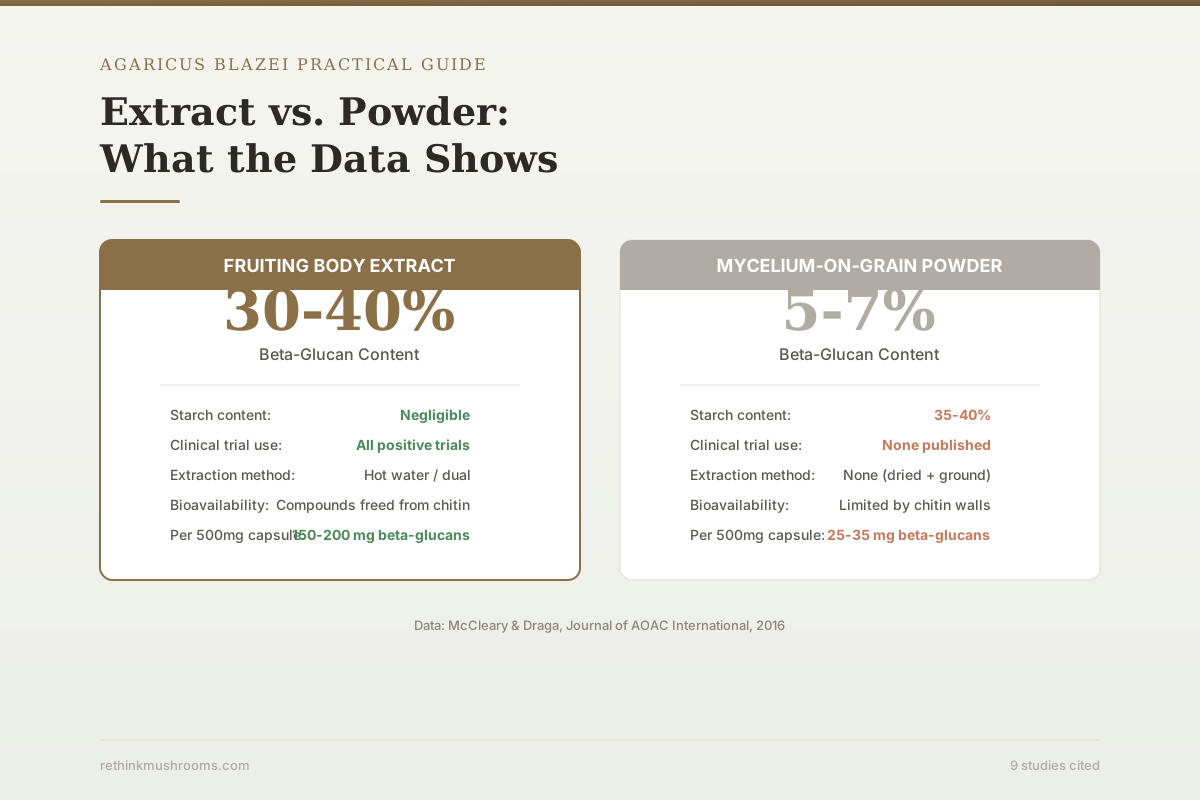
The difference between an Agaricus blazei extract and a raw mushroom powder is not a marketing distinction. It is a measurable difference in beta-glucan concentration that ranges from 5-fold to 10-fold depending on the product. When McCleary and Draga developed a standardized method for measuring beta-glucans in mushroom products in 2016, they found that fruiting body extracts consistently contained 30-40% beta-glucans, while mycelium grown on grain averaged 5-7% beta-glucans with 35-40% residual starch from the grain substrate.[1] Since beta-glucans are the primary compounds behind ABM's documented immune effects, this gap matters. Every clinical trial that produced positive results in cancer patients, hepatitis patients, and IBD patients used extracted forms of ABM, not raw powders.
Key Takeaways
- Standardized beta-glucan testing showed fruiting body extracts contain 30-40% beta-glucans, while mycelium-on-grain products contain 5-7% plus 35-40% residual starch (McCleary & Draga, Journal of AOAC International, 2016)
- Hot water extraction isolates a (1,6)-linked beta-D-glucan with (1,3)-branching from ABM fruit bodies, the structural configuration associated with antitumor activity (Dong et al., Carbohydrate Research, 2002)
- The antitumor beta-glucan fraction from ABM required hot water extraction at 121 degrees C followed by ethanol precipitation to isolate the active polysaccharide (Ohno et al., Biological and Pharmaceutical Bulletin, 2001)
- Enzymatic hydrolysis of ABM beta-glucans into smaller oligosaccharides increased anti-diabetic activity, suggesting that processing method affects biological function (Kim et al., Biotechnology Letters, 2005)
- All major ABM clinical trials (Ahn 2004, Tangen 2015, Ohno 2011) used commercially prepared extracts (ABMK or AndoSan), not raw mushroom powder
- Polysaccharides from A. brasiliensis (blazei) and A. bisporus showed similar immunomodulatory activity on human monocytes when extracted and purified, but differed in structural composition (Smiderle et al., BMC Complementary and Alternative Medicine, 2011)
What "Extract" Actually Means for ABM
An extract is not simply ground-up mushroom in a capsule. Extraction involves using a solvent, most commonly hot water, to dissolve target compounds out of the mushroom cell wall matrix and concentrate them. The cell walls of fungi are made of chitin, a tough structural polymer that human digestive enzymes cannot break down efficiently. Beta-glucans and other bioactive polysaccharides are embedded within this chitin matrix. Without extraction, many of these compounds pass through the digestive tract intact.[2]
For ABM specifically, the standard extraction process involves:
- Hot water extraction: Dried fruiting bodies are boiled or pressure-cooked in water at temperatures ranging from 80 to 121 degrees C. This dissolves water-soluble polysaccharides, including the (1,3)-(1,6)-beta-D-glucans that drive immune activity.
- Filtration and concentration: The liquid is separated from insoluble cell wall material and reduced in volume.
- Ethanol precipitation (optional): Adding ethanol to the concentrated extract precipitates polysaccharides while leaving smaller molecules in solution, further concentrating beta-glucan content.
- Drying: The final product is spray-dried or freeze-dried into a powder.
Ohno and colleagues demonstrated this process in 2001 when isolating the antitumor beta-glucan from ABM. Their extraction used repeated hot water treatment at 121 degrees C, followed by ethanol precipitation, yielding a fraction that was mainly composed of (1,6)-beta-glucan with documented antitumor activity in mice.[3]
Some manufacturers use dual extraction, combining hot water and ethanol steps. Hot water pulls out polysaccharides (beta-glucans, proteoglycans). Ethanol pulls out non-water-soluble compounds like ergosterol and certain phenolic acids. Whether dual extraction produces a more effective product than hot water alone has not been tested in clinical trials for ABM. For the specific comparison between hot water and ethanol extraction results, see the dedicated article.
What "Powder" Means and Why It Falls Short
A raw mushroom powder is exactly what it sounds like: dried mushroom material ground into fine particles. No extraction step. No concentration. The beta-glucans remain locked inside chitin-walled cells, and whatever the mushroom contained in its natural state is what ends up in the capsule.
The problem worsens when the powder is made from mycelium grown on grain rather than fruiting bodies. Most commercial mycelium products are grown on sterilized rice or oat grain. The mycelium colonizes the grain but is never separated from it. When the product is dried and ground, the resulting powder contains both mycelium and the grain substrate. McCleary and Draga's 2016 analysis quantified this problem: mycelium-on-grain products averaged 5-7% beta-glucans and tested positive for high alpha-glucan (starch) content, ranging from 35-40%.[1]
This means a consumer taking a 500 mg capsule of mycelium-on-grain powder is getting approximately 25-35 mg of beta-glucans and 175-200 mg of rice starch. The same 500 mg capsule filled with a fruiting body extract would contain 150-200 mg of beta-glucans.
The distinction matters because the 7 red flags in mushroom supplements include products that list "myceliated grain" or "mycelial biomass" without disclosing beta-glucan content. The label terminology is covered in detail in the mushroom label terms guide.
The Beta-Glucan Structure That Matters
Not all beta-glucans are equal. The biological activity of mushroom beta-glucans depends on their branching pattern. Dong and colleagues characterized the water-soluble beta-D-glucan from ABM fruiting bodies in 2002, identifying it as a (1,6)-linked beta-D-glucopyranosyl backbone with (1,3)-linked branches occurring every three backbone residues.[4]
This (1,3)-(1,6) branching pattern is what distinguishes fungal beta-glucans from cereal beta-glucans (which have (1,3)-(1,4) branching). The fungal pattern binds to Dectin-1 receptors on macrophages and dendritic cells, triggering immune activation. Cereal beta-glucans bind less effectively to these receptors, which is why oat beta-glucans are studied primarily for cholesterol reduction (via bile acid binding) rather than immune modulation.
Smiderle and colleagues compared polysaccharides from Agaricus brasiliensis (a synonym for A. blazei) and Agaricus bisporus (the common button mushroom) and found that both produced immunomodulatory effects on human monocytic THP-1 cells when properly extracted and purified.[6] The key word is "extracted." The raw, unextracted material was not tested. The extraction process was what made the bioactive fractions available.
What the Clinical Trials Used
Every ABM clinical trial that produced published results used an extracted product, not a raw powder. Understanding which form was tested is critical for interpreting the evidence.
ABMK (Agaricus Blazei Murill Kyowa): Used in the Ahn 2004 trial that showed significantly increased NK cell activity (P < 0.002) in 100 gynecological cancer patients on chemotherapy.[8] ABMK is a commercially prepared extract from fruiting bodies, manufactured in Japan.
AndoSan: Used in the Tangen 2015 randomized double-blind trial in 40 multiple myeloma patients, which demonstrated shifts in regulatory T cells, plasmacytoid dendritic cells, and KIR gene expression.[9] AndoSan is a liquid extract containing 82% ABM plus smaller fractions of Hericium erinaceus and Grifola frondosa. It is manufactured using hot water extraction.
ABM granulated powder: Used in the Ohno 2011 Phase I safety trial, which tested 1.8, 3.6, and 5.4 g daily in 78 cancer survivors for 6 months. This was described as "granulated powder" rather than a raw mushroom powder. The product underwent processing that concentrated the active ingredients beyond what simple grinding would achieve.
No published clinical trial has compared an ABM extract head-to-head against a raw ABM powder. The assumption that extracts are superior is based on beta-glucan concentration data and the fact that all positive trials used extracted forms, not on a direct comparative study. For details on how these forms were used in immune-compromised patients, see the dedicated article.
Processing Affects Biological Activity
The relationship between processing and function goes beyond simple concentration. Kim and colleagues demonstrated in 2005 that enzymatically hydrolyzed beta-glucan oligosaccharides from ABM had stronger anti-diabetic activity than the intact beta-glucan polymer.[5] Smaller molecular weight fragments were more effective at stimulating insulin secretion in vitro than the full-size polysaccharide.
This has practical implications. Two products could contain the same total beta-glucan percentage but deliver different biological effects depending on whether the beta-glucans are intact polymers, partially hydrolyzed fragments, or fully broken down oligosaccharides. Current supplement labels do not typically disclose molecular weight distribution.
A comprehensive review by Da Silva de Souza and colleagues catalogued ABM's known bioactive compounds: polysaccharides (beta-glucans, alpha-glucans, proteoglycans), lipids including ergosterol, phenolic acids, and blazein (a steroid unique to ABM).[2] Different extraction methods capture different subsets of these compounds. Hot water extraction captures polysaccharides. Ethanol extraction captures ergosterol and lipids. A raw powder technically contains all of them, but locked behind chitin cell walls that limit absorption.
How to Read an ABM Supplement Label
Hetland and colleagues noted in their 2008 review that ABM is "rich in immunomodulating polysaccharides, beta-glucans" but that the biological effects depend on the specific preparation used.[7] This means the supplement label needs to provide enough information for a buyer to assess product quality.
Key label elements to check:
- Source material: Fruiting body, mycelium, or mycelium-on-grain. Fruiting body is the standard used in clinical research.
- Extraction method: Hot water, ethanol, dual, or none. "None" usually means raw powder.
- Beta-glucan content: Listed as a percentage, ideally verified by third-party testing using the McCleary method (or equivalent enzymatic assay). Products that list only "polysaccharides" without specifying beta-glucans may be counting starch.
- Extract ratio: Claims like 10:1 extract ratios are common but do not guarantee beta-glucan content. A 10:1 ratio means 10 kg of raw material produced 1 kg of extract, but says nothing about what was extracted.
- Standardization: Whether the product is standardized to a specific beta-glucan percentage. Clinical trial products like ABMK and AndoSan have defined compositions. Generic supplements vary widely.
For recommended amounts based on clinical trial protocols, see the Agaricus blazei dosage guide. For interactions with medications, see the drug interactions article.
The Safety Question Across Forms
The Ohno Phase I trial established basic safety for an ABM granulated powder at doses up to 5.4 g daily for 6 months, with a 12% adverse event rate (mostly GI symptoms) and no dose-dependent pattern. AndoSan showed no safety signals in myeloma patients during high-dose chemotherapy. But these findings apply to the specific products tested, not to all ABM products generically.
Raw powders and poorly processed extracts carry additional concerns. Heavy metal accumulation (cadmium, lead) can be higher in products that include the entire mushroom or its growing substrate without post-harvest purification. Contamination with competing molds or bacteria is a risk in products made from mycelium grown on grain substrates, where sterility is harder to maintain at scale. The ABM safety profile article covers these concerns in detail.
The Bottom Line
Agaricus blazei supplements come in two fundamentally different forms: extracted products (concentrated through hot water or dual extraction) and raw powders (dried and ground, with or without extraction). Standardized beta-glucan testing shows fruiting body extracts contain 30-40% beta-glucans, while mycelium-on-grain powders contain 5-7% beta-glucans and up to 40% residual starch. Every published clinical trial showing positive immune outcomes in ABM used extracted forms. No head-to-head comparison between extract and powder exists in the clinical literature, so the superiority of extracts is inferred from concentration data and trial history rather than proven in a direct study.
Frequently Asked Questions
Sources & References
- 1RTHM-00438·McCleary, Barry V et al. (2016). “Measurement of β-Glucan in Mushrooms and Mycelial Products..” Journal of AOAC International.Study breakdown →PubMed →↩
- 2RTHM-00468·da Silva de Souza, Aline Cristine et al. (2017). “Agaricus blazei Bioactive Compounds and their Effects on Human Health: Benefits and Controversies..” Current pharmaceutical design.Study breakdown →PubMed →↩
- 3RTHM-00038·Ohno, N et al. (2001). “Antitumor beta glucan from the cultured fruit body of Agaricus blazei..” Biological & pharmaceutical bulletin.Study breakdown →PubMed →↩
- 4RTHM-00044·Dong, Qun et al. (2002). “Structural characterization of a water-soluble beta-D-glucan from fruiting bodies of Agaricus blazei Murr..” Carbohydrate research.Study breakdown →PubMed →↩
- 5RTHM-00082·Kim, Yea-Woon et al. (2005). “Anti-diabetic activity of beta-glucans and their enzymatically hydrolyzed oligosaccharides from Agaricus blazei..” Biotechnology letters.Study breakdown →PubMed →↩
- 6RTHM-00234·Smiderle, Fhernanda R et al. (2011). “Polysaccharides from Agaricus bisporus and Agaricus brasiliensis show similarities in their structures and their immunomodulatory effects on human monocytic THP-1 cells..” BMC complementary and alternative medicine.Study breakdown →PubMed →↩
- 7RTHM-00133·Hetland, G et al. (2008). “Effects of the medicinal mushroom Agaricus blazei Murill on immunity, infection and cancer..” Scandinavian journal of immunology.Study breakdown →PubMed →↩
- 8RTHM-00066·Ahn, W-S et al. (2004). “Natural killer cell activity and quality of life were improved by consumption of a mushroom extract, Agaricus blazei Murill Kyowa, in gynecological cancer patients undergoing chemotherapy..” International journal of gynecological cancer : official journal of the International Gynecological Cancer Society.Study breakdown →PubMed →↩
- 9RTHM-00404·Tangen, Jon-Magnus et al. (2015). “Immunomodulatory effects of the Agaricus blazei Murrill-based mushroom extract AndoSan in patients with multiple myeloma undergoing high dose chemotherapy and autologous stem cell transplantation: a randomized, double blinded clinical study..” BioMed research international.Study breakdown →PubMed →↩