Reishi Safety & Dosing
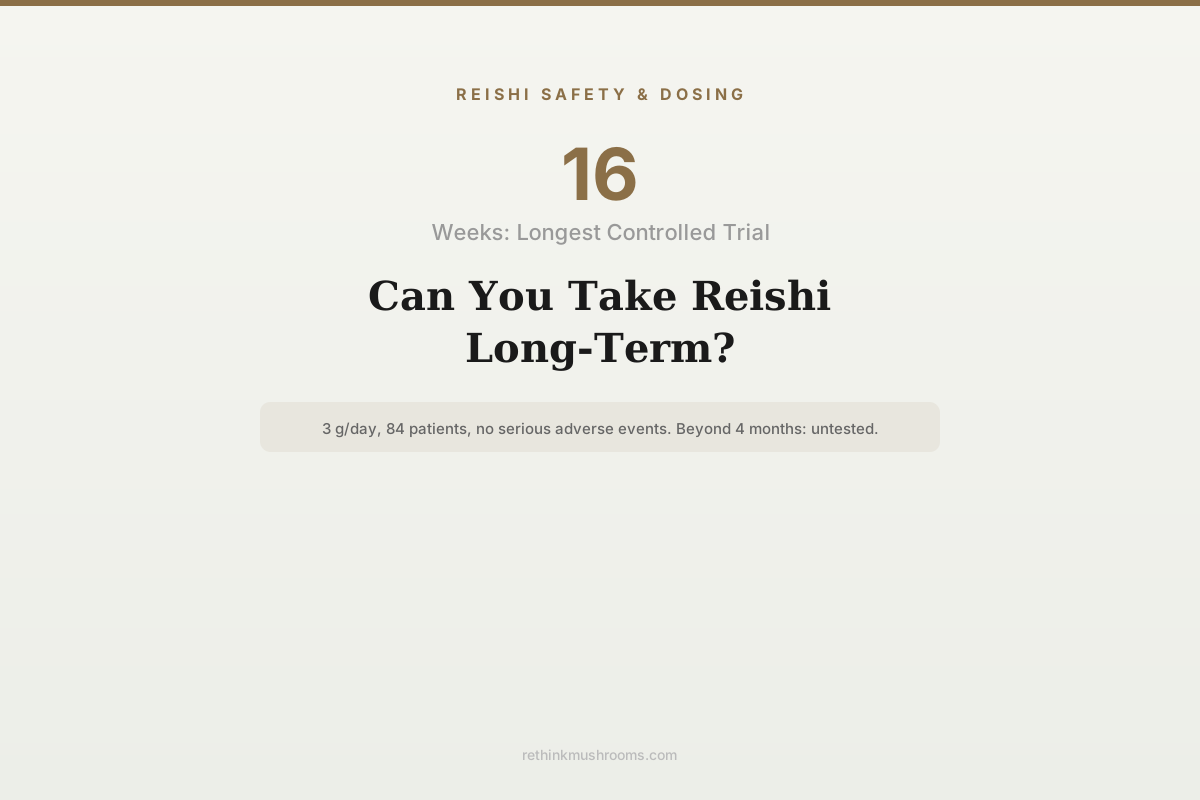
16 Weeks
The longest randomised placebo-controlled trial of Ganoderma lucidum in humans ran 16 weeks at 3 grams per day. No serious adverse events were recorded, and the Cochrane review pooling all trials out to four months found only a non-significant increase in minor side effects.
Klupp et al., Scientific Reports, 2016
84 patients
randomised in the longest trial, 16 weeks at 3 g/day
RR 1.67
relative risk of any adverse event vs. placebo in the Cochrane pooled analysis, 95% CI 0.86–3.24
26.3%
of 19 US reishi products matched their label ingredients
Klupp et al., Scientific Reports, 2016
 View as image ↗
Reishi (Ganoderma lucidum) has been consumed in East Asia for more than two thousand years, and Chinese and Japanese populations have taken it at gram-per-day doses for decades. Yet the longest randomised controlled trial in the Western scientific literature lasted only 16 weeks.[1] The Cochrane systematic review pooling all eligible trials covered interventions up to four months, with participants taking up to 3 grams per day.[2] No human trial has tested reishi beyond this window in a controlled design, which means "long-term safety" in the strict research sense has not been established. What we have instead is a coherent picture across short-to-medium-term RCTs, one serious case report of drug-induced liver injury, documented antiplatelet activity, and striking variability in commercial product quality. For the compound-level background, see reishi bioactive compounds: triterpenes, polysaccharides, and sterols.
Key Takeaways
- The longest RCT ran 16 weeks in 84 patients with type 2 diabetes at 3 g/day of Ganoderma lucidum; no overall increased risk of adverse events vs. placebo was detected (Klupp et al., 2016)
- The Cochrane review of five trials (398 participants, up to 4 months) found a non-significant relative risk of adverse events of 1.67 (95% CI 0.86–3.24) vs. placebo, with no serious side effects reported (Klupp et al., 2015)
- A 10-day RCT at 4 g/day in 16 healthy volunteers produced no adverse effects on blood chemistry, haematology, ECG, or urinalysis (Wicks et al., 2007)
- A 2013 case report documented drug-induced liver injury resembling autoimmune hepatitis in a woman taking extracts of Agaricus blazei and Ganoderma lucidum alongside thymoma therapy (Hisamochi et al., 2013)
- Reishi inhibits platelet aggregation in a dose-dependent manner; 3 g/day for two weeks reduced ADP-induced aggregation by 17.7–31.5% in atherosclerosis patients (Tao & Feng, 1990)
- Commercial product quality is unreliable: only 5 of 19 US reishi supplements (26.3%) matched their label ingredients by triterpene and polysaccharide content (Wu et al., 2017)
What "Long-Term" Actually Means in Reishi Research
The honest answer to "can you take reishi long-term" begins with acknowledging that the question is under-studied. In pharmacology, long-term safety usually refers to continuous use beyond six months in a controlled setting, with structured adverse-event surveillance, laboratory monitoring, and defined stopping rules. No published trial of reishi meets that definition. The longest placebo-controlled trial ran 16 weeks.[1] The Cochrane review covered interventions up to four months.[2]
This gap matters because several of reishi's documented pharmacological effects (immune modulation, platelet inhibition, glucose handling) could behave differently over years than over weeks. Chronic immunomodulation, in particular, is not fully captured by a 16-week window. For readers comparing dosing decisions, see reishi dosage guide: how much should you take?.
The 16-Week Klupp Trial: The Longest Placebo-Controlled Data
Klupp et al. (2016) conducted a prospective, double-blind, randomised, placebo-controlled trial of Ganoderma lucidum in 84 patients with type 2 diabetes mellitus and metabolic syndrome.[1] Participants were allocated to one of three arms: reishi alone, reishi plus Cordyceps sinensis, or placebo. The dosage was 3 grams per day for 16 weeks. The primary outcomes were HbA1c and fasting plasma glucose; safety was a secondary outcome tracked across the full intervention.
The combined intervention produced no significant changes in any primary or secondary outcome, and (critically for safety) no overall increased risk of adverse events was observed in either active-treatment arm compared with placebo. HbA1c baseline-adjusted difference in means was 0.13% (95% CI -0.35 to 0.60, p = 0.60), and fasting plasma glucose showed similarly null findings. For the efficacy question in metabolic disease, see reishi for metabolic syndrome: addressing inflammation, lipids, and glucose together.
What this trial does establish is that 3 g/day of a standardised reishi product, taken daily for about four months by adults with metabolic comorbidities, did not produce a measurable safety signal compared with placebo. What it does not establish is whether daily gram-range dosing for one, five, or ten years carries the same profile.
The Cochrane Pooled Safety Analysis
The 2015 Cochrane systematic review on Ganoderma lucidum for cardiovascular risk factors included five randomised controlled trials with a combined 398 participants.[2] The three trials with usable data compared reishi at 1.4 to 3 grams per day against placebo over 12 to 16 weeks of intervention. Most participants had type 2 diabetes.
For safety, the Cochrane authors reported that participants taking G. lucidum for four months were 1.67 times more likely to experience any adverse event than those on placebo (relative risk 1.67, 95% confidence interval 0.86 to 3.24). That confidence interval crosses 1.0, meaning the difference was not statistically significant. The review emphasised that the adverse events recorded were not serious: nausea, dizziness, and other mild symptoms that resolved with continued use or on discontinuation. No clinically serious safety signal was reported across the pooled trials. This is the most complete synthesis of controlled-trial safety data available for reishi.
Short-Term Safety in Healthy Volunteers
Wicks et al. (2007) conducted a double-blind randomised placebo-controlled trial in 16 healthy adult volunteers who received 2 grams of Ganoderma lucidum extract or placebo twice daily (4 g/day total) for 10 consecutive days.[3] The protocol included subjective questionnaires, electrocardiograms, complete blood counts, blood chemistry, urinalysis, and immune panels (CD4, CD8, CD19, CD56).
No adverse effects were observed in the extract group compared with placebo across any laboratory domain. A transient increase in CD56 (natural killer cell marker) count was detected during the intervention and returned to baseline 10 days after stopping, though the increase did not reach statistical significance given the small sample. The authors concluded that dose-escalating long-term trials were warranted. Eighteen years later, those trials still do not exist at the durations they proposed. For the immune side of this data, see how reishi modulates innate and adaptive immunity.
The Chu Crossover and the Pazzi Pilot
Chu et al. (2012) ran a 12-week randomised, double-blind, placebo-controlled crossover trial in 26 patients with borderline hypertension or hyperlipidaemia, using 1.44 g/day of Ganoderma lucidum.[4] Reishi was well tolerated across the intervention. Plasma insulin and HOMA-IR were lower after reishi than after placebo; antioxidant status, blood pressure, urine catecholamines, and lymphocyte subsets did not change significantly. Safety was consistent with prior trials: no clinically meaningful deviations in haematology, chemistry, or tolerability.
Pazzi et al. (2020) ran a six-week double-blind randomised pilot in women with fibromyalgia, comparing 6 grams per day of micro-milled G. lucidum carpophores with placebo.[5] Between-group differences for happiness, depression, and quality-of-life measures did not reach statistical significance, though within-group trends favoured reishi. No serious adverse events were reported at this higher daily dose over six weeks. Pazzi's trial is the only published RCT using 6 g/day for an extended period, which doubles the typical Cochrane-pooled dose and still produced no safety signal.
Cancer-Adjunct Trials: The Highest-Risk Populations
Short-term use of reishi as an adjunctive therapy has been tested in cancer populations, where the baseline risk of adverse events from disease and standard treatment is already high. Zhao et al. (2012) conducted a pilot randomised clinical trial of Ganoderma lucidum spore powder in breast cancer patients undergoing endocrine therapy.[6] The trial reported improvements in cancer-related fatigue without producing new safety concerns beyond those attributable to the underlying treatment.
Tang et al. (2005) ran a randomised, double-blind, placebo-controlled study of a Ganoderma lucidum polysaccharide extract in 132 patients with neurasthenia.[7] Patients received 5.4 grams per day of the polysaccharide fraction for 8 weeks. The extract was well tolerated, and the paper reported improvements in the clinical global impression of severity. For the broader cancer-adjunct picture, see reishi for immune support during chemotherapy.
Across these medium-duration trials, the safety signal has been consistent: at 1.4 to 6 g/day for 6 to 16 weeks, reishi is generally well tolerated in populations ranging from healthy volunteers to patients with metabolic, rheumatic, or oncological disease. Whether that tolerability extends to years of continuous use cannot be answered from this dataset.
The Hisamochi Case Report: Drug-Induced Liver Injury
The most serious published adverse-event case involving reishi is not a trial finding but a case report. Hisamochi et al. (2013) described a 60-year-old woman with stable stage III malignant thymoma who developed severe hepatitis during long-term use of an Agaricus blazei Murill extract combined with an extract of Ganoderma lucidum.[8] The same report documented a second case involving A. blazei and fucoidan. Both cases were diagnosed as drug-induced liver injury (DILI) using the Roussel Uclaf Causality Assessment Method, and histology closely resembled autoimmune hepatitis. Serum immunoglobulin G and zinc sulphate turbidity rose progressively between the start of mushroom supplementation and the clinical presentation.
Two caveats matter. First, the reishi exposure was combined with A. blazei in the index case, so attributing causality to reishi alone is not possible from this report. Second, the authors suggested the mechanism was immune activation driven by the A. blazei component, with reishi contributing uncertainly. But the case illustrates a real principle: concentrated mushroom extracts taken alongside oncology care and other medications can produce autoimmune-like liver injury that takes months to develop and presents insidiously. Patients with existing liver disease or on hepatotoxic medications sit in the highest-risk group by inference.
The Antiplatelet Signal
Tao and Feng (1990) investigated reishi's effect on platelet aggregation in 15 healthy volunteers and 33 patients with atherosclerotic disease.[9] After 3 grams per day for two weeks, ADP-induced platelet aggregation was inhibited by 31.5% (ADP 2 μmol/L) and 17.7% (ADP 3 μmol/L), both statistically significant reductions versus baseline. Extracorporeal thrombus length, wet weight, and dry weight were all reduced after reishi administration.
This is a dose-dependent, mechanism-coherent signal rather than an isolated oddity. Clinically, it means reishi could theoretically augment bleeding risk in patients already taking antiplatelet drugs (aspirin, clopidogrel), anticoagulants (warfarin, direct oral anticoagulants), or NSAIDs. No published case of a reishi-warfarin interaction causing a major bleed has been documented, but the pharmacological rationale is strong enough that the signal belongs in any honest long-term safety discussion. For a fuller treatment, see reishi side effects and drug interactions: a safety review.
Pediatric Data
Henao et al. (2018) conducted a randomised clinical trial of yogurt enriched with β-glucans from Ganoderma lucidum in children aged 3–5 from Medellín, Colombia.[10] The intervention was delivered as a functional food rather than a concentrated extract, and the trial reported immunomodulatory changes without safety concerns in the paediatric age range at the doses tested. This is the only paediatric randomised data available for reishi, and the route of administration (food matrix) does not generalise to capsule-based supplementation at gram-range doses.
Why Product Quality Matters for a Safety Conversation
Wu et al. (2017) purchased 19 batches of Ganoderma lucidum dietary supplements from the US market and evaluated their triterpene and polysaccharide content using chromatographic methods and saccharide mapping.[11] Only 5 of the 19 products (26.3%) were consistent with their label claims. The remaining 74% contained detectably different amounts or forms of the key bioactive classes than their packaging indicated.
This finding has direct implications for any long-term safety conclusion drawn from clinical trials. Trials use characterised, standardised products. Consumers do not. A person taking a reishi supplement for years has no way to verify that the product in month 36 matches the product in month 1, or that either resembles the product used in Klupp's 16-week trial. The safety data from controlled trials cannot be mechanically translated to the supplement market without that verification step. For a practical framework, see reishi extract vs. whole mushroom powder: which is better?.
What the Evidence Supports and What It Does Not
| Question | Evidence | Confidence |
|---|---|---|
| Is reishi well tolerated at 1.4–6 g/day for up to 16 weeks? | Yes: multiple RCTs, Cochrane pooled analysis | High |
| Are the adverse events serious? | No: Cochrane reports non-serious AEs only (RR 1.67, 95% CI 0.86–3.24) | Moderate |
| Is continuous multi-year use proven safe? | No: no trial has exceeded 16 weeks of randomised follow-up | None |
| Can reishi cause liver injury? | One published case report of DILI resembling autoimmune hepatitis in combination with A. blazei | Low (rare, combination exposure) |
| Does reishi inhibit platelets? | Yes: 17.7–31.5% reduction in ADP-induced aggregation at 3 g/day | Moderate |
| Do commercial reishi products match their labels? | No: only 26.3% of 19 US products did (Wu et al., 2017) | Moderate |
| Is reishi safe in children? | Limited: one RCT in food-matrix form, no paediatric extract data | Very low |
The Bottom Line
The evidence supports reishi as well tolerated at 1.4 to 6 g/day for up to 16 weeks in adults, with no serious adverse events across pooled randomised trials (Klupp et al., 2015). Beyond four months, controlled safety data do not exist. A published case of drug-induced liver injury involving reishi plus another mushroom extract (Hisamochi et al., 2013), documented antiplatelet activity (Tao & Feng, 1990), and 74% non-compliance with label claims in US commercial products (Wu et al., 2017) define the outer edges of the safety picture. Multi-year continuous use remains untested in controlled trials.
Frequently Asked Questions
Sources & References
- 1RTHM-00429·Klupp, Nerida L et al. (2016). “A double-blind, randomised, placebo-controlled trial of Ganoderma lucidum for the treatment of cardiovascular risk factors of metabolic syndrome..” Scientific reports.Study breakdown →PubMed →↩
- 2RTHM-00380·Klupp, Nerida L et al. (2015). “Ganoderma lucidum mushroom for the treatment of cardiovascular risk factors..” The Cochrane database of systematic reviews.Study breakdown →PubMed →↩
- 3RTHM-00123·Wicks, Sheila M et al. (2007). “Safety and tolerability of Ganoderma lucidum in healthy subjects: a double-blind randomized placebo-controlled trial..” The American journal of Chinese medicine.Study breakdown →PubMed →↩
- 4RTHM-00247·Chu, Tanya T W et al. (2012). “Study of potential cardioprotective effects of Ganoderma lucidum (Lingzhi): results of a controlled human intervention trial..” The British journal of nutrition.Study breakdown →PubMed →↩
- 5RTHM-00648·Pazzi, Francesco et al. (2020). “Ganoderma lucidum Effects on Mood and Health-Related Quality of Life in Women with Fibromyalgia..” Healthcare (Basel.Study breakdown →PubMed →↩
- 6RTHM-00276·Zhao, Hong et al. (2012). “Spore Powder of Ganoderma lucidum Improves Cancer-Related Fatigue in Breast Cancer Patients Undergoing Endocrine Therapy: A Pilot Clinical Trial..” Evidence-based complementary and alternative medicine : eCAM.Study breakdown →PubMed →↩
- 7RTHM-00088·Tang, Wenbo et al. (2005). “A randomized, double-blind and placebo-controlled study of a Ganoderma lucidum polysaccharide extract in neurasthenia..” Journal of medicinal food.Study breakdown →PubMed →↩
- 8RTHM-00287·Hisamochi, Akiko et al. (2013). “Drug-induced liver injury associated with Agaricus blazei Murill which is very similar to autoimmune hepatitis..” Clinical journal of gastroenterology.Study breakdown →PubMed →↩
- 9RTHM-00011·Tao, J et al. (1990). “Experimental and clinical studies on inhibitory effect of ganoderma lucidum on platelet aggregation..” Journal of Tongji Medical University = Tong ji yi ke da xue xue bao.Study breakdown →PubMed →↩
- 10RTHM-00512·Henao, Sandra Lorena Duque et al. (2018). “Randomized Clinical Trial for the Evaluation of Immune Modulation by Yogurt Enriched with β-Glucans from Lingzhi or Reishi Medicinal Mushroom, Ganoderma lucidum (Agaricomycetes), in Children from Medellin, Colombia..” International journal of medicinal mushrooms.Study breakdown →PubMed →↩
- 11RTHM-00499·Wu, Ding-Tao et al. (2017). “Evaluation on quality consistency of Ganoderma lucidum dietary supplements collected in the United States..” Scientific reports.Study breakdown →PubMed →↩