Reishi (Ganoderma lucidum)
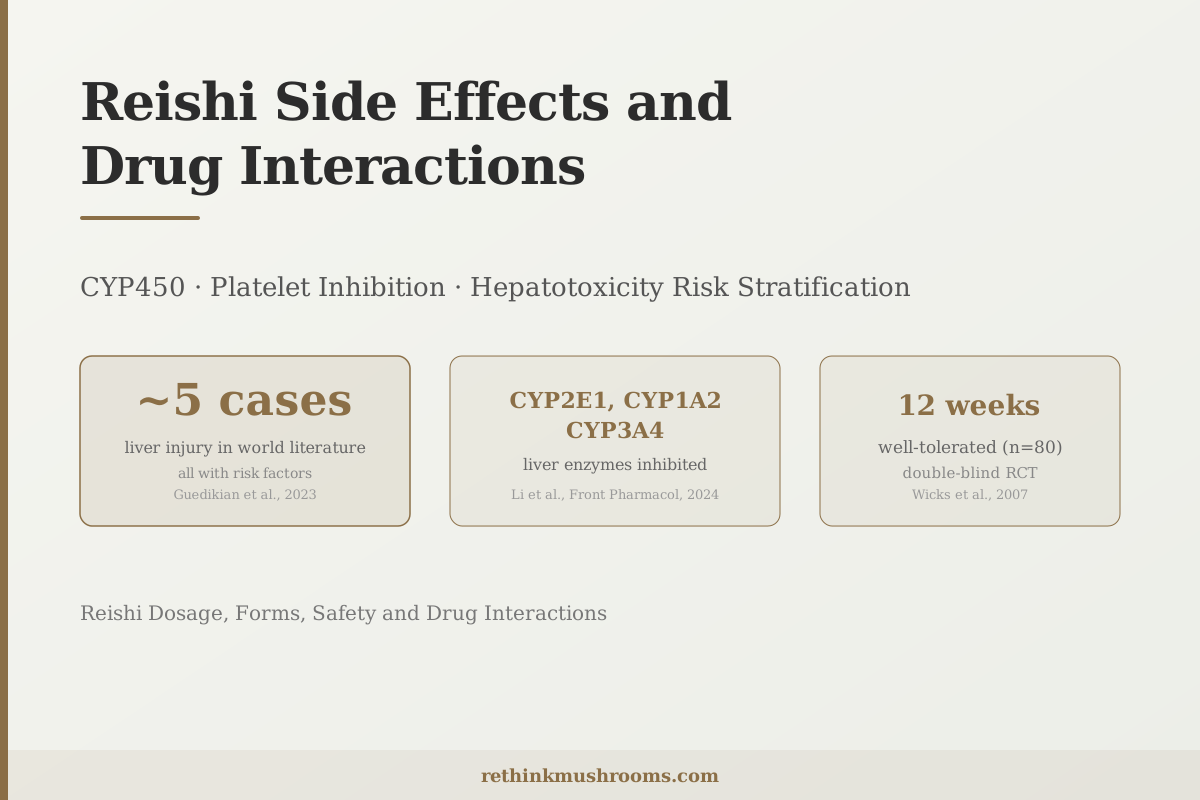
~5 hepatotoxicity cases in world literature
Guedikian et al. (2023) reviewed the published literature and found approximately 5 documented cases of reishi-associated liver injury worldwide. All involved identifiable risk factors: powdered form, alcohol co-use, or pre-existing liver disease.
Guedikian et al., Cureus, 2023
CYP2E1, CYP1A2, CYP3A4
liver enzymes inhibited by Reishi triterpenoids (Li 2024) — involved in clearing warfarin, statins, and many cancer drugs
Platelet inhibition
Poniedzialek et al. (2019) confirmed Reishi significantly inhibited platelet clumping in human blood — relevant when combined with blood thinners
12 weeks, safe
Wicks et al. (2007) found no significant adverse events vs. placebo in 80 healthy volunteers over 12 weeks at standard doses
Guedikian et al., Cureus, 2023
 View as image ↗
Reishi mushroom (Ganoderma lucidum) has one of the strongest safety records among widely used medicinal mushrooms. Wicks and colleagues (2007) confirmed this in a double-blind RCT: 80 healthy volunteers taking Reishi extract over 12 weeks showed no significant adverse events compared to placebo.[5] At dietary and standard supplement doses, the risk profile is benign for most healthy adults.
But Reishi does have real interactions worth knowing. Its triterpenoid compounds (ganoderic acids) inhibit a family of liver enzymes called CYP enzymes that break down and clear many common medications, including warfarin, statins, and several cancer drugs. It also inhibits platelet clumping, which compounds the anticoagulant risk. And a small number of liver injury cases — approximately five in the published world literature — have been documented, all associated with identifiable risk factors. This review covers the safety evidence with the precision those cases deserve. For the overall Reishi introduction, see the complete Reishi guide.
Key Takeaways
- Reishi triterpenoids inhibit three liver enzyme subtypes — CYP2E1, CYP1A2, and CYP3A4 — that clear warfarin, statins, acetaminophen, and several cancer drugs; this can raise drug blood levels and increase toxicity risk[1]
- Poniedzialek et al. (2019) confirmed Reishi extract significantly inhibits platelet aggregation and prolongs coagulation times in human blood — a mechanism that compounds bleeding risk when combined with anticoagulant or antiplatelet drugs[2]
- Approximately 5 cases of reishi-associated liver injury appear in the published world literature; all involved identifiable risk factors (powdered form, alcohol co-use, or pre-existing liver disease)[4]
- Ahmad et al. (2021) noted that crude powdered reishi appears in more adverse event cases than standardized extract forms — powder form is associated with higher hepatotoxicity risk than well-processed extracts[6]
- Wicks et al. (2007) established general safety at standard supplement doses in a 12-week double-blind RCT with 80 healthy volunteers — the primary human safety anchor for short-term Reishi supplementation[5]
- Long-term human safety data beyond 1 year for any form of Reishi is absent; current evidence supports short-to-medium-term use (up to 1 year for standardized extracts) with known risk stratification
Reishi Safety Summary
General safety in healthy adults: Good evidence from a 12-week double-blind RCT (n=80). Standard supplement doses well-tolerated with mild GI effects in a small minority.
Drug interactions by priority:
- HIGH — Anticoagulants (warfarin, heparin): Two mechanisms operate simultaneously — CYP enzyme inhibition raises warfarin blood levels, AND platelet inhibition adds independent bleeding risk. This is the highest-priority interaction.
- HIGH — Cancer drugs metabolized by CYP1A2/CYP3A4: Many chemotherapy agents are processed by CYP3A4; elevated levels could increase toxicity. Cancer patients should discuss Reishi with their oncologist before use.
- MODERATE — Statins (lovastatin, simvastatin, atorvastatin): Processed by CYP3A4; Reishi inhibition may raise statin blood levels, potentially increasing muscle side effect risk.
- MODERATE — NSAIDs and antiplatelet drugs (aspirin, clopidogrel, ibuprofen): Reishi's platelet inhibition adds to these drugs' effects.
- LOW — Acetaminophen: CYP2E1 processes a toxic acetaminophen metabolite; inhibition context-dependent. Relevant only at high acetaminophen doses.
- HEPATOTOXICITY RISK: Very rare (~5 cases). Risk factors: powdered form (vs. extract), concurrent alcohol use, pre-existing liver disease.
- CONTRAINDICATIONS: Active liver disease, planned surgery (platelet effect), pregnancy (insufficient data), current immunosuppressive therapy (Reishi activates immune function).
The CYP450 Interaction: How Reishi Affects Your Body's Drug-Clearing System
The most clinically significant and least discussed Reishi interaction involves a family of enzymes in the liver called cytochrome P450 (CYP) enzymes. These enzymes break down and clear most drugs from the body. Their activity determines how quickly drugs are eliminated, which determines blood concentration. When CYP enzyme activity is reduced, drugs clear more slowly, accumulating to higher levels.
Li and colleagues (2024) specifically tested Reishi triterpenoids — the ganoderic acid compounds that dissolve in alcohol — against multiple CYP enzyme subtypes and confirmed inhibitory activity for three of them.[1]
CYP2E1 metabolizes acetaminophen and several cancer drugs. Inhibiting CYP2E1 slows clearance of these drugs and their metabolites. The acetaminophen concern is at high doses — the CYP2E1 pathway produces a toxic acetaminophen intermediate (NAPQI), and at normal doses, other clearance pathways handle it; at high acetaminophen doses, the impaired clearance becomes more relevant.
CYP1A2 metabolizes caffeine, some antidepressants, and several cancer drugs including erlotinib. Inhibiting CYP1A2 raises blood levels of co-administered CYP1A2-metabolized medications.
CYP3A4 is the most important CYP enzyme by volume — it metabolizes approximately 50% of clinically used drugs, including statins (lovastatin, simvastatin, atorvastatin), many chemotherapy drugs (docetaxel, paclitaxel, imatinib), some HIV medications, and benzodiazepines. CYP3A4 inhibition is the broadest and most consequential interaction.
The practical implication: anyone taking medications regularly — especially warfarin, statins, or cancer drugs — should assess whether those drugs are metabolized by CYP1A2 or CYP3A4 before adding Reishi supplementation at meaningful doses. Prescribers can check this quickly; patients can also check medication information sheets, which typically list the primary metabolizing enzyme.
Li 2024 is an in vitro study — it tested the inhibitory effects of Reishi triterpenoids on enzyme activity in a lab setting, not in living patients with real medications. The clinical significance of the interaction depends on how much triterpenoid content a supplement delivers (water-only extracts have low triterpene content and thus lower interaction risk than alcohol extracts). But the mechanism is established, and the drug list it affects is too important to dismiss.
For a deeper look at the triterpene compounds driving this interaction, see how Reishi triterpenes differ from polysaccharides in mechanism.
The Anticoagulant Risk: Two Pathways, One Direction
Reishi affects blood clotting through two distinct mechanisms, both pointing toward increased bleeding risk.
Poniedzialek and colleagues (2019) screened eight edible medicinal mushrooms for effects on platelet function in human blood samples.[2] Ganoderma lucidum extract significantly inhibited platelet aggregation — the clumping of blood cells that initiates clot formation — and prolonged coagulation times in the in vitro assay. This is direct mechanistic confirmation that Reishi compounds impair the platelet side of the clotting process.
The second pathway, described above, runs through CYP enzyme inhibition: warfarin is metabolized by CYP2C9 (and to a lesser degree by CYP1A2 and CYP3A4), so Reishi may reduce warfarin clearance and raise its blood concentration. More warfarin plus impaired platelets represents a doubly elevated bleeding risk.
For people taking warfarin specifically, the standard monitoring tool is the INR — a blood test that measures how quickly blood clots, expressed as a ratio compared to a reference. Elevated INR means slower clotting and higher bleeding risk. If Reishi raises warfarin levels, INR would increase. This is the measurable clinical concern, not a theoretical one.
People taking aspirin, clopidogrel, newer anticoagulants (rivaroxaban, apixaban), or NSAIDs regularly face similar considerations at the platelet inhibition level.
Hepatotoxicity: Very Rare, Risk Factors Identifiable
The hepatotoxicity story with Reishi is one of the clearest examples of a risk that is real, rare, and context-dependent.
Wanmuang and colleagues (2007) published what became the most-cited case: a patient who developed fatal fulminant liver failure — rapid, severe liver destruction — after taking Ganoderma lucidum powder.[3] The patient used a high-dose powdered form rather than a standardized extract. This case report established Reishi-associated hepatotoxicity as a recognized clinical possibility and led regulatory agencies in some countries to add liver injury warnings to Reishi product labeling.
Guedikian and colleagues (2023) published a more recent case — acute liver injury in a patient using Reishi who also consumed alcohol — and included a literature review noting approximately 5 total published hepatotoxicity cases as of 2023.[4] The review identified consistent risk factors across cases: powdered whole mushroom (not standardized extract), concurrent alcohol use, and in some cases pre-existing liver conditions.
Ahmad et al. (2021) provided broader context in their comprehensive toxicological review: standardized extract forms appear to have a safer liver profile than crude powdered mushroom.[6] Most safety research has focused on extracts rather than raw powder, and the hepatotoxicity cases cluster around powder use.
To put the approximately 5 world-literature cases in scale: Ganoderma lucidum is consumed by tens of millions of people globally and has been used medicinally in East Asia for decades. Five published adverse case reports represents an extremely low incidence in the context of that use volume. The risk is not negligible — liver failure can be fatal, as in the Wanmuang case — but it is highly contextual, appearing associated with specific forms and circumstances rather than Reishi use generally.
The paradox worth noting: Reishi is extensively studied as hepatoprotective in other contexts. Its compounds show liver-protective properties in many studies, particularly for liver fibrosis and toxin-induced damage. The rare hepatotoxicity cases appear to represent idiosyncratic reactions in specific risk-factor contexts, not a direct hepatotoxic mechanism. For the broader context on Reishi and liver health, see Ganoderma lucidum and liver fibrosis: can Reishi help.
General Safety at Standard Doses
Against the interaction backdrop above, Wicks et al.'s (2007) safety RCT provides the baseline.[5] In 80 healthy volunteers taking Ganoderma lucidum extract over 12 weeks in a double-blind placebo-controlled design, no significant adverse events were recorded compared to placebo. Mild gastrointestinal effects (nausea, mild stomach upset) occurred in a small minority of participants in the Reishi group but at rates not significantly different from placebo.
Jafari and colleagues (2025) analyzed adverse event data across 17 Reishi RCTs.[7] The consistent finding: mild GI effects are the most common adverse event at standard doses; serious adverse events were rare across the trial pool. This meta-level summary is reassuring for general use at standard doses in healthy adults without contraindicated medications.
Ahmad et al. (2021) documented duration boundaries: standardized extract has human safety data to approximately 1 year; powder has human safety evidence to approximately 16 weeks.[6] Data beyond these windows is largely absent.
Populations Where the Evidence Identifies Elevated Risk
The following situations represent higher-than-baseline risk based on the evidence reviewed above:
People taking warfarin or other anticoagulants: Two independent mechanisms increase bleeding risk — CYP enzyme inhibition and platelet inhibition. This is the clearest and most evidence-based interaction concern.
People taking statins, especially simvastatin or lovastatin: CYP3A4 inhibition may raise statin blood levels, increasing the risk of muscle pain and damage (myopathy). Pravastatin (which doesn't use CYP3A4) has lower interaction potential.
People on cancer therapy: Both CYP1A2 and CYP3A4 metabolize cancer drugs; immune-activating properties of Reishi may also conflict with certain cancer treatment protocols. This is a prescriber-level decision.
People with active liver disease: The rare hepatotoxicity cases include patients with pre-existing liver conditions. Active liver disease is a consistent caution point across hepatotoxicity analyses.
People who regularly consume alcohol: The Guedikian 2023 case illustrates the alcohol-Reishi combination as a hepatotoxicity risk factor.
People using crude powdered Reishi (not standardized extract): Ahmad 2021's review identifies crude powder as having more adverse event associations than extracts. If using Reishi, well-standardized extracts appear safer than unprocessed powder.
Pre-surgical patients: Platelet inhibition has implications for surgery. The standard guidance for supplements with antiplatelet effects is to discontinue 1-2 weeks before elective surgery.
For dosing context alongside safety considerations, see Reishi dosage guide: how much should you take. For the extraction method dimension of safety, see Reishi extract vs. whole mushroom powder: which is better.
The Bottom Line
Reishi is well-tolerated at standard doses in healthy adults without contraindicated medications, supported by a 12-week safety RCT (Wicks 2007) and meta-level adverse event data across 17 trials (Jafari 2025). The primary concerns: CYP enzyme inhibition (Li 2024) affecting warfarin, statin, and cancer drug clearance; platelet inhibition adding to anticoagulant risk (Poniedzialek 2019); and rare hepatotoxicity (~5 world cases) associated with powdered form, alcohol co-use, and pre-existing liver disease (Wanmuang 2007, Guedikian 2023). Risk is manageable when identified — it is not distributed uniformly across all users.
Frequently Asked Questions
Sources & References
- 1RTHM-01926·Li, Dawei et al. (2024). “Triterpenoids from Ganoderma lucidum inhibit cytochrome P450 enzymes interfering with the metabolic process of specific clinical drugs..” Frontiers in pharmacology.Study breakdown →PubMed →↩
- 2RTHM-01114·Poniedziałek, Barbara et al. (2019). “The Effect of Mushroom Extracts on Human Platelet and Blood Coagulation: In vitro Screening of Eight Edible Species..” Nutrients.Study breakdown →PubMed →↩
- 3RTHM-00122·Wanmuang, Harirak et al. (2007). “Fatal fulminant hepatitis associated with Ganoderma lucidum (Lingzhi) mushroom powder..” Journal of the Medical Association of Thailand = Chotmaihet thangphaet.Study breakdown →PubMed →↩
- 4RTHM-00826·Guedikian, Roupen et al. (2023). “Ganoderma lingzhi (Reishi Mushroom)-Induced Acute Liver Injury in the Setting of Alcohol Use: A Case Report and Review of the Literature..” Cureus.Study breakdown →PubMed →↩
- 5RTHM-00123·Wicks, Sheila M et al. (2007). “Safety and tolerability of Ganoderma lucidum in healthy subjects: a double-blind randomized placebo-controlled trial..” The American journal of Chinese medicine.Study breakdown →PubMed →↩
- 6RTHM-01321·Ahmad, Rizwan et al. (2021). “Ganoderma lucidum (Reishi) an edible mushroom; a comprehensive and critical review of its nutritional, cosmeceutical, mycochemical, pharmacological, clinical, and toxicological properties..” Phytotherapy research : PTR.Study breakdown →PubMed →↩
- 7RTHM-02098·Jafari, Ali et al. (2025). “The Nutritional Significance of Ganoderma lucidum on Human Health: A GRADE-Assessed Systematic Review and Meta-Analysis of Clinical Trials..” Food science & nutrition.Study breakdown →PubMed →↩