Reishi (Ganoderma lucidum)
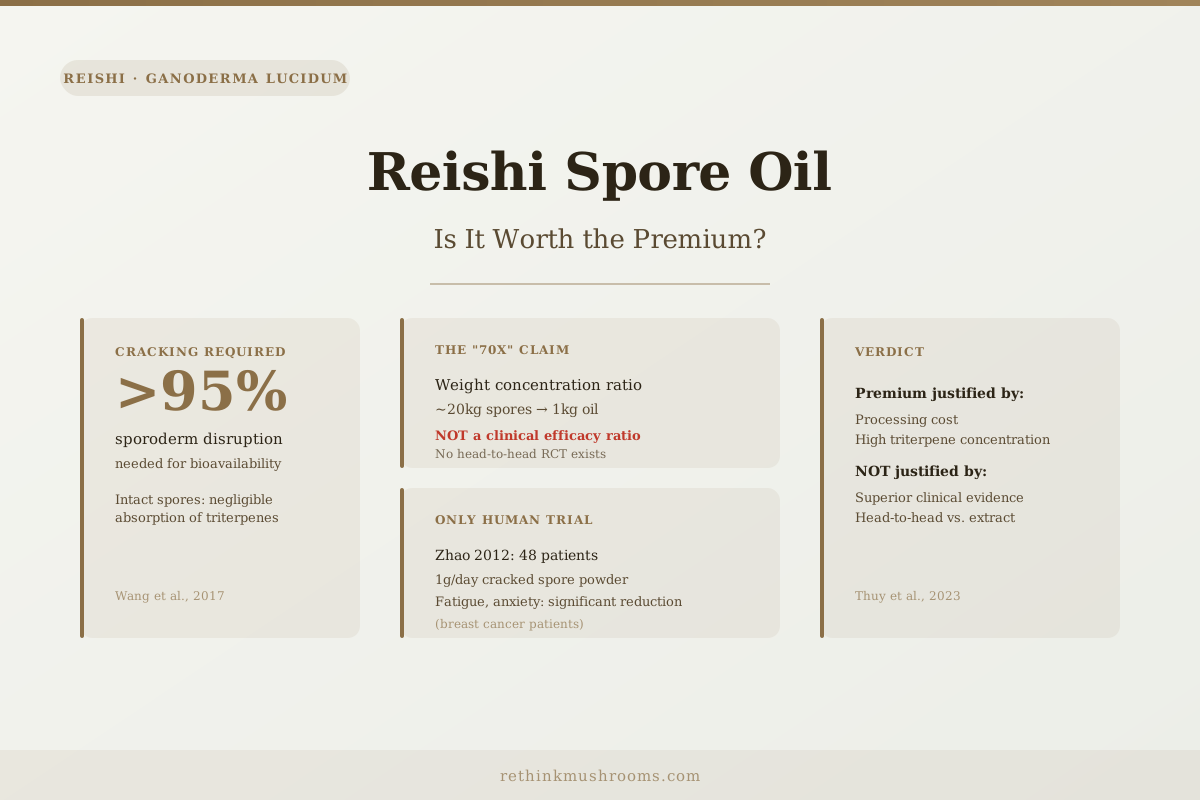
>95% sporoderm disruption
Wang et al. (2017) showed that intact reishi spores have a chitin-reinforced wall impermeable to digestive enzymes; combined chemical and physical cracking achieves greater than 95% sporoderm disruption; without it, the enclosed triterpenes and nucleosides cannot be absorbed.
Wang et al., Natural Product Research, 2017
1 RCT
is the only controlled human trial of reishi spore preparations (Zhao et al., 2012)
1g/day
cracked spore powder dose in the only human trial, for cancer-related fatigue
70x claim
refers to weight concentration ratio from raw spores to oil, not clinical efficacy per milligram
Wang et al., Natural Product Research, 2017
 View as image ↗
Reishi spore oil is among the most expensive reishi products on the market, and it comes with dramatic marketing claims: "70x more potent than the fruiting body," "nature's most concentrated reishi." Evaluating whether any of this is justified requires understanding three things: what reishi spores actually contain, why cracking the spore wall is non-negotiable for bioavailability, and what the clinical evidence actually shows for spore preparations.
The short answer: spore oil has a genuine chemical rationale, one human trial supporting it, and zero head-to-head trials comparing it to standard reishi extract. The premium is partly justified by the concentration and processing cost. It is not justified by superior clinical trial evidence.
This is a cluster article in the Reishi Dosage, Forms, Safety series. For a comparison of fruiting body extract versus whole powder, see reishi extract vs. whole mushroom powder: which is better?. For the pillar introduction to reishi, see what is reishi mushroom.
Key Takeaways
- Intact reishi spores are essentially bioavailable as a food source but the enclosed triterpenes and nucleosides require sporoderm cracking to be absorbed; Wang et al. (2017) showed that combined chemical and physical methods achieve greater than 95% disruption, which is required for meaningful bioactive release[1]
- Thuy et al.'s 2023 systematic review confirmed that cracked spore preparations show immune-modulating, anti-fatigue, and hepatoprotective effects in clinical studies, with safety comparable to fruiting body extracts[2]
- The Zhao 2012 pilot RCT (n=48 breast cancer patients, 4 weeks) is the only controlled human trial specifically testing spore preparations; 1g/day cracked spore powder significantly reduced fatigue, anxiety, and depression versus placebo[3]
- The "70x more potent" marketing claim describes a weight concentration ratio (roughly 20kg of raw spores yields 1kg of oil), not a head-to-head clinical efficacy comparison to standard extract
- No randomized controlled trial compares reishi spore oil directly to fruiting body dual extract for any health outcome; the premium price is not backed by evidence of superior clinical effects per milligram of triterpenes
- Ahmad et al. (2021) noted that standardized extract appears to have a safer adverse event profile than crude powder; properly processed spore preparations fall closer to the extract end of this spectrum[4]
What Reishi Spores Actually Are
Ganoderma lucidum releases microscopic reproductive spores from the pores on the underside of its fruiting body cap. Each mature mushroom releases billions of spores over its reproductive period. Harvesting these spores at scale requires collection sheets placed under cultivated mushrooms, a labor-intensive process that partially explains the product's price.
What makes spores chemically distinctive is their composition relative to the fruiting body. Spores contain:
Higher triterpene density. The concentration of ganoderic acids and related triterpene compounds in spores is substantially higher per gram than in the fruiting body tissue.
Unique lipid-soluble nucleosides. Spores contain adenosine, uridine, and other nucleosides in a lipid-soluble form that is absent or present in lower quantities in the fruiting body. These compounds have independent pharmacological activity including cardiovascular and immunomodulatory effects.
Spore-specific fatty acids. The lipid fraction of spore oil (the primary target of the extraction process) contains oleic acid, linoleic acid, and other unsaturated fatty acids in a ratio not found in fruiting body extracts.
This chemical distinctiveness is genuine. Spores are not just a concentrated version of the fruiting body; they have a different compound profile. Whether that different profile translates to different or superior clinical outcomes is the question the evidence cannot yet answer.
Why Intact Spores Are Essentially Useless
Here is the problem the supplement industry often mentions without properly explaining: reishi spores have a sporoderm, an outer wall built from chitin reinforced with other structural polymers. This wall evolved to protect the spore's genetic material during dispersal. It is exceptionally durable.
Human digestive enzymes do not break down chitin efficiently. A spore product made from intact, unprocessed spores passes through the gastrointestinal tract with the valuable contents still locked inside the intact sporoderm. The compound profile described above is real; the bioavailability of an uncracked spore product is negligible.
Wang and colleagues (2017) investigated methods for disrupting the sporoderm and found that achieving greater than 95% disruption requires combining chemical and physical actuation methods.[1] Physical methods alone (ultrasound, vibration, pressure) achieved incomplete cracking. Chemical methods alone were similarly insufficient. The combination achieved the threshold needed for meaningful extraction yield of triterpenes and nucleosides.
This is why the specific labeling on spore products matters: "cracked," "sporoderm-broken," or "cell-wall broken" is not marketing language. It is the difference between a product with genuine bioavailability and one without. A spore product without explicit cracking disclosure is likely intact spores with negligible bioavailability.
What Spore Oil Is and How It Is Made
Spore oil is not the same as cracked spore powder, though both require the cracking step.
Cracked spore powder is the sporoderm-disrupted spore material dried and encapsulated or pressed into tablets. It contains the full compound profile of the spore: triterpenes, polysaccharides, nucleosides, fatty acids.
Spore oil is produced by taking cracked spores and performing a supercritical CO2 extraction (sometimes solvent extraction) to isolate the lipid-soluble fraction: primarily triterpenes, nucleosides, and fatty acids. The resulting oil is highly concentrated in these compounds; the polysaccharide fraction is largely left behind.
The concentration ratio that produces the "70x more potent" claim comes from the weight math: it takes roughly 20 to 70 kg of raw spores (depending on extraction yield) to produce 1 kg of spore oil. This ratio means the oil is 20x to 70x more concentrated by weight than the raw starting material. It says nothing about what happens when that concentrated oil is consumed at the dose on a capsule label compared to a standard dual extract at its dose.
To make a valid potency comparison, you would need to equalize the amount of active compound (ganoderic acid per milligram, for example) and compare health outcomes in a trial. That study has never been done.
From Spore to Oil
What the “70x More Potent” Claim Actually Measures
Each stage adds real processing cost, but only one number here is backed by a study. The final concentration ratio describes weight lost during manufacturing — not how much active compound reaches you per capsule.
- 1
Raw spores collected
Negligible bioavailabilityMicroscopic reproductive spores gathered on sheets under cultivated fruiting bodies. Chitin-reinforced sporoderm keeps the contents locked in.
- 2
Sporoderm cracked
>95% disruption [ref 1]Combined chemical + physical actuation (ultrasonication, refrigeration) opens the wall so triterpenoids and nucleosides can dissolve out.
- 3
CO₂ extraction
Lipid fraction onlySupercritical CO₂ (or solvent) extraction isolates the lipid-soluble fraction — triterpenes, nucleosides, fatty acids. Polysaccharides are left behind.
- 4
Spore oil
~20–70:1 by weightThe concentrated end product. It takes roughly 20–70 kg of raw spores to yield 1 kg of oil — a weight ratio, not a clinical dose.
Concentration by weight is not potency per dose. A 20–70:1 weight ratio tells you how much raw material was reduced — not that a capsule of oil outperforms a matched dose of standard dual extract in any health outcome. No head-to-head trial has tested that.
Sporoderm-disruption threshold: Wang et al. (2017), Natural Product Research 31(20):2428–2434 [ref 1]. Weight-concentration ratio: manufacturing yield, not a clinical measure.
Fact Check
Does '70x more potent' mean 70x the clinical effect?
The claim
“Reishi spore oil is 70x more potent than the fruiting body.”
Origin: supplement marketing, derived from the manufacturing weight-concentration ratio.
What research shows
MisleadingThe '70x' figure is a weight ratio — it takes roughly 20 to 70 kg of raw spores to produce 1 kg of oil. It describes how much raw material is concentrated during processing, not how a labeled dose performs against a standard extract.
No head-to-head trial has compared spore oil to a quality dual-extract fruiting body product at matched active-compound doses. Concentration by weight and clinical potency per dose are different measurements.
Weight-concentration ratio is a manufacturing yield figure, not a clinical measure. No head-to-head RCT exists.
The Only Human RCT for Spore Preparations
Zhao and colleagues (2012) ran the only published randomized controlled trial specifically testing reishi spore preparations in humans.[3]
48 breast cancer patients undergoing endocrine therapy received either cracked Ganoderma lucidum spore powder at 1,000mg per day or placebo for four weeks. The outcomes measured were cancer-related fatigue, anxiety, depression, and appetite loss using validated instruments.
Results: spore powder significantly reduced fatigue scores, anxiety scores, and depression scores versus placebo. Appetite loss did not show significant improvement. The spore preparation was well-tolerated with no serious adverse events.
Two important limits: First, the population is breast cancer patients on hormonal therapy, not a general healthy population. Cancer-related fatigue and anxiety in an oncology context may respond differently to GL than fatigue and anxiety in otherwise healthy adults. Second, the study used cracked spore powder at 1g/day, not spore oil. Spore oil and cracked spore powder have related but not identical compound profiles (spore oil is the lipid-soluble fraction only). The Zhao 2012 results cannot be directly extended to spore oil products.
But as the only controlled trial for any spore-specific GL preparation, it is the only clinical anchor available for this product category.
Zhao et al. (2012) · Evidence-Based Complementary and Alternative Medicine
- Population
- 48 breast cancer patients with cancer-related fatigue undergoing endocrine therapy
- Intervention
- Cracked Ganoderma lucidum spore powder, 1,000 mg/day, oral, for 4 weeks
- Comparator
- Placebo
- Finding
- Statistically significant improvements in fatigue (FACT-F), anxiety, and depression (HADS) versus placebo; appetite loss did not improve significantly; well tolerated with no serious adverse events.
narrow-scope Positive result, but narrow scope: an oncology population on hormonal therapy, and the intervention was cracked spore POWDER — not spore oil, whose lipid-only fraction differs. The result cannot be transferred directly to spore oil or to healthy adults.
Zhao et al. (2012), Evidence-Based Complementary and Alternative Medicine 2012:809614 [ref 3].
Dose Reality
Reishi spore preparations: Research vs. commercial doses
What research used
1,000 mg/day
Cracked spore powder, oral
Once daily · 4 weeks
The only controlled human dose, tested in breast cancer patients (Zhao 2012).
What supplements sell
Varies widely
Spore oil softgels
Per-label, often unstandardized
Spore oil capsules; the tested powder dose does not map cleanly onto the lipid-only oil.
There is no established clinical dose for reishi spore oil. The single human dose on record is for cracked spore powder, a different preparation.
- *Spore oil is the lipid-soluble fraction only; it is not interchangeable with the whole cracked-spore powder used in the trial.
- *No dose-ranging study exists for spore oil in any population.
Research dose: Zhao et al. (2012) [ref 3]. Commercial doses reflect typical product labeling, not clinical validation.
What the Systematic Review Confirms
Thuy and colleagues' 2023 systematic review of GL spore pharmacological activity and safety synthesized the available research across multiple study types.[2]
Key findings from the review: Cracked spore preparations demonstrated immune-modulating, anti-fatigue, and hepatoprotective effects in the clinical studies reviewed. Intact spore preparations showed negligible bioactivity, confirming the cracking necessity. Safety profile of cracked spore preparations was comparable to fruiting body extracts. The review did not identify any evidence that cracked spores produce superior clinical outcomes compared to fruiting body extracts on equivalent compound doses.
The hepatoprotective finding is worth noting in context: reishi has a well-documented hepatoprotective (liver-protecting) activity at standard doses, though rare hepatotoxic cases exist (discussed in reishi side effects and drug interactions). The Thuy 2023 review found the same protective pattern for spore preparations.
The Safety Profile Relative to Fruiting Body Extracts
Ahmad and colleagues' 2021 comprehensive review of reishi safety noted that standardized extract preparations appear to have a more favorable adverse event profile than crude powdered whole mushroom.[4] The hepatotoxicity cases in the published literature are associated predominantly with crude powder preparations, particularly at high doses and with concurrent alcohol use.
Properly processed spore oil (extracted, standardized, and without crude plant material) falls toward the safer end of this spectrum. The extraction process removes some of the raw material that may contribute to adverse events. The Zhao 2012 RCT found cracked spore powder well-tolerated at 1g/day. Thuy 2023 confirmed a favorable safety profile across the reviewed literature.
For anyone already taking medications metabolized by CYP450 enzymes (warfarin, certain statins, some chemotherapy agents), the high triterpene concentration in spore oil is relevant: reishi triterpenoids inhibit CYP enzymes that clear these drugs. Higher triterpene concentration means potentially higher interaction risk. People on these medications should discuss any high-triterpene reishi product with their prescriber. See ganoderic acid extraction methods: how processing affects potency for more on how preparation affects the active compound profile.
Drug Interaction
ModerateConcentrated triterpenes raise the CYP450 interaction stakes
Concern
Reishi triterpenoids inhibit CYP450 enzymes that clear common prescription drugs. Because spore oil concentrates the triterpene fraction, the same capsule can carry a higher inhibitory load than a standard extract dose.
What the research says
Reishi's toxicological reviews associate its most serious adverse events with crude, high-dose preparations, and standardized extracts show a more favorable profile. But the interaction mechanism does not disappear with a cleaner extract — a higher triterpene concentration means a potentially higher interaction risk, not a lower one.
Particularly relevant for: People taking warfarin or other anticoagulants, certain statins, or chemotherapy agents metabolized by CYP450.
What to do
Do not start a high-triterpene spore product without clearing it with the prescriber who manages your CYP450-metabolized medication. This article is educational and is not medical advice.
Ahmad et al. (2021), comprehensive and critical reishi review [ref 4]; CYP450 inhibition is a documented reishi triterpenoid mechanism.
Is Spore Oil Worth the Premium? An Evidence-Based Verdict
The verdict depends on what you are trying to achieve.
The case for spore oil: The chemistry is genuinely distinct. Spores contain a higher triterpene density than fruiting body tissue plus lipid-soluble nucleosides absent from standard extracts. The Thuy 2023 systematic review confirms clinical activity. For applications where high triterpene concentration is the goal (anti-inflammatory purposes, cancer adjunct support, immune modulation), the concentrated compound profile has a plausible rationale.
The case against paying the premium: No head-to-head RCT compares spore oil to a good quality dual-extract fruiting body product for any health outcome. The "70x more potent" claim describes manufacturing concentration, not clinical effect size per dose. The only human RCT for spore preparations used cracked spore powder at 1g/day in a cancer population, not spore oil, not a general healthy population. For general immune support, a quality dual-extract (standardized for both beta-glucan and triterpene content) is supported by more clinical trial data and costs substantially less.
The cracking verification problem: Many products marketed as spore oil or spore powder do not specify their cracking method or efficiency. Without verified greater-than-95% sporoderm disruption, the product's bioavailability is not established. The price premium is only warranted for a properly cracked preparation.
For context on how this form compares to the broader extract-vs-powder decision, see reishi extract vs. whole mushroom powder: which is better?. For the companion dosage guidance article, see reishi dosage guide: how much should you take?.
The Bottom Line
Reishi spore oil has a genuine chemical differentiation from fruiting body extracts: higher triterpene density and unique lipid-soluble nucleosides that require sporoderm cracking for bioavailability. One human RCT (cracked spore powder in breast cancer patients) and a 2023 systematic review confirm clinical activity. The "70x more potent" claim describes weight concentration in manufacturing, not clinical efficacy per milligram. No head-to-head trial compares spore oil to standard dual extract. The premium is justified by processing cost and compound concentration; it is not backed by evidence of superior clinical outcomes.
Frequently Asked Questions
Sources & References
- 1RTHM-00496·Wang, Jiajia et al. (2017). “Breaking the sporoderm of Ganoderma lucidum spores by combining chemical reaction with physical actuation..” Natural product research.Study breakdown →PubMed →↩
- 2RTHM-01802·Thuy, Nguyen Huu Lac et al. (2023). “Pharmacological Activities and Safety of Ganoderma lucidum Spores: A Systematic Review..” Cureus.Study breakdown →PubMed →↩
- 3RTHM-00276·Zhao, Hong et al. (2012). “Spore Powder of Ganoderma lucidum Improves Cancer-Related Fatigue in Breast Cancer Patients Undergoing Endocrine Therapy: A Pilot Clinical Trial..” Evidence-based complementary and alternative medicine : eCAM.Study breakdown →PubMed →↩
- 4RTHM-01321·Ahmad, Rizwan et al. (2021). “Ganoderma lucidum (Reishi) an edible mushroom; a comprehensive and critical review of its nutritional, cosmeceutical, mycochemical, pharmacological, clinical, and toxicological properties..” Phytotherapy research : PTR.Study breakdown →PubMed →↩